












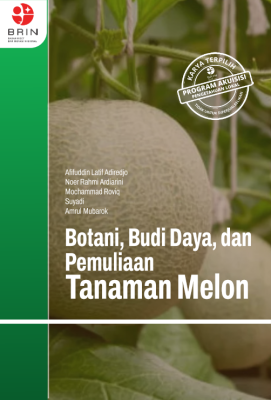
Buah melon termasuk salah satu buah yang digemari masyarakat Indonesia. Sebagai salah satu komoditas hortikultura, tanaman melon memiliki potensi besar untuk dikembangkan melalui sistem budi daya yang sesuai dan tepat. Upaya pengembangan tanaman melon dapat dilakukan dengan merakit varietas hibrida dan unggul agar produksi meningkat, stabil, dan kualitas buahnya sesuai kebutuhan masyarakat dan pasar. Salah satu kegiatan penting dalam perakitan varietas pada pemuliaan tanaman melon adalah hibridisasi. Hibridisasi bertujuan menggabungkan sifat-sifat unggul dari berbagai induk untuk memperoleh varietas dengan performa agronomi yang baik dan hasil yang tinggi.
Buku Botani, Budi Daya, dan Pemuliaan Tanaman Melon ini hadir untuk memberikan informasi tentang pengembangan varietas melon melalui teknik hibridisasi. Pembaca akan diajak memahami pentingnya dasar budi daya melon, best practices hibridisasi, serta studi kasus tentang teknik dan strategi yang mudah dan pernah digunakan pada pemuliaan tanaman melon. Buku ini dapat dimanfaatkan sebagai sumber referensi bagi petani milenial, maha- siswa, atau pemulia dan peminat pertanian lainnya yang tertarik untuk memperdalam pengetahuan tentang budi daya tanaman melon.
Kami berharap hadirnya buku ini dapat menjadi referensi bacaan untuk menambah wawasan dan pengetahuan bagi seluruh pembaca. Akhir kata, kami mengucapkan terima kasih kepada semua pihak yang telah membantu proses penerbitan buku ini.
Acquaah, G. 2012. Priciples of Plant Genetics Breeding. Journal of Chemical Information and Modeling.
Agustina, R., M. Solikhun, and Suhaili. 1995. Pengaruh Pemberian Pupuk Kotoran Sapi dan Anorganik terhadap Pertumbuhan dan Hasil Tanaman Melon (Cucumis melo L.). Universitas Muhammadiyag Gresik, Gresik.
Ajuru, M., and B.E. Okoli. 2013. The Morphological Characterization of The Melon Species in The Family Curcubitaceae Juss and Their Utilization in Nigeria. International J. of Modern Botany, 3(2), pp. 15–19.
Akhalkatsi, M., and R. Lösch. 2005. Water Limitation Effect an Seed Development and Germination in Trigonella coerulea
(Fabaceae). Flora: Morphology, Distribution, Functional Ecology of Plants, 200(6), pp. 493–501. Available at: https://doi.org/10.1016/j.flora.2005.06.001.
Andayani, N., M. Aqil, R. Efendi, et al. 2018 Line × Tester Analysis Across Equatorial Environments. to Study Combining Ability of Indonesian Maize Inbred Asian J Agri and Biol, 6(2), pp. 213–220.
Ansari, W.A., N. Atri, J. Ahmad, et al. 2019. Drought Mediated hysiological and Molecular Changes in Muskmelon (Cucumis melo L.), PLoS ONE, 14(9), pp. 1–21. Available at: https://doi.org/10.1371/journal.pone.0222647.
Barros, A.K.A., G.H.S. Nunes, M.A. Queiroz, et al. 2011 Diallel Analysis of Yield and Quality Traits of Melon Fruits Crop Breeding and Applied. Biotechnology, 11(4), pp. 313–319.
Bhutia, N.D., T. Seth, V.D. Sendhe, et al. 2015. Estimation of Heterosis, Dominance Effect and Genetic Control of Fresh Fruit Yield, Quality and Leaf Curl Disease Severity Traits of Chilli Pepper (Capsicum annuum L.), Scientia Horticulturae,182(1), pp. 47–55. Available at: https://doi.org/10.1016/j.scienta.2014.11.017.
BPS. 2022. Statistik Hortikultura 2021. Badan Pusat Statistik. Available at:
https://www.bps.go.id/publication /2022/06/08/44e935e 8c 141bcb37569aed3/statistik-hortikultura-2021.html (Accessed: 23 March 2023).
Cabello, M.J., M.T. Castellanos, F. Romojaro, et al. 2009. Yield and Quality of Melon Grown Under Different Irrigation and Nitrogen Rates. Agricultural Water Management, 96(5), pp. Available at: https://866–874. doi.org/10.1016/j.agwat.2008.11.006.
Campos, M., M.J. Gonzalo, A. Díaz, et al. 2023. A Novel Introgression Line Library Derived from a Wild Melon Gives Insights into the Genetics of Melon Domestication, Uncovering New Genetic Variability Useful for Breeding. International Journal of Molecular Sciences, 24(12), 10099.
Choudhary, B.R., S.M. Haldar, R Bhargava, et al. 2013. Monoecious Line of Muskmelon Developed. ICAR News, 9, pp. 9-10.
Choudhary, B.R., and S. Pandey. 2023. Muskmelon Genetics, Breeding, and Cultural Practices in Handbook of Cucurbits Growth Cultural, Practices, and Physiology. London: CDRC Press.
Cramer, G.R., K. Urano, S. Delrot, et al. 2011. Effects of Abiotic Stress on Plants: A Systems Biology Perspective. BMC Plant Biology, 11(1), pp. 163. doi.org/ 10.1186/1471-2229-11-163.
Cui, Y., S. Ouyang, Y. Zhao, et al. 2022. Plant Responses to High Temperature and Drought: A Bibliometrics Analysis. Frontiers in Plant Science, 13, pp. 1–17. Available at: https://doi.org/10.3389/fpls. 2022.1052660.
Daryanto, A., S. Sujiprihati, and M. Syukur. 2010. Heterosis dan Daya Gabung Karakter Agronomi Cabai (Capsicum annuum L.) Hasil Persilangan Half Diallel. Indonesian Journal of Agronomy, 38(2), pp. 113–121.
Daryono, B.S., S.D. Hayuningtyas, and S.D. Maryanto. 2012. Perakitan Melon (Cucumis melo L.) Kultivar Melodi Gama 3 dalam Rangka Penguatan Industri Pertanian Nasional. Prosiding Seminar Nasional. Semarang: Fakultas Ekonomi Pembangunan Universitas Negeri Semarang, pp. 245–256.
Daryono, B.S., and S.D. Maryanto. 2018 Keanekaragaman dan Potensi Sumber Daya Genetik Melon. Yogyakarta: Gadjah Mada University.
Dhaliwal, M. and T. Lal. 1996. Genetics of Some Important Characters Using Line x Tester Analysis in Muskmelon. The Indian Journal of Genetics and Plant Breeding, 56(2), pp. 207– 213.
Dirjen Hortikultura Kementerian Pertanian. 2020. Statistika Available at: https://Produksi Hortikultura. hortikultura.pertanian.go.id/.
Do Nascimento, T.L. F. F, Saouza, R. C. S. Diaza, et al. 2018. Agronomic characterization and. heterosis in Watermelon genotypes’, Pesquisa Agropecuaria. Tropical, 48(2).
Do Nascimento, T.L. F. F, Saouza, R. C. S. Diaza, et al. 2019. Watermelon General and Specific. Combining Ability’, Comunicata Scientiae, 10(1), pp. 132–140. Available at: https://doi.org/10.14295/cs.v10i1.2899.
Dogan, E., H. Kirnak, K. Berekatoglu, et al. 2008. Water Stress Imposed on Muskmelon (Cucumis Melo L.) and -arid Irrigation Science, 26(2), pp. 131–138. Available at: https://doi.org/10.1007/s00271-007-0079-7.
Farooq, M., A. Wahid, N. Kobayashi, et al. 2009. Plant Drought Strees: Effect, mechanism and Management Agron. Sustain Dev, 29, pp. 185–212.
Fehr, W.R. 1939. Principles of Cultivar Development 1st edn New York: Macmillan. Publishing Company.
Feyzian, E., H. Deghani, A.M. Rezai, et al. 2009. Diallel Cross Analysis for Maturity and Yield-Related Traits in Melon (Cucumis melo L.) Euphytica, 168(2), pp. 215–223. Available at:https://doi.org/10.1007/s10681-009-9904-9.
Gautam, N., M. Kumar, D. Kumar, et al. 2018. Combining Ability and Gene Action Studies of Some Post-Harvest and Nutritional Quality Traits in Tomato (Solanum lycopersicum L.). International Journal of Chemical Studies, 5(2), pp. 1992– 1996. Available at: https://doi.org/10.5958/2454- 8634.2018.00014.1.
Gazzar, E.I., M. EL-Ghonemy, and S. Mousa. 2013. Evaluation of New Inbred Lines of White Maize Via Line x Tester Analysis Over Three Locations. Journal of Plant Production, 4(6), pp. 897– 906. Available at: https://doi.org/10.21608/jpp.2013.73303.
Golabadi, M., S. Ercisli, and F. Ahmadi. 2019. Environmental and Physiological Effects on Cross-Ability and Seed Production of Greenhouse Cucumber. Journal of Seed Science, 41(2), pp. 134–143. Available at: https://doi.org/10.1590/2317- 1545v41n2175689.
Grumet, R., Bullet, N.L. Katzir, et al. 2007. New Insights into Reproductive Development In Melon (Cucumis melo L .). International Journal of Plant Developmental Biology, 1(2), pp. 253–264.
Gurmu, F., S. Hussein, and M. Laing. 2018. Combining Ability, Heterosis, and Heritability of Storage Root Dry Matter, Beta- Carotene, and Yield-Related Traits in Sweetpotato. .Hort Science, 53(2), pp. 167–175. Available at: https://doi.org/10.21273/HOR TSCI12280-17.
Hallauer, A.R. 2007. History, Contribution, and Future of Quantitative Genetics in Plant Breeding: Lessons from Maize. Crop Science, 47(3), pp. 16.
Handayani, D. R. 2022. Pendugaan Daya Gabung beberapa Karakter Hasil dan Komponen Hasil pada Persilangan Diallel Sepuluh Galur Melon (Cucumis melo L.). Tesis. Fakultas Pertanian Universitas Brawijaya, Malang.
Harliani, E.N., E. R. Palupi, and D. S. Wahyudin. 2014. Potensi Penyimpanan Serbuk Sari dalam Produksi Benih Hibrida Mentimun (Cucumis sativus L) Varietas KE014.J. Hort. Indonesia, 5(2), pp. 104–117.
Helena, L., M. S. Coelho, K. M. M. Siquera, et al. 2012. Relationship of Floral Morphology and Biology of Yellow Melon ybrids with the Attractiveness of Pollinators. SINSECTA, 24, pp. 143– 149.
Huda, A.N., W. B. Suwarno, and A. Maharijaya. 2018. Karakteristik Buah Melon ( Cucumis melo L .) pada Lima Stadia Kematangan Agron, 46(3), pp. 298–305.
Ibrahim, E.A. 2012 Response of Some Egyptian Sweet elon (Cucumis melo var. Aegyptiacus L.) Cultivars to Water Stress Conditions. Journal of Applied Horticulture, 14(1), pp. 67–70. Available at: https://doi.org/10.37855/jah.2012.v14i01.12.
IPGRI. 2003. Descriptor for Melon (Cucumis melo L.). Rome, Italy. Iqbal, M., M. F Barchia, and A. Romeida. 2019. Pertumbuhan dan
Hasil Tanaman Melon (Cucumis. melo L.) pada Komposisi
Media Tanam dan Frekuensi Pemupukan. yang Berbeda JIPI, 21(2), pp. 108–114.
Iriany, R.N., S. Sujiprihati, M. Syukur, et al. 2011. Evaluasi Daya Gabung dan Heterosis Lima Galur Jagung Manis. (Zea mays var. saccharata) Hasil Persilangan Diallel. Jurnal Agronomi Indonesia, 39(2), pp. 103–111.
Jiang, W., N, Li, D. Zhang, et al. 2020 ‘Elevated Temperature and Drought Stress Significantly Affect Fruit Quality and. Activity of Anthocyanin-related Enzymes in Jujube (Ziziphus jujuba Mill. cv. ’Lingwuchangzao’). PLoS ONE, 15(11), pp. 1–
Available at: https://doi.org/10.1371/journal.pone.0241491.
Kamaratih, D. and Ritawati. 2020. Pengaruh Pupuk KCl dan KNO3 terhadap Pertumbuhan dan Produksi Tanaman Melon
Hibrida (Cucumis meloL.) Hortuscoler, 1(2), pp. 48–55.
Kartikawati, N.K. 2008. Pengaruh Tipe Penyerbukan terhadap Keberhasilan Reproduksi pada Tanaman Melaleuca cajuputi subsp cajuputi. Jurnal Penelitian Hutan Tanaman, pp. 99–107.
Kearsey, M. J., dan H. S. Pooni. 1996. The Genetical Analysis of Quantitative Traits. Springer, Birmingham, UK.
Kenigsbuch, D. and Y. Cohen. 1990. The inheritance of Gynoecy in muskmelon. Genome, 33(3), pp. 317–320. Available at: https://doi.org/10.1139/g90-049.
Kesh, H. and. P. Kaushik. 2020 Advances in Melon Breeding (Cucumis melo L.): An Update Plant Disease, 79(11), pp. 1107–1109. Available at: https://doi.org/10.20944/preprints202010.0149.v1.
Khalil, R.M., F. A. Ali, A. M. Metwally, et al. 2004. Breeding studies on pepper Acta Horticulturae , 637, pp. 161–168. Available at: https://doi.org/10.17660/ActaHortic.2004.637.18.
Khan, M., M. Alam, M. M. Hossain, et al. 2012. Influence of Weather Factors on the Incidence. and Distribution of. Pumpkin Beetle Infesting Cucurbits. Bangladesh Journal of Agricultural Research, 37(2), pp. 361–367. Available at: https://doi.org/10.3329/bjar.v37i2.11241.
Kirana, R. and E. Sofiari. 2007. Heterosis. dan Heterobeltiosis pada Persilangan 5 Genotip Cabai dengan Metode Dialil. Jurnal Hortikultura, 17(2), pp. 111–117. Available at: https://doi.org/10.21082/jhort.v17n2.2007.p.
Kumar, R. and T. C. Wehner. 2013. Quantitative. Analysis of Generations for Inheritance of. Fruit Yield in Watermelon. HortScience , 48(7), pp. 844–847. Available at: https://doi.org/10.21273/hortsci.48.7.844.
Kumar, S. et al. 2008 Studies on Crossing. Ratio and Pollination Time in Tomato Hybrid Seed Production ( Lycopersicon esculentum Mill .). Main , 21(1), pp. 30–34.
Kumar, S., R. Kumar, D. Kumar, et al. 2017. Heterotic Potential, Potence Ratio, Combining. Ability and Genetic Control of Yield and its Contributing Traits in Cucumber (Cucumis sativus L.). Journal of Crop and Horticultural Science, 45(3), pp. 175–190. Available at: https://doi.org/10.1080/01140671.2016.1270336.
Kumara, B.S., K. N. Ganesan, G. Nallathambi, et al. 2013. Heterosis of Single ross Sweet Corn Hybrids Developed With Inbreds of Domestic Genepool. Journal Agriculture, 100(3), pp. 52–56.
Leorentina, A.B. 2019. Hibridisasi Beberapa Varietas Melon (Cucumis melo L.) dengan Perlakuan Waktu Penyerbukan dan Proporsi Bunga Berdasarkan Rancangan Tersarang. Skripsi. Universitas Brawijaya, Malang.
Loy, J., T. A. Natti, and S. K. Fritts. 2022. Chemical Regulation of Sex Expression in a Gynomonoecious Line of Muskmelon Journal of the American Society for Horticultural. Science, 104(1), pp. 100–101.
Mahdy, E.E., M. A. Ali, and A. M. Mahmoud 2011. The Effect of Environment on Combining Ability and Heterosis in Grain Sorghum (Sorghum bicolor L. Moench). Asian Journal. of Crop Science, 3(1), pp. 1–15. Available at: https://doi.org/10.3923/ajcs.2011.1.15.
Makful, M., H. Hendri, S. Sahlan, et al. 2017. Karakter Buah Galur Melon Generasi S6 dan S7. Plasma Nutfah, 23(1), pp. 1–12.
Malik, S.I., H. N. Malik, N. M. Minhas, et al. 2004. General and Specific Combining Ability Studies in. Maize Diallel Crosses. International. Journal of Agriculture & Biology, 6(5), pp. 856– 859.
Martias, M., F., F. Nasutionet, dan N. Noflindawari et al. 2011. Respons Pertumbuhan dan Produksi Pepaya terhadap. Pemupukan Nitrogen dan Kalium di Lahan Rawa Pasang. Surut’, Hort, 21(4), pp. 324–330.
Milind, P. and Kulwant, S. 2016. Musk Melon is Eat-Must Melon.
IRJP, 2(8), pp. 52–57.
Murthy, R. K. S., Ravindranath, S. S. Rani. 2013. Ethnobotany and Distribution of Wild and of Wild and Cultivated Genetic Resources of Cucurbitaceae in the Eastern Ghats of Peninsular India. Topclass Journal of Herbal Medicine, 2(6), 149-158.
Napolitano, M., N. Terzaroli, S. Kashyap et al. 2020 Heterosis in (Cucumis melo L Plants , 9(2), p. 282. Available at: https://doi.org/10.3390/plants9020282.
Nawaz, M.A., X. Han, Chen-Chen, et al. 2018. Nitrogen Use Efficiency of Watermelon Grafted onto 10 Wild Watermelon Rootstocks Under Low Nitrogen Conditions Agronomy, 8(11). Available at: https://doi.org/10.3390/agronomy8110259.
Nuñez-Palenius,. H.G., M. G. Lim, N. O. Alejo, et al. 2008. Melon Fruits: Genetic Diversity, Physiology , and Biotechnology Features. Critical Reviews. in Biotechnology, 28 (1), pp. 13– 55. Available at: https://doi.org/10.1080/07388550801891111.
Nwokwu, G.N., Ekwu, L.G. and. Utobo, E.B. 2018. Effect of Water Stress at Different Phenological. Stages of Muskmelon (Cucumis melo L). Indian. Journal of Agricultural Research, 52(4), pp. 452–455. Available at: https://doi.org/10.18805/IJARE.A-312.
Olalla, Â.D.S., A. Juan, and C. Faberio. 2002. Production of Muskmelon (Cucumis melo L .) Under. Controlled. Deficit Irrigation in a Semi-Srid Climate. Agricultural. Water Managemen, 54, pp. 93–105.
Oren, A. 2002. Diversity of Halophilic Microorganisms: Environments, Phylogeny , Physiology, and Applications. Journal of Industrial Microbiology and Biotechnology, 28(1), pp. 56–63. Available at: https://doi.org/10.1038/sj/jim/7000176.
Pandini, F., Vello, N.A. and Lopes, A.C. de A. 2002. Heterosis in Soybeans for Seed Yield Components and Associated Traits. International Journal of Agriculture & Biology, 45(4), pp. 401–412.
Paris, M.K., J. E. Zalapa, J. D. M. Creight. et al. 2008. Genetic Dissection of Fruit Quality Components in Melon (Cucumis melo L.) Using a RIL Population Derived from Exotic x Elite US Western Shipping germplasm’, Molecular. Breeding, 22(3), pp. 405–419. Available at: https://doi.org/10.1007/s11032-008-9185-3.
Pessarakli, M. 2016. Handbook of Cucurbits, Handbook of Cucurbits. London: CRC Press. Available at: https://doi.org/10.1201/b19233.
Prasath, D. and V. Ponnuswami. 2008. Heterosis and Combining Ability for Morphological, Yield and Quality Characters in Coffee. Hybrids’, Indian Journal Horticulture, 65(4), pp. 441– 445.
Raju, P.N. 2017. Comprehensive Overview of Cucumis melo’, 6(10),pp. 181–186.
Reid, J.B. 1979. Flowering. in Pisum: The Effect of Age on The Gen and The Site of Action. of Gene Hari. Annals of Botany, 44(2), pp. 163–173. Available at: https://doi.org/10.1093/oxfordjournals.aob.a085716.
Respatijarti, A.L. Adiredjo, and. M. Roviq. 2020. Influence of Pollination Time and Flower Proportion. on The Success Rate of Pollination and Yield of Melon Varieties (Cucumis melo L .)’, Asian Journal of Plant Sciences, 19(4), pp. 469–473.
Rohini, N., V. Lakshamanan, D. Saradevi, et al. 2017. Assessment of Combining Ability for Yield and Quality Components in Hot Pepper (Capsicum annuum L.). Spanish Journal. of Agricultural. Research, 15(2). Available at: https://doi.org/10.5424/sjar/2017152-10190.
Rohmatin, S., Badami, K. and Pawana, G. 2022. Karakter Kuantitatif Melon Generasi S0-S4. Rekayasa, 15(2), pp. 260 –266. Available at:
https://doi.org/10.21107/rekayasa.v15i2.15109.
Rukundo, P., H. Shimelis, M. Laing, et al. 2017. Combining abAlity, Maternal Effects, and Heritability of Drought Tolerance Yield and Yield Components in Sweetpotato. Frontiers in Plant Science, 7(1), pp. 1–14.
Ruswandi, D. J. Supriatna, A. T. Makkulawu, et al. 2015. Determination of Combining Ability and Heterosis of Grain Yield Components for Maize Mutants Based on Line X Tester Analysis Journal of Crop Science, 7(1), pp. 19–33.
Santosa, R. E. 2018. Efektivitas Hibridisasi Beberapa Varietas Melon (Cucumis melo L.) dengan Perlakuan Waktu Penyerbukan dan Proporsi Bunga Betina dan Bunga Jantan. Skripsi. Brawijaya, Malang.
Sayed, A. A. E., A.H. Gharib, and M.A.F.A.E. Tahawey. 2019 ‘Heterosis and. Combining Ability in Melon (Cucumis Melo L.). Menoufia Journal of Plant Production, 4(5), pp. 429–441. Available at: https://doi.org/10.21608/mjppf.2019.123004.
Schemberger, M.O., M. A. Stroka, L. Reis, et al. 2020. Transcriptome Profiling of Non-Climacteric “Yellow” Melon During Ripening: Insights on Sugar. Metabolism. BMC Genomics, 21(1), pp. 1–20. Available at: https://doi.org/10.1186/s12864-020-6667-0.
Setiawati, R. and N. Bafdal. 2020. Dampak Kualitas air tanah terhadap Kualitas Melon (Cucumis melo L.). Agrotekma , 4(2), pp. 83–93. Available. at: https://doi.org/https://doi.org/10.31289/agr.v4i2.2868 Agrotekma.
Setyowidianto, E.P., N. Basuki, and D. Damanhuri. 2017. Daya Gabung dan Heterosis Galur Jagung (Zea mays L.) . pada Karakter Hasil dan Komponen Hasil’, Jurnal . Agronomi Indonesia, 45(2), p. 124. Available at: https://doi.org/10.24831/jai.v45i2.11650.
Seymour, G. B., and W. B. McGlasson. 1993. Melons. In: Biochemistry of Fruit Ripening, pp. 273–290. Seymour, G., Taylor, J., and Tucker, G., Eds., Chapman & Hall, London.
Shashikumar, K.. and Pitchaimuthu, M. 2016. Heterosis And Combining Ability Analysis of Quantitative and Qualitative Traits in Muskmelon (Cucumis melo L.). International Journal of. Agricultural Science and Research, 6(2), pp. 341– 348.
Shavrukov, Y. A. Kurishbayev, S. Jatayev, et al. 2017. Early Flowering as a Drought Escape Mechanism in Plants: How Can it Aid Wheat Production?’, Frontiers in Plant Science. Available at: https://doi.org/10.3389/fpls.2017.01950.
Shigita, G., T. P. Dung, M. N. Pervin, et al. 2023. Elucidation of Genetic Variation and Population Structure of Melon Genetic Resources in the NARO Genebank, and Construction of the World Melon Core Collection. Breeding Science, 73(3). DOI: 10.1270/jsbbs.22071
Singh, H.K. and A. Tiwari. 2018. Exploitation of Heterosis for Yield and. Contributing Traits in Cucumber (Cucumis sativus L .). Journal of Pharmacognosy and Phytochemistry, 7(3), pp. 395–397.
Singh, P. D. S. Cheema, M. S. Dhaliwal, et al. 2014. Heterosis and Combining Ability For Earliness, Plant Growth, Yield And Fruit Attributes in Hot Pepper (Capsicum annuum L.) Involving Genetic and Cytoplasmic-Genetic Male Sterile Lines. Scientia Horticulturae, 168(1), pp.. 175–188. Available at: https://doi.org/10.1016/j.scienta.2013.12.031.
Sobir, F. D. Siregar, and F. A. Nurrohmah. 2014. Berkebun Melon Unggul. Jakarta : Penebar Swadaya.
Soloklui, A.A.G., A. Gharaghani, N. Oraguize, et al. 2018. Heritability and Combining Ability for Cold Hardiness From Partial. Dialleles in Iranian Pomegranate Cultivars. HortScience, 53(4), pp. 427 –431. Available at: https://doi.org/10.21273/HORTSCI12763-17.
Sopandie. 2014. Fisiologi Adaptasi Tanaman terhadap Cekaman Abiotik pada Agroekosistem Tropika. Bogor: IPB Press.
Stagnari, F., A. Galieni, and M. Pisante. 2016. Drought Stress Effects on Crop Quality. Water Stress and Crop Plants: A Sustainable Approach, 2–2(June), pp. 375–392. Available at: https://doi.org/10.1002/9781119054450.ch23.
Stanghellini, M.S., J. R. Schultheis, and J. T. Ambrose. 2002. Pollen Mobilization in Selected Cucurbitaceae and The Putative Effects of Pollinator Abundance on Pollen Depletion Rates. Journal of the American Society for Horticultural Science, 127(5), pp. 729–736.
Stoleru, V. G. Mihalache, G. C. Teliban, et al. 2020. Yield and Nutritional Response of Greenhouse Grown Tomato Cultivars to Sustainable Fertilization and Irrigation Management. Plants., 9(8), pp. 1–15. Available at: https://doi.org/10.3390/plants9081053.
Susanto, G.W.A. 2018. Estimation of Gene Action Through Combining Ability for Maturity in Soybean. Sabrao Journal of Breeding and Genetics, 50(1), pp. 62–71.
Syukur, M. and H. Sutjahjo. 2013. Analisis Daya Gabung Galur- Galur Jagung Tropis di. Dua Lokasi. Jurnal Agronomi Indonesia, 41(2), pp. 105–111.
Tridiati, M. Muttaqin, and N. S. Amalia. 2019. Pertumbuhan , Produksi , dan Kualitas. Buah Melon dengan Pemberian Pupuk Silika’, JIPI, 24(4), pp. 366–374. Available at: https://doi.org/10.18343/jipi.24.4.366.
Tschoeke, P.H., E.E. Oliviera, M.S Dalcin, et al. 2015. Diversity and Flower-Visiting Rates of Bee species as Potential Pollinators of Melon ( Cucumis melo L.) in the Brazilian Cerrado. Scientia Horticulturae, 186, pp. 207–216. Available at: https://doi.org/10.1016/j.scienta.2015.02.027.
Vidal, M. D.M., D. Jong, H. C. Wien, et al. 2010. Pollination and Fruit Set in Pumpkin (Cucurbita pepo) by Honey Bees. Revista Brasileira de Botanica, 33(1), pp. 107–113. Available at: https://doi.org/10.1590/s0100-84042010000100010.
Widyasmara, N.I., F. Kusmiyati, and K. Karno. 2018. Efek Xenia dan Metaxenia pada Persilangan Tomat Ranti dan Tomat Cherry. Journal of Agro Complex, 2(2), p. 128. Available at: https://doi.org/10.14710/joac.2.2.128-136.
Wiguna, G., A. Purwantoro, and Nasrullah. 2013. Evaluasi daya Gabung Lima Galur Mentimun (Cucumis sativus L.) Hasil Persilangan Diallel. Jurnal Hortikultura, 23(4), pp. 310–317.
Yokota, A., S. Kawasaki, M. Iwano, et al. 2002. Citrulline and DRIP- 1 Protein (ArgE homologue) in Drought Tolerance of. Wild Watermelon’, Annals of Botany, 89(SPEC. ISS.), pp. 825–832. Available at: https://doi.org/10.1093/aob/mcf074.
Zare, M. R. Choukan. E. M. Heravan, et al. 2011. Gene Action of Some Agronomic Traits in Corn (Zea mays L.) using Diallel Cross. Analysis. African Journal of Agricultural Research, 6(3), pp. 693–703. Available at: https://doi.org/10.5897/AJAR10.646.

This work is licensed under a Creative Commons Attribution-ShareAlike 4.0 International License.