












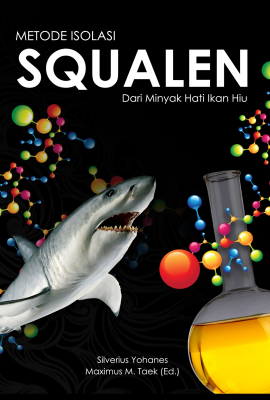
Squalen adalah senyawa kandungan utama minyak hati ikan hiu. Squalen memiliki banyak manfaat bagi manusia, dan digunakan secara luas untuk berbagai keperluan. Squalen bermanfaat untuk kesehatan kulit, menangkal radikal bebas, sebagai antioksidan, dan mencegah penyakit degeneratif. Squalen juga bersifat antiinflamasi, dapat meningkatkan kesehatan jantung, dan memperkuat sistem imun tubuh. Berbagai produk perawatan kulit seperti krim, lotion dan serum, dan berbagai formulasi obat-obatan, vaksin dan suplemen makanan kesehatan banyak menggunakan squalen sebagai bahan aktifnya.
Buku ini menguraikan tentang salah satu cara sederhana untuk mendapatkan squalen dari minyak hati ikan hiu. Dalam buku ini diuraikan cara dan tahapan proses isolasi untuk mendapatkan squalen murni dari minyak hati ikan hiu, mulai dari ekstraksi minyak hati ikan hiu, hidrolisis minyak, pemisahan dan pemurnian squalen, serta identifikasi dan karakterisasi squalen dari minyak hati ikan hiu.
Buku ini tidak hanya berisi pembahasan tentang metode isolasi squalen dari minyak hati ikan hiu. Banyakjuga informasi ilmiah dari hasil kajian terbaru tentang ikan hiu, minyak hati ikan hiu, squalen dan senyawa-senyawa yang berhubungan, nilai ekonomi squalen, prospek pengembangan squalen, sumber-sumber squalen non-hewani yang prospektif, dan teknologi produksi squalen di masa depan. Semua itu telah penulis rangkum selengkap mungkin untuk disajikan kepada para pembaca sekalian. Karena itu, buku ini tidak hanya berguna sebagai bahan bacaan untuk pengetahuan umum saja, tapi lebih daripada itu, dapat juga menjadi tambahan referensi bagi para peneliti dan mahasiswa yang mempelajari ilmu kimia bahan alam, teori maupun praktik.
A. Andries, I. Popa, N. Elena Babeanu, S. Nita, and O. Popa, “Squalene-natural resources and applications,” Farmacia, vol. 62, no. 5, pp. 840–862, 2014.
A. Fernandez-Cuesta, L. Leon, L. Velasco, and R. De la Rosa, “Changes in squalene and sterols associated with olive maturation,” Food Research International, vol. 54, no. 2, pp. 1885–1889, 2013.
A. L. Ronco, E. De Stefani, and A. Ronco, “Squalene: a multi-task link in the crossroads of cancer and aging,” Functional Foods in Health and Disease, vol. 3, no. 12, pp. 462–476, 2013.
A. Nakazawa, Y. Kokubun, H. Matsuura et al., “TLC screening of thraustochytrid strains for squalene production,” Journal of Applied Phycology, vol. 26, no. 1, pp. 29–41, 2014.
Aioi A., Shimizu T., Kuriyama K. Effect of squalene on superoxide anion generation induced by a skin irritant, lauroylsarcosine. Int. J. Pharm. 1995;113:159–164.
Bockisch, M. 1998. Fats and Oils Handbook, AOCS Press, Hamburg Germany.
C. V. Rao, H. L. Newmark, and B. S. Reddy, “Chemopreventive effect of squalene on colon cancer,” Carcinogenesis, vol. 19, no. 2, pp. 287–290, 1998.
Clarke, S., E.J. Gulland, Milner, and T. Bjorndal. 2007. Perspectives: social, economic, and regulatory drivers of the shark fin trade, Marine Resource Economics, 22:305–327.
D. Mcphee, A. Pin, L. Kizer, and L. Perelman, “Squalane from sugarcane,” Cosmetics & Toiletries magazine, vol. 129, no. 6, pp. 1–6, 2014.
D. W. Hall, S. N. Marshall, K. C. Gordon, and D. P. Killeen, “Rapid quantitative determination of squalene in shark liver oils by Raman and IR spectroscopy,” Lipids, vol. 51, no. 1, pp. 139–147, 2016.
E. Naziri, F. Mantzouridou, and M. Z. Tsimidou, “Squalene resources and uses point to the potential of biotechnology,” Lipid Technology, vol. 23, no. 12, pp. 270–273, 2011.
F. Dent and S. Clarke, “State of the global market for shark products,” FAO Fisheries and Aquaculture Technical Paper, vol. 590, p. 187, 2015.
F. Esra Gunes, M. Universitesi Saglik Bilimleri Fakultesi, B. Diyetetik Bolumu, and I. Turkiye, “Medical use of squalene as a natural antioxidant derleme/review,” Journal of Marmara University Institute of Health Sciences, vol. 33, no. 44, pp. 220–228, 2013.
Fahmi, Dharmadi. Tinjauan Status Perikanan Hiu dan Upaya Konservasinya di Indonesia. Direktorat Konservasi Kawasan dan Jenis Ikan KKP, Juni 2013.
G. P. Ghimire, H. T. Nguyen, N. Koirala, and J. K. Sohng, “Advances in biochemistry and microbial production of squalene and its derivatives,” Journal of Microbiology and Biotechnology, vol. 26, no. 3, pp. 441–451, 2016.
G. S. Kelly, “Squalene and its potential clinical uses,” Alternative Medicine Review, vol. 44, no. 11, pp. 29–36, 1999.
G. Wejnerowska, P. Heinrich, and J. Gaca, “Separation of squalene and oil from Amaranthus seeds by supercritical carbon dioxide,” Separation and Purification Technology, vol. 110, pp. 39–43, 2013.
H. L. Newmark, “Squalene, olive oil, and cancer risk: a review and hypothesis,” Carcinogenesis, vol. 6, no. 12, pp. 1101–1103, 1997.
H. P. He and H. Corke, “Oil and squalene in Amaranthus grain and leaf,” Journal of Agricultural and Food Chemistry, vol. 51, no. 27, pp. 7913–7920, 2003.
Indra T. Maulana, Sukraso, dan Sophi Damayanti, “Kandungan asam lemak dalam minyak ikan Indonesia,” Jurnal Ilmu dan Teknologi Kelautan Tropis, vol. 6, no. 1, hlm. 121-130, 2014.
K. H. S. Farvin, R. Anandan, S. Hari Senthil Kumar et al., “Cardioprotective effect of squalene on lipid profile in isoprenaline-induced myocardial infarction in rats,” Journal of Medicinal Food, vol. 9, no. 4, pp. 531–536, 2006.
Kohno Y., Egawa Y., Itoh S., Nagaoka S., Takahashi M., Mukai K., “Kinetic study of quenching reaction of singlet oxygen and scavenging reaction of free radical by squalene in n-butanol,” Biochim. Biophys. Acta. 1995; 1256:52–56.
L. H. Reddy and P. Couvreur, “Squalene: a natural triterpene for use in disease management and therapy,” Advanced Drug Delivery Reviews, vol. 61, no. 15, pp. 1412–1426, 2009.
M. Azalia Lozano-Grande, Shela Gorinstein, Eduardo Espitia-Rangel, Gloria Davila-Ortiz, and Alma Leticia Martínez-Ayala, “Plant sources, extraction methods, and uses of squalene,” International Journal of Agronomy, 13 pages, vol. 2018.
M. Tsujimoto, “Squalene: a highly unsaturated hydrocarbon in shark liver oil,” Industrial and Engineering Chemistry, vol. 12, no. 1, pp. 63–72, 1920.
O. Popa, N. E. Babeanu, I. Popa, S. Nita, and C. E. Dinu-Parvu, “Methods for obtaining and determination of squalene from natural sources,” BioMed Research International, vol. 2015, 16 pages, 2015.
P. Gupta, K. Singhal, A. K. Jangra, V. Nautiyal, A. Pandey, “Shark Liver Oil: A Review,” AJPER 2012, Vol 1, Issue 2 (1-15).
Paolo M. Nainggolan, “Pemburuan Hiu Ancaman Bagi Ekosistem Laut,” https://www.national-oceanographic.com/article/pemburuan-hiu-ancaman-bagi-ekosistem-laut, 21 Jul 2021.
R. Steiner, M. Drescher, M. Bonakdar, and W. Johannisbauer, “Method for producing squalene,” 2004.
R. Uazhanova, Alimardanova M., Kizatova M., “Investigation of Biochemical Properties and Fractional Composition of Amaranth Oil,” Journal of Life Sciences, 2013; 7(4): 437-442.
R. W. Owen, R. Haubner, G. Würtele, W. E. Hull, B. Spiegelhalder, and H. Bartsch, “Olives and olive oil in cancer prevention,” European Journal of Cancer Prevention, vol. 13, no. 4, pp. 319–326, 2004.
Ryzard Amarowicz, “Squalene: a natural antioxidant?” European Journal of Lipid Science and Technology, vol. 111, no. 5, pp. 411-412, 2009.
S. K. Kim and F. Karadeniz, “Biological importance and applications of squalene and squalane,” Advances in Food and Nutrition Research, vol. 65, pp. 223–233, 2012.
S. Yohanes, “Isolasi dan karakterisasi senyawa bioaktif squalen dari minyak hati ikan hiu Nusa Tenggara Timur,” Laporan Penelitian, pp. 1-50, 1998.
T. J. Smith, “Squalene: potential chemopreventive agent,” Expert Opinion on Investigational Drugs, vol. 9, no. 8, pp. 1841–1848, 2000.
W.T. White, P.R. Last, J.D. Stevens, G.K. Yearsley, Fahmi, and Dharmadi, “Economically important sharks and rays of Indonesia (Hiu dan pari yang bernilai ekonomis penting di Indonesia),” Australian Centre for International Agricultural Research, 2006.
W. Xu, X. Ma, and Y. Wang, “Production of squalene by microbes: an update,” World Journal of Microbiology and Biotechnology, vol. 32, no. 12, 2016.
Z. R. Huang, Y. K. Lin, and J. Y. Fang, “Biological and pharmacological activities of squalene and related compounds: Potential uses in cosmetic dermatology,” Molecules, vol. 14, no. 1, pp. 540–554, 2009.

This work is licensed under a Creative Commons Attribution-ShareAlike 4.0 International License.