












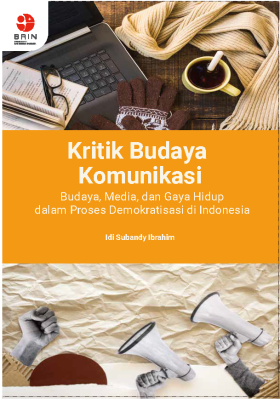
Buku ini mengkaji dua corak budaya komunikasi dan media yang menonjol berlangsung dalam proses demokratisasi di Indonesia. Pertama, budaya media yang berpusat pada media sendiri. Sebagai entitas bisnis, beberapa media tertentu cenderung menekankan pada keuntungan bisnis semata. Logika komersialisme pers dan komodifikasi berita telah menjadi primadona dalam cara berpikir pengelola pers dan kinerja jurnalisme. Di tengah iklim persaingan media yang kian keras, pers diarahkan sebagai mesin pencetak uang, pemasok iklan, dan pemburu rating dan viral. Dalam logika budaya media seperti ini, kian sulit menempatkan kepentingan publik di atas atau setara dengan kepentingan modal dan kuasa.
Kedua, budaya media yang berpusat pada publik. Sebagai entitas ideal, sejatinya media bisa menjadi kekuatan penting dalam membangun budaya pemerintahan, politik, hukum, ekonomi, pendidikan, dan lingkungan hidup yang sehat. Logika bahwa pers sebagai kekuatan signifikan dalam proses demokratisasi di Indonesia, memungkinkan pers berada di garis depan dalam menyuarakan kritik terhadap dekadensi dan degradasi budaya yang berlangsung dalam ruang publik. Dalam kondisi kehidupan demokrasi yang tidak sehat dan ruang publik yang tidak fair serta budaya masyarakat sipil yang belum matang, peran media amat dibutuhkan dalam pembelajaran publik mengenai arti penting budaya kewargaan yang menjunjung tinggi hukum dan penghargaan terhadap hak-hak asasi manusia.
Abdullah, I. (1997). Dari domestik ke publik: Jalan panjang pencarian identitas perempuan. Dalam Abdullah, I. (Ed.). Sangkan paran gender. Pusat Penelitian Kependudukan Universitas Gadjah Mada & Pustaka Pelajar.
Abdullah, I. (2006). Konstruksi dan reproduksi kebudayaan. Pustaka Pelajar.
Abdullah, T. (2001a). Nasionalisme dan sejarah. Satya Historia.
Abdullah, T. (2001b, 23 April). Buku, kebablasan, dan kebebasan. Makalah pada Seminar Nasional Ikatan Penerbit Indonesia (IKAPI), Jakarta, Indonesia.
Acharya, K. & Noronha, F. (Eds.). (2010). The green pen: Environmental journalism in India and south Asia. Sage.
Adorno, T. & Horkheimer, M. (1979). The Culture industry: Enlightenment as mass deception. (abridged). Dalam J. Curran, M. Gurevitch, & J. Woollacott (Eds.), Mass communication and Society. Sage.
Ahmed, A. S. (1992). Postmodernism and Islam: Predicament and promise. Routledge.
Alfian dkk. (Eds.). (1980). Kemiskinan struktural. Yayasan Ilmu-ilmu Sosial.
Allen, R. (Ed.). (1992). Channels of discourse, reassembled. Routledge.Altschull, H. J. (1984). Agents of power: The role of the news media in human affairs. Longman.
Amal, I. (2007, 8 Februari). Pers dan kemiskinan. Makalah pada Konvensi Nasional Media Massa se-Indonesia, Hari Pers Nasional, Samarinda, Indonesia.
Andersen, R. & Gray, J. (Eds.). (2008). Battleground: The media, Vol. 1 & 2. Greenwood Press.
Anderson, B. R. O’G. (1983). Imagined communities: Reflections on the origins and spread of nationalism. Verso.
Anderson, B. R. O’G. (1990). Language and power: Exploring political cultures in Indonesia. Cornell University Press.
Andrejevic, M. (2004). Reality TV: The work of being watched. Rowman & Littlefield.
Ang, I. (1996). Living room wars: Rethinking media audiences for a postmodern world. Routledge.
Anonim (2006). Dictionary of media studies. A & C Black Publisher.
Antlöv, H. (1999). The new rich and cultural tensions in rural Indonesia. Dalam M. Pinches (Ed.), Culture and privilege in capitalist Asia. Routledge.
Appadurai, A. (1996). Modernity at large: Cultural dimensions of globalization. University of Minnesota Press.
Apple, M. W. (1996). Cultural politics and education. Teachers College Press.
Apple, M. W. (1998). Selling our children: Channel one and the politics of education. Dalam R. W. McChesney dkk. (Eds.), Capitalism and the information age: The political economy in the global communication revolution. Monthly Review Press.
Arif, A. (2010). Jurnalisme bencana, bencana jurnalisme: Kesaksian dari tanah bencana. KPG, Tembi, Tifa, & LSPP.
Arps, B. & van Heeren, K. (2006). Ghosthunting and vulgar news: Popular realities on recent Indonesian television. Dalam H. S. Nordholt & I. Hoogenboom (Eds.), Indonesian transitions. Pustaka Pelajar.
Ath-Thawil, N. S. (1985). Kemiskinan dan keterbelakangan di negara-negara Muslim. (Muhammad Bagir, penerj.). Mizan.
Atmakusumah (2008, 23 Mei). Kita belajar dari pers bebas. Kompas.
Atmakusumah dkk. (Eds.) (1996). Mengangkat masalah lingkungan ke media massa. Lembaga Pers Dr. Soetomo [LPDS] & Yayasan Obor Indonesia.
Bagdikian, B. H. (1987). The media monopoly. Beacon Press.
Bagdikian, B. H. (1992). The media monopoly. Fourth edition. Beacon Press.
Barber, B. R. (1995). Jihad vs Mcworld: How globalism and tribalism are reshaping the world. Ballantine Books.
Barber, B. R. dkk. (1997). The state of “electronically enhanced democracy”: A survey of the internet. The Walt Whitman Center/the Culture and Politics of Democracy.
Barnard, M. (2002). Fashion as communication. Second edition. Routledge.
Barry, J. (1994) Beyond the shallow and the deep: Green politics, philosophy and praxis. Environmental Politics, 3(3). https://doi.org/10.1080/09644019408414152
Barthes, R. (1967). Elements of semiology. (A. Lavers & C. Smith, penerj.). Jonathan Cape.
Barthes, R. (1971). The Rhetoric of the image. (B. Trench, penerj.). Working Papers in Cultural Studies, No. 1, CCCS, University of Birmingham.
Barthes, R. (1973). Mythologies. (A. Lavers, penerj.) (1957). Paladin.
Baskoro, L. R. (2003). Jurnalisme lingkungan, jurnalisme menggerakkan. Yayasan Karya Jurnalis Indonesia.
Baudrillard, J. (1983). Our theater of cruelty. Dalam In the shadow of silent majorities. Semiotext[e].
Baudrillard, J. (1987a). The Ecstasy of communication. Semiotext(e).
Baudrillard, J. (1987b). The evil demon of image. Power Institute of Fine Arts.
Baudrillard, J. (1990). Mass media culture. Dalam Revenge of the crystal. Pluto Press.
Baudrillard, J. (2020). The art of disappearing. Baudrillard Now, 28 Juni. https://baudrillard-scijournal.com/the-art-of-disappearing/
Bauman, Z. (1998). Globalization. Polity Press.
Bavadam, L. (2010). Environment stories, among the most challenging. Dalam K. Acharya & F. Noronha (Eds.), The green pen: Environmental journalism in India and south Asia. Sage.
Beck, U. (1992). The risk society. Routledge.
Beckerman, W. (2002). A poverty of reason: Sustainable development and economic growth. The Independent Institute.
Bell, D. (1961). The end of ideology. Collier Books.
Beng-Huat, C. (2000). Consumption in Asia: Lifestyles and identities. Routledge.
Bennett, W. L. & Entman, R. M. (Eds.). (2001). Mediated politics: Communication in the future of democracy. Cambridge University Press.
Berger, P. L. & Luckmann, T. (1967). The social construction of reality. Anchor.
Best, S. & Kellner, D. (1991). Postmodern theory: Critical interrogations. MacMillan Education.
Bhakti, I. N., Cahyono, H., Basyar, M. H., Nurhasim, M., Sihbudi, M. R., & Yanuarti, S. (2001). Militer dan politik kekerasan orde baru: Soeharto di belakang peristiwa 27 juli? (I. S. Ibrahim, ed.). Mizan & Lembaga Ilmu Pengetahuan Indonesia (LIPI).
Blumler, J. G. & Gurevitch, M. (1995). The crisis of public communication. Routledge.
Bosmajian, H. A. (1989). The language of oppression. Public Affairs Press.
Bourdieu, P. (1979). Outline of a theory of practice. Cambridge University Press.
Bourdieu, P. (1984). Distinction: A social critique of the judgment of taste (R. Nice, penerj.). Harvard University Press.
Bourdieu, P. (1991). Language and symbolic power (G. Raymond & M. Adamson, penerj.). Harvard University Press.
Boyle, K. (2005). Media and violence: Gendering the debates. Sage.
Brunsting, S. & Postmes, T. (2002). Social movement participation in the digital age: Predicting offline and online collective action. Journal of Small Group Research, Vol. 33 No. 5. http://dx.doi.org/10.1177/104649602237169
Budiman, A., Hatley, B., & Kingsbury, D. (Eds.). (1999). Reformasi: Crisis and change in Indonesia. Monash Asia Institute.
Burns, L. S. (2002). Understanding journalism. Sage.
Camara, D. H. (2000). Spiral kekerasan. Pustaka Pelajar & Insist Press.
Campbell, C. (1989). The Romantic ethic and the spirit of modern consumerism. Blackwell.
Camus, A. (1990). Krisis kebebasan. Yayasan Obor Indonesia.
Carey, J. W. (1989). Communication as culture: Essays on media and society. Unwin Hyman.
Carey, J. W. (1998). Political ritual on television: Episodes in the history of shame, degradation and excommunication. Dalam T. Liebes, T. & J. Curran (Eds.), Media, ritual and identities. Routledge.
Carter, C. & Weaver, C. K. (2003). Violence and the media. Open University Press.
Carter, N. (2007). The politics of the environment: Ideas, activism, policy. Second edition. Cambridge University Press.
Castells, M. (1996). The rise of the network society. Blackwell.
Castells, M. (2001). The internet galaxy. Oxford University Press.
Casty, A. (Ed.). (1968). Mass media and mass man. Holt, Rinehart & Winston.
Chaerowati, D. L. & Ibrahim, I. S. (2023). Peran radio komunitas sebagai aktor lokal dalam rehabilitasi kerusakan lingkungan. Dalam E. Surmaini, L. S. Supriatin, & Y. Sarvina (Eds.), Teknologi dan kearifan lokal untuk adaptasi perubahan iklim. Penerbit BRIN. https://doi.org/10.55981/brin.901.c725
Chaerowati, D. L. (2014). Media anak Indonesia: Representasi idola anak dalam majalah anak-anak. Yayasan Pustaka Obor Indonesia.
Chambers, D. (2000). Globalizing media agendas: The production of journalism. Dalam H. de Burgh (Ed.), Investigative journalism: Context and practice. Routledge.
Chaney, D. (1994). The Cultural turn. Routledge.
Chaney, D. (1996). Lifestyles. Routledge.
Charon, J. M. (1997). Symbolic interactionism: An introduction, An interpretation, An integration. Prentice-Hall.
Chen, M. (1996). Anak-anak dan televisi. Gramedia.
Chomsky, N. (1987). Manufacturing consent. Pantheon.
Chomsky, N. (1998). Propaganda and control of the public mind. Dalam R. W. McChesney dkk. (Eds.), Capitalism and the information age: The political economy of the global communication revolution. Monthly Review Press.
Cohen, A. P. (1985). The symbolic construction of community. Tavistock.
Cohen, S. & Young, J. (Eds.). (1973). The manufacture of news. Constable.
Combs, J. E. & Nimmo, D. (1993). The new propaganda: The dictatorship of palaver in contemporary politics. Longman.
Couldry, N. & Miller, D. (Eds.). (2003). Contesting media power: Towards a global comparative perspective. Rowan & Littlefield.
Couldry, N. (2003). Media rituals: A critical approach. Routledge.
Coutas, P. (2006). Fame, fortune, fantasy: Indonesian idol and the new celebrity.” Asian Journal of Communication, 16 (4). https://doi.org/10.4324/9780203825396
Cox, H. (1969). Sex and secularization. Dalam P. Collier (Ed.), Crisis: A contemporary reader. Harcourt, Brace & World, Inc.
Curran, J. dkk. (Eds.). Mass communication and society. Arnold.
Dahana, R. P. (2006, 25 Maret). Kekerasan, milik siapa?. Kompas.
Dahlgren, P. & Sparks, C. (Eds.). (1992). Journalism and popular culture. Sage.
Dahlgren, P. (2000). Media, citizens and civic culture. Dalam M. Gurevitch & J. Curran (Eds.), Mass media and society. Third edition. Edward Arnold.
Dahlgren, P. (2001a). The internet and the democratization of civic culture. Political Communication, 17. https://doi.org/10.1080/10584600050178933
Dahlgren, P. (2001b). The transformation of democracy?. Dalam B. Axford & R. Huggins (Eds.), New media and politics. Sage.
Dalton, R. J. (1994). The green rainbow: Environmental groups in western Europe. Yale University Press.
Davis, D. K. dan Jasinski, J. (1999, April). Di balik perang budaya: Sebuah agenda penelitian komunikasi dan budaya (I. S. Ibrahim, penerj.). Dalam Jurnal Komunikasi (Ikatan Sarjana Komunikasi Indonesia), Vol. 3.
de Beauvoir, S. (1974). The second sex (1949). (H. M. Parshley, penerj.). Bantam Books.
De Certeau, M. (1987). The practice of everyday life. University of California Press.
Debord, G. (1981). Society of the spectacle. Free Press.
Della Porta, D. & Diani, M. (1999). Social movements: An introduction. Blackwell.
Denzin, N. K. & Lincoln, Y. S. (Eds.). (1994). Handbook of qualitative research. Sage.
Deresiewicz, W. (2009, 30 Januari). The end of solitude. The Chronicle Review. http://chronicle.com/article/The-End-of-Solitude/3708
Dewey, J. (1954). The public and its problems. Swallow Press.
Dhakidae, D. (1991). The state, the rise of capital and the fall of political journalism: Political economy of Indonesian news industry (Disertasi Ph. D, tidak dipublikasikan). Universitas Cornell, USA.
Dharmasaputra, S. & Wisanggeni, A. (2008, 27 Desember). Gaya kampanye belajar dari Obama: Jaring dukungan lewat facebook. Kompas.
Downing, J. (Ed.) (2001). Radical media: Rebellious communication and social movements. Sage.
Downing, J. dkk. (Eds.) (1990). Questioning the media: A critical introduction. Sage.
Down, E. & Boyson, A. R. (2009). Dark matters. Dalam E. Downs (Ed.), The dark side of media and technology: A 21st century guide to media and technological literacy. Peter Lang.
Downs, E. (2017). Educational technology. Dalam M. Allen (Ed.), SAGE encyclopedia of communication research methods. Sage. doi: 10.4135/9781483381411.n152
Downs, E. (Ed.). (2019). The dark side of media and technology: A 21st century guide to media and technological literacy. Peter Lang.
Dyer, R. (1992). Only entertainment. Routledge.
Eagleton, T. (1991). Ideology: An introduction. Verso.
Emmerson, D. K. (2002). Apakah cereknya telah mendidih?: Demokrasi dan kekerasan di Indonesia. Dalam A. M. Makka (Ed.), Demokratisasi tak boleh henti. The Habibie Centre.
Esslin, M. (1982). Age of television. Freeman Press.
Evers, H-D. (Ed.) (1988). Teori masyarakat: Proses peradaban dalam sistem dunia modern. Yayasan Obor Indonesia.
Fairclough, N. (1995). Media discourse. Edward Arnold.
Fannoy, S. W. (2001). 10 anugerah terindah untuk ananda. Kaifa.
Featherstone, M. (1987). Lifestyle and consumer culture. Theory, Culture and Society, 4. https://doi.org/10.1177/026327687004001003
Featherstone, M. (1991). Consumer culture and postmodernism. Sage.
Featherstone, M. (1992). Postmodernism and the aestheticization of everyday life. Dalam S. Lash & J. Friedman (Eds.), Modernity and identity. Blackwell.
Featherstone, M. (Ed.) (1990). Global culture: Nationalism, globalization, and modernity. Sage.
Fiske, J. & Hartley, J. (1978). Reading television. Methuen.
Fiske, J. (1987). Television culture. Methuen.
Fiske, J. (1989a). Understanding popular culture. Unwin & Hyman.
Fiske, J. (1989b). Reading the popular. Unwin Hyman.
Foucault, M. (1976). The history of sexuality, Vol. I: An introduction. Penguin Books.
Foucault, M. (1979). Discipline and punish: The birth of the prison. Vintage Books.
Fowler, R. (1991). Language in the news: Discourse and ideology in the press. Routledge.
Freud, S. (2000). Pengarang kreatif dan pelamun (Iwan Mucipto, penerj.). Dalam T. Heraty (Ed.), Hidup matinya sang pengarang: Esei-esei tentang kepengarangan oleh sastrawan dan filsuf. Yayasan Obor Indonesia.
Friedan, B. (1984). Feminine mystique. Norton; Dell, 20th Anniversary Edition.
Fromm, E. (1942). Escape from freedom. Routledge & Kegan Paul.
Fromm, E. (1947). Man for himself. Rinehart.
Fromm, E. (1956). The sane society. Routledge & Kegan Paul.
Fromm, E. (2000). Akar kekerasan: Analisis sosio-psikologis atas watak manusia. Pustaka Pelajar.
Fukuyama, F. (1992). The end of history and the last man. Hamish Hamilton.
Galtung, J. (1980). The true worlds: A transnational perspective. The Institute for World Order & The Free Press. https://unesdoc.unesco.org/ark:/48223/pf0000041562
Gandy Jr., O. H. (1998). Communication and race: A structural perspective. Arnold.
Garnham, N. (1987). Concepts of culture: Public policy and the culture Industries. Cultural Studies, 1. https://doi.org/10.1080/09502388700490021
Gazali, E. dkk. (2003). Konstruksi sosial industri penyiaran. Departemen Ilmu Komunikasi FISIP Universitas Indonesia.
Geertz, C. (1992a). Politik kebudayaan. (F. B. Hardiman, penerj.). Kanisius.
Geertz, Clifford. (1992b). Tafsir kebudayaan. (F. B. Hardiman, penerj.). Kanisius.
Gerbner, G. (1992). Violence and terror in and by the media. Dalam M. Qatar & B. Dagenais (Eds.), Media, crisis and democracy: Mass communication and the disruption of social order. Sage.
Gerbner, G. dkk. (1994). Growing up with television: The cultivation perspective. Dalam J. Bryant & D. Zillmann (Eds.). (2002), Media effects: Advances in theory and research. Second edition. Erlbaum.
Gergen, K. J. & Gergen, M. (1991). Toward reflexive methodologies. Dalam F. Steier (Ed.), Research and reflexivity. Sage.
Gergen, K. J. (1985). The social constructionist movement in modern psychology. American Psychologist, 40. https://psycnet.apa.org/doi/10.1037/0003-066X.40.3.266
Gergen, K. J. (1991, November). Identitas di era postmodern (wawancara dengan A. P. Sanoff, wartawan U.S. News). (R. P. Dahana, penerj.). Horison, No. 11. (Tulisan original diterbitkan 1 Juli 1991, dalam U.S. News & World Report).
Gerke, S. (1995, 16–17 Oktober). Symbolic consumption as a way of life: The new Indonesian middle-class. Makalah pada Seminar On Social and Cultural Dimensions of Market Expansion, Goethe Institute (Jakarta), Labuan, Malaysia.
Gerke, S. (2000). Global lifestyles under local conditions: the new Indonesian middle class. Dalam C. Beng-Huat (Ed.), Consumption in Asia: Lifestyles and identities. Routledge.
Giddens, A. (1984). The constitution of society: Outline of the theory of structuration. University of California Press.
Giddens, A. (1987). The nation-state and violence. University of California Press.
Giddens, A. (1990). The consequences of modernity. Polity Press.
Giddens, A. (1991). Modernity and self-identity: Self and society in the late modern age. Stanford University Press.
Giddens, A. (1999). The third way: The renewal of social democracy. Polity Press.
Giddens, A. (2000). Runaway world: How globalization is reshaping our lives. Routledge.
Glenn, N. D. (1977). Cohort analysis. Sage Publications.
Goethals, G. T. (1981). The TV ritual: Worship at the video altar. Beacon Press.
Goffman, E. (1976). Gender advertisement. The MacMillan Press.
Golding, P., & Murdock, G. (1996). Culture, communications and political economy. Dalam J. Curran & M. Gurevitch (Eds.), Mass media and society. Second edition. Arnold.
Goode, E. & Ben-Yehuda, N. (1994). Moral panics: The social construction of deviance. Blackwell Press.
Goonasekera, A. (1998). Children’s voice in the media: A study of children television programs in Asia”, Media Asia, Vol. 25, No. 3. https://doi.org/10.1080/01296612.1998.11726557
Gray, J. (1999). Children are from heaven: Positive parenting skills for raising cooperative, confident, and compassionate children. HarperCollins.
Gray, J., Sandvoss, C., & Harrington, C. L. (Eds.). (2007). Fandom: Identities and communities in a mediated world. New York University Press.
Griffin, EM. (2003). A first look at communication theory. Fifth edition. McGraw-Hill.
Gripsrud, J. (2008). The cultural dimension of democracy. Dalam I. Bondebjerg & P. Madsen (Eds.), Media, democracy and European culture. Intellect.
Gunew, S. & Yeatman, A. (Eds.). (1993). Feminism and the politics of difference. Westview Press.
Gunster, S. (2004). Capitalizing on culture: Critical theory and cultural studies. University of Toronto Press.
Gunter, B, Harrison, J., & Wykes, M. (2003). Violence on television: Distribution, form, context, and themes. Lawrence Erlbaum Associates (LEA).
Gutstein, D. (1999). E.con: How the internet undermines democracy. Stoddart.
Habermas, J. (1989). The structural transformation of the public sphere. MIT Press.
Hall, E. dkk. (1983). Psychology today: An introduction. Fifth edition. Random House.
Hall, S. (1980). The social production of news. Dalam S. Hall, D. Hobson, A. Lowe, & P. Willis (Eds.), Culture, media, language. Hutchinson.
Hall, S. (1994). Notes on deconstructing ‘the popular’. Dalam J. Storey (Ed.), Cultural theory and popular culture. Harvester Wheatsheaf.
Hall, S. (1996). Signification, representation, ideology. Dalam J. Curran, D. Morley, & V. Walkerdine (Eds.), Communication studies and communication. Arnold.
Hall, S. dkk. (Eds.). (1980). Culture, media and language. Hutchinson.
Hamad, I. (2004). Konstruksi realitas politik dalam media massa: Sebuah studi critical discourse analysis berita-berita politik. Granit.
Hamamoto, D. Y. (1989). Nervous laughter: Television situation comedy and liberal democratic ideology. Praeger.
Hamelink, C. J. (2000). The ethics of cyberspace. Sage.
Hamelink, C. J. (2002). Moral challenges in the information society. Media Development, 4.
Hanazaki, Y. (1996). The Indonesian press in the era of keterbukaan: A force for democratization (Disertasi Ph. D tidak diterbitkan). Department of Asian Language and Studies, Universitas Monash, Melbourne, Australia.
Hardiman, F. B. (2008, 6 April). ‘Fasisme’ media dalam demokrasi sms (acara kontes Tv 3). Kompas.
Hardiman, F. B. (2009). Demokrasi deliberatif. Kanisius.
Hardiman, F. B. (2021). Aku klik maka aku ada: Manusia dalam revolusi digital. Kanisius.
Hargreaves, I. (2003). Journalism: Truth or dare? Oxford University Press.
Hartiningsih, M. (1999). Perlindungan hak anak jangan ditunda!” Dalam H. Suranto (Ed.) Jurnalisme anak pinggiran. Kelompok Kerja untuk Anak Pinggiran.
Hartley, J. (1996). Popular reality: Journalism, modernity, popular culture. Arnold.
Hatley, B. (1999). Cultural expression and social transformation in Indonesia. Dalam A. Budiman, B. Hatley, & D. Kingsbury (Eds.), Reformasi: Crisis and change in Indonesia. Monash Asia Institute.
Hatta, M. (1956, 27 November). Lampau dan Datang. Pidato pada penerimaan gelar Doktor Honoris Causa dari Universitas Gadjah Mada (UGM), Yogyakarta, Indonesia.
Hatta, M. (1985). Membangun ekonomi Indonesia: Kumpulan pidato ilmiah. Inti Idayu Press.
Haug, W. F. (1986). Critique of commodity aesthetics: Appearance, sexuality and advertising in capitalist society. University of Minnesota Press.
Hebdige, D. (1979). Subculture: The meaning of style. Methuen.
Hefner, R. W. (Ed.). (1998). Market cultures: Society and morality in the new Asian capitalism. Westview.
Heidegger, M. (1977). The question concerning technology and other essays. Garland Publishing.
Herman, E. S. & Chomsky, N. (1998). Manufacturing consent: The political economy of the mass media. Pantheon.
Herman, E. S. & O’Sullivan, G. (1990). The terrorism industry. Pantheon Books.
Herman, E. S. (1998). The propaganda model revisited. Dalam R. W. McChesney, E. M. Wood & J. B. Foster (Eds.), Capitalism and the information age: The political economy of the global communication revolution. Monthly Review Press.
Heryanto, A. (2000). Media, nation, dan sejarah. Dalam D. N. Hidayat dkk. (Eds.), Pers dalam ‘revolusi Mei’: Runtuhnya sebuah hegemoni. Gramedia Pustaka Utama.
Heryanto, A. (2006). State terrorism and political identity in Indonesia. Routledge.
Heryanto, A. (2009). Budaya pop Indonesia: Kehangatan seusai perang dingin. Prisma, Vol. 28, No. 2.
Hidayat, D. N. (2000). Jurnalis, kepentingan modal, dan perubahan sosial. Dalam D. N. Hidayat dkk. (Eds.), Pers dalam “revolusi Mei”: Runtuhnya sebuah hegemoni. Gramedia Pustaka Utama.
Hill, A. (2005). Reality TV: Audiences and popular factual television. Routledge.
Hill, D. & Sen, K. (2000). The internet in Indonesia’s new democracy. Dalam P. Ferdinand (Ed.), The internet, democracy and democratization. Frank Cass.
Hill, D. & Sen, K. (2002). Netizens in combat: Conflict on the internet in Indonesia. Asian Studies Assosiation of Australia, 26(2). https://doi.org/10.1080/10357820208713339
Hill, D. & Sen, K. (2005). The internet in Indonesia’s new democracy. Routledge.
Hindman, M. (2008). The myth of digital democracy. Princeton University Press.
Hirsch, P. & Warren, C. (1998). The politics of environment in southeast Asia. Routledge.
Hirst, P. & Thompson, G. (1996). Globalization in question. Polity Press.
Hobart, M. (1999). The end of the world news. Dalam R. Rubinstein & L. Connor (Eds.), Staying local in the global village: Bali in the twentieth century. University of Hawaii Press.
Hobart, M. (2006a). Entertaining illusions: How Indonesian elites imagine reality TV affects the masses. Asian Journal of Communication, 16(4). https://doi.org/10.1080/01292980601012428
Hobart, M. (2006b). Introduction: Why is entertainment television in Indonesia important? Asian Journal of Communication, 16(4). https://doi.org/10.1080/01292980601012352
Hoffner, C. A. & Levine, K. J. (2007). Enjoyment of mediated fright and violence: A meta-analysis. Dalam R. W. Preiss, B. M. Gayle, N. Burrell, M. Allen, & J. Bryant (Eds.), Mass media effects research: Advances through meta-analysis. Lawrence Erlbaum Associates (LEA).
Holmes, S. & Jermyn, D. (Eds.). (2004). Understanding reality television. Routledge.
Hooker, V. M. (Eds.). (1993). Culture and society in new order Indonesia. Oxford University Press.
Huntington, S. P. (1993). The Clash of civilization. Foreign Affairs, Musim Panas. https://www.foreignaffairs.com/articles/united-states/1993-06-01/clash-civilizations
Ibrahim, I, S. (2004). Sirnanya komunikasi empatik: Krisis budaya komunikasi dalam masyarakat kontemporer. PBQ.
Ibrahim, I. S. & Suranto, H. (Eds.). (1998). Wanita dan media: Konstruksi ideologi gender dalam ruang publik orde baru. Rosdakarya.
Ibrahim, I. S. (1999). Kekerasan, teknologi, dan teknologi kekerasan. Dalam Sukandi A.K (Ed.), Politik kekerasan orba: Akankah terus berlanjut?. Mizan.
Ibrahim, I. S. (2005). Pendekatan kritis dalam studi komunikasi: Sekilas perjumpaan tradisi kritis Eropa dan tradisi pragmatis Amerika. Dalam H. Hardt, Critical communication studies: Sebuah pengantar komprhensif sejarah perjumpaan tradisi kritis Eropa dan tradisi pragmatis Amerika. (I. S. Ibrahim & Y. Iriantara, penerj.). Jalasutra.
Ibrahim, I. S. (2007). Budaya populer sebagai komunikasi: Dinamika popscape dan mediascape di Indonesia kontemporer. Jalasutra.
Ibrahim, I. S. (2020, 23 April). Kejutan komodifikasi digital. Pikiran Rakyat.
Ibrahim, I. S. (2023, 8 Juli). Teknologi, harapan dan kecemasan. Kompas. https://www.kompas.id/baca/opini/2023/07/07/teknologi-harapan-dan-kecemasan
Ibrahim, I. S. (2024, 2 November). Politik di pentas budaya populer digital. Kompas. https://www.kompas.id/baca/opini/2024/11/01/politik-di-pentas-budaya-populer-digital
Ibrahim, I. S. (2024, 6 Juli). Sisi gelap dunia digital. Kompas. https://www.kompas.id/baca/opini/2024/07/05/sisi-gelap-dunia-digital
Ibrahim, I. S. (Ed.). (1997). Ecstasy gaya hidup: Kebudayaan pop dalam masyarakat komoditas Indonesia. Mizan.
Ibrahim, I.S., Amirudin, A., & Kustiman, E. (2023). Representations of stunting in Indonesian national newspaper: Positioning a culture-oriented approach. MediaTor, Vol. 16, No. 2. https://doi.org/10.29313/mediator.v16i2.2922
Illich, I. (1998). Matinya gender. (O. I. Naomi, penerj.). Pustaka Pelajar. (Karya original diterbitkan 1982).
Iqbal, M. (2021). Javid namah – Kitab keabadian: Pengembaraan ruhani ke langit. Mizan Media. (Karya original diterbitkan 1932).
Jakubowitcz, A. & Palmer, R. (2002). Framing Soeharto: Australian media accounts of the fall from power. Gazette: The International Journal for Communication Studies, Vol. 64, No.2. https://doi.org/10.1177/17480485020640020701
Jensen, C. (2000). What free press?. Dalam P. Philips (Ed.), Censored 2000: The year’s top twenty-five censored stories. Seven Stories Press.
Jhally, S. (1990, Juli). Image-based culture: Advertising and popular culture. Dalam The World and I.
Johnson, K. & Ferguson, T. (1990). Thrusting ourselves: The sourcebook on psychology for women. The Atlantic Monthly Press.
Jolly, M. (1993). Colonizing the women: The maternal body and empire. Dalam S. Gunew & A. Yeatman (Eds.), Feminism and the politics of difference. Westview Press.
Jordan, T. (1999). Cyberpower: The culture and politics of cyberspace and the internet. Routledge.
Kahn, R. & Kellner, D. (2004). New media and internet activism: From the ‘battle of Seattle’ to blogging. Journal of New Media and Society, Vol 6 (1). https://doi.org/10.1177/1461444804039908
Karatzogianni, A. (2006). The Politics of cyberconflict. Routledge.
Kartodirdjo, S. (1993). Pembangunan bangsa: Tentang nasionalisme, kesadaran dan kebudaayaan nasional. Aditya Media.
Kayam, U. (1997, Maret). Berkubang di antara pemiskinan dan pemerkayaan budaya. Jurnal Pers Indonesia, No. 4/XVIII.
Keane, J. (1998, 28 Agustus). The humbling of the intellectuals, public life in the era of communicative abundance. Times Literary Supplement. http://www.johnkeane.net/wp-content/uploads/1998/01/publife.pdf
Kellner, D. (1990). Television and the crisis of democracy. Westview Press.
Kellner, D. (1992). Toward a multiperspectival cultural studies. Continental Review, 26.
Kellner, D. (1995). Media culture: Cultural studies, identity and politics between the modern and the postmodern. Routledge.
Kellner, D. (2003). Media spectacle. Routledge.
Kertzer, D. I. (1983). Generation as a social problem. Annual Review of Sociology, 9. https://doi.org/10.1146/annurev.so.09.080183.001013
Kitley, P. (2000). Television, nation, and culture in Indonesia. Ohio University Centre for International Studies.
Kleden, I. (1994, Desember). Transnationalization of life-style: The Indonesian experience. Prisma, 34.
Kleden, I. (2000, 20 Desember). Epistemologi kekerasan di Indonesia. Kompas.
Kline, S. (1993). Out of the garden: Toys and children’s culture in the age of TV marketing. Verso.
Kline, S. (1995). The Play of market: On the internationalization of children’s culture. Theory Culture & Society. (M. Featherstone, ed.), Vol. 12, No. 2. https://doi.org/10.1177/026327695012002006
Koentjaraningrat (1974). Kebudayaan, mentalitet dan pembangunan. Gramedia.
Kompas (2002, 13 Januari). Acara horor di tv dan radio: Iiiih ngeriii… tetapi, bikin penasaran lho.
Kompas (2002, 22 September). ‘Infotainment’ horor di televisi: Hasratnya mencekam, wujudnya menggelikan.
Kompas (2009, 3 November). Dukungan dari jagat maya. Tajuk Rencana.
Kompas (2009, 4 November). Rekaman: ‘Dagelan’ hukum di Mahkamah Konstitusi.
Kompas (2009, 4 November). Skandal penegakan hukum!, Tajuk rencana.
Kompas (2009, 8 April). Facebook, jejaring sosial yang digemari dunia.
Kundera, M. (1996). Slowness. Harper Perennial.
Kuntowijoyo (1987). Budaya dan masyarakat. Tiara Wacana.
Kuntowijoyo (2000). Muslim tanpa masjid: Esai-asai agama, budaya, dan politik dalam bingkai strukturalisme transendental. (I. S. Ibrahim, ed.). Mizan.
Lash, S. (2002). Critique of information. Sage.
Latif, Y. & Ibrahim, I. S. (1994). ‘Kekerasan spiritual’ dalam masyarakat pasca-modern. Ulumul Qur’an, Vol. 4, No.3.
Latif, Y. & Ibrahim, I. S. (Eds.). (1996). Bahasa dan kekuasaan: Politik wacana di panggung orde baru. Mizan.
Latif, Y. (2014). Mata air keteladanan: Pancasila dalam perbuatan. Mizan.
Lazarsfeld, P. F. & Merton, R. K. (1948). Mass communication, popular taste and organized social action. Dalam L. Bryson (Ed.), The communication of ideas. Harper.
Lee, C. W. (1997). A study on the lifestyles and TV watching behaviors. Advertising Research, 35.
Leeden, M. A. (1991). Secrets. Dalam S. Serfaty (Ed.), The Media and foreign policy. St. Martin’s Press.
Levy, S. (1994). We have seen the content and it is us. Journal of Media Studies, Vol. 8, No.1.
Lewis, O. (1966). The Culture of poverty. Dalam La Vida. Random House. http://www.jstor.org/stable/24931078
Lewis, O. (1969, Oktober). The Possession of the poor. Scientific American. https://doi.org/10.1038/scientificamerican1069-114
Lewis, O. (1988). Kisah lima keluarga: Telaah-telaah kasus orang Meksiko dalam kebudayaan kemiskinan. (L. R. Hamzah, penerj.). Yayasan Obor Indonesia.
Liebes, T. & Curran, J. (Eds.). (1998). Media, ritual and identities. Routledge.
Liebrucks, A. (2001). The concept of social construction. Theory & Psychology, Vol. 11, No.3. https://doi.org/10.1177/0959354301113005
Lim, M. (2003a). From real to virtual (and back again): Civil society, public sphere and the Internet in Indonesia. Dalam K. C. Ho, R. Kluver, & K. C. Yang (Eds.), Asia.com: Asia encounters the internet. Routledge Curzon.
Lim, M. (2003b). The Internet, social networks, and reform in Indonesia. Dalam N. Couldry & D. Miller (Eds.), Contesting media power: Towards a global comparative perspective. Rowan & Littlefield.
Lim, M. (2006). Cyber urban activism and the political change in Indonesia. Journal East-Bound (1). https://www.researchgate.net/publication/267939105_Cyber-Urban_Activism_and_Political_Change_in_Indonesia
Lippmann, W. (1922 [1946]). Public Opinion. Penguin.
Littlejohn, S. W. (2000). Theories of human communication. Sixth edition. Wadsworth.
Lubis, M. (1972). Manusia Indonesia: Sebuah pertanggungjawaban. Inti Idayu Press.
Lubis, T. M. (2004, 22 Februari). Perang sudah dimulai. Tempo.
Luechtefeld, L. (2004). Covering pollution: An investigative reporter’s guide. Investigative Reporters and Editors.
Lull, J. (2000). Media, communication, culture: A global approach. Second edition. Columbia University Press.
Lutz, B. & du Toit, P. (2014). Defining democracy in a digital age: Political support on social media. Palgrave Macmillan. doi: 10.1057/9781137496195.0008.
Lyon, D. (2002). The Surveillance society. Open University Press.
Lyotard, J-F. (1984). Postmodern condition: A report of knowledge. University of Minnesota Press.
Makka, A. M. (Ed.). (2002). Demokratisasi tak boleh henti. The Habibie Centre.
Mangunwijaya, Y. B. (Ed.) (1983 & 1985). Teknologi dan dampak kebudayaannya. Yayasan Obor Indonesia.
Manheim, K. (1952). The problem of generations. Dalam Essays on Sociology of Knowledge. Oxford University Press.
Manne, A. (2014). The life of I: The new culture of narcissism. Melbourne University Publishing.
Marcuse, H. (1964). One dimensional man: Studies in the ideology of advanced industrial society. Beacon Press.
Marquez, G. G. (2008). Profesi paling baik di dunia. Dalam The World Bank Institute, Hak memberitakan: Peran pers dalam pembangunan ekonomi (M. Hamid, penerj.). Pusat Data dan Analis Tempo & The World Bank.
McCaughey, M. & Ayers, M. D. (Eds.). (2003). Online activism in theory and practice. Routledge.
McChesney, R. (1997). Corporate media and threat to democracy. Seven Stories Press.
McChesney, R. W. (1999). Rich media, poor democracy: Communication politics in dubious times. New Press.
McCracken, G. (1998). Culture and consumption: New approaches to the symbolic character of consumer goods and activities. Indiana University Press.
McKibben, B. (1992). The age of missing information. Random House.
McKibben, B. (2008). American eagle: Environmental writing since Thoreau. Library of America.
McLuhan, M. (1964). Understanding media: The extensions of man. Routledge & Kegan Paul.
McManus, J. (1994). Market-driven journalism: Let the citizen beware?. Sage.
McQuail, D. (1992). Media performance: Mass communication and the public interest. Sage.
McQuail, D. (2005). McQuail’s mass communication theory. Fifth edition. Sage.
Media Indonesia (2007, 16 Agustus). Memerangi kemiskinan dalam bingkai MDGs. Editorial.
Media Indonesia (2009, 3 November). KPK vs POLRI: Satu Menit, Seratus Dukungan ‘Facebookers’.
Media Indonesia (2009, 4 November). Tekanan melalui facebook. Editorial.
Merrill, J. C. (1982). How Time stereotyped three US presidents. Journalism Quarterly, Musim Gugur (1965). Dimuat kembali dalam C. J. Boltz & D. U. Seyler (Eds.), Language power. Random House.
Mill, J. S. (1996). Perihal kebebasan. (Alex Lanur, penerj.). Yayasan Obor Indonesia.
Miller, D. (1987). Material culture and mass consumption. Blackwell.
Miller, T. (Ed.). (2003). Television: Critical concepts in media and cultural studies. 5 vols. Routledge.
Modleski, T. (Ed.). (1986). Studies in entertainment: Critical approaches to mass culture. Indiana University Press.
Morozov, E. (2010). The net delusion: The dark side of internet freedom. Public Affairs.
Mosco, V. (1996). The political economy of communication. Sage.
Mossberger, K., Tolbert, C. J., & McNeal, R. S. (2007). Digital citizenship, the internet, society and participation. MIT Press.
Mowlana, H., Gerbner, G., & Schiller, H. I. (Eds.). (1992). Triumph of the image: The media’s war in the Persian Gulf. Westview Press.
Mulvey, L. (1981). Visual pleasure and the narrative cinema. (1974). Dalam T. Bennett dkk. (Eds.). Popular television and film. Open University Press.
Mulyana, D. & Ibrahim, I. S. (Eds.). (1998). Bercinta dengan televisi: Ilusi, impresi, dan imaji sebuah kotak ajaib. Rosdakarya.
Mulyana, D. (2000, 12 November). Globalizing Indonesia through television. Makalah pada konferensi Global Visual Culture, di Universitas Wisconsin, Madison, USA.
Naess, A. (1973). The Shallow and the deep, long-range ecology movement. Inquiry, 16. https://doi.org/10.1080/00201747308601682
Naess, A. (1989). Ecology, community and lifestyle. Cambridge University Press.
Naisbitt, J., Naisbitt, N., & Philips, D. (1999). High tech high touch: Technology and our search for meaning. High Tech. High Touch, Inc.
Nasr, S. H. (1967). Man and nature: The spiritual crisis of modern man. Unwin.
Nasr, S. H. (1983). Islam dan nestapa dunia modern. Pustaka.
Nasr, S. H. (1990). Islam and the environmental crisis. The Islamic Quarterly, Vol. 34, No. 4. https://www.proquest.com/scholarly-journals/islam-environmental-crisis/docview/1304278156/se-2
Negroponte, N. (1995). Being digital. Knopf.
Neumayer, C. & Raffl, C. (2008, Desember). Facebook for social protest? The value of social software for political activism in the anti-FARC rallies. DigiActive Research Series.
Newcomb, H. (1974). TV: The most popular art. Anchor/Doubleday.
Neymeyer, G. J. (Ed.). (1993). Constructivist assessment: A casebook. Sage.
Nimmo, D. & Combs, J. E. (1983). Mediated political reality. Longman.
Nitibaskara, Tb. R. R. (2008, 28 Mei). Berita kejahatan di tengah persaingan industri televisi. Suara Pembaruan.
Nordholt, H. S. (2002). Genealogy of violence. Dalam Roots of Violence in Indonesia: Contemporary Violence in Historical Perspective. KITLV Press.
Norris, P. (2000). A virtuous circle: Political communications in postindustrial societies. Cambridge University Press.
Norris, P. (2001). Political communications and democratic politics. Dalam J. Bartle & D. Griffiths (Eds.), Political communications transformed: From morrison to mandelson. Palgrave.
Nugroho, G. (1995). Kekuasaan dan hiburan. Yayasan Bentang Budaya.
Nugroho, G. (2008, 17 Mei). Televisi, mimbar keluarga yang hilang. Kompas.
Nye, J. S. & Keohane, R. O. (2000). Globalization: What’s new? what’s not? (and so what?). Foreign Policy. Musim Semi. https://doi.org/10.2307/1149673
Ohmae, K. (1990). The borderless world. HarperCollins.
Ohmae, K. (1995). The end of the nation-state: The rise of regional economies. HarperCollins.
Onghokham (1997). Show kemewahan, suatu simbol sukses. Dalam I. S. Ibrahim (Ed.), Ecstasy gaya hidup: Kebudayaan pop dalam masyarakat komoditas Indonesia. Mizan.
Orwell, G. (1946). Politics and the English language. Mount Holyoke College, Department of International Relations. http://www.mtholyoke.edu/acad/intrel/orwell46.htm
Pabottingi, M. (1994). Pembangunan kebudayaan sebagai masalah politik dan ekonomi. Ulumul Qur’an, Vol. V, No. 2.
Paterson, M. (2006). Consumption and everyday life. Routledge.
Pearson, J. C. (1985). Gender and communication. Brown Publishers.
Petre, C. (2021). All the news that’s fit to click. Princeton University Press.
Phillips, K. (1975). Mediacracy. Doubleday.
Pickerill, J. (2003). Cyberprotest: Environmental activism online. Manchester University Press.
Piliang, Y. A. (1998). Sebuah dunia yang dilipat. Mizan.
Pinches, M. (Ed.). (1999). Culture and privilege in capitalist Asia. Routledge.
Pos Kota (2008, 7 Desember). Doa ibunda Marcella.
Postman, N. (1985). Amusing ourselves to death: Public discourse in the age of show business. Penguin.
Preiss, R. W., Gayle, B. M., Burrell, N., Allen, M., & Bryant, J. (Eds.). (2007). Mass media effects research: Advances through Meta-analysis. Lawrence Erlbaum Associates (LEA).
Priyatna, H. (2009). Sukses di era facebook. How Press (Kelompok Pustaka Hidayah).
Pudjomartono, S. (2009, 3 November). Pengadilan opini publik. Kompas.
Raboy, M. & Bruck, P. A. (Eds.). (1989). Communication for and against democracy. Black Rose Books.
Rakhmat, J. (1996). Komunikasi dan perubahan politik di Indonesia. Dalam Y. Latif & I. S. Ibrahim (Eds.), Bahasa dan kekuasaan: Politik wacana di panggung orde baru. Mizan.
Rakhmat, J. (1997). TV sudah menjadi ‘the first God’. Dalam I. S. Ibrahim & D. Dj. Malik (Eds.), Hegemoni budaya. Bentang.
Rakow, L. F. (1990). Feminist perspective on popular culture. Dalam J. Downing, A. Mohammadi, & A. Sreberny-Mohammadi (Eds.), Questioning the media: A critical introduction. Sage.
Redana, B. (2002). Potret manusia sebagai si anak kebudayaan massa. Lembaga Studi Pers dan Pembangunan (LSPP).
Rendra, W. S. (1999, 20 Februari). Kekerasan dan revolusi kebudayaan. Gatra.
Resink, D. (1998). Politics on the internet: The normalization of cyberspace. Dalam C. Toulouse & T. Luke (Eds.), The Politics of cyberspace. Routledge.
Reynolds, K. (1994). Children’s literature in the 1890s and the 1990s. Northcote House Publishers.
Rheingold, H. (1993). The virtual community: homesteading on the electronic frontier. Addison-Wesley.
Riesman, D., Glazer, N., & Denney, R. (1956). The Lonely crowd: A study of the changing American character. Anchor Books.
Roach, C. (1999). Journalism for people: An interview with P. Sainath. Media Development, Vol. 2. http://www.wacc.org.uk/publications/md/md1999-2/sainath.html
Robison, R. (1996). The middle class and the bourgeoisie in Indonesia. Dalam R. Robison & D. S. Goodman (Eds.), The New rich in Asia: Mobile phones, McDonald’s and middle-class revolution. Routledge.
Rodgers, J. (2003). Spatializing international politics. Routledge.
Rogers, C. (1951). Client-centered therapy: Its current practice, implications, and theory. Houghton Mifflin.Rogers, C. (1961). On becoming a person. Houghton Mifflin.
Rook, D. W. (1985). The Ritual dimension of consumer behavior. Journal of Consumer Research, 12(4). https://doi.org/10.1086/208514
Sahin, H. & Robinson, J. P. (1981, Januari). Beyond the realism of necessity: Television and the colonization of leisure. Media, Culture and Society 3(1).
Said, E. W. (1994). Culture and imperialism. Vintage.
Saifuddin, A. F. (2007, 24 Januari). Kemiskinan di Indonesia: Realita di balik angka. Ringkasan pidato ilmiah pada Pengukuhan sebagai Guru Besar Antropologi, Fakultas Ilmu Sosial dan Ilmu Politik (FISIP) UI, Depok, Indonesia.
Sarwono, S. W. (1997). Gaya hidup kawula muda masa kini. Dalam I. S. Ibrahim (Ed.), Ecstasy gaya hidup: Kebudayaan pop dalam masyarakat komoditas Indonesia. Mizan.
Sassi, S. (2000). The controversies of the internet and the revitalization of local political life. Dalam K. Hacker & J. van Dijk (Eds), Digital democracy. Sage.
Sassi, S. (2001). The transformation of the public sphere? Dalam B. Axford & R. Huggins (Eds.), New media and politics. Sage.
Schiller, D. (1999). Digital capitalism. MIT Press.
Schiller, H. (1976). Communication and cultural domination. International Art & Science Press, White Plains.
Schultze, Q. J. (1990). Secular television as popular religion. Dalam R. Abelman & S. M. Hoover (Eds.), Religious television: Controversies and conclusions. Ablex.
Schwichtenberg, C. (Ed.). (1993). Madonna connection: Representational politics, subcultural identities, and cultural theory. Westview Press.
Sears, L. J. (Ed.). (1993). Fantasizing the feminine in Indonesia. Duke University Press.
Sen, A. (1999). Development as freedom. Alfred A. Knoft.
Sen, A. (2000). Demokrasi tidak/bisa memberantas kemiskinan (Yuliani Liputo, Penerj.; Idi Subandy Ibrahim, ed.). Mizan.
Sen, K. & Hill, D. T. (2000). Media, culture, and politics in Indonesia. Oxford University Press.
Sendjaja, S. Dj. (1998, Juli). Sistem media massa yang adil dan demokratisasi sesuai tuntutan Reformasi. Jurnal Ikatan Sarjana Komunikasi Indonesia (ISKI) Vol.1.
Servon, L. (2002). Bridging the digital divide. Blackwell.
Shields, R. (1992). Lifestyle shopping: The subject of consumption. Routledge.
Shiraishi, S. S. (1995, 31 Maret -1 April). Doraemon goes overseas. Makalah untuk Lokakarya Japan in Asia, Cornell University, Southeast Asia Program and Center for International Studies, USA.
Shiraishi, S. S. (1997). Japan’s soft power: Doraemon goes overseas. Dalam P. J. Katzenstein & T. Shiraishi (Eds.), Network power: Japan and Asia. Cornell University Press.
Shoemaker, P. J. & Reese, S. D. (1996). Mediating the message: Theories of influences on mass media content. Longman.
Sholle, D. J. (1988). Critical studies: From the theory of ideology to power/knowledge. Critical Studies in Mass Communications, 5. https://doi.org/10.1080/15295038809366683
Shrum, L. J. (Ed.). (2004). Psychology of entertainment media: Blurring the lines between entertainment and persuasion. Lawrence Erlbaum Associates (LEA).
Sihbudi, M. R., Irewati, A., Bhakti, I. N., Nurhasim, M., Haris, S., & Ratnawati, T. (2001). Bara dalam sekam: Identifikasi akar masalah dan solusi atas konflik lokal di Aceh, Maluku, Papua, dan Riau. (I.S. Ibrahim, ed.). Mizan, Lembaga Ilmu Pengetahuan Indonesia (LIPI), & Kantor Menristek RI.
Silverblatt, A. (1995). Media literacy: Keys to interpreting media messages. Praeger.
Silverblatt, A., Ferry, J., & Finan, B. (2009). Approaches to media literacy: A handbook. Second edition. Routledge.
Siregar, A. (2001, 9 Februari). Plus-minus pers dan masyarakat. Kompas.
Siregar, A. (2006). Etika komunikasi. Pustaka Book Publisher.
Slouka, M. (1995). War of the worlds: Cyberspace in the high-tech assault and reality. Basic Books.
Soedjatmoko (1984). Pembangunan dan kebebasan (Atmakusumah, penerj.). LP3ES. (Karya original diterbitkan 1979).
Soemarwoto, O. (2001, 6 Februari). Otonomi daerah timbulkan masalah lingkungan hidup. Kompas.
Sparks, C. (2001). The internet and the global public sphere. Dalam W. L. Bennett & R. M. Entman (Eds.), Mediated politics: Communication in the future of democracy. Cambridge University Press.
Sparrow, B. H. (1999). Uncertain guardians: The news media as a political institution. The Johns Hopkins University Press.
Sribudiasih, K. (2005). Berani nolak TV?! Divisi Anak dan Remaja Penerbit Mizan.
Stevenson, N. (1995). Understanding media culture: Social theory and mass communication. Sage.
Suparlan, P. (Ed.). (1993). Kemiskinan di perkotaan. Yayasan Obor Indonesia.
Suranto, H. (Ed.). (1999). Jurnalisme anak pinggiran. Kelompok Kerja untuk Anak Pinggiran.
Suranto, H., Setiawan, H., & Ginanjar, G. (1999). Pers Indonesia pasca-Soeharto. LSPP & AJI.
Suwarna, B. (2008, 14 Desember). Siapa Marcella, siapa Agung? Kompas.
Swasono, S-E. dkk. (Eds.). (1988). Sekitar kemiskinan dan keadilan: Dari cendekiawan kita tentang Islam. UI Press.
Tapscott, D. (1998). Growing up digital: The rise of the net generation. McGraw-Hill.
Tarabishi, G. (1988). Women against her sex: A critique of nawal el-Saadawi (with a reply by Nawal el-Saadawi). Saqi Books.
Taylor, J. (1993). Kampung-kampung miskin dan tempat pengelompokan penghuni liar di kota-kota Asia Tenggara. Dalam P. Suparlan (Ed.), Kemiskinan di perkotaan. Yayasan Obor Indonesia.
Taylor, V. & Whittier, N. E. (1992). Collective identity in social movement communities. Dalam A. D. Morris & C. M. Mueller (Eds.), Frontiers in social movement theory. Yale University Press.
Tedesco, J. C. (2004). Changing the channel: Use of the internet for communicating about politics. Dalam L. L. Kaid (Ed.), The handbook of political communication research. Lawrence Erlbaum.
Tehranian, M. (1989, 1 Desember). Information technologies and world development: Promises, perils, and prospects. Forum Komunikasi, Vol. I, No. 3.
Tehranian, M. (1995). Technologies of power: Information machines and democratic prospects, Second edition. Ablex.
Tempo (2008, 15-21 Desember). Marcella dan sejumlah kekerasan. Tempo, 43.
Tempo (2008, 15-21 Desember). Penganiayaan: Ada Ananda di kantor Marcella. Tempo, 43.
Tempo (2008, 8-14 Desember). Ananda dan Marcella tersangka. Tempo, 42.
Tessa, M. (2004). Here is the views-as-news. British Journalism Review, Vol. 15, No. 2.
Thussu, D. K. (2007). News as entertainment: The rise of global infotainment. Sage.
Thwaites, T., Davies, L., & Mules, W. (1994). Tools for cultural studies. Macmillan.
Tigert, D. J. (1974). Lifestyle analysis as a basis for media selection. Dalam American Marketing Association (Eds.), Life style and psychographics. New York.
Tim LBH Pers (2010). Riset peradilan pers di Indonesia. LBH Press dan Tifa.
Tolson, A. (1996). Mediations – Text and discourse in media studies. Arnold.
Tomlison, A. (1991). Consumption, identity and style. Routledge.
Tuchman, G. (1978). Making news: A study in the construction of reality. The Free Press.
Tunstall, J. (1993). Television producers. Routledge, 1993.
Turkle, S. (1995). Life on the screen: Identity in the age of the internet. Simon & Schuster.
van De Donk, W. dkk. (2004). Cyberprotest: New media, citizens and social movements. Routledge.
van Heeren, K. (2007). Return of the kyai: Representations of horror, commerce, and censorship in post-Soeharto Indonesian film and television. Inter-Asia Cultural Studies, 8(2). https://doi.org/10.1080/13583880701238688
van Zoonen, Liesbet. (1994). Feminist media studies. Sage.
Vegh, S. (2003). Classifying forms of online activism: The case of cyberprotests against the World Bank. Dalam M. McCaughey & M. D. Ayers (Eds.), Cyberactivism: Online activism in theory and practice. Routledge.
Virilio, P. (2000). Information bomb. Verso.
Wahl-Jorgensen, K. dan T. Hanitzsch (Eds.). (2009). The handbook of journalism studies. Routledge.
Waltz, M. (2005). Alternative and activist media. Edinburgh University Press.
Wardhana, V, SP. (2001). Televisi dan prasangka budaya massa. Media Lintas Inti Nusantara.
Webster, F. (1995). Theories of the information society. Routledge.
Webster, F. (Ed.). (2001). Culture and politics in information age: A new politics? Routledge.
Wertham, F. (1968). School for Violence. Dalam O. N. Larsen (Ed.), Violence and the mass media. Harper & Row.
West, B., Sandman, P., & Greenberg, M. (2003). The reporter’s environmental handbook. Third edition. Rutgers University Press.
Westling, M. (2007). Expanding the public sphere: The impact of facebook on political Communication. UWP.
Whinship, J. (1980). Sexuality for Sale. Dalam S. Hall dkk. (Eds.), Culture, media, language. Hutchinson & Co.
Williams, F. & Pavlik, J. V. (Eds.). (1994). The People’s right to know: Media, democracy and the information highway. Lawrence Erlbaum Associate (LEA).
Williams, R. (1974). Television: Technology and cultural form. Fontana.
Williamson, J. (1978). Decoding advertisement. Marion Boyars.
Wynne, D. (1998). Leisure, lifestyle, and the new middle class: A case study. Routledge.
Wyss, B. (2008). Covering the environment: How journalists work the green beat. Routledge.
Yunus, M. (2006, 10 Desember). Pidato penerimaan hadiah Nobel. Oslo, Norwegia. https://www.nobelprize.org/prizes/peace/2006/yunus/lecture/
Yunus, M. (2007). Bank kaum miskin: Kisah Yunus dan Grameen bank memerangi kemiskinan. (Irfan Nasution, penerj.). Marjin Kiri.
Zohar, D. & Marshall, I. (2001). SQ (spiritual intelligence). Mizan.

This work is licensed under a Creative Commons Attribution-ShareAlike 4.0 International License.