












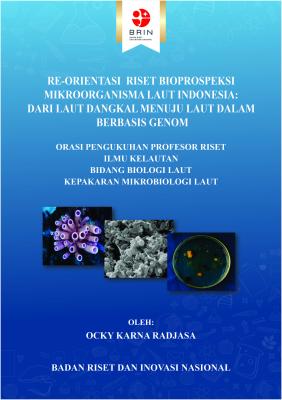
Bioprospeksi mikroorganisme laut Indonesia dilakukan lebih kepada mikroorganisme laut dangkal seperti terumbu karang berbasis metode konvensional. Hampir 68% laut Indonesia lebih dalam dari 200 m dan dikategorikan sebagai laut dalam. Biodiversitas mikroorganisme laut dalam masih sangat terbatas sehingga membuka peluang riset bioprospeksi mikroorganisme laut dalam. Pendekatan biologi molekuler khususnya pemanenan gen dan biologi sintetis terbukti ampuh sebagai pelengkap metode konvensional terutama untuk mengungkit metabolit yang tersembunyi dan meningkatkan peluang penemuan metabolit baru
Ayuningrum D., Liu, Y., Riyanti, Sibero, M. T., Kristiana, R., Asagabaldan, M. A., Wuisan, Z. G., Trianto, A., Radjasa, O. K., Sabdono, A., & Schäberle. T. F. (2019) Tunicate-associated bacteria show a great potential for the discovery of antimicrobial compounds. PLoS ONE, 14(3): e0213797. https://doi.org/10.1371/journal.pone.0213797
Bahry, M. S., Radjasa, O. K., & Trianto, A. (2021). Potential of marine sponge-derived fungi in the aquaculture system. Biodiversitas Journal of Biological Diversity, 22(7). https://doi.org/10.13057/biodiv/d220740
Baran, M. T., Miziak, P., & Bonio, K. (2020). Characteristics of carotenoids and their use in the cosmetics industry. Journal of Education Health and Sport, 10(7), 192–196. https://doi.org/10.12775/jehs.2020.10.07.020
Bethlehem, L., & Van Echten-Deckert, G. (2020). Ectoines as novel anti-inflammatory and tissue protective lead compounds with special focus on inflammatory bowel disease and lung inflammation. Pharmacological Research, 164, 105389. https://doi.org/10.1016/j.phrs.2020.105389
Blin, K., Shaw, S., Augustijn, H. E., Reitz, Z. L., Biermann, F., Alanjary, M., Fetter, A., Terlouw, B. R., Metcalf, W. W., Helfrich, E. J. N., Van Wezel, G. P., Medema, M. H., & Weber, T. (2023). antiSMASH 7.0: new and improved predictions for detection, regulation, chemical structures and visualisation. Nucleic Acids Research, 51(W1), W46–W50. https://doi.org/10.1093/nar/gkad344
Bogacz-Radomska, L., & Harasym, J. (2018). B-Carotene—properties and production methods. Food Quality and Safety, 2(2), 69–74. https://doi.org/10.1093/fqsafe/fyy004
Cita, Y. P., Suhermanto, A., Radjasa, O. K., & Sudharmono, P. (2017). Antibacterial activity of marine bacteria isolated from sponge Xestospongia testudinaria from Sorong, Papua. Asian Pacific Journal of Tropical Biomedicine, 7(5), 450–454. https://doi.org/10.1016/j.apjtb.2017.01.024
Coral Triangle ATLAS. (t.t.). The Coral Triangle. Diakses pada 25 November 2024 dari http://ctatlas.coraltriangleinitiative.org/
Dubinsky, Z, & Stambler, N. (Ed.). (2010). Coral Reefs: An Ecosystem in Transition. Springer Dordrecht. https://doi.org/10.1007/978-94-007-0114-4
Ettinger-Epstein, P., Tapiolas, D. M., Motti, C. A., Wright, A. D., Battershill, C. N., & De Nys, R. (2007). Production of Manoalide and Its Analogues by the Sponge Luffariella variabilis Is Hardwired. Marine Biotechnology, 10(1), 64–74. https://doi.org/10.1007/s10126-007-9037-x
Garner, K. L. (2021). Principles of synthetic biology. Essays in Biochemistry, 65(5), 791–811. https://doi.org/10.1042/ebc20200059
GEBCO Bathymetric Compilation Group 2021. (2021). The General Bathymetric Chart of the Oceans (GEBCO)_2021 Grid - a continuous terrain model of the global oceans and land. British Oceanographic Data Centre. https://doi.org/10.5285/c6612cbe-50b3-0cff-e053-6c86abc09f8f
Goldman, A. D., & Landweber, L. F. (2016). What Is a Genome? PLoS Genetics, 12(7), e1006181. https://doi.org/10.1371/journal.pgen.1006181
Graf, R., Anzali, S., Buenger, J., Pfluecker, F., & Driller, H. (2008). The multifunctional role of ectoine as a natural cell protectant. Clinics in Dermatology, 26(4), 326–333. https://doi.org/10.1016/j.clindermatol.2008.01.002
Hanif, N., Murni, A., Tanaka, C., & Tanaka, J. (2019). Marine Natural Products from Indonesian Waters. Marine Drugs, 17(6), 364. https://doi.org/10.3390/md17060364
Hart, J., Lill, R., Hickford, S., Blunt, J., & Munro, M. (2000). The Halichondrins: Chemistry, Biology, Supply and Delivery. In N. Fusetani (Ed.), Drugs from the Sea (134–153). Karger Publisher. https://doi.org/10.1159/000062488
Hentschel, U., Hopke, J., Horn, M., Friedrich, A. B., Wagner, M., Hacker, J., & Moore, B. S. (2002). Molecular Evidence for a Uniform Microbial Community in Sponges from Different Oceans. Applied and Environmental Microbiology, 68(9), 4431–4440. https://doi.org/10.1128/aem.68.9.4431-4440.2002
Hildebrand, M., Waggoner, L. E., Liu, H., Sudek, S., Allen, S., Anderson, C., Sherman, D. H., & Haygood, M. (2004). bryA. Chemistry & Biology, 11(11), 1543–1552. https://doi.org/10.1016/j.chembiol.2004.08.018
Huang, Z., Lin, Y., & Fang, J. (2009). Biological and Pharmacological Activities of Squalene and Related Compounds: Potential Uses in Cosmetic Dermatology. Molecules, 14(1), 540–554. https://doi.org/10.3390/molecules14010540
Jares-Erijman, E. A., Ingrum, A. L., Carney, J. R., Rinehart, K. L., & Sakai, R. (1993). Polycyclic guanidine-containing compounds from the Mediterranean sponge Crambe crambe: the structure of 13, 14, 15-isocrambescidin 800 and the absolute stereochemistry of the pentacyclic guanidine moieties of the crambescidins. The Journal of Organic Chemistry, 58(18), 4805–4808. https://doi.org/10.1021/jo00070a012
Joint, I., Muhling, M., & Querellou, J. (2010). Culturing marine bacteria - an essential prerequisite for biodiscovery. Microbial Biotechnology, 3(5), 564–575. https://doi.org/10.1111/j.1751-7915.2010.00188.x
Kelecom, A. (2002). Secondary metabolites from marine microorganisms. Anais da Academia Brasileira de Ciências, 74(1), 151–170. https://doi.org/10.1590/S0001-37652002000100012
Kem, W. R. (2000). The brain a7 nicotinic receptor may be an important therapeutic target for the treatment of Alzheimer’s disease: studies with DMXBA (GTS-21). Behavioural Brain Research, 113(1–2), 169–181. https://doi.org/10.1016/s0166-4328(00)00211-4
Khan, U. M., Sevindik, M., Zarrabi, A., Nami, M., Ozdemir, B., Kaplan, D. N., Selamoglu, Z., Hasan, M., Kumar, M., Alshehri, M. M., & Sharifi-Rad, J. (2021). Lycopene: Food Sources, Biological Activities, and Human Health Benefits. Oxidative Medicine and Cellular Longevity, 2021(1). https://doi.org/10.1155/2021/2713511
Kim, S., & Karadeniz, F. (2012). Biological Importance and Applications of Squalene and Squalane. Advances in Food and Nutrition Research, 223–233. https://doi.org/10.1016/b978-0-12-416003-3.00014-7
Kiran, G. S., Ramasamy, P., Sekar, S., Ramu, M., Hassan, S., Ninawe, A., & Selvin, J. (2018). Synthetic biology approaches: Towards sustainable exploitation of marine bioactive molecules. International Journal of Biological Macromolecules, 112, 1278–1288. https://doi.org/10.1016/j.ijbiomac.2018.01.149
Kristiana, R., Bedoux, G., Pals, G., Mudianta, I. W., Taupin, L., Marty, C., Asagabaldan, M. A., Ayuningrum, D., Trianto, A., Bourgougnon, N., Radjasa, O. K., Sabdono, A., & Hanafi, M. (2020). Bioactivity of compounds secreted by symbiont bacteria of Nudibranchs from Indonesia. PeerJ, 8, e8093. https://doi.org/10.7717/peerj.8093
Kristiana, R., Sibero, M. T., Farisa, M. Y., Ayuningrum, D., Dirgantara, D., Hanafi, M., Radjasa, O. K., Sabdono, A., & Trianto, A. (2019). Antibacterial potential of nudibranch-associated bacteria from Saparua and Nusa Laut Islands, Indonesia. Biodiversitas Journal of Biological Diversity, 20(7), 1811–1819. https://doi.org/10.13057/biodiv/d200704
Kusmita, L., Mutiara, E. V., Nuryadi, H., Pratama, P. A., Wiguna, A. S., & Radjasa, O. K. (2017). Characterization of carotenoid pigments from bacterial symbionts of soft-coral Sarcophyton sp. from North Java Sea. International Aquatic Research, 9(1), 61–69. https://doi.org/10.1007/s40071-017-0157-2
Kusmita, L., Mutmainah, N., Sabdono, A., Trianto, A., Radjasa, O. K., & Pangestuti, R. (2021). Characteristic Evaluation of Various Formulations of Anti-Aging Cream from Carotenoid Extract of Bacterial Symbiont Virgibacillus salarius Strain 19.PP.Sc1.6. Cosmetics, 8(4), 120. https://doi.org/10.3390/cosmetics8040120
Kusmita, L., Nuryadi, H., Widyananto, P. A., Muchlissin, S., Sabdono, A., Trianto, A., & Radjasa, O. K. (2021). Bioactivity of carotenoid produced by soft coral symbiotic microorganisms from Panjang and Karimunjawa Island, Centra Java, Indonesia. Biodiversitas Journal of Biological Diversity, 22(2), 732–740. https://doi.org/10.13057/biodiv/d220226
Kusmita, L., Radjasa, O. K., Sabdono, A., & Trianto, A. (2021). Characterization of Carotenoids from Bacterial Symbiont Virgibacillus salarius Strain 19.PP.Sc1.6 from Panjang Island, Jepara, North Java Sea Indonesia. International Journal of Pharmaceutical Research, 13(2), 2114–2122. https://doi.org/10.31838/ijpr/2021.13.02.274
Li, L., Maclntyre, L. W., & Brady, S. F. (2021). Refactoring biosynthetic gene clusters for heterologous production of microbial natural products. Current Opinion in Biotechnology, 69, 145–152. https://doi.org/10.1016/j.copbio.2020.12.011
Lozada, M., & Dionisi, H. M. (2015). Microbial Bioprospecting in Marine Environments. In Springer eBooks, 307–326. https://doi.org/10.1007/978-3-642-53971-8_11
Marini, A., Reinelt, K., Krutmann, J., & Bilstein, A. (2013). Ectoine-Containing Cream in the Treatment of Mild to Moderate Atopic Dermatitis: A Randomised, Comparator-Controlled, Intra-Individual Double-Blind, Multi-Center Trial. Skin Pharmacology and Physiology, 27(2), 57–65. https://doi.org/10.1159/000351381
Mayer, A. M., Jacobson, P. B., Fenical, W., Jacobs, R. S., & Glaser, K. B. (1998). Pharmacological characterization of the pseudopterosins: Novel anti-inflammatory natural products isolated from the Caribbean soft coral, Pseudopterogorgia elisabethae. Life Sciences, 62(26), PL401–PL407. https://doi.org/10.1016/s0024-3205(98)00229-x
Mendola, D. (2003). Aquaculture of three phyla of marine invertebrates to yield bioactive metabolites: process developments and economics. Biomolecular Engineering, 20(4–6), 441–458. https://doi.org/10.1016/s1389-0344(03)00075-3
Mendola, D. (2000). Aquacultural Production of Bryostatin 1 and Ecteinascidin 743. In N. Fusetani (Ed.), Drugs from the Sea (120–133). Karger Publisher. https://doi.org/10.1159/000062482
Micera, M., Botto, A., Geddo, F., Antoniotti, S., Bertea, C. M., Levi, R., Gallo, M. P., & Querio, G. (2020). Squalene: More than a Step toward Sterols. Antioxidants, 9(8), 688. https://doi.org/10.3390/antiox9080688
Nurachman, Z., Kono, A., Radjasa, O. K., & Natalia, D. (2010). Identification a Novel Raw-Starch-Degrading-α-Amylase from a Tropical Marine Bacterium. American Journal of Biochemistry & Biotechnology, 6(4), 300–306. https://doi.org/10.3844/ajbbsp.2010.300.306
Paramasivan, K., & Mutturi, S. (2022). Recent advances in the microbial production of squalene. World Journal of Microbiology and Biotechnology, 38(5). https://doi.org/10.1007/s11274-022-03273-w
Wang, J., Zhang, R., Chen, X., Sun, X., Yan, Y., Shen, X., & Yuan, Q. (2020). Biosynthesis of aromatic polyketides in microorganisms using type II polyketide synthases. Microbial Cell Factories, 19, 110. https://doi.org/10.1186/s12934-020-01367-4
Yarkent, Ç., & Oncel, S. S. (2022). Recent Progress in Microalgal Squalene Production and Its Cosmetic Application. Biotechnology and Bioprocess Engineering, 27(3), 295–305. https://doi.org/10.1007/s12257-021-0355-z
Zhivkoplias, E., Jouffray, J., Dunshirn, P., Pranindita, A., & Blasiak, R. (2024). Growing prominence of deep-sea life in marine bioprospecting. Nature Sustainability, 7, 1027–1037. https://doi.org/10.1038/s41893-024-01392-w

This work is licensed under a Creative Commons Attribution-ShareAlike 4.0 International License.