












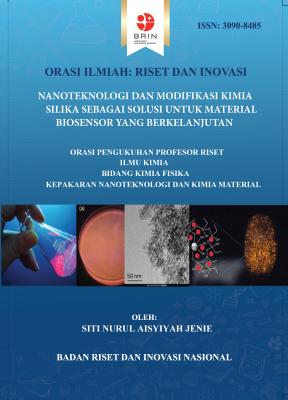
Nanomaterial berbasis silika telah menjadi salah satu platform paling menjanjikan yang telah membuka peluang besar dalam menciptakan biosensor yang lebih sensitif, selektif, dan berkelanjutan. Silika sebagai bahan dasar nanomaterial memiliki keunggulan fisis dan kimia seperti luas permukaan yang tinggi, kestabilan termal, keberadaan gugus fungsional aktif, serta sifat biokompatibel dan biodegradable, yang menjadikannya kandidat ideal sebagai transduser dalam sistem biosensor. Di era yang menuntut deteksi biomolekul atau molekul kimia secara cepat, akurat, dan ekonomis, kebutuhan akan material biosensor yang efisien dan ramah lingkungan menjadi sangat mendesak. Integrasi nanoteknologi dan modifikasi kimia permukaan silika menjadi pendekatan strategis untuk menjawab tantangan tersebut.
Rekam jejak riset kami menawarkan pendekatan inovatif dengan memanfaatkan endapan geothermal sebagai sumber nanosilika, yang tidak hanya mengurangi beban limbah industri panas bumi, tetapi juga menghasilkan material baru yang fungsional dan berkelanjutan. Proses sintesis yang digunakan, seperti metode sol-gel, terbukti sederhana, terkontrol, dan memiliki reproducibility tinggi. Nanosilika geothermal yang dihasilkan menunjukkan karakteristik morfologi dan kimia yang setara dengan nanosilika dari prekursor komersial, sekaligus menurunkan biaya produksi secara signifikan.
Lebih jauh, modifikasi kimia nanosilika geothermal dengan dye organik baik secara fisik (adsorpsi) maupun kimia (kovalen) telah berhasil menghasilkan nanosilika berfluoresensi. Material ini telah kami aplikasikan dalam berbagai platform biosensor optik dan bioimaging, serta dalam bidang forensik untuk deteksi sidik jari laten. Kinerja biosensor yang dikembangkan menunjukkan sensitivitas tinggi dalam mendeteksi bakteri, antigen, dan antibodi. Selain itu, karena sifat permukaan yang aktif, nanosilika ini memiliki potensi untuk dimodifikasi lebih lanjut dengan sifat fungsional lain, seperti sifat magnetik, guna meningkatkan selektivitas sistem deteksi.
Hasil riset ini menunjukkan bahwa nanoteknologi dan modifikasi kimia silika dapat menjadi solusi konkret dalam menyediakan material biosensor yang berkelanjutan. Material ini tidak hanya murah dan mudah diproduksi, tetapi juga kompatibel secara biologis dan ramah lingkungan. Selain itu, pendekatan ini memberi nilai tambah pada limbah industri, sejalan dengan prinsip ekonomi sirkular dan pembangunan berkelanjutan.
Airyn, A. E., Apriyani, F., Petrus, H. T. B. M., Angelina, M., Kristiani, A., Pambudi, F. I., & Aisyiyah Jenie, S. N. (2024). Preliminary Study on the Modification of Quantum Dots/Geothermal Silica Nanocomposites with Breast Cancer Antibody (MUC-1). Journal of Physics: Conference Series, 2705(1), 012014. doi:10.1088/1742-6596/2705/1/012014
Andreani, A. S., Tachrim, Z. P., Kunarti, E. S., Hashimoto, T., Hayashita, T., Jenie, S. N. A., & Santosa, S. J. (2022). The effect of a-cyclodextrin and B-cyclodextrin as stabilizing agents on the size of gold nanoparticles. AIP Conference Proceedings, 2493(1). doi:10.1063/5.0109954
Apriyani, F., Julyansyah, D., Angelina, M., Randy, A., Manurung, R. V., Yuliarto, B., & Jenie, S. N. A. (2023). Preliminary Study of Modified Fluorescent Silica Nanoparticles for the Detection of IgY Antibody. Journal of Metastable and Nanocrystalline Materials, 35, 19-24. doi:10.4028/p-axmy8o
Das, B., Franco, J. L., Logan, N., Balasubramanian, P., Kim, M. I., & Cao, C. (2021). Nanozymes in Point-of-Care Diagnosis: An Emerging Futuristic Approach for Biosensing. Nano-Micro Letters, 13(1), 193. doi:10.1007/s40820-021-00717-0
Devreese, J. T. (2007). Importance of Nanosensors: Feynman’s Vision and the Birth of Nanotechnology. MRS Bulletin, 32(9), 718-725. doi:10.1557/mrs2007.147
Dewi, K. K., Septiani, N. L. W., Wustoni, S., Nugraha, Jenie, S. N. A., Manurung, R. V., & Yuliarto, B. (2024). One-Dimensional HKUST-1-Decorated Glassy Carbon Electrode for the Sensitive Electrochemical Immunosensor of NS1 Dengue Virus Serotype-3. ACS Omega, 9(1), 1454-1462. doi:10.1021/acsomega.3c07856
Douroumis, D., Onyesom, I., Maniruzzaman, M., & Mitchell, J. (2012). Mesoporous silica nanoparticles in nanotechnology. Critical Reviews in Biotechnology, 48(September 2011), 1-17. doi:10.3109/07388551.2012.685860
Elmaria, F. A., Aulia, F., Hidayati, L. N., Kristiani, A., Sudiyarmanto, Kusumastuti, Y., Jenie, S. N. A., & Petrus, H. T. M. B. (2024). Facile synthesis of magnetic-fluorescent iron oxide-geothermal silica core/shell nanocomposites via modified sol–gel method. Journal of Sol-Gel Science and Technology. doi:10.1007/s10971-024-06318-8
Elmaria, F. A., & Jenie, S. N. A. (2021). Magnetic Nanoparticles Based on Natural Silica as A Methyl Ester Forming Acid Catalyst. Indonesian Journal of Applied Chemistry, 23(2), 49-54. doi:10.14203/inajac.v23i2.473
Fitri, W. A., Sururoh, L., & Jenie, S. N. A. (2019). The effect of calcination temperature on the synthesis of magnetic silica nanoparticles from geothermal sludge. AIP Conference Proceedings, 2175(1). doi:10.1063/1.5134644
Fuji-Keizai. (2004). Biosensor Market, R&D Applications & Commercial Implication: W.S. & Worldwide. Retrieved from https://books.google.com.au/books?id=qo9VYgEACAAJ
Haerudin, Pramono, A. W., Kusuma, D. S., Jenie, A., Voelcker, N. H., & Gibson, C. (2014). Preparation and Characterization of Chitosan/Montmorillonite (MMT) Nanocomposite Systems. International Journal of Technology, 1(1), 291-319. doi:https://doi.org/10.14716/ijtech.v1i1.33
Hanifah, N., Septiani, N. L. W., Nugraha, N., Jenie, S. N. A., & Yuliarto, B. (2024). Zeolitic imidazolate framework 8 (ZIF-8) as sensing material for electrochemical detection of dopamine. AIP Conference Proceedings, 3073(1). doi:10.1063/5.0199393
Hasanah, N., Manurung, R. V., Jenie, S. N. A., Indriyati, Prastya, M. E., & Andreani, A. S. (2023). The effect of size control of Gold Nanoparticles Stabilized with a-cyclodextrin and B-cyclodextrin and their antibacterial activities. Materials Chemistry and Physics, 302, 127762. doi:https://doi.org/10.1016/j.matchemphys.2023.127762
Ismail, A., Widyaningtyas, A. L., Susanto, B. H., & Nasikin, M. (2020). Facile Synthesis Silica Nanoparticles from Indonesia Silica Sand and their Physico-Chemical Properties. Key Engineering Materials, 862, 35-39. doi:10.4028/www.scientific.net/KEM.862.35
Jane, A., Dronov, R., Hodges, A., & Voelcker, N. H. (2009). Porous silicon biosensors on the advance. Trends in Biotechnology, 27(4), 230-239. doi:10.1016/j.tibtech.2008.12.004
Jenie, A. S. N., Krismastuti, F. S. H., Ningrum, Y. P., Kristiani, A., Yuniati, M. D., Astuti, W., & Petrus, H. T. B. M. (2020). Geothermal silica-based fluorescent nanoparticles for the visualization of latent fingerprints. Materials Express, 10(2), 258-266. doi:10.1166/mex.2020.1551
Jenie, S. N. A., Du, Z., McInnes, S. J. P., Ung, P., Graham, B., Plush, S. E., & Voelcker, N. H. (2014). Biomolecule detection in porous silicon based microcavities via europium luminescence enhancement. Journal of Materials Chemistry B, 2, 7694-7703. doi:10.1039/C4TB01409J
Jenie, S. N. A., Ghaisani, A., Ningrum, Y. P., Kristiani, A., Aulia, F., & Petrus, H. T. B. M. (2018). Preparation of silica nanoparticles from geothermal sludge via sol-gel method. AIP Conference Proceedings, 2026(1), 020008. doi:10.1063/1.5064968
Jenie, S. N. A., Hickey, S. M., Du, Z., Sebben, D., Brooks, D. A., Voelcker, N. H., & Plush, S. E. (2017). A europium-based ‘off-on’ colourimetric detector of singlet oxygen. Inorganica Chimica Acta, 462, 236-240. doi:http://dx.doi.org/10.1016/j.ica.2017.03.043
Jenie, S. N. A., Krismastuti, F. S. H., Kusumastuti, Y., Petrus, H. T. B. M., & Kristiani, A. (2019). Preparation of Fluorescent Nanoparticles Based on Natural Silica for Bioimaging. In J. Imanishi (Ed.), Toward the Future of Asia: My Proposal (Vol. 4, pp. 107-113). Japan: The Japan Times.
Jenie, S. N. A., Kristiani, A., Kustomo, Simanungkalit, S., & Mansur, D. (2017). Preparation of nanobiochar as magnetic solid acid catalyst by pyrolysis-carbonization from oil palm empty fruit bunches. AIP Conference Proceedings, 1904(1). doi:10.1063/1.5011875
Jenie, S. N. A., Kristiani, A., Sudiyarmanto, Khaerudini, D. S., & Takeishi, K. (2020). Sulfonated magnetic nanobiochar as heterogeneous acid catalyst for esterification reaction. Journal of Environmental Chemical Engineering, 8(4), 103912. doi:https://doi.org/10.1016/j.jece.2020.103912
Jenie, S. N. A., Kusumastuti, Y., Krismastuti, F. S. H., Untoro, Y. M., Dewi, R. T., Udin, L. Z., & Artanti, N. (2021). Rapid Fluorescence Quenching Detection of Escherichia coli Using Natural Silica-Based Nanoparticles. Sensors, 21(3). doi:10.3390/s21030881
Jenie, S. N. A., Pace, S., Sciacca, B., Brooks, R. D., Plush, S. E., & Voelcker, N. H. (2014). Lanthanide Luminescence Enhancements in Porous Silicon Resonant Microcavities. ACS Applied Materials & Interfaces, 6(15), 12012-12021. doi:10.1021/am500983r
Jenie, S. N. A., Plush, S. E., & Voelcker, N. H. (2016). Recent Advances on Luminescent Enhancement-Based Porous Silicon Biosensors. Pharmaceutical research, 33(10), 2314–2336. doi:10.1007/s11095-016-1889-1
Jenie, S. N. A., Plush, S. E., & Voelcker, N. H. (2017). Singlet Oxygen Detection on a Nanostructured Porous Silicon Thin Film via Photonic Luminescence Enhancements. Langmuir, 8606-8613. doi:10.1021/acs.langmuir.7b00522
Jenie, S. N. A., Prieto-Simon, B., & Voelcker, N. H. (2015). Development of l-lactate dehydrogenase biosensor based on porous silicon resonant microcavities as fluorescence enhancers. Biosensors and Bioelectronics, 74, 637-643. doi:http://dx.doi.org/10.1016/j.bios.2015.07.025
Kajihara, K. (2013). Recent advances in sol – gel synthesis of monolithic silica and silica-based glasses. Journal of Asian Ceramic Societies, 1(2), 121-133. doi:10.1016/j.jascer.2013.04.002
Kartika, A. E., Setiyanto, H., Manurung, R. V., Jenie, S. N. A., & Saraswaty, V. (2021). Silver Nanoparticles Coupled with Graphene Nanoplatelets Modified Screen-Printed Carbon Electrodes for Rhodamine B Detection in Food Products. ACS Omega, 6(47), 31477-31484. doi:10.1021/acsomega.1c03414
Kim, T. G., An, G. S., Han, J. S., Hur, J. U., Park, B. G., & Choi, S. C. (2017). Synthesis of size controlled spherical silica nanoparticles via sol-gel process within hydrophilic solvent. Journal of the Korean Ceramic Society, 54(1), 49-54. doi:10.4191/kcers.2017.54.1.10
Kusumastuti, Y., Petrus, H. T. B. M., Yohana, F., Buwono, A. T., & Zaqina, R. B. (2017). Synthesis and characterization of biocomposites based on chitosan and geothermal silica. AIP Conference Proceedings, 1823(1), 020127-020121-020126. doi:10.1063/1.4978200
Licha, K., & Olbrich, C. (2005). Optical imaging in drug discovery and diagnostic applications. Advanced Drug Delivery Reviews, 57(8), 1087-1108. doi:http://dx.doi.org/10.1016/j.addr.2005.01.021
Luong, J. H. T., Male, K. B., & Glennon, J. D. (2008). Biosensor technology: Technology push versus market pull. Biotechnology Advances, 26(5), 492-500. doi:http://dx.doi.org/10.1016/j.biotechadv.2008.05.007
Madhurantakam, S., Muthukumar, S., & Prasad, S. (2022). Emerging Electrochemical Biosensing Trends for Rapid Diagnosis of COVID-19 Biomarkers as Point-of-Care Platforms: A Critical Review. ACS Omega, 7(15), 12467-12473. doi:10.1021/acsomega.2c00638
Maulana, M. Y., Raissa, R., Nurrudin, A., Andreani, A. S., Angelina, M., Septiani, N. L. W., Yuliarto, B., & Jenie, S. N. A. (2024). An ultra-sensitive SARS-CoV-2 antigen optical biosensor based on angiotensin converting enzyme 2 (ACE-2) functionalized magnetic-fluorescent silica nanoparticles. Nanotechnology, 35(20), 205702. doi:10.1088/1361-6528/ad27aa
Maulana, M. Y., Yuliarto, B., Jenie, S. N. A., & Septiani, N. L. W. (2023). Comparative X-Ray Diffraction (XRD) Study on the Synthesis of Natural Based Magnetic Silica Nanoparticles. Journal of Metastable and Nanocrystalline Materials, 35, 25-31. doi:10.4028/p-6d8vlt
Maulidia, A., Sujoto, V. S. H., Sudarmaja, D. P. A., Putri, J. J. E., Jenie, S. N. A., Astuti, W., Supriyatna, Y. I., Warmada, I. W., Sutijan, Anggara, F., & Petrus, H. T. B. M. (2023). Kinetic Study of Lithium Leaching from Sidoarjo Mud Using Sulfuric Acid. Mining, Metallurgy & Exploration, 40(4), 1279-1288. doi:10.1007/s42461-023-00812-3
Mayer, M., & Baeumner, A. J. (2019). A Megatrend Challenging Analytical Chemistry: Biosensor and Chemosensor Concepts Ready for the Internet of Things. Chemical Reviews, 119(13), 7996-8027. doi:10.1021/acs.chemrev.8b00719
Nurkhaliza, F., Fathoni, A., Yati, I., Prastya, M. E., Jenie, S. N. A., & Andreani, A. S. (2023). UV–vis Study on B-Cyclodextrin as Dual Function for Synthesis AgNPs and Antibacterial Application. Macromolecular Symposia, 409(1), 2200182. doi:https://doi.org/10.1002/masy.202200182
Petrus, H. T. B. M., Fairuz, F. I., Sa’dan, N., Olvianas, M., Astuti, W., Jenie, S. N. A., Setiawan, F. A., Anggara, F., Ekaputri, J. J., & Bendiyasa, I. M. (2021). Green geopolymer cement with dry activator from geothermal sludge and sodium hydroxide. Journal of Cleaner Production, 293, 126143. doi:https://doi.org/10.1016/j.jclepro.2021.126143
Petrus, H. T. B. M., Olvianas, M., Shafiyurrahman, M. F., Pratama, I. G. A. A. N., Jenie, S. N. A., Astuti, W., Nurpratama, M. I., Ekaputri, J. J., & Anggara, F. (2022). Circular Economy of Coal Fly Ash and Silica Geothermal for Green Geopolymer: Characteristic and Kinetic Study. Gels, 8(4), 233.
Qhobosheane, M., Santra, S., Zhang, P., & Tan, W. (2001). Biochemically functionalized silica nanoparticles. Analyst, 126(8), 1274-1278. doi:10.1039/B101489G
Rafique, M., Tahir, M. B., Rafique, M. S., & Hamza, M. (2020). Chapter 1 - History and fundamentals of nanoscience and nanotechnology. In M. B. Tahir, M. Rafique, & M. S. Rafique (Eds.), Nanotechnology and Photocatalysis for Environmental Applications (pp. 1-25): Elsevier.
Reshetilov, A. N., & Bezborodov, A. M. (2008). Nanobiotechnology and biosensor research. Applied Biochemistry and Microbiology, 44(1), 1-5. doi:10.1134/S0003683808010018
Shandilya, R., Bhargava, A., Bunkar, N., Tiwari, R., Goryacheva, I. Y., & Mishra, P. K. (2019). Nanobiosensors: Point-of-care approaches for cancer diagnostics. Biosensors and Bioelectronics, 130, 147-165. doi:https://doi.org/10.1016/j.bios.2019.01.034
Sifana, N. O., & Jenie, S. N. A. (2022). Fabrication and characterization of FITC-modified naturalbased silica nanoparticles using sol-gel method. IOP Conference Series: Earth and Environmental Science, 963(1), 012025. doi:10.1088/1755-1315/963/1/012025
Sifana, N. O., Melyna, Septiani, N. L. W., Septama, A. W., Manurung, R. V., Yuliarto, B., & Jenie, S. N. A. (2024). Detection of Methicillin-Resistant Staphylococcus Aureus using vancomycin conjugated silica-based fluorescent nanoprobe. Spectrochimica Acta Part A: Molecular and Biomolecular Spectroscopy, 307, 123643. doi:https://doi.org/10.1016/j.saa.2023.123643
Silvia, P. Z., Jenie, S. N. A., & Petrus, H. T. B. M. (2022). Tunable particle size synthesis of nanoclay from Sidoarjo geothermal mud via ultrasonic method. AIP Conference Proceedings, 2708(1). doi:10.1063/5.0123140
Sutijan, S., Darma, S. A., Hananto, C. M., Sujoto, V. S. H., Anggara, F., Jenie, S. N. A., Astuti, W., Mufakhir, F. R., Virdian, S., Utama, A. P., & Petrus, H. T. B. M. (2023). Lithium Separation from Geothermal Brine to Develop Critical Energy Resources Using High-Pressure Nanofiltration Technology: Characterization and Optimization. Membranes, 13(1), 86.
Syauqi, M., Astuti, W., Jennie, S. N. A., Petrus, H. T. B. M., Sujoto, V. S. H., & Mulyono, P. (2023). Modelling of Nano Silica Formation from Geothermal Silica Using Co-Precipitation Method. Solid State Phenomena, 345, 171-178. doi:10.4028/p-nVH0KL
Tangkas, I. W. C. W. H., Sujoto, V. S. H., Astuti, W., Jenie, S. N. A., Anggara, F., Utama, A. P., Petrus, H. T. B. M., & Sutijan. (2023). Synthesis of Titanium Ion Sieves and Its Application for Lithium Recovery from Artificial Indonesian Geothermal Brine. Journal of Sustainable Metallurgy, 9(2), 613-624. doi:10.1007/s40831-023-00664-7
Untoro, Y. M., Widyasari, D. A., Supriadi, E., & Jenie, S. N. A. (2020). The Effect of Rhodamine B on The Properties of Fluorescent Nanoparticles Derived from Geothermal Silica. The Journal of Pure and Applied Chemistry Research, 9(3), 171-171.
Wicaksono, D. H. B., Utari, L., Wulan, N., Engel, D. J., Widjaja, S. T., Jovinka, X., Genilar, L. A., Setiawan, S. A., Yuliarto, B., Dipojono, H. K., Jenie, S. N. A., Tursiloadi, S., Krismastuti, F. S. H., & Herbani, Y. (2018). Preliminary study on graphene/metal oxide nanoparticles-coated cotton fabrics for flexible gas sensor. AIP Conference Proceedings, 2024(1), 020063. doi:10.1063/1.5064349
Widyasari, D. A., Aulia, F., Andreani, A. S., Dewi, R. T., Septiani, N. L. W., Yuliarto, B., & Jenie, S. N. A. (2023). Synthesis of Silica Nanoparticle and Cd-Based Carboxyl Quantum Dots (SiNPaQDs) Conjugates as Biosensing Platform: A Pleriminary Study. ITB Graduate School Conference, 2(2), 144-152.
Widyasari, D. A., Julyansyah, D., Kristiani, A., Widyaningrum, B. A., Petrus, H. T. B. M., Manurung, R. V., & Jenie, S. N. A. (2021). Conjugation of E.coli antibody with fluorescent natural silica-based nanoparticles: Preparation and characterization. AIP Conference Proceedings, 2382(1), 30009-30009. doi:10.1063/5.0060386
Widyasari, D. A., Kristiani, A., Randy, A., Manurung, R. V., Dewi, R. T., Andreani, A. S., Yuliarto, B., & Jenie, S. N. A. (2022). Optimized antibody immobilization on natural silica-based nanostructures for the selective detection of E. coli. RSC Advances, 12(33), 21582-21590. doi:10.1039/D2RA03143D
Wu, Y., Xue, P., Kang, Y., & Hui, K. M. (2013). Highly specific and ultrasensitive graphene-enhanced electrochemical detection of low-abundance tumor cells using silica nanoparticles coated with antibody-conjugated quantum dots. Analytical Chemistry, 85(6), 3166-3173. doi:10.1021/ac303398b
Wulandari, M., Hasanah, N., Yuliarto, B., Angelina, M., Manurung, R., Jenie, S., & Andreani, A. (2023). A Rapid Colorimetric Method to Investigate SARS-CoV-2 by Using Gold Nanoparticles Capped with O-Hydroxybenzoic Acid.
Yuce, M., & Kurt, H. (2017). How to make nanobiosensors: Surface modification and characterisation of nanomaterials for biosensing applications. RSC Advances, 7(78), 49386-49403. doi:10.1039/c7ra10479k

This work is licensed under a Creative Commons Attribution-ShareAlike 4.0 International License.