











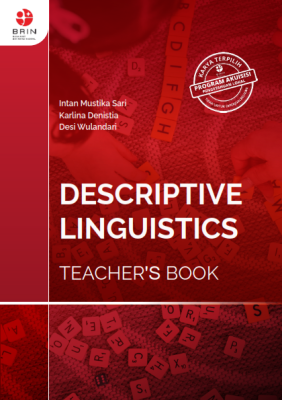
The “Descriptive Linguistics: Teacher Book” is designed to equip teachers with the tools needed to effectively teach the core elements of English linguistics in an engaging and dynamic way. It provides activities and exercises that align with each topic, ensuring that students not only grasp the theory but also apply their knowledge practically.
This covers key areas, such as:
The “Descriptive Linguistics: Teacher Book” can support educators in delivering the course material, ensuring that students with minimal knowledge of linguistics gain a solid understanding of the fundamental concepts through both theory and practical exercises. It also provides comprehensive tools for teaching, including detailed answers and solutions to all exercises in the student teacher book, offering clear explanations to enhance student comprehension and guide class discussions and a range of assessment criteria for evaluating individual, pair, group, and whole-class activities, ensuring that teachers can assess not only the accuracy of answers but also students' critical thinking, problem-solving, and collaboration skills.
By using this book, teachers will be equipped to foster a classroom environment where students not only grasp the foundational concepts of linguistics but also develop their communication skills, both in written and spoken forms. Whether used as part of lesson plans or as supplementary material, this teacher book is an invaluable resource for teaching linguistics interactively.
Anderson, S. R. (1992). Amorphous morphology. Cambridge University Press.
Aronoff, M., & Fudeman, K. (2011). What is morphology? Fundamentals of linguistics. John Wiley & Sons.
Beard, R. (1995). Lexeme-morpheme base morphology: A general theory of inflection and word formation. State University of New York Press.
Booij, G. E. (2005). The grammar of words: An introduction to linguistic morphology. Oxford University Press.
Borsley, R. D., & Borjars, K. (Eds.). (2011). Non-transformational syntax: Formal and explicit models of grammar (1st ed.). Wiley.
https://doi.org/10.1002/9781444395037
Burton-Roberts, N. (2021). Analysing sentences: An introduction to English syntax (5th ed.). Routledge. https://doi.org/10.4324/9781003118916
Bussmann, H. (2006). Routledge dictionary of language and linguistics. Routledge.
Cahya, U. D., Pasaribu, A. N., Engelbertha S, R., Susanti, E., Diliana, E., Sari, N., Hutauruk, T. L., Sari, I. M., Gaspersz, S., & Tamrin, A. F. (2023). English literature. Yayasan Kita Menulis. https://kitamenulis.id/2023/08/30/english-literature/
Chomsky, N. (2002). Syntactic Structures. Walter de Gruyter.
Conradt, S. (2016, July 19). 11 fun facts about the International Phonetic Alphabet. Mental Floss. https://www.mentalfloss.com/article/83340/11-fun-facts-about-international-phonetic-alphabet
Cruse, D. A. (1986). Lexical semantics. Cambridge University Press.
Fasold, R. W., & Connor-Linton, J. (Eds.). (2006). An introduction to language and linguistics. Cambridge University Press.
Fernandez, E. M., & Cairns, H. S. (2010). Fundamentals of psycholinguistics. John Wiley & Sons.
Freepik. (n.d.) Gray geometric Memphis design element vector. Retrieved September 3, 2024, from https://www.freepik.com/free-vector/gray-geometric-memphis-design-element-vector_34380754.htm
Fromkin, V., Rodman, R., & Hyams, N. (2009). An introduction to language (9th ed.). Wadsworth.
Haspelmath, M., & Sims, A. D. (2010). Understanding morphology (2nd ed.). Hodder Education.
Gao, C. & Zheng, Q. (2014). A linguistic study of antonymy in English text. Journal of Language Teaching and Research, 5(1), 234–238. Academy Publisher. https://doi:10.4304/jltr.5.1.234-238
Geeraerts, D. (2017). Lexical semantics. Oxford Research Encyclopaedias. https://doi.org/10.1093/acrefore/9780199384655.013.29
Hoffman, P., Lambon Ralph, M. A. & Rogers, T. T. (2013). Semantic diversity: A measure of semantic ambiguity based on variability in the contextual usage of words. Behaviour Research Methods, 45, 718–730 https://doi.org/10.3758/s13428-012-0278-x
Hudson, G. (2000). Essential introduction linguistics. Blackwell PublishersJohn Benjamins Publishing Company. (n.d.). Chapter 4, exercise 5. John Benjamins Publishing. https://benjamins.com/sites/z.156/exercise/c4q5
Jones, S., Murphy, M. L., Paradis, C., & Willners, C. (2012). Antonyms in English: Construals, constructions and canonicity. Cambridge University Press.
Kearns, K. (2017). Semantics. Bloomsbury Publishing
Knowles, M. & Moon, R. (2006). Introducing metaphor. Routledge
Lakoff, G., & Johnson, M. (1980). Metaphors we live by. University of Chicago Press.
Luuk, E. (2015). Syntax–semantics interface. International Encyclopedia of the Social & Behavioral Sciences. https://doi.org/10.1016/B978-0-08-097086-8.57035-4
Lyons, J. (1977). Semantics (Vol. 2). Cambridge University Press.
Palmer, F. R. (1976). Semantics (2nd ed.). Cambridge University Press.
Pasaribu, A. N., Widyastuti, A., Masruroh, E., Halim, A., Sari, I. M., Riyadi, A., Yulianti, Y., Achmad, S., Bouti, S., & Arianti, I. (2024). Pengantar ilmu linguistik. Yayasan Kita Menulis.
Piccolo, G., & Shiffer, E. (2023, May 22). 55 funny graduation quotes to make the class of 2024 laugh. Good Housekeeping. https://www.goodhousekeeping.com/life/inspirational-stories/g27816229/funny-graduation-quotes/
Putriana, A., Kasoema, R. S., Mukhoirotin, M., Gandasari, D., Retnowuni, A., Aminah, R. S., Wiyati, E. K., Kato, I., Akbar, M. F., & Sari, I. M. (2021). Psikologi komunikasi. Yayasan Kita Menulis.
Reimer, N. (2010). Introducing semantics. Cambridge University Press.
Richards, J. C., Platt, J. T., & Weber, H. (1985). Longman dictionary of applied linguistics. Longman.
Roach, P., Hartman, J., Setter, J., & Jones, D. (Eds.). (2006). Cambridge English pronouncing dictionary (17th ed). Cambridge University Press.
Roma, J. (2018). Practical phonetics exercises for Bachillerato. Burlington Books.
Saussure, F. de. (1959). Course in general linguistics. Philosophical Library.
Saeed, J. I. (2016). Semantics (4th ed.). Blackwell Publisher, Ltd.
Smith, C. J. (1879). Synonyms and antonyms. George Bell and Sons
Swiggers, P. (2011). The morpheme in Bloomfield’s language. In M. Janse (Ed.), Productivity and Creativity: Studies in General and Descriptive Linguistics in Honor of E. M. Uhlenbeck (pp. 251–264). De Gruyter Mouton. https://doi.org/10.1515/9783110806946.25
toPhonetics. (n.d.). IPA phonetic transcription of English text. https://tophonetics.com
Widyastuti, A., Sari, I. M., Melansari, N., Mulya Nugraha, R., Yulianti, Nucifera, P., Ray, S. A., Yulianda, A., & Tawakkal, M. I. (2024). Semantik: Makna dalam bahasa. Yayasan Kita Menulis. https://kitamenulis.id/2024/04/24/semantik-makna-dalam-bahasa/
Zsiga, E. (2006). The sounds of language. In Ralph. W. Fasold & J. Connor-Linton (Eds.), An introduction to language and linguistics (pp. 13–54). Cambridge University Press.

This work is licensed under a Creative Commons Attribution-ShareAlike 4.0 International License.