












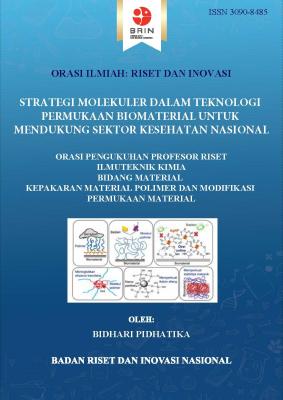
Penguasaan teknologi modifikasi permukaan biomaterial merupakan elemen strategis dalam mendukung transformasi sistem kesehatan nasional menuju visi Indonesia Emas 2045. Inovasi dalam bidang ini melibatkan pendekatan multidisipliner yang mencakup ilmu fisika, kimia, dan biologi molekuler, serta pengembangan permukaan biomaterial dari sifat biopasif menuju sistem bioaktif hingga responsif dan otonom. Selama dua dekade terakhir, berbagai kontribusi ilmiah telah dihasilkan bersama tim kolaboratif, baik di dalam maupun luar negeri, seperti pengembangan lapisan polimer di permukaan sebagai platform biopasif yang stabil, sistem bioaktif dual-fungsi untuk menekan infeksi dan mendukung regenerasi jaringan, hingga lapisan responsif yang mampu merespons stimuli. Berbagai teknologi berbasis kimia, fisika, dan kombinasi keduanya telah digunakan, seperti teknologi pencangkokan dan plasma. Dengan menjadikan permukaan biomaterial sebagai tempat interaksi utama dengan lingkungan biologis, strategi modifikasi ini membuka peluang besar untuk memperkuat kemandirian teknologi alat kesehatan nasional, menurunkan biaya kesehatan, dan meningkatkan kualitas hidup pasien secara berkelanjutan. Melalui penguatan ekosistem inovasi, hasil riset ini siap menjadi fondasi untuk kebijakan dan pengembangan industri biomaterial Indonesia yang tangguh, adaptif, dan berbasis sains.
Abdulrahman, A. G., Endytiastuti, E., Ardhani, R., Sudarso, I. S. R., Pidhatika, B., Fauzi, M. B., Susilowati, H., Kristanti, Y., & Handajani, J. (2025). Evaluating the Efficacy of Gelatin-Chitosan-Tetraethyl Orthosilicate Calcium Hydroxide Composite as a Dental Pulp Medicament on COX-2, PGP 9.5, TNF-a Expression and Neutrophil number. F1000Research, 13, 1258. https://doi.org/10.12688/f1000research.156336.2
Ana, I. D., Vrana, N. E., Morita, A., Satria, G. A. P., & Hathroubi, S. (2025). Antibacterial surface functionalization of biomedical scaffolds: A transformation towards more adaptive, resilient regenerative therapy. Results in Surfaces and Interfaces, 19, 100481. https://doi.org/10.1016/j.rsurfi.2025.100481
Ardhani, R., Diana, R., & Pidhatika, B. (2022). How Porphyromonas gingivalis Navigate the Map: The Effect of Surface Topography on the Adhesion of Porphyromonas gingivalis on Biomaterials. Materials, 15(14), 4988. https://doi.org/10.3390/ma15144988
Ardhani, R., Suraya, T., Wulanjati, M. P., Ana, I. D., Rühe, J., & Pidhatika, B. (2022). Photoreactive polymer and C,H-insertion reaction to tailor the properties of CHA/gelatin-based scaffold. International Journal of Polymer Analysis and Characterization, 27(5), 326–345. https://doi.org/10.1080/1023666X.2022.2076012
Bhardwaj, N., & Kundu, S. C. (2010). Electrospinning: A fascinating fiber fabrication technique. Biotechnology Advances, 28(3), 325–347. https://doi.org/10.1016/j.biotechadv.2010.01.004
Bousquet, A., Awada, H., Hiorns, R. C., Dagron-Lartigau, C., & Billon, L. (2014). Conjugated-polymer grafting on inorganic and organic substrates: A new trend in organic electronic materials. In Progress in Polymer Science (Vol. 39, Issue 11, pp. 1847–1877). Elsevier Ltd. https://doi.org/10.1016/j.progpolymsci.2014.03.003
Castner, D. G., & Ratner, B. D. (2002). Biomedical surface science: Foundations to frontiers. Surface Science, 500(1), 28–60. https://doi.org/https://doi.org/10.1016/S0039-6028(01)01587-4
Chen, S., Guo, Y., Liu, R., Wu, S., Fang, J., Huang, B., Li, Z., Chen, Z., & Chen, Z. (2018). Tuning surface properties of bone biomaterials to manipulate osteoblastic cell adhesion and the signaling pathways for the enhancement of early osseointegration. Colloids and Surfaces. B, Biointerfaces, 164, 58–69. https://doi.org/10.1016/j.colsurfb.2018.01.022
Chen, Y., Cao, W., Zhou, J., Pidhatika, B., Xiong, B., Huang, L., Tian, Q., Shu, Y., Wen, W., Hsing, I.-M., & Wu, H. (2015). Poly(l-lysine)-graft-folic acid-coupled poly(2-methyl-2-oxazoline) (PLL-g-PMOXA-c-FA): A Bioactive Copolymer for Specific Targeting to Folate Receptor-Positive Cancer Cells. ACS Applied Materials & Interfaces, 7(4), 2919–2930. https://doi.org/10.1021/am508399w
Chen, Y., Pidhatika, B., von Erlach, T., Konradi, R., Textor, M., Hall, H., & Lühmann, T. (2014). Comparative assessment of the stability of nonfouling poly(2-methyl-2-oxazoline) and poly(ethylene glycol) surface films: An in vitro cell culture study. Biointerphases, 9(3), 031003. https://doi.org/10.1116/1.4878461
Cordero, D., López-Álvarez, M., Rodríguez-Valencia, C., Serra, J., Chiussi, S., & González, P. (2013). In vitro response of pre-osteoblastic cells to laser microgrooved PEEK. Biomedical Materials, 8(5), 055006. https://doi.org/10.1088/1748-6041/8/5/055006
Eskani, I. N., Rahayuningsih, E., Astuti, W., & Pidhatika, B. (2023). Low Temperature In Situ Synthesis of ZnO Nanoparticles from Electric Arc Furnace Dust (EAFD) Waste to Impart Antibacterial Properties on Natural Dye-Colored Batik Fabrics. Polymers, 15(3). https://doi.org/10.3390/polym15030746
Eskani, I. N., Rahayuningsih, E., Astuti, W., & Pidhatika, B. (2024). In situ synthesis of zinc oxide nanoparticles from electric arc furnace dust waste for functionalization of fabric: optimization with response surface methodology. IOP Conference Series: Earth and Environmental Science, 1388(1), 012022. https://doi.org/10.1088/1755-1315/1388/1/012022
Gad, S. C., & Gad-McDonald, S. (2015). Biomaterials, medical devices, and combination products: Biocompatibility testing and safety assessment. CRC Press.
Gheisarifar, M., Thompson, G. A., Drago, C., Tabatabaei, F., & Rasoulianboroujeni, M. (2021). In vitro study of surface alterations to polyetheretherketone and titanium and their effect upon human gingival fibroblasts. The Journal of Prosthetic Dentistry, 125(1), 155–164. https://doi.org/https://doi.org/10.1016/j.prosdent.2019.12.012
Handajani, J., Ardhani, R., Sudarso, I. S. R., Pidhatika, B., Mohammed, A., & Fauzi, M. B. (2024). Evaluation of the Expression of Nestin in the Pulp after Application of Gelatin-Chitosan-Tetraethyl Orthosilicate-Calcium Hydroxide Composite. Malaysian Journal of Medicine & Health Sciences, 20, 29–34.
Hoogenboom, R. (2007). Poly (2-oxazoline) s: Alive and Kicking. Macromolecular Chemistry and Physics, 208(1), 18–25. https://doi.org/https://doi.org/10.1002/macp.200600558
Hoogenboom, R. (2009). Poly (2-oxazoline) s: a polymer class with numerous potential applications. Angewandte Chemie International Edition, 48(43), 7978–7994. https://doi.org/10.1002/anie.200901607
Hoogenboom, R., & Schlaad, H. (2017). Thermoresponsive poly(2-oxazoline)s, polypeptoids, and polypeptides. Polymer Chemistry, 8(1), 24–40. https://doi.org/10.1039/c6py01320a
Kleber, C., Bruns, M., Lienkamp, K., Rühe, J., & Asplund, M. (2017). An interpenetrating, microstructurable and covalently attached conducting polymer hydrogel for neural interfaces. Acta Biomaterialia, 58, 365–375. https://doi.org/https://doi.org/10.1016/j.actbio.2017.05.056
Konradi, R., Pidhatika, B., Mühlebach, A., & Textor, M. (2008). Poly-2-methyl-2-oxazoline: A peptide-like polymer for protein-repellent surfaces. Langmuir, 24(3), 613–616. https://doi.org/10.1021/la702917z
Lava, K., Verbraeken, B., & Hoogenboom, R. (2015). Poly(2-oxazoline)s and click chemistry: A versatile toolbox toward multi-functional polymers. European Polymer Journal, 65, 98–111. https://doi.org/10.1016/j.eurpolymj.2015.01.014
Ma, S., Zhang, X., Yu, B., & Zhou, F. (2019). Brushing up functional materials. NPG Asia Materials, 11(24). https://doi.org/10.1038/s41427-019-0121-2
Mahajan, A., & Sidhu, S. S. (2018). Surface modification of metallic biomaterials for enhanced functionality: a review. Materials Technology, 33(2), 93–105. https://doi.org/10.1080/10667857.2017.1377971
Mahmudi, M., Ardhani, R., Pidhatika, B., Suyanta, S., Swasono, Y. A., Rudianto, R. P., & Nuryono, N. (2024). Development of a local drug delivery system for promoting the regeneration of infective bone defects: composite films with controlled properties. Polymer Bulletin, 81(12), 11215–11238. https://doi.org/10.1007/s00289-024-05243-8
Mahmudi, Nuryono, Pidhatika, B., & Suyanta. (2022). Synthesis of bioactive membranes for guided tissue regeneration (GTR): a comparative study of the effect silane-based cross-linker. RASAYAN J.Chem, 15(1), 102–107. https://doi.org/10.31788/RJC.2022.1516435
Maudisha. (2024). DOKTOR FTUI KEMBANGKAN BIOMATERIAL BERBASIS LOGAM DALAM NEGERI GUNA PENGEMBANGAN BONE PLATE IMPLAN TULANG . Https://Www.Ui.Ac.Id/Doktor-Ftui-Kembangkan-Biomaterial-Untuk-Bone-Plate-Implan-Tulang/.
Montoya, C., Du, Y., Gianforcaro, A. L., Orrego, S., Yang, M., & Lelkes, P. I. (2021). On the road to smart biomaterials for bone research: definitions, concepts, advances, and outlook. Bone Research, 9(1). https://doi.org/10.1038/s41413-020-00131-z
Mukherji, R., Patil, A., & Prabhune, A. (2014). Role of Extracellular Proteases in Biofilm Disruption of Gram Positive Bacteria with Special Emphasis on Staphylococcus aureus Biofilms. Enzyme Engineering, 04(01), 1000126. https://doi.org/10.4172/2329-6674.1000126
Namiki, A., Kawai, T., & Ichige, K. (1986). Angle-resolved time-of-flight spectra of neutral particles desorbed from laser irradiated CdS. Surface Science, 166(1), 129–140. https://doi.org/https://doi.org/10.1016/0039-6028(86)90536-4
National Institute of Biomedical Imaging and Bioengineering. (2024). Biomaterial Technologies: What are biomaterials? . https://www.nibib.nih.gov/science-education/science-topics/biomaterials
Ngoerah, I. G. N. G. (2023). Akselerasi Alat Kesehatan PDN dalam Mutu dan Keselamatan Pasien Suatu Keinginan atau Kebutuhan. Https://Www.Persi.or.Id/Wp-Content/Uploads/2023/11/36.K6_RSUP-Prof.Dr_.IGNG_.-Ngoerah_-Akselerasi-Alat-Kesehatan-PDN-Dalam-Mutu-Dan-Keselamatan-Pasien-Suatu-Keinginan-Atau-Kebutuhan.Pdf.
Ninan, N., Pidhatika, B., Bright, R., Kartika, B. M., Rudianto, R. P., Swasono, Y. A., Ardhani, R., & Vasilev, K. (2024). Advancing sustainable technologies: plasma-engineered bioplastics with silver nanoparticle integration. Journal of Materials Science, 59(20), 9003–9020. https://doi.org/10.1007/s10853-024-09673-7
Pandiyarajan, C. K., & Genzer, J. (2019). Thermally activated one-pot, simultaneous radical and condensation reactions generate surface-anchored network layers from common polymers. Macromolecules, 52(2), 700–707. https://doi.org/10.1021/acs.macromol.8b02194
Pidhatika, B. (2019). Hemocompatibility study of surface-attached antibiofouling polymer monolayers. Journal of Physics: Conference Series, 1282(1), 012069. https://doi.org/10.1088/1742-6596/1282/1/012069
Pidhatika, B., Ardhani, R., & Prasetyanto, E. A. (2022). PERMUKAAN BIOMATERIAL: Strategi Modifikasi Karakterisasi dan Respon Tubuh. UGM PRESS.
Pidhatika, B., Ardhani, R., Swasono, Y. A., Anggraeni, R., Andriyanti, W., Santosa, F. A., Rudianto, R. P., Ana, I. D., & Dewi, A. H. (2025). Advancing Bone Regeneration: The Impactful Role of Plasma Technology. Plasma Processes and Polymers, 22(2), 2400171. https://doi.org/https://doi.org/10.1002/ppap.202400171
Pidhatika, B., Chen, Y., Coullerez, G., Al-Bataineh, S., & Textor, M. (2014). ToF-SIMS analysis of poly(l-lysine)-graft-poly(2-methyl-2-oxazoline) ultrathin adlayers. Analytical and Bioanalytical Chemistry, 406(5), 1509–1517. https://doi.org/10.1007/s00216-013-7537-2
Pidhatika, B., & Macgregor, M. (2023). Surface “CLICK” Reaction Between Acetylene-Decorated Polymeric Platform and Azide-Decorated Compounds. Surface Review and Letters, 30(03), 2350016.
Pidhatika, B., Möller, J., Benetti, E. M., Konradi, R., Rakhmatullina, E., Mühlebach, A., Zimmermann, R., Werner, C., Vogel, V., & Textor, M. (2010). The role of the interplay between polymer architecture and bacterial surface properties on the microbial adhesion to polyoxazoline-based ultrathin films. Biomaterials, 31(36), 9462–9472. https://doi.org/https://doi.org/10.1016/j.biomaterials.2010.08.033
Pidhatika, B., Möller, J., Vogel, V., & Konradi, R. (2008). Nonfouling surface coatings based on poly(2-methyl-2-oxazoline). Chimia, 62(4), 264–269. https://doi.org/10.2533/chimia.2008.264
Pidhatika, B., & Nalam, P. C. (2019). Investigation of design parameters in generating antifouling and lubricating surfaces using hydrophilic polymer brushes. Journal of Applied Polymer Science, 136(24), 47659. https://doi.org/https://doi.org/10.1002/app.47659
Pidhatika, B., Ninan, N., Bright, R., Palms, D., Rahmawan, Y., & Vasilev, K. (2024). Plasma-assisted surface engineering for value added in starch bioplastics: A study on enhanced surface properties and natural dye immobilization. Journal of Applied Polymer Science, 141(12). https://doi.org/10.1002/app.55130
Pidhatika, B., & Rakhmatullina, E. (2014). The synthesis of polymeric dual-functional antimicrobial surface based on poly(2-methyl-2-oxazoline). Indonesian Journal of Biotechnology, 19(1), 12–22. https://doi.org/10.22146/ijbiotech.8630
Pidhatika, B., Ridwan, N. F., & Rakhmawati, A. (2016). Poly (2-methyl-2-oxazoline)(PMOXA) and antimicrobial peptide GKH17 as potential antimicrobial coatings for contact lenses. ASEAN Engineering Journal, 5(1), 15–24. https://doi.org/https://doi.org/10.11113/aej.v5.15464
Pidhatika, B., Rodenstein, M., Chen, Y., Rakhmatullina, E., Mühlebach, A., Acikgöz, C., Textor, M., & Konradi, R. (2012). Comparative stability studies of Poly(2-methyl-2-oxazoline) and Poly(ethylene glycol) brush coatings. Biointerphases, 7(1), 1–15. https://doi.org/10.1007/s13758-011-0001-y
Pidhatika, B., Widyaya, V. T., Nalam, P. C., Swasono, Y. A., & Ardhani, R. (2022). Surface Modifications of High-Performance Polymer Polyetheretherketone (PEEK) to Improve Its Biological Performance in Dentistry. Polymers, 11(24). https://doi.org/10.3390/polym14245526
Pidhatika, B., Zhao, N., & Rühe, J. (2019). Development of surface-attached thin film of non-fouling hydrogel from poly(2-oxazoline). Journal of Polymer Research, 26(1). https://doi.org/10.1007/s10965-018-1677-1
Pidhatika, B., Zhao, N., Zinggeler, M., & Rühe, J. (2019). Surface-attached dual-functional hydrogel for controlled cell adhesion based on poly(N,N-dimethylacrylamide). Journal of Polymer Research, 26(3). https://doi.org/10.1007/s10965-019-1728-2
Ratner, B. D., Hoffman, A. S., Schoen, F. J., Lemons, J. E., Wagner, W. R., Sakiyama-Elbert, S. E., Zhang, G., & Yaszemski, M. J. (2020). 1.1.1 -Introduction to Biomaterials Science: An Evolving, Multidisciplinary Endeavor. In W. R. Wagner, S. E. Sakiyama-Elbert, G. Zhang, & M. J. Yaszemski (Eds.), Biomaterials Science (Fourth Edition) (pp. 3–19). Academic Press. https://doi.org/https://doi.org/10.1016/B978-0-12-816137-1.00001-5
Richardson, J. J., Björnmalm, M., & Caruso, F. (2015). Technology-driven layer-by-layer assembly of nanofilms. Science, 348(6233), aaa2491. https://doi.org/10.1126/science.aaa2491
Riga, E., Saar, J., Erath, R., Hechenbichler, M., & Lienkamp, K. (2017). On the Limits of Benzophenone as Cross-Linker for Surface-Attached Polymer Hydrogels. Polymers, 9(12), 686. https://doi.org/10.3390/polym9120686
Rossegger, E., Schenk, V., & Wiesbrock, F. (2013). Design strategies for functionalized poly (2-oxazoline) s and derived materials. Polymers, 5(3), 956–1011. https://doi.org/https://doi.org/10.3390/polym5030956
Subbiahdoss, G., Pidhatika, B., Coullerez, G., Charnley, M., Kuijer, R., van der Mei, H., Textor, M., & Busscher, H. (2010). Bacterial biofilm formation versus mammalian cell growth on titanium-based mono- and bi-functional coating. European Cells and Materials, 19, 205–213. https://doi.org/10.22203/eCM.v019a20
Sukaryo, S. G., Purnama, A., & Hermawan, H. (2016). Structure and properties of biomaterials. In Biomaterials and Medical Devices: a Perspective from an Emerging Country (pp. 1–22). Springer. https://doi.org/https://doi.org/10.1007/978-3-319-14845-8_1
Syibyan, F. L., Siswanta, D., Pidhatika, B., Suprapto, Kamiya, Y., & Otomo, R. (2024). Plasma Functionalization for Enhanced Natural Dye Affinity on Bioplastics: A Novel Approach. Plasma Processes and Polymers. https://doi.org/10.1002/ppap.202400184
Tang, X., Huang, K., Dai, J., Wu, Z., Cai, L., Yang, L., Wei, J., & Sun, H. (2017). Influences of surface treatments with abrasive paper and sand-blasting on surface morphology, hydrophilicity, mineralization and osteoblasts behaviors of n-CS/PK composite. Scientific Reports, 7(1), 568. https://doi.org/10.1038/s41598-017-00571-4
Thulaseedharakurup, S., Ninan, N., Pidhatika, B., Hayles, A., Alemie, M. N., Vasilev, K., & Parameswaranpillai, J. (2025). Surface functionalisation of crosslinked polyvinyl alcohol/cellulose nanofiber biocompatible composite membrane using plasma. Nano-Structures & Nano-Objects, 41, 101461.
Verbraeken, B., Monnery, B. D., Lava, K., & Hoogenboom, R. (2017). The chemistry of poly(2-oxazoline)s. European Polymer Journal, 88, 451–469. https://doi.org/https://doi.org/10.1016/j.eurpolymj.2016.11.016
von Erlach, T., Zwicker, S., Pidhatika, B., Konradi, R., Textor, M., Hall, H., & Lühmann, T. (2011). Formation and characterization of DNA-polymer-condensates based on poly(2-methyl-2-oxazoline) grafted poly(l-lysine) for non-viral delivery of therapeutic DNA. Biomaterials, 32(22), 5291–5303. https://doi.org/10.1016/j.biomaterials.2011.03.080
Wang, Z., Yu, Z., Wang, Z., Li, S., Song, L., Xu, T., Shen, G., Wang, Y., Huang, T., Dong, X., Yang, G., & Gao, C. (2024). Surface-activated 3D-printed PEEK implant enhances anti-infection and osteogenesis. Composites Part B: Engineering, 273, 111258. https://doi.org/10.1016/j.compositesb.2024.111258
Ye, L., & Pidhatika, B. (2010). Investigation on PLL-g-PMOXA / PLL-g-PiPrOXA: Non-fouling Polymeric Coating for Niobium Oxide Surface. ETH Zürich.
Zhao, N., & Pidhatika, B. (2020). The preparation of dual-functional hydrogel as the surface coating of plastics in biomedical applications. Majalah Kulit, Karet, Dan Plastik, 35(2), 63. https://doi.org/10.20543/mkkp.v35i2.5604

This work is licensed under a Creative Commons Attribution-ShareAlike 4.0 International License.