












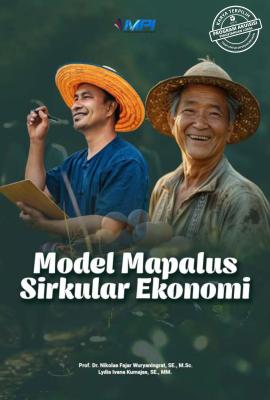
The Mapalus circular economy model is a new approach to rural economic development that combines the principles of the circular economy with the Minahasa tradition of mutual cooperation, known as Mapalus. This model aims to optimize agriculture by minimizing waste and increasing value added, through the development of derivative products that meet community needs. This book contains studies related to the circular economy, focusing on creating sustainable economic, production, and consumption cycles. This model can be built through social cohesion, solidarity, and knowledge transfer among community members. In its implementation, the Mapalus circular economy consists of several stages: collective planting and harvesting, the development of agricultural by-products, local distribution and consumption, and the reinvestment of profits to ensure the sustainability of the village economy. The success of the model heavily depends on the synergy of policy/regulatory factors, knowledge resources, access to funding, and environmental education. The implementation of this model is expected to serve as a solution for villages in Indonesia in addressing the increasingly complex challenges of food security, social change, and the economy.
Anderson Jr. (2003). Risk in rural development: challenges for managers and policy makers. Agricultural Systems Journal, 75(2), 161–197.
Apriyanto M. (2019). Pelatihan dan Pendampingan Pengolahan Komoditas Kelapa. Jurnal Pengabdian Dan Pemberdayaan Masyarakat, 3(2), 2579–9126.
Argote L. (2014). Knowledge Transfer and Organizational Learning. In The Wiley Blackwell Handbook of the Psychology of Training, Development, and Performance Improvement.
ASIF M. (2021). Lean Six Sigma institutionalization and knowledge creation: towards developing theory. Total Quality Management & Business Excellence, 32(7–8), 811–828.
Balliet D, Tybur Jm & Van Lange Pam. (2016). Functional Interdependence Theory: An
Evolutionary Account of Social Situations. Personality and Social Psychology Review, 21(4), 361–388.
Barrett, Cb., Lee Dr & Mcpeak Jg. (2005). Institutional Arrangements for Rural Poverty Reduction and Resource Conservation. World Development, 33(2), 193–197.
Bhunia, S., Bhowmik A & Mukherjee J. (2022). Waste management of rural slaughterhouses in developing countries. Advanced Organic Waste Management, 425–449.
Bidikar, Sg., Rane Sb., Potdar Pr. (2022). Product development using Design for Six Sigma approach: case study in switchgear industry. International Journal of System Assurance Engineering and Management, 13(1), 203–230.
Bonfiglio, A., Camaioni B., Coderon S., & Esposti R, Pagliacci F, Sotte F. (2017). Are rural regions prioritizing knowledge transfer and innovation? Evidence from Rural Development Policy expenditure across the EU space. Journal of Rural Studies, 53, 78–87.
Chen X. (2009). Review of China’s agricultural and rural development: policy changes and current issues. China Agricultural Economic Review, 1(2), 121–135.
Chienwattanasook, K., Trisakhon, C., Ridsomboon L. (2023). The Success of Training in Social Media Marketing and Adaptation of Community Enterprises in the Era of the COVID-19 Pandemic. International Journal of Operations and Quantitative Management, 29(1), 175–190.
Cohen Wm., Levinthal Da. (1990). Absorptive Capacity: A New Perspective on Learning and Innovation. Administrative Science Quarterly, 35(1), 128–152.

This work is licensed under a Creative Commons Attribution-ShareAlike 4.0 International License.