












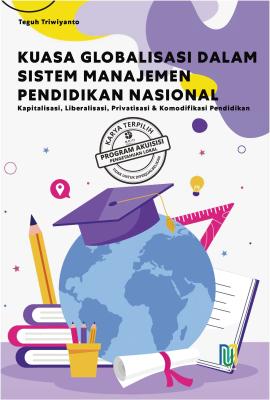
Buku ini mengurai kuasa globalisasi dalam sistem pendidikan nasional: kapitalisasi, liberalisasi, privatisasi & komodofikasi pendidikan. Pada bidang pendidikan soft power dapat melalui hard power, status quo dan peningkatan kekuatan, mengikuti tren globalisasi dan internasionalisasi di seluruh dunia. Interdependensi dan kompleksitas internasionalisasi pendidikan dalam tren globalisasi yang semakin berkembang di seluruh dunia. Melalui mode globalisasi, yang menjadi garis kebijakan GATS, sektor pendidikan terus menggurita. Imbas pandemi juga keras menghantam sektor pendidikan seluruh negara di dunia.
Kompetisi global, anak kandung kapitalisme, tidak terelakkan membawa dampak di sektor pendidikan. Salah satunya yaitu internasionalisasi pendidikan yang mengarah kepada kapitalisasi, liberalisasi, privatisasi, dan komodofikasi pendidikan. Internasionalisasi pendidikan terwujud melalui empat mode globalisasi, yaitu cross border supply, consumption abroad, commercial presence, dan movement of natural persons. Dampak mode globalisasi di sektor pendidikan yang tidak tertangani dengan baik, pada suatu negara dapat memunculkan simpang jalan sistem pendidikan nasionalnya.
Altman, S. A., & Bastian, C. R. (2022, April). The State of Globalization in 2022. Harvard Business Review Home. https://hbr-org.translate.goog/2022/04/the-state-of-globalization-in-2022?
Astomo, P. (2021). Legal Politics of Responsive National Education System in the Globalization Era and the Covid-19 Pandemic. Yuridika, 36, 401. https://doi.org/10.20473/ydk.v36i2.25897
Baglioni, E., Campling, L., Coe, N. M., & Smith, A. (2022). Labour regimes and global production. Agenda Publishing.
Beaumont, C., & Hartley, P. (2019). The cyber security knowledge exchange: working with employers to produce authentic PBL scenarios and enhance employability. In Z. Pan, A. D. Cheok, W. Müller, M. Zhang, A. El Rhalibi, & K. Kifayat (Eds.), Transactions on edutainment XV (pp. 209–228). Springer. https://doi.org/10.1007/978-3-662-59351-6_14.
Bell, M.P., Leopold, J., Berry, D.,Hall, A.V. (2018). Diversity, discrimination, and persistent inequality: Hope for the future through the solidarity economy movement. Journal of Social Issues, 74(1), 224-243. DOI: 10.1111/josi.12266.
Ben Naseir, M. A., Dogan, H., Apeh, E., Richardson, C., & Ali, R. (2019). Contextualising the national cyber security capacity in an unstable environment: A spring land case study. In Á. Rocha, H. Adeli, L. P. Reis, & S. Costanzo (Eds.), New Knowledge in Information Systems and Technologies (pp. 373–382). Springer International Publishing. https://doi.org/10.1007/978-3-030-16181-1_35.
DHL Global Connectedness Index. (2021). DHL Global Connectedness Index. DHL. https://www.dhl.com/global-en/delivered/globalization/global-connectedness-index.html
Dodgson, J. E. (2017). Tentang penelitian: Metodologi kualitatif. Journal of Human Lactation, 33(2), 355–358.
Drake-Brockman, Jane. (2011).The importance of measuring the delivery of services via commercial presence of offshore foreign affiliates: some case studies from Australian business experience. Tokyo: Asian Development Bank.
Driscoll, M. (2000). Psychology of learning for instruction. Boston: Allyn& Bacon
Ekman, Åsa Odin., & Engblom, Samuel. (2019). Expanding the movement of natural persons through free trade agreements? A review of CETA, TPP and ChAFTA. International Journal of Comparative Labour Law and Industrial Relations, 35(2), 163–200.
Elçi, A., & Seçkin, Z. (2019). Cyberbullying awareness for mitigating consequences in higher education. Journal of Interpersonal Violence, 34(5), 946–960. https://doi.org/10.1177/0886260516646095
Furuta, J. (2019). Liberal individualism and the globalization of education as a human right: the worldwide decline of early tracking, 1960–2010. Sociology of Education. https://doi.org/10.1177/0038040719873848.
Gall, M.D., Gall, S.P., Borg, W.R. (2003). Educational research; an introduction. Boston: Pearson Education, Inc.
Galvan, J. (2006). Writing literature reviews: A Guide for student of the behavioral sciences (Third Editions). Glendale CA: Pyrczak Publishing.
Garrett, Richard., Kinser, Kevin., Jason E. Lane., & Merola, Rachael. (2016). International branch campuses: Trends and developments. Redhill: Surrey.
Gerro, Tally Katz. (2017). Cross-national differences in the consumption of non-national culture in Europe. Cultural Sociology, 11(4), 438 –467.
Hou, Y.-W., & Cheng, K. S. Y. (2022). Opportunities and Challenges Under Globalization on the Higher Education Reforms in Taiwan from 2000 to the Present. In J. Zajda & W. J. Jacob (Eds.), Discourses of Globalisation and Higher Education Reforms: Emerging Paradigms (pp. 179–195). Springer International Publishing. https://doi.org/10.1007/978-3-030-83136-3_12
Hsu, Locknie. (2017). Legal barriers to supply chain connectivity in Asean. Research Collection School of Law, 34(1), 184-195.
Huang, Futao. (2007). Internationalization of higher education in the developing and emerging countries: a focus on transnational higher education in Asia. Journal of Studies in International Education, 11(1), 421-432.
Huda, M., & Teh, K. S. (2018). Empowering professional and ethical competence on reflective teaching practice in digital era. In Dikilitas, K., Mede, E., & Atay, D. (Ed.), Mentorship strategies in teacher education (pp. 136-152).
Hugo, G. (2013). Governance and institutional issues in migration in Asia, in cross-border governance in asia: regional issues and mechanisms. UN, New York, DOI: 10.18356/b269c3ab-en.
ICEF Monitor. (2017). Southeast Asia trading and mobility bloc continues to take shape. https://monitor.icef.com/2017/07/southeast-asia-trading-mobility-bloc-continues-take-shape/
Kurian, V. Mathew., & Manikandan, A.D. (2011). Impact of the India Sri Lanka free trade agreement on pepper trade in Kerala. Rajagiri Journal of Social Development, 2(2), 127-146.
Kurniawan, P. W. (2017). Sejarah berdirinya perguruan rakyat (Volksuniversiteit) 1928 di Jakarta. Historia: Jurnal Pembelajaran Sejarah dan Sejarah UM Metro, 5(1), 15–30.
Kusuma, Anggun Badu. (2021). Ki Hadjar Dewantara. Makalah dipresentasikan dalam Seminar Nasional Matematika dan Pendidikan Matematika pada tanggal 29 Agustus 2020 di Prodi Pendidikan Matematika FKIP UMP.
Laats, A. (2012). Red schoolhouse, burning cross: The Ku Klux Klan of the 1920s and educational reform. History of Education Quarterly, 52(1), 323-350.
Lahoud, H. A., & Tang, X. (2006). Information security labs in IDS/IPS for distance education. SIGITE ’06. https://doi.org/10.1145/1168812.1168826
Landon, Adam C., Tarrant, Michael A., Rubin, Donald L., & Stoner, Lee. (2017).Beyond “just do it”: fostering higher-order learning outcomes in short-term study abroad. Aera Open, 3(1), 1–7.
Lane J., Owens T., & Kinser K. (2015). Cross border higher education, international trade, and economic competitiveness: A review of policy dynamics when education crosses borders. Toronto, Geneva and Brighton: Ileap, Cuts International Geneva and Caris.
Lane, Jason E. (2011). Global expansion of international branch campuses: Managerial and leadership challenges. New Directions for Higher Education, 155(1), 5–17.
Latifah, Abidatul., Moh. Mustofa, Solehatul., & Fatimah, Nurul. (2016). Penerapan program kelas advance placement (AP) dalam menunjang visi internasional siswa di SMA semesta bilingual boarding school Semarang. Solidarity, 5(2), 94-104.
Lawal-Adebowale, O. A. (2017). Effect of mobile telecommunication technologies on globalization of Nigerian rural areas. Journal of Rural Social Sciences, 32(2), 20–36.
Lee, Molly N. N. (2007). Higher Education in Southeast Asia in the Era of Globalization. In: Forest J.J.F., Altbach P.G. (eds.) International Handbook of Higher Education. Springer International Handbooks of Education, vol 18. Springer, Dordrecht.
Lee, Molly N. N. (2016). Contemporary education policies in Southeast Asia: common philosophical underpinnings and practices. Asia Pacific Educ, 17(1), 465–478.
Muthoifin, M., & Jinan, M. (2015). Pendidikan karakter Ki Hadjar Dewantara: Studi kritis pemikiran karakter dan budi pekerti dalam tinjauan islam. Profetika: Jurnal Studi Islam, 16(2), 167-180–180.
Nagata, Y. (2007). Case Study: The Netherlands alternative education shaken by changes in its basic foundation. In Y. Nagata (Ed.), Alternative education: Global perspectives relevant to the Asia-Pacific Region (pp. 57–73). Springer Netherlands. https://doi.org/10.1007/978-1-4020-4986-6_5
Nalle, Victor Imanuel Williamson. (2011). Mengembalikan tanggung jawab negara dalam pendidikan: kritik terhadap liberalisasi pendidikan dalam UU Sidiknas dan UU BHP. Jurnal Konstitusi: Keadilan dan Demokrasi Substantif, 8(4), 555-556.
Natalia, B. (2021). Philosophical basis on education principle of tamansiswa in the beginning of its establishment. Academy of Education Journal, 12(1), 15-21.
Palmer, John D., Roberts, Amy., Cho, Young Ha., & Ching, Gregory S. (2011). The internationalization of East Asian higher education globalization’s impact. New York: Palgrave Macmillan.
Patgiri, Binoy Kumar. (2018). Educational philosophy of Mahatma Gandhi and its impact on present education system. Research Review International Journal of Multidisciplinary, 3(9): 789-791
Paul, T. (2019). When balance of power meets globalization: China, India and the small states of South Asia. Politics, 39(1), 50–63.
QS University Rankings. (2019). https://www.topuniversities.com/qs-world-university-rankings/methodology.
Quynh, Anh Le. (2016).The Impact of Globalisation on the Reform of Higher Education in Vietnam. International Journal of Business and Economic Affairs, 1(1), 29-35.
Raharjo, Sabar Budi. (2014). Contribution of eight national education standards towards learning achievement. Jurnal Pendidikan dan Kebudayaan, 20(4), 470-481.
Rajesh, M. (2015). Revolution in communication technologies: impact on distance education. Turkish Online Journal of Distance Education, 16(1), 62-88.
Saharudin, Muhammad Dhiyauddin. (2021). The Role of Academic Administration in Higher Education in Malaysia. International Journal of Management, Sciences, Innovation, and Technology, 2(2), 16-21.
Salifou, K. Coulibaly., & Cao, Erbao, T. (2018). Metuge Mekongcho, Economic globalization, entrepreneurship, and development. Technological Forecasting and Social Change, 127(1), 271-280.
Salloum, S. A., Al-Emran, M., Monem, A. A., & Shaalan, K. (2018). Using text mining techniques for extracting information from research articles. In K. Shaalan, A. E. Hassanien, & F. Tolba (Eds.), Intelligent natural language processing: trends and applications (pp. 373–397). Springer International Publishing. https://doi.org/10.1007/978-3-319-67056-0_18
Saltman, Kenneth J., & Means, Alexander J. (2019).The wiley handbook of global educational reform. USA: Wiley Blackwell.
Trilling, D., & Jonkman, J. G. F. (2018). Scaling up content analysis. Communication Methods and Measures, 12(2–3), 158–174.
Tschurenev, J. (2017). Women, early childhood education, and global reform movements: new perspectives on colonial and national education in India. Südasien-Chronik-South Asia Chronicle, 7(1), 425–448.
Tsuchiya, Kenji. (1975).The Tamansiswa movement — Its early eight years and Javanese background. Journal of Southeast Asian Studies, 6(2), 164-177.
Tsuchiya, Kenji. (2019). Demokrasi dan kepemimpinan: Kebangkitan gerakan tamansiswa. Jakarta: Balai Pustaka & Kepustakaan Populer Gramedia.
UNESCO. (2018) Accountability in education: Global education monitoring report 2017–18.Paris, UNESCO. http:// unesdoc.unesco.org/images/0025/002593/ 259338e.pdf (Accessed 24 September 2019).
UNESCO. (2019a). New methodology shows that 258 million children, adolescents and youth are out of school. UIS Fact Sheet, No. 56 | September 2019.
UNESCO. (2019b).The 2018 Global Education Meeting (GEM 2018). Brussels: Government of Belgium.
Yulia, V. Nadtochy., Elena, N. Klochko., Marina, V. Danilina., Lira, K., Gurieva, Ruslan I., Bazhenov, & Vladimir. V. Bakharev. (2016). Economic factors and conditions for the transformation of the education services market in the context of globalization. International Review of Management and Marketing, 6(1), 33-39.
Yuliantoro, Dwi Agus. (2016). Rintisan Sekolah Bertaraf Internasional (RSBI) court case and contesting visions of Indonesian national identity. Dissertation. U.S.A: Michigan State University.
Zaini Tamin, AR, et.al (2018). Politik pendidikan: konsep dan praktik kebijakan pendidikan di Indonesia. Sidoarjo: CV. Dwiputra Pustaka Jaya.
Zhang, X., & Huang, A. Z. (2018). Research on the international education path for Chinese standard going global. Educational Sciences: Theory & Practice, 18(6), 2652-2660.
Zhang, Y., Wildemuth, B.M. (2009). Qualitative Analysis of Content. In B. WIldemuth (ed.). Applications of Social Research Methods to Questions in Informaation and Library Science. Wesport CT: Libraries Unlimited.
Ziguras, Christopher. (2003).The impact of the GATS on transnational tertiary education: Comparing experiences of New Zealand, Australia, Singapore and Malaysia. The Australian Educational Researcher, 30(3), 89-109.
Zulkifli, M. (2014). Globalisasi komunikasi dalam hubungannya dengan pendidikan di Indonesia. Al-Munzir, 7(2), 139-161.

This work is licensed under a Creative Commons Attribution-ShareAlike 4.0 International License.