












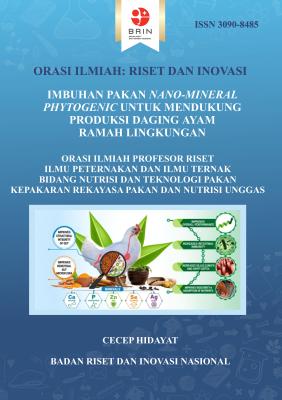
Dokumen ini merupakan orasi ilmiah Profesor Riset yang membahas inovasi Nano-Mineral Phytogenic sebagai imbuhan pakan untuk mendukung produksi daging ayam yang lebih efisien, sehat, dan ramah lingkungan. Orasi ilmiah ini menekankan bahwa sektor unggas memainkan peran strategis dalam menyediakan protein hewani nasional, tetapi masih menghadapi tantangan besar seperti biaya pakan yang tinggi, efisiensi pemanfaatan nutrien yang rendah, dan pencemaran lingkungan akibat ekskresi mineral berlebih.
Penulis menjelaskan bahwa penggunaan nano-mineral, khususnya inovasi Nano-Mineral Phytogenic berupa Nano-Zn Phytogenic (NZP), yang merupakan kombinasi Zn nano partikel dengan senyawa bioaktif tanaman, dapat meningkatkan bioavailabilitas mineral, memperbaiki konversi pakan, mendukung kesehatan usus dan sistem kekebalan tubuh, serta mengurangi ekskresi mineral ke lingkungan.
Dokumen ini menyoroti proses pengembangan, karakteristik, manfaat biologis, efisiensi ekonomi, dan implikasi lingkungan dari NZP, sekaligus memetakan potensi, peluang, tantangan, dan strategi pengembangannya dalam industri unggas nasional. Secara keseluruhan, orasi ilmiah ini menekankan bahwa nano-mineral phytogenic merupakan inovasi strategis untuk mendorong transformasi industri unggas menuju sistem produksi yang berkelanjutan, kompetitif, dan mendukung ketahanan pangan nasional
Abd EL Haliem, H. S., Attia, F., Hermes, I., Mohamed, H. S., & Farroh, K. Y. (2025). Efficacy of Dietary Zinc Oxide Nanoparticles Supplementation on Serum Biochemical, Nutrients Retention and Chemical Composition of Meat and Tibia in Broiler Chickens. Egyptian Poultry Science Journal, 0(0), 0–0. https://doi.org/10.21608/epsj.2025.20953.1066
Adli, D. N., Hidayat, C., Kurniawan, R., Rantan, R., Endang, K., Darmawan, A., Bakrie, B., Arta, S., Simon, A., & Ginting, P. (2026). Do zinc nanoparticles exert dose-dependent effects in broiler chickens? a meta-analysis of performance , immunity , and antioxidant response. Tropical Animal Health and Production, 58, 35. https://doi.org/10.1007/s11250-025-04799-5.
Ahmad, I., Mashwani, Z. U. R., Raja, N. I., Kazmi, A., Wahab, A., Ali, A., Younas, Z., Yaqoob, S., & Rahimi, M. (2022). Comprehensive Approaches of Nanoparticles for Growth Performance and Health Benefits in Poultry: An Update on the Current Scenario. BioMed Research International, 2022. https://doi.org/10.1155/2022/9539908
Bhagwat, V. G., Balamurugan, E., & Rangesh, P. (2021). Cocktail of chelated minerals and phytogenic feed additives in the poultry industry: A review. Veterinary World, 14(2), 364–371. https://doi.org/10.14202/vetworld.2021.364-371
Bien, D., Michalczuk, M., Lysek-Gladysinska, M., Jozwik, A., Wieczorek, A., Matuszewski, A., Kinsner, M., & Konieczka, P. (2023). Nano-Sized Selenium Maintains Performance and Improves Health Status and Antioxidant Potential While Not Compromising Ultrastructure of Breast Muscle and Liver in Chickens. Antioxidants, 12(4). https://doi.org/10.3390/antiox12040905
Budiarsana, I. G. M., & Hidayat, C. (2012). Model kemitraan dan dukungan teknologi pada agribisnis peternakan ayam lokal. Workshop Nasional Unggas Lokal, 61–67.
Cahyaningsih, R., Magos Brehm, J., & Maxted, N. (2021). Setting the priority medicinal plants for conservation in Indonesia. In Genetic Resources and Crop Evolution (Vol. 68, Issue 5). https://doi.org/10.1007/s10722-021-01115-6
Cai, S. J., Wu, C. X., Gong, L. M., Song, T., Wu, H., & Zhang, L. Y. (2012). Effects of nano-selenium on performance, meat quality, immune function, oxidation resistance, and tissue selenium content in broilers. Poultry Science, 91(10), 2532–2539. https://doi.org/10.3382/ps.2012-02160
Candan, T., & Bagdatli, A. (2017). Use of Natural Antioxidants in Poultry Meat. J. of Sci, 13(2), 279–291. https://doi.org/10.18466/cbayarfbe.319752
Clark, H. (2017). The Estimation and Mitigation of Agricultural Greenhouse Gas Emissions from Livestock. December 2015, 5–13. https://doi.org/10.14334/proc.intsem.lpvt-2016-p.5-13
Crosara, F. S. G., Santos, S. K. A., Silva, L. S. S., Carvalho, G. L., Litz, F. H., & Fernandes, E. A. (2021). Organic copper, iron, manganese and zinc: Digestibility, production parameters and egg quality of layers. Arquivo Brasileiro de Medicina Veterinaria e Zootecnia, 73(3), 733–741. https://doi.org/10.1590/1678-4162-12195
Ditjen PKH. (2025). Buku Statistik Peternakan dan Kesehatan Hewan 2025. Direktorat Jenderal Peternakan dan Kesehatan Hewan. Kementerian Pertanian. (Vol. 1).
El-Abd, N. M., Hamouda, R. A., Al-Shaikh, T. M., & Abdel-Hamid, M. S. (2022). Influence of biosynthesized silver nanoparticles using red alga Corallina elongata on broiler chicks’ performance. Green Processing and Synthesis, 11(1), 238–253. https://doi.org/10.1515/gps-2022-0025
El-Gogary, M. (2020). Ecofriendly Synthesis of Calcium Nanoparticles With Biocompatible Rosmarinus Officinalis Extract on Physiological and Immunological Effects in Broiler Chickens. Egyptian Poultry Science Journal, 40(1), 81–102. https://doi.org/10.21608/epsj.2020.78748
El-Gogary, M., & El-Said, E. (2019). Effect of in-Ovo Injection With Iron–Methionine Chelates or Iron Nano-Particles and Post Hatch Dietary Folic Acid on Growth Performance and Physiological Responses of Broiler Chickens. Egyptian Poultry Science Journal, 39(4), 753–770. https://doi.org/10.21608/epsj.2019.63487
El Boushy, A. R. (1979). Available phosphorus in poultry. 2. Effect of phosphorus in diet on performance of chicks, bone composition and strength, and calcium and inorganic phosphorus in blood plasma. Netherlands Journal of Agricultural Science, 27(2), 184–189. https://doi.org/10.18174/njas.v27i2.17065
El Sabry, M. I., McMillin, K. W., & Sabliov, C. M. (2018). Nanotechnology Considerations for Poultry and Livestock Production Systems - A Review. Annals of Animal Science, 18(2), 319–334. https://doi.org/10.1515/aoas-2017-0047
Elwinger, K., Fisher, C., Jeroch, H., Sauveur, B., Tiller, H., & Whitehead, C. C. (2016). A brief history of poultry nutrition over the last hundred years. World’s Poultry Science Journal, 72(4), 701–720. https://doi.org/10.1017/S004393391600074X
Engida, D. T., Ayele, M., Waktole, H., Tamir, B., Regassa, F., & Tufa, T. B. (2023). Effects of Phytogenic Feed Additives on Body Weight Gain and Gut Bacterial Load in Broiler Chickens. World’s Veterinary Journal, 13(1), 205–213. https://doi.org/10.54203/SCIL.2023.WVJ22
Fagier, M. A. (2021). Plant-Mediated Biosynthesis and Photocatalysis Activities of Zinc Oxide Nanoparticles: A Prospect towards Dyes Mineralization. Journal of Nanotechnology, 2021. https://doi.org/10.1155/2021/6629180
Hamdi, M., Solà-Oriol, D., Franco-Rosselló, R., Aligué-Alemany, R., & Pérez, J. F. (2017). Comparison of how different feed phosphates affect performance, bone mineralization and phosphorus retention in broilers. Spanish Journal of Agricultural Research, 15(3), 1–10. https://doi.org/10.5424/sjar/2017153-11149
Hassan, S., Hassan, F. ul, & Rehman, M. S. ur. (2020). Nano-particles of Trace Minerals in Poultry Nutrition: Potential Applications and Future Prospects. Biological Trace Element Research, 195(2), 591–612. https://doi.org/10.1007/s12011-019-01862-9
Hidayat, C. (2012). Pengembangan produksi ayam lokal berbasis bahan pakan lokal. Wartazoa, 22(2), 85–98.
Hidayat, C. (2015). Kontribusi Ayam Lokal Sebagai Penghasil Daging Dan Telur Nasional. In Darodjah S, Setiawan I, Hidayat R, Susilawati I, Sulistyati M, & Astuti Y (Eds.), Prosiding Seminar Nasional Peternakan Berkelanjutan 7. Fakultas Peternakan, Universitas Padjadjaran. Jatinangor 11 november 2015. (Vol. 7, pp. 744–752). Fakultas Peternakan Universitas Padjadajran.
Hidayat, C. (2016). Pemanfaatan Fitase sebagai Upaya Penanggulangan Asam Fitat dalam Ransum Ayam Pedaging. Wartazoa, 26(2), 057–068. https://doi.org/10.14334/wartazoa.v26i2.1178
Hidayat, C. (2022). Efektivitas Penggunaan Nanomineral pada Pakan terhadap Peningkatan Performa Ayam: Review. Jurnal Peternakan Indonesia (Indonesian Journal of Animal Science), 24(3), 237. https://doi.org/10.25077/jpi.24.3.237-251.2022
Hidayat, C., Irawan, A., Jayanegara, A., Sholikin, M. M., Prihambodo, T. R., Yanza, Y. R., Wina, E., Sadarman, S., Krisnan, R., & Isbandi, I. (2021). Effect of dietary tannins on the performance, lymphoid organ weight, and amino acid ileal digestibility of broiler chickens: A meta-analysis. Veterinary World, 14(6), 1405–1411. https://doi.org/10.14202/vetworld.2021.1405-1411
Hidayat, C., & Iskandar, S. (2018). Weight estimation of empty carcass and carcass cuts weight of female SenSi-1 Agrinak chicken. Jurnal Ilmu Ternak Dan Veteriner, 22(1), 24. https://doi.org/10.14334/jitv.v22i1.1626
Hidayat, C., & Iskandar, S. (2019). The influence of dietary protein and energy levels on the performance, meat bone ratio and meat chemical composition of SenSi-1 Agrinak chicken. Jurnal Ilmu Ternak Dan Veteriner, 24(1). https://doi.org/10.14334/jitv.v24i1.1913
Hidayat, C., Purwanti, S., Komarudin, & Rahman. (2021). Reducing air pollution from broiler farms. IOP Conference Series: Earth and Environmental Science, 788(1). https://doi.org/10.1088/1755-1315/788/1/012150
Hidayat, C., & Rahman, R. (2019). Review: Peluang Pengembangan Imbuhan Pakan Fitogenik Sebagai Pengganti Antibiotika dalam Ransum Ayam Pedaging di Indonesia. Jurnal Ilmu Dan Teknologi Peternakan Tropis, 6(2), 188. https://doi.org/10.33772/jitro.v6i2.7139
Hidayat, C., Sadarman, S., Adli, D. N., Rusli, R. K., Bakrie, B., Ginting, S. P., Asmarasari, S. A., Brahmantiyo, B., Darmawan, A., Zainal, H., Fanindi, A., Rusdiana, S., Herdiawan, I., Sutedi, E., Yanza, Y. R., & Jayanegara, A. (2024). Comparative effects of dietary zinc nanoparticle and conventional zinc supplementation on broiler chickens: A meta-analysis. Veterinary World, 17(8), 1733–1747. https://doi.org/10.14202/vetworld.2024.1733-1747
Hidayat, C., Sumiati, & Iskandar, S. (2015). Growth responses of native chicken Sentul G-3 on diet containing high rice-bran supplemented with phytase enzyme and ZnO. Jurnal Ilmu Ternak Dan Veteriner, 19(3), 193–202. https://doi.org/10.14334/jitv.v19i3.1082
Hidayat, C., Sumiati, Jayanegara, A., & Wina, E. (2020). Effect of zinc on the immune response and production performance of broilers: A meta-analysis. Asian-Australasian Journal of Animal Sciences, 33(3), 465–479. https://doi.org/10.5713/ajas.19.0146
Hidayat, C., Sumiati, S., Jayanegara, A., & Wina, E. (2021). Supplementation of Dietary Nano Zn-Phytogenic on Performance, Antioxidant Activity, and Population of Intestinal Pathogenic Bacteria in Broiler Chickens. Tropical Animal Science Journal, 44(1), 90–99. https://doi.org/10.5398/tasj.2021.44.1.90
Hidayat, C., Sumiati, Wina, E., & Jayanegara, A. (2018). Pembuatan Nanopartikel Zink Menggunakan Ekstrak Tanaman untuk Imbuhan Pakan Ayam Pedaging. Wartazoa, 28(3), 107–118. https://doi.org/10.14334/wartazoa.v28i3.1833
Hidayat, C., Sumiati, Wina, E., & Jayanegara, A. (2021). The effect of nano Zn fitogenik addition on broiler diet to carcass traits, relative organ weights and haematological response. IOP Conference Series: Earth and Environmental Science, 788(1). https://doi.org/10.1088/1755-1315/788/1/012036
Hidayat, C., Widiawati, Y., Tiesnamurti, B., Pramono, A., Krisnan, R., & Shiddieqy, M. (2021). Comparison of methane production from cattle, buffalo, goat, rabbit, chicken, and duck manure. IOP Conference Series: Earth and Environmental Science, 648(1). https://doi.org/10.1088/1755-1315/648/1/012112
Hidayat, C., Wina, E., Ishak, A. B. L., Krisnan, R., Komarudin, Asmarasari, S. A., Zainal, H., Cahyaningsih, T. W., & Hoesen, Y. A. (2023). Supplementation of dietary nano zinc phytogenic on growth performance and carcass traits of the growing Kampung Unggul Balitbangtan chickens. South African Journal of Animal Science, 53(3), 338–347. https://doi.org/10.4314/sajas.v53i3.02
Hidayat, C., Wina, E., & Sopiyana, S. (2021). Manfaat Senyawa Bioaktif Dedak Padi untuk Pakan Fungsional Ternak Ayam. Wartazoa, 31(2), 75–84. https://doi.org/10.14334/wartazoa.v31i2.2676
Hidayat, C., Wina, E., Sumiati., Jayanegara, A., & Ishak, A. (2023). Sertifikat Paten. Formula Nano Zink Fitogenik dan Proses Pembuatannya Untuk Imbuhan Pakan Ternak. Nomor Paten IDP000085259. Kementerian Hukum dan Hak Asasi Manusia Republik Indonesia.
Hidayat C. (2016). Produksi ayam lokal di indonesia. In Sugiharto, Surono, Sutaryo, & Karyanto (Eds.), Prosiding Seminar Nasional Kebangkitan Peternakan II “Membangun Kewirausahaan Dalam Pengelolaan Kawasan Peternakan Berbasis Sumberdaya Lokal” (pp. 22–36). Indonesian Society of Animal Agriculture (ISAA).
Hidayat C, & Nurhayati IS. (2019). Unggas dan emisi gas rumah kaca di Indonesia (Tier 2 IPCC). In Aldrian E, Puspowardoyo S, & Haryanto B (Eds.), Emisi gas rumah kaca dari peternakan di Indonesia dengan Tier 2 IPCC (pp. 1–142). LIPI Press.
Hidayat C, Sumiati, Wina E, & Jayanegara A. (2020a). Pengaruh Penambahan Nano Zn Fitogenik dalam Ransum AyamPedaging terhadap Histomorfometri Usus. Prosiding Seminar Nasional Teknologi Peternakan Dan Veteriner Virtual, 554–563.
Hidayat C, Sumiati, Wina E, & Jayanegara A. (2020b). Pengaruh Penambahan Nano Zn Fitogenik dalam Ransum Ayam Pedaging terhadap Histomorfometri Usus. Prosiding Seminar Nasional Teknologi Peternakan Dan Veteriner Virtual , 554–563. https://doi.org/10.14334/Pros.Semnas.TPV-2020-p.554-563
Hidayat C, Sumiati, Wina E, & Jayanegara A. (2021a). Characteristics of Nano Zn-Fitogenik (NZF) made by greensynthesis process using guava leaves (Psidium guajava) forfeed additives. IOP Conference Series: Earth and Environmental Science, 888(1), 1–12. https://doi.org/10.1088/1755-1315/888/1/011001
Hidayat C, Sumiati, Wina E, & Jayanegara A. (2021b). The effect of nano Zn fitogenik addition on broiler diet tocarcass traits, relative organ weights and haematologicalresponse. IOP Conference Series: Earth and Environmental Science, 788(1), 1–11. https://doi.org/10.1088/1755-1315/788/1/011001
Hu, P., Li, K., Peng, X., Yao, T., Zhu, C., Ennab, W., Luo, X., & Cai, D. (2024). Zinc intake ameliorates intestinal morphology and oxidative stress of broiler chickens under heat stress. January, 1–10. https://doi.org/10.3389/fimmu.2023.1308907
Irawan, A., Hidayat, C., Jayanegara, A., & Ratriyanto, A. (2021). Essential oils as growth-promoting additives on performance, nutrient digestibility, cecal microbes, and serum metabolites of broiler chickens: A meta-analysis. Animal Bioscience, 34(9), 1499–1513. https://doi.org/10.5713/AB.20.0668
Iskandar, S., Hidayat, C., & Cahyaningsih, T. (2015). The effect of feeding pre-starter on performance efficiency of local chicken (KUB chicken). Jurnal Ilmu Ternak Dan Veteriner, 19(3). https://doi.org/10.14334/jitv.v19i3.1083
Islam, M. T. (2019). Applications of nanomaterials for future food security: challenges and prospects. Malaysian Journal of Halal Research, 2(1), 6–9. https://doi.org/10.2478/mjhr-2019-0002
Kadja, G. T., & Ilmi, M. M. (2019). Indonesia Natural Mineral for Heavy Metal Adsorption: a Review. Journal of Environmental Science and Sustainable Development, 2(2), 139–164. https://doi.org/10.7454/jessd.v2i2.1033
Karuvantevida, N., Razia, M., Bhuvaneshwar, R., Sathishkumar, G., Prabukumar, S., & Sivaramakrishnan, S. (2022). Bioactive Flavonoid used as a Stabilizing Agent of Mono and Bimetallic Nanomaterials for Multifunctional Activities. Journal of Pure and Applied Microbiology, 16(3), 1652–1662. https://doi.org/10.22207/JPAM.16.3.03
Kaur, H., Srivastava, S., Goyal, N., & Walia, S. (2024). Behavior of zinc in soils and recent advances on strategies for ameliorating zinc phyto-toxicity. Environmental and Experimental Botany, 220(December 2023), 105676. https://doi.org/10.1016/j.envexpbot.2024.105676
Konkol, D., & Wojnarowski, K. (2018). The use of nanominerals in animal nutrition as a way to improve the composition and quality of animal products. Journal of Chemistry, 2018. https://doi.org/10.1155/2018/5927058
Kuziemska, B., Klej, P., Wysokinski, A., Jaremko, D., & Pakula, K. (2022). Yielding and Bioaccumulation of Zinc by Cocksfoot under Conditions of Different Doses of This Metal and Organic Fertilization
Latif, Abbas S, Kormin F, & Mustafa MK. (2019). Green Synthesis of Plant-Mediated Metal Nanoparticles: the Role of Polyphenols. Asian Journal of Pharmaceutical and Clinical Research, 12(7), 75–84. https://doi.org/10.22159/ajpcr.2019.v12i7.33211
Lee, J. H., Hosseindoust, A., Kim, M. J., Kim, K. Y., Kim, T. G., Moturi, J., & Chae, B. J. (2021). Effects of hot-melt extruded nano-copper on the Cu bioavailability and growth of broiler chickens. Journal of Animal Science and Technology, 63(2), 295–304. https://doi.org/10.5187/JAST.2021.E24
Lestari, D., Harini, N. V. A., & Lase, J. A. (2021). Strategies anda Prospects Development Agribusiness of Local Chicken Indonesia. Jurnal Perternakan, 5(1), 32–39.
Lu, L., Liao, X. dong, & Luo, X. gang. (2017). Nutritional strategies for reducing nitrogen, phosphorus and trace mineral excretions of livestock and poultry. Journal of Integrative Agriculture, 16(12), 2815–2833. https://doi.org/10.1016/S2095-3119(17)61701-5
Maghsoudi, A., & Saeidi, S. (2018). Evaluation of the Effect of Zinc Nano Oxide on Salmonella typhimurium Poultry Isolates. 1(1), 14–17.
Mallin, M. A., & Cahoon, L. B. (2003). Industrialized animal production - A major source of nutrient and microbial pollution to aquatic ecosystems. Population and Environment, 24(5), 369–385. https://doi.org/10.1023/A:1023690824045
Mekonnen, G., Negash, A., Gashu, M., & Belachew, N. (2023). Echinops kebericho Aqueous Root Extract Assisted Green Synthesis of Zinc Oxide Nanoparticles for Photocatalytic Degradation of Methylene Blue. Letters in Applied NanoBioScience, 12(3), 1–17. https://doi.org/10.33263/LIANBS123.072
Mohamed, M. A., & Hassan, H. M. A. (2023). Phytogenic Substances as Safe Growth Promoters in Poultry Nutrition. International Journal of Veterinary Science, 12(1), 89–100. https://doi.org/10.47278/journal.ijvs/2022.134
Mohd Yusof, H., Abdul Rahman, N., Mohamad, R., Zaidan, U. H., & Samsudin, A. A. (2023). Influence of Dietary Biosynthesized Zinc Oxide Nanoparticles on Broiler Zinc Uptake, Bone Quality, and Antioxidative Status. Animals, 13(1), 1–18. https://doi.org/10.3390/ani13010115
Moss, A. F., Chrystal, P. V., Cadogan, D. J., Wilkinson, S. J., Crowley, T. M., & Choct, M. (2021). Precision feeding and precision nutrition: A paradigm shift in broiler feed formulation? Animal Bioscience, 34(3), 354–362. https://doi.org/10.5713/ab.21.0034
Naiel, B., Fawzy, M., Halmy, M. W. A., & Mahmoud, A. E. D. (2022). Green synthesis of zinc oxide nanoparticles using Sea Lavender (Limonium pruinosum L. Chaz.) extract: characterization, evaluation of anti-skin cancer, antimicrobial and antioxidant potentials. Scientific Reports, 12(1), 1–12. https://doi.org/10.1038/s41598-022-24805-2
Niveditha, M., Shelar, V. R., & B.M., B. (2024). Green Synthesis: An Alternative Sustainable Route for Nanotechology. Journal of Advances in Biology & Biotechnology, 27(7), 1054–1069. https://doi.org/10.9734/jabb/2024/v27i71065
Noaman, H. A., & Mohammed, D. J. (2025). Organic Vs. Inorganic Mineral Supplements in Poultry: Availability and Physiological Effects: Subject Review. American Journal of Biology and Natural Sciences, 2(7), 165–175. https://doi.org/10.51699/ajbns.v2i7.1238
Nollet, L., Van Der Klis, J. D., Lensing, M., & Spring, P. (2007). The effect of replacing inorganic with organic trace minerals in broiler diets on productive performance and mineral excretion. Journal of Applied Poultry Research, 16(4), 592–597. https://doi.org/10.3382/japr.2006-00115
Núñez, R., Elliott, S., & Riboty, R. (2023). The effect of dietary supplementation of organic trace minerals on performance, mineral retention, lymphoid organs and antibody titres of broilers. Journal of Applied Animal Nutrition , 11(1), 23–32. https://doi.org/10.3920/JAAN2022.0002
Patric Joshua, P., Valli, C., & Balakrishnan, V. (2016). Effect of in ovo supplementation of nano forms of zinc, copper, and selenium on post-hatch performance of broiler chicken. Veterinary World, 9(3), 287–294. https://doi.org/10.14202/vetworld.2016.287-294
Qu, J., Zuo, X., Xu, Q., Li, M., Zou, L., Tao, R., Liu, X., Wang, X., Wang, J., Wen, L., & Li, R. (2023). Effect of Two Particle Sizes of Nano Zinc Oxide on Growth Performance, Immune Function, Digestive Tract Morphology, and Intestinal Microbiota Composition in Broilers. Animals, 13(9). https://doi.org/10.3390/ani13091454
Rusli, R. K., Amizar, R., Suci, D. M., Tanjung, J. T., Nadia, R., Hidayat, C., Zurmiati, Z., Darmawan, A., Reski, S., Hilmi, M., Mahata, M. E., Gunawan, A., Yuniza, A., & Mutia, R. (2026). Green-synthesized ZnO nanoparticles utilizing Garcinia mangostana leaves enhance performance , carcass traits , meat quality , antioxidant status , and insuline-like growth factor-1 gene expression in broiler chickens. Tropical Animal Health and Production, 58, 248.
Rusli, R. K., Darmawan, A., Hidayat, C., & Krisnan, R. (2025). Evaluation Of The Phytochemical Composition And Antimicrobial Properties of Centella Asiatica Leaf Meal Extract As A Feed Additive Candidate For Poultry. Archives of Razi Institute, 80(2), 617–624. https://doi.org/10.32592/ARI.2025.80.2.617
Rusli, R. K., Hilmi, M., Mahata, M. E., Yuniza, A., Zurmiati, Z., Reski, S., Mutia, R., & Hidayat, C. (2024). Green synthesis of zinc oxide nanoparticles utilizing extract from Garcinia mangostana leaves: Characterization and optimization of calcination temperature. Journal of Advanced Veterinary and Animal Research, 11(3), 573–582. https://doi.org/10.5455/javar.2024.k807
Rusli, R. K., Mahata, M. E., Yuniza, A., Zurmiati, Z., Reski, S., Hidayat, C., Hilmi, M., & Mutia, R. (2024a). Optimization of solvent and extraction time on secondary metabolite content of mangosteen leaf (Garcinia mangostana L.) as a feed additive candidate on poultry. Journal of Advanced Veterinary and Animal Research, 11(1), 139–145. https://doi.org/10.5455/JAVAR.2024.K758
Rusli, R. K., Mahata, M. E., Yuniza, A., Zurmiati, Z., Reski, S., Hidayat, C., Hilmi, M., & Mutia, R. (2024b). Optimization of solvent and extraction time on secondary metabolite content of mangosteen leaf (Garcinia mangostana L.) as a feed additive candidate on poultry. Journal of Advanced Veterinary and Animal Research, 11(1), 139–145. https://doi.org/10.24425/jwld.2024.151801
Rusli, R. K., Sadarman, S., Hidayat, C., Sholikin, M. M., Hilmi, M., Yuniza, A., Mutia, R., Jayanegara, A., & Irawan, A. (2022). A meta-analysis to evaluate the effects of garlic supplementation on performance and blood lipids profile of broiler chickens. Livestock Science, 263. https://doi.org/10.1016/j.livsci.2022.105022
Rusli, R. K., Santi, M. A., Hilmi, M., Hidayat, C., Darmawan, A., Mutia, R., Jayanegara, A., & Irawan, A. (2025). Essential oils alleviate coccidiosis impact in broiler chickens: a meta-analysis. Animal Bioscience, 38(12), 2726–2740.
Rusli, R. K., Zurmiati, Z., Mutia, R., Reski, S., Darmawan, A., Hidayat, C., Mahata, M. E., Hilmi, M., & Yuniza, A. (2025). Green-synthesized zinc oxide nanoparticles from Garcinia mangostana leaf extract: A promising antibacterial agent for poultry. Veterinary World, 18(2), 263–269. https://doi.org/10.14202/vetworld.2025.263-269
Saadh, M. J. (2021). Synthesis, characterization, and applications of gold nanoparticles. Pharmacologyonline, 3(03), 1870–1874. https://doi.org/10.47583/ijpsrr.2022.v77i01.003
Sadarman, Irawan A, Hidayat C, Elfawati, Sholikin MM, Harahap RP, Rusli RK, Solfaine R, Sofyan A, Nahrowi, Jayanegara A, Irawan, A., Hidayat, C., Elfawati, Sholikin, M. M., Harahap, R. P., Rusli, R. K., Solfaine, R., Sofyan, A., … Jayanegara, A. (2021). Propolis supplementation on broiler chicken performances, nutrient digestibility, and carcass characteristics: A Meta-Analysis. Tropical Animal Science Journal, 44(4), 425–433. https://doi.org/10.5398/tasj.2021.44.4.425
Sandoval, M., Henry, P. R., Ammerman, C. B., Miles, R. D., & Littell, R. C. (1997). Relative Bioavailability of Supplemental Inorganic Zinc Sources for Chicks. Journal of Animal Science, 75, 3195–3205.
Schaible, P. J. (1941). The Minerals in Poultry Nutrition—A Review. Poultry Science, 20(3), 278–288. https://doi.org/10.3382/ps.0200278
Shelton, J. L., & Southern, L. L. (2007). Interactive effects of zinc, copper and manganese in diets for broiler. International Journal of Poultry Science, 6(7), 466–469.
Surai, P. F. (2002). Selenium in poultry nutrition 2. Reproduction, egg and meat quality and practical applications. World’s Poultry Science Journal, 58(4), 431–450. https://doi.org/10.1079/WPS20020032
Taylor, P., Mohanna, C., & Nys, Y. (2010). Effect of dietary zinc content and sources on the growth , body zinc deposition and retention , zinc excretion and immune response in chickens Effect of dietary zinc content and sources on the growth , body zinc deposition and retention , zinc excretion a. November 2014, 37–41. https://doi.org/10.1080/00071669987926
Thyagarajan, D., Barathi, M., Sakthivadivu, R., & Sakthivadivu, & R. (2014). Risk Mitigation of Poultry Industry Pollutants and Waste for Environmental Safety. Type: Double Blind Peer Reviewed International Research Journal Publisher: Global Journals Inc, 14(1).
Ul Hassan, A., Din, A. M. U., & Ali, S. (2017). Chemical characterisation of himalayan rock salt. Pakistan Journal of Scientific and Industrial Research Series A: Physical Sciences, 60(2), 67–71. https://doi.org/10.52763/pjsir.phys.sci.60.2.2017.67.71
Wedekind, K. J., & Baker, D. (1990). Zinc Bioavailability In Feed-Grade SourcesOf Zinc. Journal Animal Science, 68(July), 684–689.
Zacharias, B., Pelletier, W., & Drochner, W. (2007). Availability of inorganic and organic bound copper and zinc fed at physiological levels to fattening pigs. 2, 45–50.

This work is licensed under a Creative Commons Attribution-ShareAlike 4.0 International License.