












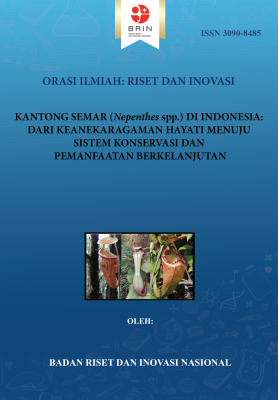
Dalam klasifikasi tumbuhan, Nepenthes digolongkan sebagai tumbuhan karnivora, Indonesia merupakan pusat persebaran di dunia dan sampai saat ini memiliki 83 jenis atau 39,3% dari jumlah total yang ada di dunia, tersebar di Pulau Sumatra 39 jenis, Kalimantan 24 jenis, Sulawesi 14 jenis, Papua 13 jenis, Maluku 5 jenis, dan Jawa 3 jenis, sebagian besar status keberadaaanya dilindungi oleh undang-undang. Keanekaragaman jenis Nepenthes di Indonesia menghadapi tekanan serius akibat hilangnya habitat, degradasi ekosistem, dan perdagangan ilegal. Oleh karena itu, upaya konservasi Nepenthes perlu dilakukan secara terintegrasi melalui pendekatan in-situ, ex-situ, penguatan kebijakan, serta keterlibatan multipihak. Menurut IUCN, di Indonesia saat ini ada enam jenis Nepenthes yang masuk kedalam kategori kritis dan masuk kedalam skala prioritas untuk segera dikonservasi, yaitu; N. aristolochioides, N. clipeata, N. dubia, N. lavicola, N. rigidifolia, dan N. sumatrana
1. Batoro, J., & A. Wartono. (2017). Review status the Nepenthes (Nepenthaceae) from Java Indonesia. Indian Journal of Plant Science. 6(1): 12-16.
2. Bauer, U., H.F. Bohn & W. Federle. (2007). Biomechanics and ecology of prey capture in Nepenthes pitcher plants. Proceedings of the 2007 Sarawak Nepenthes Summit. 18-21 August 2007, Kuching, Sarawak Forestry Corporation. 48-58.
3. Bianchi, A., C.C. Lee, M. Golos, F. Mey, M. Mansur, Y.M. Mambrasar & A.S. Robinson. (2020). Nepenthes diabolica (Nepenthaceae), a new species of toothed pitcher plant from Central Sulawesi. Phytotaxa. 464 (1): 029-048. https://doi.org/10.11646/phytotaxa.464.1.
4. Bonhomme, V., H. erve´ Pelloux-Prayer, E. Jousselin, Y. Forterre, J.J. Labat & L. Gaume. (2011). Slippery or sticky? Functional diversity in the trapping strategy of Nepenthes carnivorous plants. New Phytologist. March 2011. DOI: 10.1111/j.1469-8137.2011.03696.x. https://www.researchgate.net/publication/50849399
5. Brearley, F.Q & M. Mansur. (2012). Nutrient stoichiometry of Nepenthes species from A Bornean peat swamp forest. Carnivorous Plant Newsletter. 41(3): 105-108.
6. Brearley, F.Q. (2021). Nutrient and metal concentrations in Nepenthes macfarlanei Hemsl. (Nepenthaceae) from a Malaysian montane forest. Notulae Scientia Biologicae, Volume 13, Issue 2, Article number 10976. DOI:10.15835/nsb13210976.
7. Cheek, M., M. Jebb & M. Mansur. (2017). Nepenthes dubia. Curtis’s Botanical Magazine, 34(2): 111-122.
8. Clarke, C. (1997). Nepenthes of Borneo, Book. Natural History Publications, Kota Kinabalu, Sabah. 207 p.
9. Clarke, C. (2001). Nepenthes of Sumatra and Peninsular Malaysia, Book. Natural History Publications, Kota Kinabalu, Sabah. 326 p.
10. Clarke, C. & C. Lee. (2004). Pitcher plants of Sarawak. Book. Natural History Publications (Borneo). 80 p.
11. Cross, A.T., A.T. Krueger, P.M. Gonella, A.S. Robinson, A.S. Fleischmann. (2020). Conservation of carnivorous plants in the age of extinction. Global Ecology and Conservation.24(2020)e01272. http://www.elsevier.com/locate/gecco.
12. Damayanti, F., M. Mansur & I. Rostika. (2011). Diversity of Nepenthes spp. In West Kalimantan. Biodiversity and Conservation. 3(13):705-708.
13. Ellison, A.M. (2008). Nutrient Limitation and Stoichiometry of Carnivorous Plants. Plants Biology. 8(6): 740-747. https://doi.org/10.1055/s-2006-923956.
14. Gilbert, K., L.S. Bittleston, W. Tong & N.E. Pierce. (2020). Tropical pitcher plants (Nepenthes) act as ecological filter by altering properties of their fluid microenvironments. Nature. https://doi.org/10.1038/s41598-020-61193-x
15. Hasanah, U., Y.M. Hijriyah, E. Nuraeni & D.W. Putri (2025) “The Illegal Online Trade of Indonesian Protected Pitcher Plants”, published in Forest and Society, Vol. 9(1), pp.133-45.
https://scholarhub.unhas.ac.id/cgi/viewcontent.cgi?article=1215&context=fs (Di akses 2 November 2025).
16. Hernawati, P. Akriadi & R. Tamin. (2007). Assesment of the habitat condition and conservation status of Nepenthes in Sumatra. Proceedings of The 2007 Sarawak Nepenthes Summit. 18-21 August 2007, Kuching, Sarawak Forestry Coorporation, Malaysia. 116-121.
17. Hernawati & P. Akriadi. (2006). A field guide to the Nepenthes of Sumatra. Buku. Nepenthes Team and PILI-NGO Movement. 94 p.
18. Hidayati, N., M. Reza, T. Juhaeti & M. Mansur. (2011). Serapan karbondioksida (CO2) jenis-jenis pohon di Taman Buah ’Mekar Sari” Bogor, Kaitannya dengan potensi mitigasi gas rumah kaca. Jurnal Biologi Indonesia. 7(1): 133-145.
19. Hidayati, N., M. Mansur & T. Juhaeti. (2013). Variasi serapan karbondioksida (CO2) jenis-jenis pohon di ”Ecopark”, Cibinong dan kaitannya dengan potensi dengan potensi mitigasi gas rumah kaca. Buletin Kebun Raya. 16(1): 37-49.
20. Jebb, M.H.P. & M. Cheek. (1997). A skeleton revision of Nepenthes (Nepenthaceae). Blumea. 42(1): 1-106.
21. Kurata, K & S. Kurata. (2007). Variation of pitcher morphology within Nepenthes vieillardii in New Caledonia. Proceedings of the 2007 Sarawak Nepenthes Summit, 18-21 August 2007, Kuching, Sarawak Forestry Coorporation, Malaysia. 59-71.
22. Krisdianto. (2025). Hutan Dan Deforestasi Indonesia Tahun 2024. Siaran Pers Nomor: SP.031/HKLN/PPIP/HMS.3/03/2025. https://www.kehutanan.go.id/news/article-10 (Diakses tanggal 15 Desember 2025).
23. Lee, C., S.R Mcpherson, G. Bourke & M. Mansur. (2009). Nepenthes pitopangii (Nepenthaceae), A new species from Central Sulawesi, Indonesia. Gardens’ Bulletin Singapore. 61(1): 95-99.
24. Lee, C., A. Wistuba, J. Nerz, U. Zimmermann, A.P. Paserang, R. Pitopang. (2011). Nepenthes undulatifolia, A new pitcher plant from South East Sulawesi. New Nepenthes Volume One. Redfern Natural History Produstions. 491-523.
25. Mansur, M. (2001). Koleksi Nepenthes di Herbarium Bogoriense: prospeknya sebagai tanaman hias. Prosiding. Seminar “Menggali potensi dan meningkatkan prospek tanaman hortikultura menuju ketahanan pangan”. Kebun Raya Bogor. Hal. 244-254. ISBN: 979-8539-36-2.
26. Mansur, M. (2005). Periuk Monyet Dari Lahan Gambut Pindah Ke Pot. Majalah Trubus 423 -Februari 2005/XXXVI. Halaman 30-31.
27. Mansur, M. (2006). Nepenthes: Kantong semar yang unik. Penerbit Penebar Swadaya, Jakarta. 99 p.
28. Mansur, M. (2007). Kanekaragaman jenis Nepenthes (kantong semar) dataran rendah di Kalimantan Tengah [Diversity of Lowland Nepenthes (Kantong Semar) In Central Kalimantan]. Berita Biologi. 8(5): 335-341.
29. Mansur, M. (2008). Penelitian ekologi Nepenthes di laboratorium alam hutan gambut, Sebangau, Kereng Bangkirai, Kalimantan Tengah. Jurnal Teknologi Lingkungan-BPPT , 9(1): 67-73.
30. Mansur, M & F.Q. Brearley (2009). Ecological study on Nepenthes at Barito Ulu, Central Kalimantan, Indonesia. Proceeding of the 2007 Sarawak Nepenthes Summit, 18- 21 August, Kuching, Sarawak Forestry Coorporation, Malaysia. 26-34.
31. Mansur, M. (2010). Analisis populasi Nepenthes spp. di hutan rawa gambut, Kalampangan, Kalimantan Tengah. Jurnal Teknologi Lingkungan-BPPT. 11(1): 33-38.
32. Mansur, M. (2011). Laju Fotosintesis Jenis-Jenis Pohon Pionir Hutan Sekunder di Taman Nasional Gunung Halimun-Salak, Jawa Barat. Jurnal Teknologi Lingkungan 12(1): 35-42.
33. Mansur, M., Saefudin dan F. Syarif. (2010). Respon Pupuk Daun NPK Terhadap Pertumbuhan Nepenthes ventrata dan Nepenthes neglecta. J. Tek. Ling-BPPT. 11(3): 503-509.
34. Mansur, M., N. Hidayati & T. Juhaeti. (2011). Struktur dan komposisi vegetasi pohon serta estimasi biomassa, kandungan karbon dan laju fotosintesis di Taman Nasional Gunung Halimun-Salak. Jurnal Teknologi Lingkungan-BPPT. 12(2): 161-169.
35. Mansur, M. (2012a). Laju penyerapan CO2 pada kantong semar (Nepenthes gymnamphora Nees) di Taman Nasional Gunung Halimun-Salak, Jawa Barat. Jurnal Teknologi Lingkungan-BPPT. 13(1): 59-65.
36. Mansur, M. (2012b). Keanekaragaman jenis tumbuhan pemakan serangga dan laju fotosintesisnya di Pulau Natuna. Berita Biologi. 11(1): 33-42.
37. Mansur, M. (2012c). Potensi serapan karbondioksida (CO2) pada beberapa jenis tumbuhan lantai hutan dari Suku Araceae di Taman Nasional Gunung Halimun-Salak, Jawa Barat. Jurnal Biologi Indonesia. 8(2): 269-278.
38. Mansur, M. (2013). Tinjauan tentang Nepenthes (Nepenthaceae) Di Indonesia. Berita Biologi. 12(1): 1-7.
39. Mansur, M. (2014). Potensi serapan karbondioksida pada beberapa jenis pohon tumbuh cepat di hutan rawa gambut Hampangen, Kalimantan Tengah. Jurnal Teknologi Lingkungan-BPPT. 15(1): 21-25.
40. Mansur, M. & B.A. Pratama. (2014). Potensi serapan gas karbondioksida (CO2) pada jenis-jenis pohon pelindung jalan. Jurnal Biologi Indonesia. 10(2): 149-158.
41. Mansur, M. (2017). Potensi serapan CO2 pada beberapa jenis kantong semar (Nepenthes Spp.) dataran rendah. Berita Biologi. 16(1): 47-57.
42. Mansur, M., E.J.R. Margono, P.J. Esseen, F.Q. Brearley, S. Jakalalana, F. Rachmat, J.N.R. Haq. (2020). Diversity, abundance and ethnobotany of Nepenthes in Mandor Nature Reserve, West Kalimantan, Indonesia. Planta Carnivora Journal, June 2020. 41(1): 12-26.
43. Mansur, M., F.Q. Brearley, E.J.R. Margono, P.J. Esseen & M.R.M. Tarigan. (2021). Ecology of Nepenthes clipeata on Gunung Kelam, Indonesian Borneo. Plant Diversity and EcologyJournal. https://doi.org/10.1080/17550874.2021.1984602
44. Mansur, M., A. Salamah and E. Mirmanto. (2022). Diversity of Nepenthes Species in North Sumatra Province. Berita Biologi, 21(3): 199-209.
45. Mansur, M., A. Salamah, E. Mirmanto and F.Q. Brearley. (2022). Nutrient Concentrations in Three Nepenthes Species (Nepenthaceae) From North Sumatra. Reinwardtia, 21(2): 55-62.
46. Mansur, M., A. Salamah, E. Mirmanto and F.Q. Brearley. (2023). Diversity, ecology and conservation status of Nepenthes in west sumatra province, Indonesia. Biotropica Vol. 30 No. 2, 2023: 220 – 231.
47. Mansur, M., A. Salamah, E. Mirmanto and F.Q. Brearley. (2024). Ecology of Nepenthes on Mount Talang, West Sumatra, Indonesia. Tropical Ecology.
https://doi.org/10.1007/s42965-024-00333-0
48. Mansur, M. (2024). Ekofisiologi Nepenthes spp. Di Pulau Sumatra. Disertasi Doktor. Jurusan Biologi-FMIPA, Universitas Indonesia.
49. Mansur, M. & Brearley, F.Q. (2024). Ecological observations on Nepenthes weda on the island of Halmahera, Indonesia. Edinburgh Journal of Botany 81, Article 1978: 1–11 (2024). https://doi.org/10.24823/EJB.2024.1978
50. Mansur, M., Brearley, F.Q., A. Sadili & A. Susilo. (2025). Notes on the ecology of Nepenthes lavicola and N. mikei on Gunung Burni Telong, Sumatra, Indonesia. Taprobanica (inpress).
51. Mansur, M. (2025). Studies on the Pitcher Plants of Mount Singgalang, West Sumatra, Indonesia. Laporan Perjalanan.
52. Murphy, B., F. Forest, T. Barraclough, J. Rosindell, S. Bellot, C.S. Golos, M, Jebb & M. Cheek, (2020). A phylogenomic analysis of Nepenthes (Nepenthaceae). Molecular Phylogenetics and Evolution, 144.
53. Moran, J.A & J.A. Moran. (1998). Foliar reflectance and vector analysis reveal nutrient stress in prey-deprived pitcher plants (Nepenthes rafflesiana). International Journal of Plant Sciences. 159: 996-1001.
54. Moran, J.A. & C. Clarke. (2007). A Review of the nutrient sequestration strategies of some Borneon Nepenthes species. Proceedings of the 2007 Sarawak Nepenthes Summit, 18-21 August 2007. Kuching, Sarawak Forestry Corporation, Malaysia. 8-18.
55. Moran, J.A. & C. Clarke. (2010). The carnivorous syndrome in Nepenthes pitcher plants, Plant Signaling & Behavior, 5(6): 644-648, https://doi.org/10.4161/psb.5.6.11238.
56. Phillipps, A. & A. Lamb. (1996). Pitcher plants of Borneo, Book. Natural History Publications (Borneo) Sdn. Bhd, Kota Kinabalu. 171 p.
57. Peraturan Menteri Lingkungan Hidup Dan Kehutanan Republik Indonesia Nomor P.20/Menlhk/Setjen/Kum.1/6/2018, Tentang Jenis Tumbuhan Dan Satwa Yang Dilindungi. Jakarta, 29 Juni 2018.
58. Prawestri A D, Resa Sri Rahayu, Wulan Septiningtyas Kurniajati, Sunardi , M. Mansur. (2024). In Vitro Seed Germination and Shoot Growth of Nepenthes jamban Chi. C. Lee, Hernawati & Akhriadi, A Unique Pitcher Plant from Indonesia. Journal of Tropical Biodiversity and Biotechnology. Volume 09, Issue 02 (2024): jtbb87674. DOI: 10.22146/jtbb.87674. Published 7 June 2024, p:1-12
59. Rembold, K., E. Fischer & W. Barthlott. (2007). Prey composition and inhabitants of Nepenthes madagascariensis. Proceedings of the 2007 Sarawak Nepenthes Summit, 18-21 August 2007. Kuching, Sarawak Forestry Corporation, Malaysia. 19-25.
60. Robinson, A.S., Wistuba, J. Nerz, M. Mansur & S. McPherson. (2012). Nepenthes monticola, A new pitcher plant from West Papua. New Nepenthes: Volume One. Redfern Natural History Productions, Poole: 522-555.
61. Schwallier, R., H.J. de Boer, N. Visser, R.R. van Vugt, & B. Gravendeel. (2015). Traps as treats: a traditional sticky rice snack persisting in rapidly changing Asian kitchens. Journal of Ethnobiology and Ethnomedicine: 11-24. https://pubmed.ncbi.nlm.nih.gov/25889115/.
62. Sunardi & M. Mansur. (2021). Kelimpahan, asosiasi dan ancaman habitat Nepenthes bicalcarata hook.f. Di cagar alam mandor, kalimantan barat.
63. Thorogood, C.J, U. Bauer, S.J. Hiscock. (2018). Convergent and divergent evolution in carnivorous pitcher plant traps. New Phytologist. 217(3): 1035-1041. https://doi.org/10.1111/nph.14879.
64. Wang, C.W. (2007). Nepenthes enzymes. Proceedings of The 2007 Sarawak Nepenthes Summit. 18-21 August 2007, Kuching, Sarawak Forestry Corporation, Malaysia. 40-46.
65. Yogiara. (2004). Analisis komunitas bakteri cairan kantung semar (Nepenthes spp.) menggunakan teknik Terminal Restriction Fragment Length Polymorphism (T-RFLP) dan Amplified Ribosonal DNA Restriction Analysis (ARDRA). Tesis S-2. Pascasarjana, IPB, Bogor. 146 p.

This work is licensed under a Creative Commons Attribution-ShareAlike 4.0 International License.