












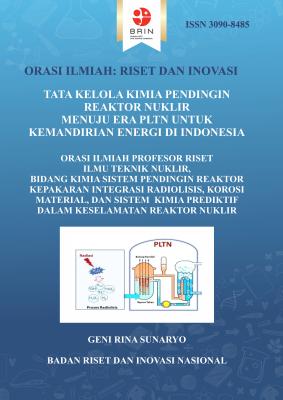
Orasi ilmiah ini membahas tata kelola kimia pendingin reaktor sebagai salah satu fondasi utama keselamatan, keandalan, dan keberlanjutan operasi reaktor nuklir. Berdasarkan rangkaian penelitian selama lebih dari tiga dekade, kajian ini mengintegrasikan aspek fundamental radiolisis air, kinetika reaksi spesies kimia, korosi dan penuaan material, serta pengelolaan sistem pendingin reaktor dalam kondisi operasi nyata. Hasil penelitian mencakup data primer radiolisis air pada temperatur tinggi dan iradiasi neutron cepat, pemodelan kinetika reaksi, serta basis data degradasi material jangka panjang pada sistem pendingin Reaktor Serba Guna G.A. Siwabessy dalam lingkungan tropis Indonesia.
Orasi ini menegaskan perlunya transformasi pengelolaan kimia pendingin dari pendekatan konvensional yang bersifat korektif menuju sistem yang prediktif, adaptif, dan berbasis data. Pendekatan tersebut didukung oleh pemantauan daring, sensor cerdas, kecerdasan buatan, analitik data, dan teknologi digital twin untuk mendeteksi anomali, memprediksi degradasi material, serta mendukung pengambilan keputusan keselamatan secara real-time.
Kontribusi ilmiah ini memberikan landasan bagi penguatan pengelolaan penuaan reaktor, pengembangan regulasi keselamatan berbasis bukti, peningkatan kapasitas sumber daya manusia, serta kesiapan industri pendukung nasional. Dalam konteks pengembangan Pembangkit Listrik Tenaga Nuklir dan Small Modular Reactor, penguasaan kimia pendingin reaktor menjadi bagian penting dalam membangun keselamatan nuklir, kemandirian teknologi, kepercayaan publik, dan ketahanan energi Indonesia.
Andresen, P. L., and Morra, M. M. (2003). Review of water chemistry effects on corrosion and stress corrosion cracking in operating reactors. Corrosion, 59(10), 895–912. https://doi.org/10.5006/1.3277593
Andresen, P. L., Angeliu, T. M., and Gorman, J. (2019). Effects of hydrogen water chemistry and zinc injection on corrosion fatigue of reactor materials. Corrosion Science, 148, 144–154. https://doi.org/10.1016/j.corsci.2019.03.008
Ardebili, A. A., Zappatore, M., Ramadan, A. I. H., and Longo, A. (2024). Digital twins of smart energy systems: enablers, design, and computational challenges. Energy Informatics, 7, 94.
Balakrishnan, R., Anantharaman, K., and Raju, M. (2021). Advances in nuclear reactor safety systems and instrumentation. Progress in Nuclear Energy, 138, 103840. https://doi.org/10.1016/j.pnucene.2021.103840
Beznosov, A. V., Kim, S., and Park, H. (2022). Digitalization and AI in water chemistry management of nuclear power plants: A roadmap to predictive maintenance. Nuclear Engineering and Design, 392, 111790. https://doi.org/10.1016/j.nucengdes.2022.111790
Beznosov, A., Sharma, R., Mishra, A., and Amritkar, R. (2022). AI and big data in nuclear power plant operation and maintenance. Nuclear Engineering and Technology, 54(10), 3605–3614. https://doi.org/10.1016/j.net.2022.06.015
Butarbutar, S. L., Sanguanmith, S., Meesungnoen, J., Sunaryo, G. R., & Jay-Gerin, J.-P. (2014). Calculation of the yields for the primary species formed from the radiolysis of liquid water by fast neutrons at temperatures between 25–350°C. Radiation Research, 181(6), 659–665. https://doi.org/10.1667/RR13638.1
Butarbutar, S. L., Sunaryo, G. R., Kusumastuti, R., and Meesungnoen, J. (2017). Low-linear energy transfer radiolysis of supercritical water at 400°C: Density dependence of the G(•OH). Sigma Epsilon-Buletin Ilmiah Teknologi Keselamatan Reaktor Nuklir.
Butarbutar, S. L., Kusumastuti, R., Subekti, M., and Sunaryo, G. R. (2018). Modelling the radiolysis of RSG-GAS primary cooling water. Journal of Physics: Conference Series, 962, 012055. https://doi.org/10.1088/1742-6596/962/1/012055
Electric Power Research Institute (EPRI). (2006). Water chemistry guidelines for nuclear power plants.
Electric Power Research Institute (EPRI). (2020). Advanced water chemistry control for small modular reactor systems.
Fuller, A., Fan, Z., Day, C., and BarLow, C. (2020). Digital twin: Enabling technologies, challenges and open research. IEEE Access, 8, 108952–108971. https://doi.org/10.1109/ACCESS.2020.2998358
Huang, Q., Peng, S., Deng, J., Zeng, H., Zhang, Z., Liu, Y., & Yuan, P. (2023). A review of the application of artificial intelligence to nuclear reactors: Where we are and what’s next. Heliyon, 9(3), e13883. https://doi.org/10.1016/j.heliyon.2023.e13883
International Atomic Energy Agency (IAEA). (2006). Fundamental Safety Principles. IAEA Safety Fundamentals No. SF-1. Vienna: International Atomic Energy Agency.
International Atomic Energy Agency. (2006). Data Processing Technologies and Diagnostics for Water Chemistry and Corrosion Control in Nuclear Power Plants (DAWAC): Report of a Coordinated Research Project 2001–2005. IAEA-TECDOC-1505. Vienna: International Atomic Energy Agency. ISBN 92-0-107906-0.
International Atomic Energy Agency (IAEA). (2009). Predisposal Management of Radioactive Waste. IAEA Safety Standards Series No. GSR Part 5. Vienna: International Atomic Energy Agency.
International Atomic Energy Agency (IAEA). (2010). Interface Between Safety and Security at Nuclear Power Plants. IAEA Nuclear Energy Series No. NP-T-1.8. Vienna: International Atomic Energy Agency.
International Atomic Energy Agency. (2011). Disposal of Radioactive Waste. IAEA Safety Standards Series No. SSR-5. Vienna: International Atomic Energy Agency.
International Atomic Energy Agency. (2016). Safety of Nuclear Power Plants: Design. IAEA Safety Standards Series No. SSR-2/1 (Rev. 1). Vienna: International Atomic Energy Agency.
International Atomic Energy Agency (IAEA). (2020). Water chemistry in nuclear power plants.
International Atomic Energy Agency (IAEA). (2021). Advances in reactor water chemistry and corrosion control.
International Atomic Energy Agency (IAEA). (2022). Application of digital technologies in nuclear water chemistry (IAEA TECDOC 1926).
International Atomic Energy Agency. (2025). Innovation, Advances and Developments in the Water Chemistry of Pressurized Water Reactors. IAEA-TECDOC-2099. Vienna: International Atomic Energy Agency. https://doi.org/10.61092/iaea.xe82-olj0
Jay-Gerin, J.-P. (2025). Fundamentals of water radiolysis. Encyclopedia, 5, 38. https://doi.org/10.3390/encyclopedia5010038
Katsumura, Y., Sunaryo, G. R., Hiroishi, D., and Ishigure, K. (1998). Fast neutron radiolysis of water at elevated temperatures relevant to water chemistry. Progress in Nuclear Energy, 32(1–2), 113–121. https://doi.org/10.1016/S0149-1970(97)00011-5
Kim, J. H., Cho, Y. H., and Lee, C. J. (2020). Review on lifetime extension strategies for nuclear power plants. Journal of Nuclear Science and Technology, 57(4), 361–370. https://doi.org/10.1080/00223131.2020.1722073
Kinoshita, N., Sueki, K., Sasa, K., Kitagawa, J., Ikarashi, S., Nishimura, T., Wong, Y.-S., Satou, Y., Handa, K., Takahashi, T., Sato, M., and Yamagata, T. (2011). Assessment of individual radionuclide distributions from the Fukushima Daiichi nuclear power plant accident. Proceedings of the National Academy of Sciences, 108(49), 19526–19529. https://doi.org/10.1073/pnas.1111729108
Le Caër, S. (2011). Water radiolysis: Influence of oxide surfaces on H2 production under ionizing radiation. Water Research, 45(9), 2655–2670. https://doi.org/10.1016/j.watres.2011.02.002
Lin, C. C. (2000). The Role of Zinc Injection in PWR Primary Coolant Chemistry. EPRI Report 1000605. Electric Power Research Institute. https://doi.org/10.2172/769246
Lister, D. H., & Uchida, S. (2015). Determining water chemistry conditions in nuclear reactor coolants. Journal of Nuclear Science and Technology, 52(4), 451–466. https://doi.org/10.1080/00223131.2014.973460
Missiaggia, M. (2024). On the radiation quality characterization in radiation therapy: from linear energy transfer to experimental microdosimetry. The European Physical Journal Plus, 139, Article 625. https://doi.org/10.1140/epjp/s13360-024-05318-5
NRC (U.S. Nuclear Regulatory Commission). (1980). TMI-2 Accident Evaluation Program: Reactor Coolant System Chemistry (NUREG-0612).
Park, J. H., Lee, C. Y., & Kim, M. Y. (2022). Real-time monitoring of coolant chemistry using integrated optical sensors in advanced reactors. Nuclear Engineering and Design, 389, 111715.
Rasheed, A., San, O., & Kvamsdal, T. (2020). Digital twin: Values, challenges and enablers from a modeling perspective. IEEE Access, 8, 21980–22012. https://doi.org/10.1109/ACCESS.2020.2970143
Saenko, V. A., Thomas, G., Yamashita, S., & Ohba, T. (2011). Radiation exposure, contamination, and protection: Lessons from the Fukushima nuclear accident. Journal of Radiation Research, 52(5), 431–446. https://doi.org/10.1269/jrr.11066
Shoji, T. (2010). Corrosion challenges in nuclear power plants. Corrosion Reviews, 28(3-4), 177–222. https://doi.org/10.1515/CRRE.2010.003
Sriyono, Sunaryo, G. R., Widodo, S., and Haryadi, C. (2018). Sriyono, Kusumastuti R., Butarbutar S.L., Febrianto, Pancoko M., Setiadipura T., Sunaryo G.R. (2018). The Temperature Dependence Analysis of Carbon Monoxide Conversion on CuO Bed of RDE Helium Purification System. J. Phys. Conf. Ser., 1493, 012005. https://doi.org/10.1088/1742-6596/1493/1/012005
Sriyono, Sunaryo, G. R., Widodo, S., and Haryadi, C. (2019). Sriyono, Kusmastuti R., Butarbutar S.L., Salimy D.H., Febrianto, Irianto I.D., Pancoko M., Sunaryo G.R. (2019), Analysis of hydrocyclone as river water pre-treatment for tertiary coolant of RDE. J. Phys.: Conf. Ser., 1198, 022040. https://doi.org/10.1088/1742-6596/1198/2/022040
Sriyono, Saprudin D., Rafi M., Sunaryo G.R., Setiawan A., and Hendro (2022). Medium Activity Liquid Radwaste Treatment by Using Ion Exchange, e 9th International Conference of the Indonesian Chemical Society ICICS 2021, by AIP Publishing. 978-0-7354-4380-8 AIP Conference Proceedings, 2638, 030003. https://doi.org/10.1063/5.0104020, Published Online: 18 August 2022.
Sunaryo G.R., Katsumura Y., Hiroishi D., Ishigure K. (1995). Radiolysis of water at elevated temperatures-II. Irradiation with ..-rays and fast neutrons up to 250° C. Radiation Physics and Chemistry, 45(1), 131-139. https://doi.org/10.1016/0969-806X(94)E0005-4
Sunaryo G.R. (2000). The effect of boric acid on radiolysis product of hydrogen peroxide when irradiated by ..-ray. Water Chemistry of Nuclear Reactor Systems, 1, 272-274.
Sunaryo G.R. and Domae M. (2008). Numerical simulation on effect of methanol addition on coolant radiolysis in pressurized water reactor. Journal of Nuclear Science and Technology, 45 (12), 1261-1274. https://doi.org/10.1080/18811248.2008.9711914
Sunaryo G.R., Meesungnoen J, Gerin J.P.J. (2011). Monte-Carlo Simulation of ..-ray and Fast Neutron Radiolysis of Liquid Water and 0.4 M H2SO4 Solutions at Temperatures up to 325oC. Atom Indonesia, 37(1), 29-35.
Sunaryo G.R., Sander H., Wisnubroto D.S. (2017). Water Chemistry Management toward Corrosion for Secondary Cooling Piping of Multi Purpose Reactor GA Siwabessy Indonesia. International Journal of Research Engineering and Science, 3(6), 56-59.
Sunaryo, G. R. (2017). Boric acid radiolysis in primary coolant water of PWR at temperature of 250°C. Jurnal Pengembangan Energi Nuklir, 19(1), 11–20. https://doi.org/10.17146/jpen.2017.19.1.3192
Sunaryo G.R., Santoso M.I., Kusumastuti R., Wisnubroto D.S., and Sriyono (2024). An in-depth four-year investigation into corrosion of carbon steel materials in the secondary cooling piping of the 30 MW RSG GAS research reactor. Int. J. Corros. Scale Inhib., 13(2), 853. https://doi.org/10.17675/2305-6894-2024-13-2-11
Sunaryo, G. R., Kusumastuti R., Wisnubroto D.S., Butarbutar S.L., Sriyono, Jatmiko D.T., (2025). Durability Study of AlMg2 in high-purity cooling water: A 15-year case from the RSG-GAS nuclear reactor. Int. J. Corros. Scale Inhib., 14 (2), 962-979. https://doi.org/10.17675/2305-6894-2025-14-2-27
Tatsujiro Suzuki. 2010. Nuclear Energy Sustainability and the 3S Concept: Safety, Security and Safeguards. Journal of Nuclear Materials Management, 38(3), 18–24.
Tibaoui, R., Sanchez, A., Grasteau, S., & Lamadie, F. (2019). Use of on-line monitoring techniques for early detection of coolant chemistry anomalies in nuclear systems. Annals of Nuclear Energy, 135, 106953.
Yu, K., Wang, Y., & Chen, D. (2021). Integration of AI and big data for anomaly detection in nuclear power plant operations. Annals of Nuclear Energy, 157, 108238. https://doi.org/10.1016/j.anucene.2021.108238
Zhang, H., & Pei, J. (2022). A digital twin framework for nuclear reactor monitoring and fault prediction. Annals of Nuclear Energy, 172, 109025. https://doi.org/10.1016/j.anucene.2022.109025.
Zhang, L., Li, X., & Wang, F. (2021). Effect of nanostructured coating on corrosion resistance of nuclear fuel cladding in simulated primary coolant. Corrosion Science, 190, 109658.
https://doi.org/10.1016/j.corsci.2021.109658
Zhao, X., Kim, J., Warns, K., Wang, X., Ramuhalli, P., Cetiner, S. M., Kang, H. G., & Golay, M. W. (2021). Prognostics and health management in nuclear power plants: An updated method-centric review with special focus on data-driven methods. Frontiers in Energy Research, 9, 696785. https://doi.org/10.3389/fenrg.2021.696785

This work is licensed under a Creative Commons Attribution-ShareAlike 4.0 International License.