



























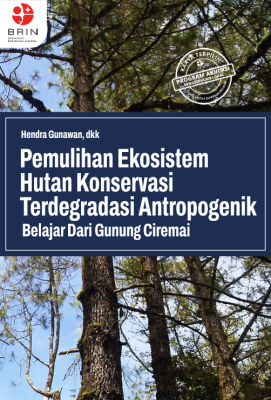
Taman nasional di Indonesia pada umumnya mengalami ancaman degradasi ekosistem akibat kegiatan manusia (antropogenik), seperti perambahan, perladangan, penebangan liar, perburuan liar, kebakaran hutan, dan invasive species. Salah satunya yang terjadi di Taman Nasional Gunung Ciremai (TNGC). Degradasi ekosistem berakibat pada terganggunya fungsi-fungsi yang melekat pada fungsi ekosistem dan fungsi taman nasional. Untuk mengatasi hal tersebut, perlu dilakukan restorasi atau pemulihan ekosistem, yakni proses membantu pemulihan ekosistem yang telah terdegradasi, rusak, atau hancur. Tujuannya adalah untuk memulihkan fungsi-fungsi ekosistem yang terdegra- dasi melalui pendekatan terpadu yang mencakup pendekatan ekologi dan silvikultur, serta pendekatan sosial, ekonomi, dan budaya.
Buku Pemulihan Ekosistem Hutan Konservasi Terdegradasi Antropogenik: Belajar dari Gunung Ciremai hadir untuk membuka, menginformasikan, dan memberikan wawasan masyarakat mengenai degradasi ekosistem hutan kawasan konservasi, rona ekosistem terdegradasi di Gunung Ciremai, zona pemulihan ekosistem, hingga upaya implementasi pemulihan ekosistem taman nasional yang terdegradasi oleh penyebab antropogenik. Buku ini dapat dimanfaatkan sebagai sumber referensi, khususnya bagi para pengelola taman nasional dalam mengimplementasikan program pemulihan ekosistem terde- gradasi, dari aspek perencanaan, pelaksanaan kegiatan, hingga monitoring dan evaluasi.
Adisoemarto, S. dan Rifai, M.A. (editor). (1994). Keanekaragaman Hayati di Indonesia. Jakarta: Kantor Menteri Negara Lingkungan Hidup (KLH) dan Konsorsium untuk Pelestarian Hutan dan Alam Indonesia (KONPHALINDO).
Aggarwal, S. (2001). Elaeocarpus grandiflorus J.E. Smith (Elaeocarpaceae). Medicinal and poisonous plants. Leiden: Plant Resources of South-East Asia. Backhuys Publishers 12(2):241-246.
Aiming, Q.I., Ellis, R.H., Keatinge, J.D.H., Wheeler, T.R., Tarawali, S.A., and Summerfield, R.J. (1999). Differences in the effects of temperature and photoperiod on progress to flowering among diverse Mucuna spp. Crop Science 182: 249–258.
Alikodra, H.S. (1990). Pengelolaan satwaliar Jilid I. Bogor: Departemen Pendidikan dan Kebudayaan, Direktorat Jenderal Pendidikan Tinggi, Pusat Antar Universitas Ilmu Hayat, Institut Pertanian Bogor.
Andriansyah, A., Supartono, T., dan Nurdin, N. (2019). Gangguan satwa liar Taman Nasional Gunung Ciremai terhadap lahan pertanian di Desa Karangsari, Kecamatan Darma, Kabupaten Kuningan. Prosiding Seminar Nasional dan Call for Paper Konservasi untuk Kesejahteraan Masyarakat I. Fakultas Kehutanan Universitas Kuningan, 12 Desember 2019. Hal: 74-81.
Anonymous. (2004). Pengelolaan Hutan Gunung Ciremai. Fakultas Kehutanan Universitas Kuningan. Tidak diterbitkan.
Arbainsyah. (2019). Ficus callophylla Blume (Moraceae). http://www.asianplant.net/ Moraceae/ Ficus_callophylla.htm. Diakses tanggal 29 Juli 2019.
Ashton, H. (2004). The royal horticultural society new encyclopedia of herbs & their uses (revised edition), Reference Reviews 18(3): 42-43.
Australian Tropical Rainforest Plants. (2019). Factsheet of Litsea glutinosa (Lour.) C.B. Rob. (Lauraceae). http://keys.trin.org.au/keyserver/data/0e0f0504-0103-430d8004060d07080d04/media/Html/taxon/Litsea_glutinosa.htm . Diakses tanggal 16 Juli 2019.
Badan Perencanaan Pembangunan Nasional [BAPPENAS]. (2003). Indonesian Biodiversity Strategy and Action Plan (IBSAP) 2003-2020. Jakarta: BAPPENAS.
Badan Pusat Statistik [BPS]. (2023). Statistik Lingkungan Hidup Indonesia 2023. Jakarta: Badan Pusat Statistik RI.
Badan Pusat Statistik [BPS]. (2024a). Angka Deforestasi (Netto) Indonesia di Dalam dan di Luar Kawasan Hutan Tahun 2013-2022 (Ha/Th). https://www.bps.go.id/id/ statistics-table/1/MjA4MSMx/angka-deforestasi--netto--indonesia-di-dalam-dan-di-luar-kawasan-hutan-tahun-2013-2021--ha-th-.html
Badan Pusat Statistik [BPS]. (2024b). Luas Penutupan Lahan Indonesia di Dalam dan di Luar Kawasan Hutan Tahun 2014-2022 Menurut Kelas (Ribu Ha). https://www.bps.go.id/id/statistics-table/1/MjA4NCMx/ luas-penutupan-lahan-indonesia-di-dalam-dan-di-luar-kawasan-hutan-tahun-2014-2022-menurut-kelas--ribu-ha-.html
Bailey, J.A. (1984). Principles of wildlife management. New York: John Wiley and Sons.
Balai Konservasi Sumber Daya Alam Jawa Barat II [BKSDA Jabar II]. (2006). Rencana pengelolaan Taman Nasional Gunung Ciremai 2006-2026: Buku I Rencana Pengelolaan. Bandung: BKSDA Jabar II. Tidak diterbitkan.
Balai Taman Nasional Gunung Ciremai [BTNGC]. (2006). Rencana pengelolaan Taman Nasional Gunung Ciremai 2006-2026, Buku I (Rencana Pengelolaan). Kuningan: Balai Taman Nasional Gunung Ciremai.
Balai Taman Nasional Gunung Ciremai [BTNGC]. (2008). Statistik Balai Taman Nasional Gunung Ciremai Tahun 2007. Kuningan: BTNGC.
Balai Taman Nasional Gunung Ciremai [BTNGC]. (2010). Zonasi. Data spasial tidak dipublikasi.
BAPPEDA Kabupaten Kuningan. (2009). RTRW Kabupaten Kuningan Tahun 2009-2029. Kuningan: BAPPEDA Kabupaten Kuningan.
Bentham, G. (1842). Notes on Mimosaceae, with a short synopsis of species. The Journal of Botany 4: 323-418.
Blockhus, J.M., Dillenbeck, M., Sayer, J.A., and Wegge, P. (eds). (1992). Conserving biological diversity in managed tropical forests. Gland, Switzerland and Cambridge, UK: IUCN.
Boer, E., and Sosef, M.S.M. (1990). Schima Reinw. ex Blume (Theaceae) in Timber Trees: Lesser-known timber. PROSEA 5(3):507-509.
Bompard, J.M. (1990). Mangifera caesia Jack (Anacardiaceae) in Edible fruits and nuts. PROSEA 2: 207-209.
Bradley, P. and Yee, S. (2015). Using the DPSIR Framework to Develop a Conceptual Model: Technical Support Document. US Environmental Protection Agency, Office of Research and Development, Atlantic Ecology Division, Narragansett, RI. EPA/600/R-15/154.
Chamberlain, J.R. (Ed). (2001). Calliandra calothyrsus: an agroforestry tree for the humid tropics. Tropical Forestry Papers No. 40.
Clewell, A., Rieger, J., and Munro, J. (2005). Society for ecological restoration international: Guidelines for developing and managing ecological restoration projects, 2nd Edition. www.ser.org and Tucson: SER International. http://www.ser.org/pdf. Diunduh Tanggal 5 Maret 2011.
Conservation International. (tanpa tahun). Biodiversity Hotspots, Targeted investment in nature’s most important places. https://www.conservation.org/priorities/biodiversity-hotspots. Diakses 16-01-2024.
Coombes, A.J. (2012). The A to Z of plant names. USA: Timber Press.
Craven, L.A., Sunarti, S., Wardani, M., Mudiana, D., Yulistarini, T. (2002). Melaleuca leucadendra (L.) L. (Myrtaceae) in kayu putih and its relatives in Indonesia. Floribunda II (1): 16 – 26.
Critical Ecosystem Partnership Fund [CEPF]. (2001). Sumatra forest ecosystems of the Sundaland biodiversity hotspot–Indonesia. https://www.cepf.net/sites/default/ files/final.sundaland.sumatra.ep__0.pdf
Critical Ecosystem Partnership Fund [CEPF]. (2014). Wallacea biodiversity hotspot. https://www.cepf.net/sites/default/files/wallacea-ecosystem-profilesummary-english.pdf
Damardono, H. (2005). Penetapan Taman Nasional Gunung Ciremai, demi elang jawa atau masyarakat Sunda? Website http://www.latin.or.id./media/kliping/kompas-1204-1.htm. Diakses tanggal 8 Agustus 2005.
Dao, N.K. (1998). Lindera oxyphylla (Meissner) Benth. (Lauraceae). Timber trees:Lesser-known timbers. Plant Resources of SouthEast Asia 5(3): 331-332.
Dasmann, R.F. (1964). Wildlife biology. New York: John Wiley & Sons Inc.
Departemen Kehutanan [Dephut]. (2004). Data strategis kehutanan 2004. Jakarta: Departemen Kehutanan.
Departemen Kehutanan [Dephut]. (2007). Buku informasi 50 taman nasional di Indonesia. Jakarta: Departemen Kehutanan.
Departemen Kehutanan [Dephut]. (2009). Statistik kehutanan Indonesia 2008. Jakarta: Departemen Kehutanan.
Departemen Kehutanan [Dephut]. (1994). Pengelolaan Hutan Lestari (Booklet). Departemen Kehutanan. Jakarta.
Department for International Development [DFID]. (2006). Laporan penelitian identifikasi potensi sosial, ekonomi, budaya dan kelembagaan masyarakat sebagai dasar pengelolaan berbasis masyarakat di Taman Nasional Gunung Ciremai. Bogor: Kerjasama Antara Pusat Litbang Hutan Dan Konservasi Alam dengan MFP-Department For International Development, United Kingdom.
Direktorat Jenderal Konservasi Sumber Daya Alam dan Ekosistem Kementerian Lingkungan Hidup dan Kehutanan [Ditjen KSDAE KLHK]. (2023). Statistik Direktorat Jenderal Konservasi Sumber Daya Alam dan Ekosistem Tahun 2022. Direktorat Jenderal Konservasi Sumber Daya Alam dan Ekosistem Kementerian Lingkungan Hidup dan Kehutanan.
Duke, J.A. (1981). Hand book of legumes of world economic importance. NewYork: Plenum Press.
Fahutan Universitas Kuningan. (2004). Pengelolaan kawasan hutan Gunung Ciremai. Kuningan: Fahutan Universitas Kuningan. Tidak diterbitkan.
Farjon, A. (2013). Sundacarpus amarus. The IUCN Red List of ThreatenedSpecies 2013: http://dx.doi.org/10.2305/IUCN.UK. Diakses 8 Agustus 2019.
..........
dst

This work is licensed under a Creative Commons Attribution-NonCommercial-ShareAlike 4.0 International License.
This book that publish in BRIN Publishing is licensed under a Creative Commons Attribution Non-commercial Share Alike 4.0 International license (CC BY-NC-SA 4.0). This license permits you to share, copy, distribute and transmit the work for your personal use and non-commercial purposes, provided you provide appropriate attribution. Derivative works and modifications must use the same license. Detailed information regarding the CC-BY-NC-SA 4.0 license is available via the link: https://creativecommons.org/licenses/by-nc-sa/4.0/
BRIN Publishing has a program named Akuisisi Pengetahuan Lokal that acquisition any of books or audiovisual content that meet our standard publication. The rights of BRIN Publishing is to disseminate and distribute all the content acquisitions for the public.
As an author you (or your employer or institution) may do the following:
All copies, print or electronic, or other use of the paper or article must include the appropriate bibliographic citation for the books


