
























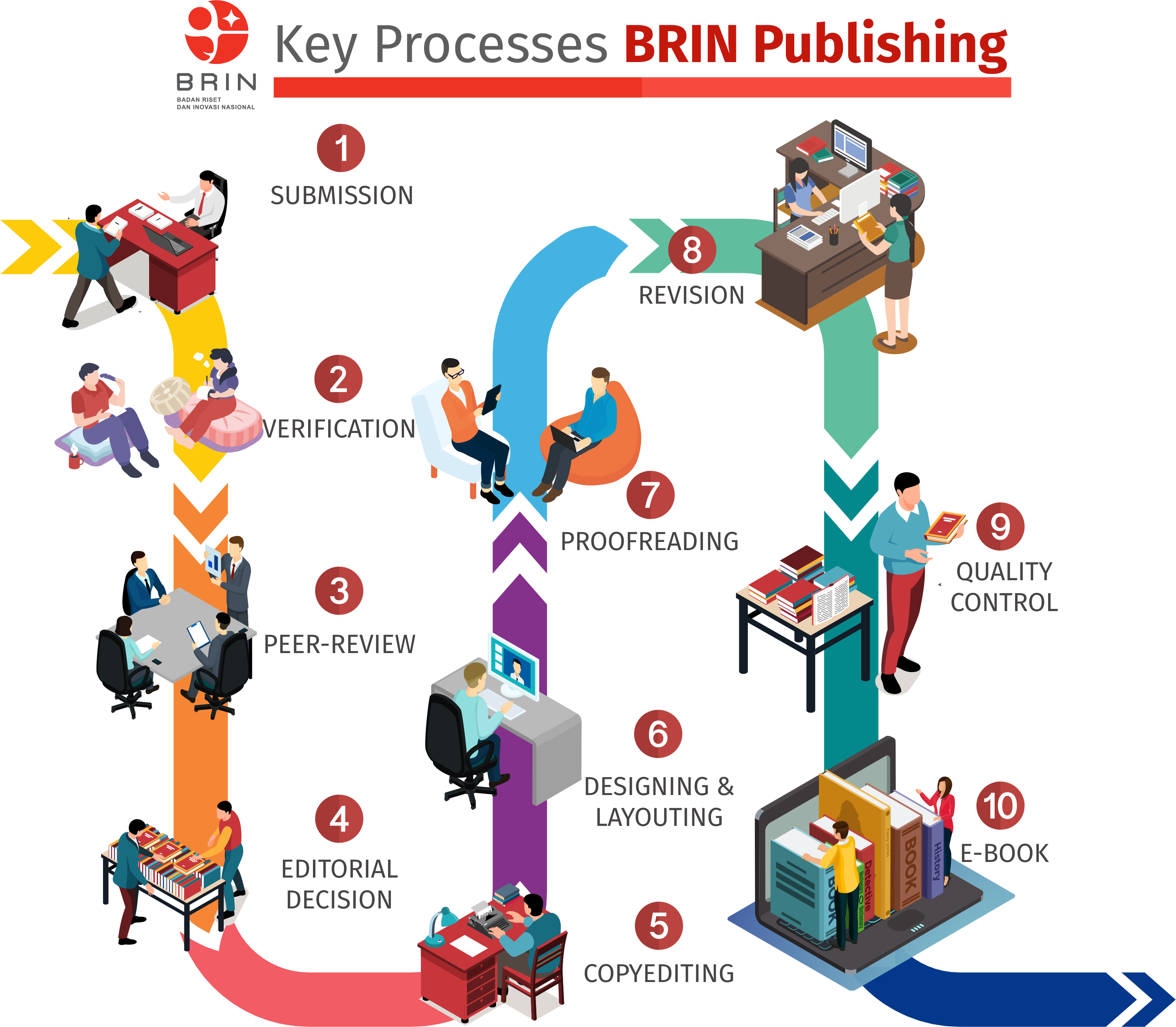
Book publication proposals are accepted throughout the year. The maximum end-to-end service duration is nine (9) months, calculated from the date of manuscript submission to the official announcement of results. Timelines are indicative and may vary depending on manuscript complexity and compliance with submission requirements.
Stage 1 & 2: Manuscript Submission & Verification (24 working days)
Stage 3: Peer-review (56 working days)
Stage 4: Editorial Decision (11 working days)
Stage 5: Copyediting (16 working days)
Stage 6, 7, 8, & 9: Book production; including layouting, cover designing, proofreading, input correction, quality control, ISBN application (62 working days)
Stage 10: E-book, including metadata, final files, online publication, DOI activation, legal deposit submission to national and regional libraries (16 working days)
BRIN Publishing upholding the copyright, privacy, license, and ethics of scientific publication. Every book that is published in BRIN Publishing gives a significantly scientific impact to the reader, because it prioritizes aspects of renewal, authenticity, and expediency. The publication ethics below are the main principles and foundations in book publication, which regulates the ethics of author, editor, reviewer, and press manager. We hope that by understanding and implementing this scientific publication, every book that is published in this jurnal can avoid all forms of the malpractice publication band copyright infringement, such as duplication, fabrication, falsification, and plagiarism.
a. Publication Ethics and Allegation of Research Misconduct
BRIN Publishing recognizes the significance of ethical principles in academic publishing and is dedicated to upholding a high standard of ethical behavior. To ensure transparency and ethical conduct throughout the publication process, BRIN Publishing adheres to rigorous peer-review standards. In line with the COPE Best Practice Guidelines, this publication ethics statement establishes clear expectations for all stakeholders, including authors, editors, reviewers, and the publisher (BRIN). With this ethical policy serving as a valuable guide, BRIN Publishing aims to promote publication ethics and prevent malpractice among all stakeholders.
b. Statement on Neutrality, Diversity, and Inclusion
BRIN Publishing upholds the values of diversity and inclusion throughout the entire publishing process. BRIN Publishing acts in a neutral, objective, and fair manner in the selection and review of submitted manuscripts. All works are assessed solely on the basis of their academic quality and contribution, without discrimination on the grounds of gender, ethnicity, religion, race, intergroup affiliation, nationality, or any other background.
c. Publisher Commitment to Ethical Publishing
The publication of a peer-reviewed article in BRIN Publishing is a vital component in creating a reputable and coherent knowledge network. It reflects the quality of the author's work and the institutions that support them and upholds the scientific method. Thus, it is crucial to establish ethical standards for all parties involved in the publishing process, including the author, editor, peer reviewer, publisher, and society.
BRIN Publishing recognizes its duty to oversee all stages of publishing and acknowledges its ethical and other responsibilities. It is committed to ensuring that editorial decisions remain independent and unbiased, unaffected by commercial revenue from advertising, reprints, or other sources. Additionally, the BRIN Publishing will facilitate communication with other publishers as needed and appropriate.
d. Allegation of Research Misconduct
Research misconduct refers to several actions, such as fabrication, falsification, citation manipulation, and plagiarism, that can occur during the production, performance, review, or reporting of research and the writing of articles. It is the responsibility of editors to ensure the accuracy and integrity of the scientific record, particularly when articles that have been published are involved in such irregularities.
To address any suspicions of misconduct fairly, editors and editorial boards follow the best practices of COPE, including an investigation of allegations made by individuals with no relevant conflicts of interest. If misconduct is suspected, the corresponding author is contacted to provide a detailed response, and additional review and involvement of experts, such as statistical reviewers, may be sought.
When there is sufficient evidence of misconduct, submitted manuscripts are rejected, and published papers may be retracted, with a link to the original article. However, for cases where misconduct is unlikely, clarifications, additional analyses, or both, published as letters to the editor, often accompanied by a correction notice and correction to the published article, can suffice.
BRIN are expected to conduct thorough investigations of allegations of scientific misconduct. It is the critical responsibility of authors and institutions to guarantee the accuracy of the scientific record. BRIN PUBLISHING will continue to fulfill its responsibilities by responding appropriately to concerns about scientific misconduct and taking necessary actions, such as corrections, retractions with replacement, and retractions, to maintain the validity and integrity of the scientific record.
e. Authorship and Contributorship
Authors should ensure that the authorship of their research publications accurately reflects the contributions made by each individual involved in the work and its reporting. Only those who have significantly contributed to the conception, design, execution, or interpretation of the study should be listed as authors. Others who have made significant contributions must be acknowledged as co-authors. In cases where major contributors are listed as authors, those who have made less substantial or purely technical contributions should be listed in an acknowledgement section. Additionally, authors should confirm that all authors have reviewed and agreed to the final version of the manuscript and their inclusion as co-authors.
f. Complaints and Appeals
BRIN Publishing has a well-defined process for managing grievances lodged against the Editorial Staff, Editorial Board, or Publisher. The complaints will be thoroughly explained to the concerned individual regarding the nature of the complaint. The scope of complaints covers any issue related to the publisher's operational procedures, such as the editorial process, unethical citation practices, biased editors/reviewers, peer-review tampering, and so on. The complaint cases will be handled in compliance with COPE's guidelines.
g. Data Access, Retention and Reproducibility
In order to uphold the integrity and transparency of research, authors are strongly encouraged to provide the raw data used in their study to the editorial team during the review process. Additionally, authors should be willing to make this data available to the public, if feasible, or retain it for a reasonable period of time following publication. It is the author's responsibility to ensure that their data can be reproduced, thus allowing other researchers to verify and build upon their findings.
h. Ethical Oversight
When conducting research that involves potentially hazardous chemicals, procedures, equipment, humans, or animals, the author must disclose these hazards in the manuscript to comply with ethical research practices. Additionally, if necessary, the author must obtain legal ethical clearance from relevant associations or organizations. For research involving confidential data or business/marketing practices, authors must explain how they will securely protect the data or information.
i. Author Ethic
j. Editor Ethic
k. Reviewer Ethic
l. Press Manager Ethic
Further information on ethics of scientific publication, please access the Committee On Publication Ethics (COPE) site.
m. Intellectual Property (Copyright Policy)
BRIN Publishing policy about intelectual property or copyright is declared here.
n. Post-Publication Discussions and Corrections
BRIN Publishing welcomes post-publication discussions and corrections from readers regarding published articles. If a reader wishes to provide discussions and corrections, they can contact the Director via email and explain their feedback. If the Director accepts the discussions and corrections, they will be published in the next issue as a Letter to the Editor. The authors of the original article are allowed to reply to the discussions and corrections by sending their response to the Director, who may publish it as a Reply to the Letter to the Editor.
o. Peer-Review Process Policy
Our peer-review process policy is designed to ensure that each submission is evaluated based on its novelty, objectivity, methodology, scientific impact, conclusions, and references. The corresponding author will receive the reviewers' comments and is expected to take appropriate actions and provide responses. The Editorial Board will then review the comments and make a final decision based on the reviewer's recommendations. More information on our peer-review process and policy can be found here.
p. Plagiarism Screening Policy
BRIN Publishing has a strict policy against plagiarism and self-plagiarism, and any papers found to contain such issues will be promptly investigated and rejected. The Editorial Board of BRIN Publishing is committed to ensuring that all published articles do not exceed a similarity score of 30%.
q. Article Withdrawal Policy; Corrections and Retractions
BRIN Publishing has established policies for handling article withdrawal, retraction, removal, and replacement.