


























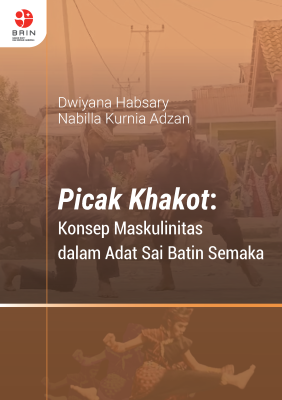
Picak khakot merupakan salah satu seni yang berasal dari subsuku Sai Batin adat Semaka, Lampung. Tarian ini menekankan teknik bela diri dengan menggunakan properti pedang sebagai landasan utamanya. Oleh karena gerakan dan unsur pendukungnya itulah tari tradisional ini lekat dengan maskulinitas. Bahkan, dikatakan bahwa pada zaman dahulu, di wilayah asalnya, laki-laki yang tidak mengikuti satu pun perguruan khakot atau tidak pernah belajar khakot dalam hidupnya patut dipertanyakan maskulinitasnya. Walaupun demikian, pada kenyataannya, khakot dapat pula ditarikan oleh wanita yang cenderung “jauh” untuk menjamah ranah bela diri tersebut.
Buku ini memaparkan nilai keindahan tari yang melekat pada kesan feminis, tetapi dalam waktu yang sama juga sangat pekat warna maskulinitasnya. Dua karakter dalam satu sajian adalah hal yang sangat jarang dalam sebuah sajian tari. Buku ini menawarkan cara menganalisis gerak tari dari ranah kinesiologi, yakni dengan membedah setiap gerak berdasarkan analisis gerak tubuh, sikap tubuh, dan ruang gerak dari perspektif pelaku. Buku ini diperuntukkan tidak hanya bagi pegiat atau akademisi seni tari Lampung, tetapi juga bagi pembaca umum yang menaruh minat pada seni kebudayaan lokal. Bagi pembaca yang penasaran akan bentuk sajian tari berkarakter maskulin sekaligus feminin tersebut, buku ini sangat dianjurkan untuk mengetahui kedua sisi itu berkelindan dalam satu sajian seni. Selamat membaca.
Amrullah, R. H. (2019). Nilai-nilai filosofis pada simbol tari pedang masyarakat berkas Kota Bengkulu. Jurnal Manthiq, IV(II), 7386. http://dx.doi.org/10.29300/mtq.v4i2.3514
Asmarani, R. (2017). Perempuan dalam perspektif kebudayaan. Jurnal Sabda, 12(1), 7–16. https://doi.org/10.14710/sabda.12.1.7-16
Azisah, S. (2016). Kontektualisasi gender, Islam, dan budaya. UIN Alauddin Makasar. https://repositori.uin-alauddin.ac.id/13084/
Benedict, R. (1947). The chrysanthemum and the sword: Pattern of Japanese culture. Secker & Warburg. https://www.amazon.com/Chrysanthemum-Sword-Patterns-Japanese-Culture/dp/0618619593
Bourdieu, P. (2001). Masculine domination (R. Nice, Penerj.). Stanford University Press. https://www.sup.org/books/title/?id=1279
Bourdieu, P., & Passeron, J. C. (1977). Reproduction on education , society and culture. Sage. https://uk.sagepub.com/en-gb/eur/reproduction-in-education-society-and-culture/book203162
Bulan, I. (2016). Transformasi kuttau lampung dari beladiri menjadi seni pertunjukan tari pedang. Jurnal Kajian Seni, 3(1), 58–68. https://doi.org/10.22146/jksks.29870
Burton, R. F. (2020). The book of the sword. Gutenberg.org. https://www.gutenberg.org/files/61751/61751-h/61751-h.htm
Brennan, R., & Moore, S. C. (2009). Weapons and violence: A review of theory and research. Aggression and Violent Behavior, 14(3), 215–225. https://doi.org/10.1016/j.avb.2009.03.003
Cornwall, A. (2010). Men, masculinity and gender in development men and masculinity. Oxford Press. https://doi.org/10.1080/741922351
Clausewitz, C. V. (1984). On war (M. Howard, & P. Paret, Penerj.). Princeton University Press. https://books.google.co.id/books/about/On_War.html?id=DRoL0Nmsrl wC&redir_esc=y
Davesa, Y. (2017). Simbol dan makna gerak tari pedang dalam upacara ngayau Dayak Mualang Kabupaten Sekadau. Jurnal Pendidikan dan Pembelajaran Khatulistiwa, 6(3), 1–12. https://jurnal.untan.ac.id/index.php/jpdpb/article/view/19127/16005
Engle, P. L. (2005). The role of men in families: achieving gender equity and supporting children. Dalam Men and Masculinity. Oxford Press. https://doi.org/10.1080/741922351
Faturochman. (1993). Perang kecil: Problem yang terus berlangsung. Universitas Gadjah Mada Press.
Gardiner, J. K. (2005). Men, masculinities, and feminist theory. Dalam M. S. Kimmel, J. Hearn, & R. W. Connell (Ed.), Handbook of studies on men and masculinities. Sage Publications. https://us.sagepub.com/en-us/nam/handbook-of-studies-on-men-and-masculinities/book226753
Hajir, A. (2019). Pengaruh Kelentukan, kekuatan, dan keseimbangan terhadap kemampuan tendangan lurus kedepan atlet pencak silat Kota Palopo [Tesis]. Universitas Negeri Makasar. http://eprints.unm.ac.id/id/eprint/13109
Hearn, J. & Connel, R. W. (2004). Handsbook of Studies of men and masculinities (M. S. Kimmel, Ed.). Sage Publications. https://us.sagepub.com/en-us/nam/handbook-of-studies-on-men-and-masculinities/book226753
Hermawan, F. F. (2017). Masculinity in Indonesian populer culture in the early era of the New Order regime. Jurnal Lingua Cultura, 11(1), 47–52. https://doi.org/10.21512/lc.v11i1.1318
Holter, O. G. (2005). Social theories for researching men and masculinities: Direct gender hierarchy and stuctural inequality. Dalam M. S. Kimmel, J. Hearn, & R. W. Connell (Ed.), Handbook of studies on men and masculinities. Sage Publications. https://us.sagepub.com/en-us/nam/handbook-of-studies-on-men-and- masculinities/book226753
Info Psikologi. (2023, 8 Juni). 5 manfaat pengendalian diri untuk kontrol amarah dan emosi. Kumparan. https://kumparan.com/info-psikologi/5-manfaat-pengendalian-diri-untuk-kontrol-amarah-dan-emosi-20Yi7T8aOfg/full
Jung, C. G. (2021). Memories, dreams, reflections. Imortal Publishing. https://shiramedia.com/book-publisher/immortal/page/3/
Koenjtaraningrat. (1983). Kebudayaan mentalitas dan pembangunan Gramedia. https://books.google.co.id/books?id=94QpZ-x1l7QC&printsec=frontcover&hl=id#v=onepage&q&f=false
Kristiansen, K. (2002). The tale of the sword-sword and swordfighters in Bronze Age Europe. Oxford Journal of Archaeology, 21(4), 319–332. https://doi.org/10.1111/1468- 0092.00166
Kusuma, H. H. (1992). Pengantar ilmu adat hukum Indonesia. Mandar Maju.
La Meri. (1986). Dance composition, the basic element. Russel. https://www.amazon.com/Dance-composition-basic-elements-Meri/dp/B0007DP7L2
Mangoensong, H. R. B. (2020). Analisis teknik gerak tradisional dengan menggunakan ilmu kinesiologi. Jurnal Seni Tari Unesa, 9(1), 77–84.
Marzuki, C. (2009). Azaz-azaz Mekanika dalam pendidikan jasmani olahraga. Wineka Media. http://repository.unp.ac.id/id/eprint/481
Marsgilo, W., & Pleck, J. H. (2005). Fatherhood and masculinities. Dalam M. S. Kimmel, J. Hearn, & R. W. Connell (Ed.), Handbook of studies on men and masculinities. Sage Publications. https://us.sagepub.com/en-us/nam/handbook-of-studies-on-men-and- masculinities/book226753
Morgan, D. (2005). Class and masculinity. Dalam M. S. Kimmel, J. Hearn, & R. W. Connell (Ed.), Handbook of studies on men and masculinities. Sage Publications. https://us.sagepub.com/en-us/nam/handbook-of-studies-on-men-and-masculinities/book226753
Morrell, R. & Swart, S. (2005). Men in Third World. Dalam M. S. Kimmel, J. Hearn, & R. W. Connell (Ed.), Handbook of studies on men and masculinities. Sage Publications. https://us.sagepub.com/en-us/nam/handbook-of-studies-on-men-and-masculinities/book226753
Nurdin, B. (2017, 9 April). Filosofi pedang. Metro Jambi. https://metrojambi.com/read/2017/04/10/20163/filosofi-pedang
Pawestri, N. (2017, 25 Desember). Makna filosofi dibalik sebilah pedang. Tribun Jogja. https://jogja.tribunnews.com/2017/12/25/inilah-makna-filosofis-di-balik-sebilah-pedang.
Sampath, N. (1997). ‘Crabs in a bucket’: Reforming male identities in Trinidad. Gender & Development, 5(2), 47–54.
Sarsito, T. (2009). Perang dalam tata kehidupan antar bangsa. Jurnal Komunikasi Massa, 2(2), 112–126. https://www.jurnalkommas.com/index.php?target=isi&jurnal=Perang+dalam+Tata+Ke hidupan+Antarbangsa
Soulat, J. & Fischer, S. (2013). Sword parts and their depositional contexts – Symbols in Migration and Merovingian Period martial society. Forn Vannen: Journal of Swedish Antiquarian Research, 109–122. https://www.academia.edu/3572087/Sword_parts_and_their_depositional_contexts_Sy mbols_in_Migration_and_Merovingian_Period_martial_society
Swain, J. (2005). Masculinities in education. Dalam M. S. Kimmel, J. Hearn, & R. W. Connell (Ed.), Handbook of studies on men and masculinities. Sage Publications. https://us.sagepub.com/en-us/nam/handbook-of-studies-on-men-and- masculinities/book226753
Sweetman, C. (1997). Men and masculinity. Oxfarm. https://www.amazon.com/Masculinity-International-Development-Caroline- Sweetman/dp/0855983779
Taga, F. (2005). East Asian masculinities. Dalam M. S. Kimmel, J. Hearn, & R. W. Connell (Ed.), Handbook of studies on men and masculinities, (129–140). https://us.sagepub.com/en-us/nam/handbook-of-studies-on-men-and-masculinities/book226753
White, S. C. (2005). Men, masculinity and gender in development. Dalam Men and Masculinity. Oxford Press.

This work is licensed under a Creative Commons Attribution-NonCommercial-ShareAlike 4.0 International License.
This book that publish in BRIN Publishing is licensed under a Creative Commons Attribution Non-commercial Share Alike 4.0 International license (CC BY-NC-SA 4.0). This license permits you to share, copy, distribute and transmit the work for your personal use and non-commercial purposes, provided you provide appropriate attribution. Derivative works and modifications must use the same license. Detailed information regarding the CC-BY-NC-SA 4.0 license is available via the link: https://creativecommons.org/licenses/by-nc-sa/4.0/
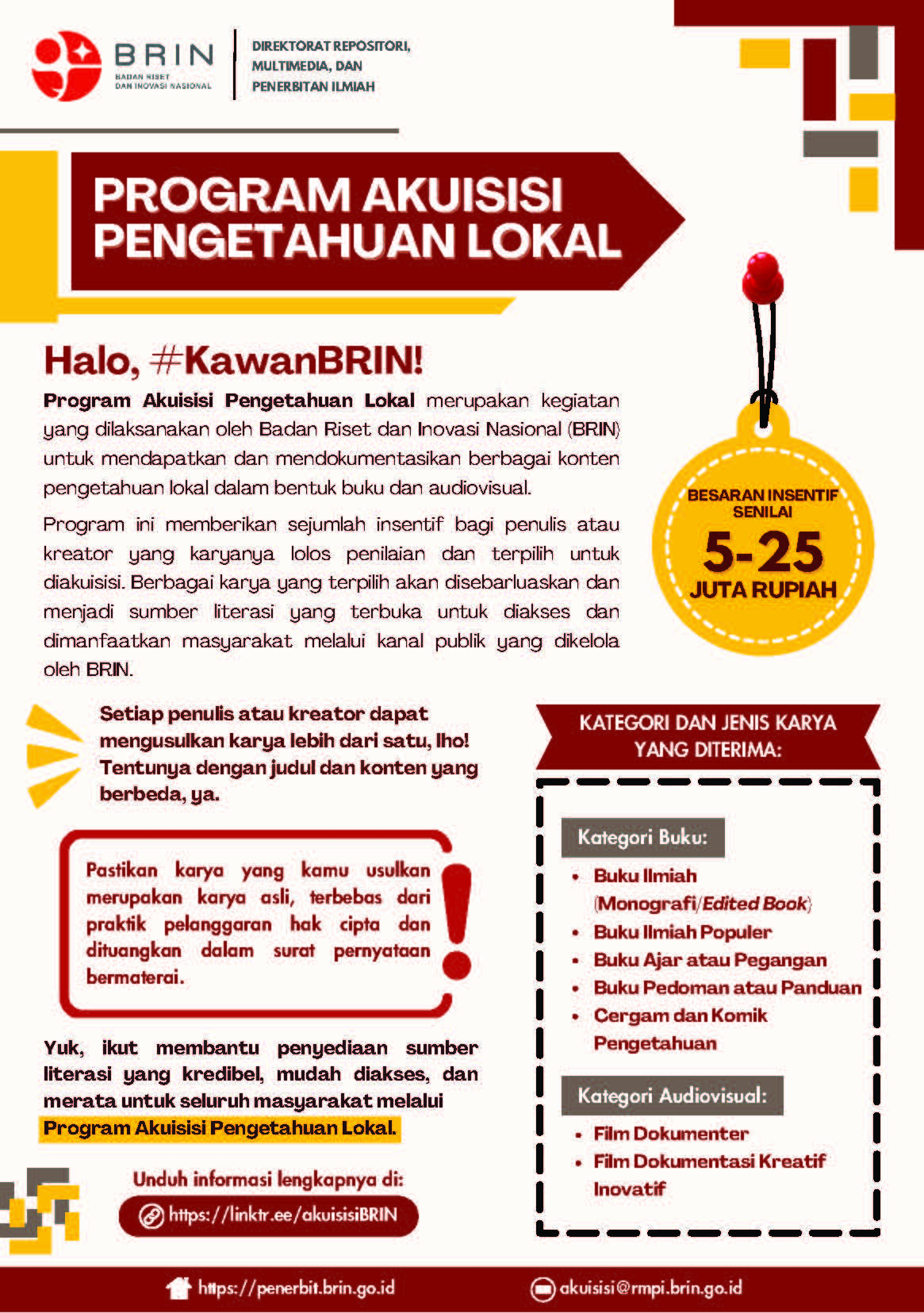
BRIN Publishing has a program named Akuisisi Pengetahuan Lokal that acquisition any of books or audiovisual content that meet our standard publication. The rights of BRIN Publishing is to disseminate and distribute all the content acquisitions for the public.
As an author you (or your employer or institution) may do the following:
All copies, print or electronic, or other use of the paper or article must include the appropriate bibliographic citation for the books