























Pedagogi musik tradisional adalah pendekatan pengajaran dan pembelajaran musik yang diwariskan secara turun-temurun melalui praktik budaya, bukan sekadar transfer keterampilan teknis. Di Lampung, praktik ini berlangsung secara informal di komunitas, sanggar, dan lingkungan sosial—jauh dari ruang kelas formal—melalui proses
mendengar, meniru, demonstrasi, dan pertunjukan. Sayangnya, kekayaan pedagogis ini hampir luput dari perhatian dunia pendidikan formal yang masih mendominasi dengan perspektif teori musik Barat, sehingga potensi besar musik tradisional Lampung sebagai sumber pengetahuan pedagogis belum sepenuhnya diakui dan dikembangkan.
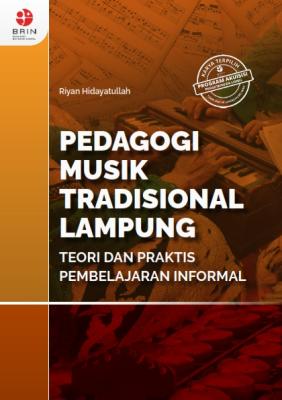
Pedagogi Musik Tradisional Lampung: Teori dan Praktis Pembelajaran Informal hadir untuk menjawab kesenjangan tersebut. Buku ini menyajikan studi mendalam berbasis etnografi hibrid selama lima tahun tentang praktik pembelajaran empat jenis musik tradisional Lampung—Gamolan Pekhing, Gitar Tunggal, Talo Balak, dan Butabuh—sekaligus mengajukan kerangka pedagogi kritis yang mendorong guru dan siswa merefleksikan pembelajaran musik dalam konteks sosial dan budaya lokal. Buku ini ditujukan bagi pengajar musik, praktisi seni, peneliti etnomusikologi, mahasiswa pendidikan musik, serta siapa pun yang ingin mengembangkan pedagogi musik berbasis kearifan lokal yang dapat direplikasi di berbagai daerah di Indonesia.
Attan, M. N. (2012). Gambus: Tinjauan awal berasaskan gaya permainan di Johor. Malaysian Journal of Music, 1(2), 87–104.
Abrahams, F. (2005). The Application of Critical Pedagogy to Music Teaching and Learning: A Literature Review. Update: Applications of Research in Music Education, 23(2), 12–22. https://doi.org/10.1177/87551233050230020103
Abrahams, F. (2007). Critical pedagogy for music education: A best practice to prepare future music educators. Visions of Research in Music Education, 7(1). https://digitalcommons.lib.uconn.edu/vrme/vol7/iss1/10
Andersen, L., Boud, D., & Cohen, R. (1999). Experience-based learning. In Understanding adult education and training (2nd ed., p. 15). Routledge.
Apple, M. (1982). Education and power. Routledge.
Banks, J. A. (1995). Multicultural education and curriculum transformation. The Journal of Negro Education, 64(4), 390–400. https://doi.org/10.2307/2967262
Banks, J. A. (2008). An introduction to multicultural education (6th edition). Pearson.
Banks, J. A., & Banks, C. A. M. (2009). Multicultural education: Issues and perspectives (7th ed.). John Wiley & Sons.
Banks, J. A., & Banks, C. A. M. (Eds.). (2016). Multicultural Education: Issues and Perspectives (9th ed.). John Wiley & Sons, Inc.
Barendregt, B. (2021). Digital ethnography, or ‘deep hanging out’ in the age of big data. In Audiovisual and digital ethnography: A practical and theoretical guide. Routledge.
Barnawi, E. (2017). Eksistensi gitar klasik Lampung tulang bawang dan pengembangannya. In N. Y. Ariyanti, E. S. Agustina, S. R. Sulistyanti, Hartoyo, E. Suroso, & Sumaryo (Eds.), Prosiding kegiatan ilmiah tingkat nasional kearifan lokal dalam dinamika masyarakat multikultural (pp. 267–279). LPPM Universitas Lampung.
Barnawi, E., & Irawan, R. (2020). Gambus Lampung Pesisir dan sistem musiknya. Graha Ilmu.
Barnawi, E. (2022). Penerapan metode konstruktivistik dalam mata kuliah musik perunggu Lampung di Prodi Pendidikan Musik Universitas Lampung (Laporan penelitian). Universitas Lampung.
Barnawi, E., & Hasyimkan. (2019). Alat musik perunggu Lampung. Graha Ilmu.
Barnawi, E., Hasyimkan, Saputra, A., Azzahra, M. F., & Dewi, R. A. (2021). Pelatihan alat musik talo balak Lampung pada Forum Karang Taruna Palapa Tiyuh Panaragan untuk mengiringi tarian Sigeh Penguten sebagai prosesi penyambutan tamu-tamu agung di Tiyuh Panaragan Kabupaten Tulang Bawang Barat. Sumbangsih: Jurnal Penulisan dan Pengabdian Universitas Lampung, 2(1), 126–137. https://doi.org/10.23960/jsh.v2i1.41
Batin, M., Hidayatullah, R., Barnawi, E., A, I. G. N., Nugroho, W., Saputra Nugraha, R. aditya, Diantori, Sambera, R., Darmawan, R., Wijaya, A., Octavian, A., Yudha, S., & Zopi, M. (2018). Notasi pembelajaran musik tradisional gamolan pekhing Sekala Brak Lampung. CV. Anugrah Utama Raharja.
Becker, J. (1980). Traditional music in modern Java: Gamelan in a changing society. University of Hawaii Press.
Blacking, J. (2000). How musical is man? (6th ed.). University of Washington Press.
Bourdieu, P. (1977). Outline of a theory of practice. Cambridge University Press.
Bourdieu, P. (1984). Distinction: A sociological critique of the judgement of taste. Cambridge University Press.
Bourdieu, P. (1987). The forms of capital. In J. Richardson (Ed.), Handbook of theory and research for sociology of education (pp. 241–258). Greenwood Press.
Bruffee, K. A. (1999). Collaborative Learning. United States of America: Johns Hopkins University Press. Retrieved 25 December 2023 from https://doi.org/10.56021/9780801859731
Cannon, R. (2000). Guide to support the implementation of the Learning and teaching plan year 2000. The University of Adelaide.
Cavalli-Sforza, L. L., & Feldman, M. W. (1981). Cultural transmission and evolution: A quantitative approach (Vol. 16). Princeton University Press.
Costes-Onishi, P., & Kwek, D. (2023). Inquiry-based learning in music: Indicators and relationships between key pedagogical practices and the quality of critical thinking. Research Studies in Music Education, 45(2), 362–378. https://doi.org/10.1177/1321103X211057457
Darling-Hammond, L. (1997). The right to learn: A blueprint for creating schools that work. Jossey-Bass.
Drake, C., & Palmer, C. (2000). Skill acquisition in music performance: Relations between planning and temporal control. Cognition, 74(1), 1–32. https://doi.org/10.1016/S0010-0277(99)00061-X
Freire, P. (1970). Pedagogy of the oppressed. Continuum.
Freire, P. (2018). Pedagogy of the Oppressed (50th Anniversary Edition). Bloomsbury Publishing USA.
Folkestad, G. (2006). Formal and informal learning situations or practices vs formal and informal ways of learning. British Journal of Music Education, 23(2), 135–145. https://doi.org/10.1017/S0265051706006887
Froehlich, H., & Frierson-Campbell, C. (2022). Inquiry in music education (2nd ed.). Routledge. https://doi.org/10.4324/9780203806517
Gardner, H. (1983). Frames of mind. Basic Books.
Gardner, Howard. (1999). Intelligence reframed: Multiple intelligences for the 21st century. Basic Books.
Green, L. (2002). How popular musicians learn: A way ahead for music education. Ashgate.
Green, L. (2005). The music curriculum as lived experience: Children’s “natural” music-learning processes. Music Educators Journal, 91(4), 27–32. https://doi.org/10.2307/3400155
Green, L. (2008). Music, informal learning and the school: A new classroom pedagogy. Ashgate.
Green, L. (2017). Music education as critical theory and practice (1st ed.). Routledge. https://www.taylorfrancis.com/books/9781351557443
Giroux, H. A. (1997). Pedagogy and the politics of hope: Theory, culture, and schooling: A critical reader. Westview Press.
Habermas, J. (1982). Lifeworld and system: A critique of functionalist reason. Englewood Cliffs, NJ: Prentice-Hall.
Hadikusuma, H. (1990). Masyarakat dan adat budaya Lampung. Mandar Maju.
Hagen, E. H., & Bryant, G. A. (2003). Music and dance as a coalition signaling system. Human Nature, 14(1), 21–51. https://doi.org/10.1007/s12110-003-1015-z
Harahap, I. (2005). Alat musik dawai (E. Suanda, Ed.). Lembaga Pendidikan Seni Nusantara.
Hasyimkan, & Hidayatullah, R. (2020). Gamolan dan hadrah. Graha Ilmu.
Herskovits, M. J. (1948). Man and his works: The science of cultural anthropology. Alfred A. Knopf.
Hidayatullah, R. (2023). Perspectives on music pedagogy in informal, performance-based learning. Virtuoso: Jurnal Pengkajian dan Penciptaan Musik, 6(1), Article 1. https://doi.org/10.26740/vt.v6n1.p57-67
Hidayatullah, R. (2023). Gitar tunggal Lampung: Enculturation and ethnopedagogy in advancing formal music education. Jurnal Seni Musik, 12(1), Article 1. https://doi.org/10.15294/jsm.v12i1.70097
Hidayatullah, R. (2022). Tradisi musik orang Lampung. In Penerbit BRIN. Penerbit BRIN. https://metatags.io/
Hidayatullah, R., Jazuli, M., & Syarif, M. I. (2021). The identity construction through music notation of the indigenous style of gitar tunggal Lampung Pesisir. Harmonia: Journal of Arts Research and Education, 21(2), 303–317. https://doi.org/10.15294/harmonia.v21i2.30253
Hidayatullah, R. (2021). Gamolan pekhing musical notation: Denoting musical sound in local style. In M. U. Wafa (Ed.), Proceeding Book of International Conference On Music and Culture (ICOMAC) (pp. 62–76). Jurusan Sendratasik Fakultas Bahasa dan Seni UNNES. sendratasik.unnes.ac.id
Hidayatullah, R. (2017). Pengantar seni pertunjukan Lampung. Arttex.
Hidayatullah, R. (2024). Gitar Tunggal Lampung Pesisir: Eksistensi, enkulturasi, dan pewarisan musik informal dalam perspektif etnopedagogi. BRIN.
Holloway, M. S. (2004). The use of cooperative action learning to increase music appreciation students’ listening skills. College Music Symposium, 4, 83–93.
Huffman, C. (2012). Making music cooperatively. GIA Publications.
Hine, C. (2015). Ethnography for the internet. Bloomsbury Academic.
Ho, Y. L., & Bautista, A. (2024). Quality assessors’ feedback and recommendations on music education in Hong Kong kindergartens. Education Sciences, 14(5), 466. https://doi.org/10.3390/educsci14050466
Hood, K. M. (2000). Ethnomusicology’s bronze age in Y2K. Ethnomusicology, 44(3), 365–375. https://doi.org/10.2307/852490
Hood, M. (1972). Music of Indonesia. In Music (pp. 1–27). Brill. Retrieved 31 March 2024 https://doi.org/10.1163/9789004482906_002
Hooks, B. (1994). Teaching to transgress: Education as the practice of freedom. Routledge.
Howard, K., & Kelley, J. (2018). World music pedagogy: Secondary school innovations. Routledge.
Hughes, D. W. (1988). Deep structure and surface structure in Javanese music: A grammar of gendhing lampah. Journal of the Society for Ethnomusicology, 32(1), 23–74. https://doi.org/10.2307/852225
Irianto, S., & Margaretha, R. (2011). Piil pesenggiri: Modal budaya dan strategi identitas ulun Lampung. Makara, Sosial Humaniora, 15(2), 140–150. https://doi.org/10.7454/mssh.v15i2.1420
Irawan, R. (2013). Deep structure pada peting Gambus dan gitar Lampung Pesisir [Master Thesis]. Pasca Sarjana Kajian Musik Nusantara, Institut Seni Indonesia Surakarta.
Irawan, R. (2020). Terminologi gambus dalam spektrum musik di Indonesia. Journal of Music Science, Technology, and Industry, 3(1), 25–41. https://doi.org/10.31091/jomsti.v3i1
Irawan, R. (2021, December 16). Aktor lokal, industri rekaman musik, dan musik popular daerah Lampung: Peran dan kontribusi Hila Hambala pada lanskap musik popular daerah Lampung [Presentation]. The International Conference and Cultural Event of Lampung Indonesia, Monash University. https://www.youtube.com/watch?v=425zxAJWCmk
Irawan, R. (2016). Ritme inti pada gambus dan gitar Lampung Pesisir: Sebuah kajian transformasi musikal. In M. Widodo, U. Suparman, Sumarti, & E. S. Agustina (Eds.), Prodising Konferensi Internasional VI, Bahasa, Sastra, dan Budaya Daerah Indonesia (pp. 461–472). Program Studi Magister Pendidikan Bahasa, Sastra, dan Daerah (MPBSD) Fakultas Keguruan dan Ilmu Pendidikan Universitas Lampung.
Iswanto, A. (2015). Fungsi seni hadrah pada masyarakat Lampung. Jurnal Bimas Islam, 8(2), 321–350.
Jing, J. (1991). The influence of traditional Chinese music on professional instrumental composition. Asian Music, 22(2), 83. https://doi.org/10.2307/834308
Kaplan, P. R., & Stauffer, S. L. (1994). Cooperative learning in music. Music Education National Conference.
Kassner, K. (2002). Cooperative learning revisited: A way to adress the standards. Music Educators Journal, 88, 17–22.
Kempers, A. J. B. (1988). The kettledrums of Southeast Asia: A bronze age world and its aftermath. MQRSEA 10.
Kozinets, R. V. (2015). Netnography: Redefined (M. Steele, Ed.; 2nd Ed). SAGE Publications Ltd.
Loofs-Wissowa, H. (1991). Dong Son drums in Viet Nam. Asian Folklore Studies, 50(2), 374. https://doi.org/10.2307/1178405
Mamak LiL Rajo Gamolan. (2018, May 8). Tabuhan Dasar Gamolan Pekhing Sekala Brak Lampung(9) [YouTube Channel]. Mamak LiL Rajo Gamolan. https://www.youtube.com/watch?v=pmPhHer4tpU
Martin, M. R., & Pickett, M. T. (2013). The effects of differentiated instruction on motivation and engagement in fifth-grade gifted math and music students [Thesis, Saint Xavier University]. In Online Submission. https://eric.ed.gov/?id=ED541341
McCarthy, M. (1996). Dance in the music curriculum: Music and dance are natural partners in a general music curriculum with a multicultural focus. Music Educators Journal, 82(6), 17–21. https://doi.org/10.2307/3398946
McCombs, B., & Whistler, J. (1997). The learner-centered classroom and school: Strategies for in- creasing student motivation and achievement. Jossey-Bass Publishers.
McLaren, P. (2003). Life in schools: An introduction to critical pedagogy in the foundations of education (4th ed). Allyn and Bacon.
McNeil, L. M. (2000). Contradictions of school reform: Educational costs of standardized testing. Routledge.
Merriam, A. P. (1964). The anthropology of music. Northwestern University Press.
Misthohizzaman. (2006). Gitar klasik Lampung: Musik dan identitas masyarakat Tulang Bawang [Tesis]. Universitas Gadjah Mada.
Nelson, L. (1980). The socratic method. Thinking: The Journal of Philosophy for Children, 2(2), 34–38.
Nettl, B. (1956). Music in primitive culture. In Music in primitive culture. Harvard University Press.
Nettl, B., & Rommen, T. (Eds.). (2017). Excursions in World Music, (Seventh Edition). Routledge. https://doi.org/10.4324/9781315619378
Peters, V. R. (2014). Framing approaches to world music pedagogy in a local music culture. In J. R. Barrett & P. R. Webster (Eds.), The Musical Experience: Rethinking Music Teaching and Learning (p. 0). Oxford University Press. https://doi.org/10.1093/acprof:oso/9780199363032.003.0008
Przybylski, L. (2020). Hybrid ethnography: Online, offline, and in between (Vol. 58). SAGE Publications, Inc.
Rahman, N. (Ed.). (2023). Gamolan pekhing: Alat tradisional Lampung Syapril Yamin (Mamak Lil Rajo Gamolan). Aura Publisher.
Regelski, T. A. (2004). Teaching general music in grades 4-8: A musicianship approach. Oxford University Press.
Rogers, C. (1983). As a teacher, can I be myself? In C. E. Merrill (Ed.), Freedom to learn for the 80s. Publishing Company.
Saranson, S. B. (1996). Barometers of change: Individual, education, and social transformation. Jossey-Bass.
Schmidt, Patrick (2002). Looking for a broader road: College music education curriculum through social lenses. Presented at the Mayday Group, Columbus, OH.
Setiadi, I. G. P. A. E. W., Widodo, W., & Suharto, S. (2023). Cultural values in traditional Talo Balak music at Sanggar Kerthi Buana, Bandar Lampung. Edumaspul: Jurnal Pendidikan, 7(2), 3588–3593. m https://doi.org/10.33487/edumaspul.v7i2.6984
Seeger, A. (2003). Music and dance. In T. Ingold (Ed.), Companion encyclopedia of Anthropology (pp. 686–705). Routledge.
Shervina, G., & Nugraheni, T. (2019). Educational value within Lampung’s Hadrah dance. 41–44. https://doi.org/10.2991/icade-18.2019.9
Shor, I. (1992). Empowering education. University of Chicago Press.
Shulman, L. (1987). Knowledge and teaching: Foundations of the new reform. Harvard Educational Review, 57(1), 1–23.
Sinaga, F. S. S., Sunarto, Sinaga, S. S., Cahyono, A., Utomo, U., & Suwito. (2025). Trunthung music as an informal educational model for decolonizing music education: A case study in cultural context. Korean Journal of Research in Music Education, 54(2), 161–182.
Sloboda, J. A. (2000). Individual differences in music performance. Trends in Cognitive Sciences, 4(10), 397–403. https://doi.org/10.1016/S1364-6613(00)01531-X
Solheim, W. G. (1988). A brief history of the dongson concept. Asian Perspectives, 28(1), 23–30.
Surujlal, J. (2013). Music and dance as learning interventions for children with intellectual disabilities. Mediterranean Journal of Social Science, 4(10), 68–75.
Syahrial. (2019). Kias tradisi lisan orang Lampung. Wedatama Widya Sastra.
Tejapermana, P., & Hernanda, A. H. (2021). Eksistensi pertunjukkan orkes gambus di Kenali Lampung Barat. Journal of Music Education And Performing Arts, 1(2), 1–13.
Tejapermana, P., & Hidayatullah, R. (2020). Critical view on the existence of gambus tunggal Lampung: Promoting collaborative working between artists and stakeholders. Harmonia: Journal of Arts Research and Education, 20(2), 176–182. https://doi.org/10.15294/harmonia.v20i2.25144
The PL Toolbox. (2024). Individual rotation progression [Situs Web]. The PL Toolbox. https://www.thepltoolbox.com/individualrotation.html
Vita, J. C., & Campbell, P. S. (2021). World music pedagogy: Gateway to global citizenship and children’s creative impulses. Malaysian Journal of Music, 10(2), 45–53. https://doi.org/10.37134/mjm.vol10.2.4.2021
Vygotsky, L. (1978). Mind in society: The development of the higher psychological processes. Cambridge University Press.
Website Portal Informasi Kecamatan Way Khilau. (2019, January 14). Kegiatan butabuh di Desa Padang Cermin [Situs Web]. Kecamatan Way Khilau. https://www.kec-waykhilau.pesawarankab.go.id/post/kegiatan-betabuh-di-desa-padang-cermin
Yao, A. (2017). The dian and dong son cultures. In J. Habu, P. V. Lape, & J. W. Olsen (Eds.), Handbook of East and Southeast Asian Archaeology (pp. 503–512). Springer. https://doi.org/10.1007/978-1-4939-6521-2_30

This work is licensed under a Creative Commons Attribution-NonCommercial-ShareAlike 4.0 International License.