


























Penguasaan sains dan teknologi keantariksaan bukan lagi sekadar eksplorasi ilmiah semata, melainkan kebutuhan strategis yang berimplikasi langsung pada kedaulatan, keamanan, dan kemajuan peradaban suatu negara. Secara global, keantariksaan sudah merambah aspek ekonomi, masyarakat, aksesibilitas, sampai diplomasi keantariksaan. Dalam konteks Indonesia, isu keantariksaan juga terus berkembang. Mulai dari sains antariksa untuk masyarakat, pengembangan teknologi roket, satelit, dan aeronautika, pemanfaatan teknologi antariksa untuk penginderaan jauh dan telekomunikasi, serta pengkajian kebijakan keantariksaan terkait.
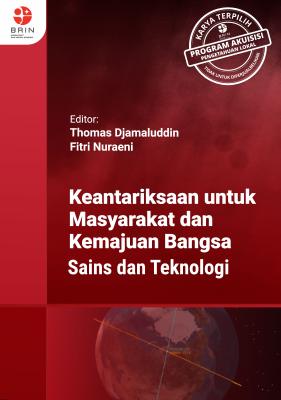
Buku berjudul Keantariksaan untuk Masyarakat dan Kemajuan Bangsa: Sains dan Teknologi ini menyajikan pembahasan keantariksaan dalam spektrum sains dan teknologinya. Di antaranya meliputi perkembangan sains antariksa seperti pengamatan aktivitas matahari (sunspot), dinamika ionosfer regional, dan medan geomagnet, serta mitigasi bencana antariksa yang mencakup analisis sampah antariksa dan potensi tumbukan asteroid.
Di ranah teknologi, buku ini mengupas upaya kemandirian teknologi roket nasional, termasuk teknik pelapisan nosel dan pengembangan propelan padat, serta kemajuan infrastruktur pengamatan melalui pengembangan teleskop radio dan pembangunan Observatorium Nasional Timau. Selain itu, buku ini juga menjembatani sains dengan kebutuhan sosioreligius masyarakat Indonesia melalui kajian ilmiah terkait batasan jendela pengamatan hilal.
Buku ini hadir sebagai referensi esensial bagi akademisi, peneliti, pengambil kebijakan, dan masyarakat umum untuk memahami urgensi serta kontribusi nyata sektor keantariksaan dalam mendukung pembangunan berkelanjutan dan kemajuan bangsa Indonesia.
Arlt, R., & Vaquero, J. M. (2020). Historical sunspot records. Living Reviews in Solar Physics, 17, 1-60.
Berghmans, D., Van der Linden, R. A. M., Vanlommel, P., Clette, F., & Robbrecht, E. (2006). History of the Sunspot Index: 25 years SIDC. Beitrage zur Geschichte der Geophysik und Kosmischen Physik, 7(1), 288.
Boteler, D. H. (2019). A 21st Century View of the March 1989 Magnetic Storm. Space Weather, 17(10), 1427–1441.
Carrasco, V. M. S., Lefèvre, L., Vaquero, J. M., & Gallego, M. C. (2015). Equivalence Relations Between the Cortie and Zürich Sunspot Group Morphological Classifications. Solar Physics, 290(5), 1445–1455.
Casanovas, J. (1997). Early observations of sunspots: Scheiner and Galileo. In 1st Advances in Solar Physics Euroconference. Advances in Physics of Sunspots (Vol. 118, p. 3).
Clette, F. (2018). The sunspot number: historical base, current recalibration and scientific impact. In Proc. Fifth Symp. “Historical Astronomical Records and Modern Science”, National Astronomical Observatory, Tokyo (Vol. 62).
Clette, F., Berghmans, D., Vanlommel, P., Van der Linden, R. A., Koeckelenbergh, A., & Wauters, L. (2007). From the Wolf number to the International Sunspot Index: 25 years of SIDC. Advances in Space Research, 40(7), 919-928.
Clette, F., Cliver, E. W., Lefèvre, L., Svalgaard, L., Vaquero, J. M., & Leibacher, J. W. (2016). Preface to topical issue: recalibration of the sunspot number. Solar Physics, 291, 2479-2486.
Clette, F., Svalgaard, L., Vaquero, J. M., & Cliver, E. W. (2014). Revisiting the Sunspot Number. A 400-Year Perspective on the Solar Cycle. Space Science Reviews, 186, 35–103.
Cortie, A. L. (1901). On the Types of Sun-Spot Disturbances. Astrophysical Journal, 13.
Djafer, D., Irbah, A., & Meftah, M. (2012). Identification of Sunspots on Full-Disk Solar Images Using Wavelet Analysis. Solar Physics, 281(2), 863–875.
Eddy, J. A., Stephenson, F. R., & Yau, K. K. (1989). On pre-telescopic sunspot records. Royal Astronomical Society, Quarterly Journal (ISSN 0035-8738), vol. 30, March 1989, p. 65-73., 30, 65-73.
Hathaway, D. H. (2015). The solar cycle. Living reviews in solar physics, 12(1), 4.
Hossfield, C. H. (2002). A history of the Zurich and American relative sunspot number indices. Journal of the American Association of Variable Star Observers, Vol. 31, No. 1, p. 48-53, 31, 48-53.
Hoyt, D. V., & Schatten, K. H. (1998). Group sunspot numbers: A new solar activity reconstruction. Solar physics, 179, 189-219.
J.M. Vaquero. (2007). Historical sunspot observations: A review. Advances in Space Research, 40(7), 929–941.
Krivsky, L. (1972) dalam McIntosh, P. S. (1990). The Classification of Sunspot Groups. Solar Physics, 125(2), 251–267.
McIntosh, P. S. (1981). The birth and evolution of sunspots-Observations. In The physics of sunspots (pp. 7-54).
McIntosh, P. S. (1990). The Classification of Sunspot Groups. Solar Physics, 125(2), 251–267.
Mossman, J. E. (1989). A comprehensive search for sunspots without the aid of a telescope, 1981-1982. Royal Astronomical Society, Quarterly Journal (ISSN 0035-8738), vol. 30, March 1989, p. 59-64., 30, 59-64.
NOAA (2024). Retrieved Mei 14, 2024, from https://www.ngdc.noaa.gov: https://www.ngdc.noaa.gov/stp/solar/ssndata.html
Schaefer, B. E. (1997). Automatic Inflation in the AAVSO Sunspot Number. The Journal of the American Association of Variable Star Observers, vol. 26, no. 1, p. 40-46, 26, 40-46.
Shapley, A. H. (1949). Reduction of sunspot-number observations. Publications of the Astronomical Society of the Pacific, 61(358), 13-21.
SILSO (2024a). Retrieved Mei 2, 2024, from www.sidc.be: https://www.sidc.be/SILSO/yearlyssnplot
SILSO (2024b). Retrieved Mei 17, 2024, from www.sidc.be: https://sidc.be/SILSO/DATA/GroupNumber/GNobservers_JV_V1-12.txt
SILSO (2024c). Retrieved Mei 2, 2024, from www.sidc.be: https://www.sidc.be/WOLF/products/K_index_V2.php
Solanki, S. K. (2003). THE ASTRONOMY AND ASTROPHYSICS Sunspots: An overview. The Astronomy and Astrophysics Review, 1769, 153–286.
Svalgaard, L., & Schatten, K. H. (2016). Reconstruction of the sunspot group number: the backbone method. Solar Physics, 291, 2653-2684.

This work is licensed under a Creative Commons Attribution-NonCommercial-ShareAlike 4.0 International License.