



























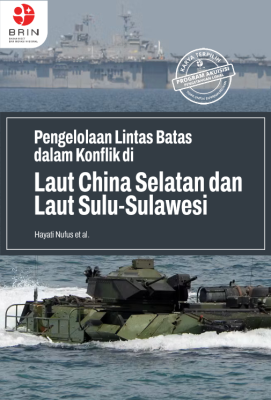
Sebagai negara kepulauan, Indonesia memiliki garis pantai yang membentang ribuan kilometer. Hal ini tentu menciptakan tantangan sendiri bagi Indonesia terkait masalah stabilitas keamanan dan kedaulatan negara. Sebagaimana yang dapat dilihat pada kajian buku ini atas Laut China Selatan dan Laut Sulu-Sulawesi yang merupakan wilayah perairan jalur stategis dunia dan bersinggungan dengan beberapa negara.
Buku ini merupakan buah kerja keras Tim Perbatasan Pusat Riset Politik BRIN selama periode 2020-2022. Mereka melakukan penelitian mendalam untuk memahami kompleksitas dan tantangan yang dihadapi Indonesia di dua kawasan strategis ini. Bagaimana Indonesia menjaga kepentingannya dan sekaligus memainkan peran yang konstruktif dalam mengelola konflik di kedua wilayah perairan ini.
Buku ini juga menawarkan wawasan yang komprehensif mengenai bagaimana Indonesia dapat memanfaatkan aktivitas lintas batas sebagai salah satu strategi dalam mengelola konflik yang terjadi. Lebih dari sekadar kajian akademis, buku ini juga berusaha menggarisbawahi pentingnya pendekatan humanis dan diplomatis dalam menghadapi tantangan geopolitik. Membuka jalan untuk pengelolaan konflik yang lebih efektif; tidak hanya menjaga perdamaian, tetapi juga mempromosikan kesejahteraan bagi masyarakat di sepanjang perbatasan.
Agasta, C., Susetyorini, P., & Setyawanto, L.T. (2017). Hak berdaulat negara kesatuan republik Indonesia di kepulauan Natuna (studi khusus Indonesia terhadap klaim peta nine-dashed line China di kepulauan Natuna). Diponegoro Law Journal 6(2), 1-13. http://www.ejournal-s1.undip.ac.id/index.php/dlr/.
Agreement between the Government of Malaysia and the Government of Indonesia on the delimitation of the continental shelves between the two countries, 27 October 1969.
Agreement on Border Trade between the Government of the Republic of Indonesia and the Government of Malaysia, 24 Agustus 1970.
Agreement on Border Trade between the Government of the Republic of Indonesia and the Government of the Republic of the Philippines, 8 Agustus 1974.
Allerton, Catherine. Statelessness and the Lives of the Children of Migrants in Sabah, East Malaysia. Tilburg Law Review 19 (2014): 26-34.
Ambarina, Dwi, R.K., Mahendra, P.K., and Syukri, H., Legal status of MoU determining the limits of the territory area between Indonesia and Malaysia, Mulawarman Law Review, vol. 5, no.2, December 2020.
Amling, Alexandra; Bell, Curtis; Salleh, Asyura; Benson, Jay; Duncan, Sean. Stable Seas: Sulu & Celebes Seas. One Earth Future, 19 Februari 2019.
Ansyari, Syahrul. (2016, Maret 24). “Pemerintah Akan Jadikan Perairan Natuna Pangkalan Militer.” https://www.viva.co.id/berita/nasional/751812-pemerintah-akan-jadikan-perairan-natuna-pangkalan-militer.
Anten, Jaap. (2021, Juni 30). “Europese Militaire Bijdrage Zuid-Chinese Zee Verandert Niets.” https://spectator.clingendael.org/nl/publicatie/europese-militaire-bijdrage-zuid-chinese-zee-verandert-niets.
ASEANstats. “Trade in goods (IMTS), annually, HS 2-digit up to 8-digit (AHTN), in US$.” 30 Oktober 2021. https://data.aseanstats.org/trade-annually.
Asian Development Bank. Comprehensive action plans of the Sulu–Sulawesi Marine Ecoregion: A priority seascape of the Coral Triangle Initiative. Mandaluyong City, Philippines: Asian Development Bank, 2011. https://www.adb.org/sites/default/files/publication/29160/ssme-action-plans.pdf Diakses 10 Oktober 2021.
Badan Pusat Statistik Kabupaten Natuna. 2021. “Kabupaten Nunukan Dalam Angka 2021”.
Bar-Tal dan Bennink. (2004). “The Nature of Reconciliation as an Outcome and as a Process”. Dalam Yaacov Bar-Siman-Tov (ed.). From Conflict Resolution to reconciliation. Oxford University Press.
BIMP-EAGA. BIMP-EAGA Vision 2025. 1 April 2017.
BIMP-EAGA. Implementation Blueprint 2012-2016. 1 Maret 2012.
Bing, Ngeow Chow. China’s growing cooperation with BIMP-EAGA. East Asia Forum. 23 September 2021. https://www.eastasiaforum.org/2021/09/23/chinas-growing-cooperation-with-bimp-eaga/ Diakses 6 Oktober 2021.
Black, Ian. 1985. The Lastposten Eastern Kalimantan and the Dutch in the Nineteenth and Early Twentieth Centuries. Journal of Southeast Asian Studies. Vol. 16/2 (September): 281-291.

This work is licensed under a Creative Commons Attribution-NonCommercial-ShareAlike 4.0 International License.
This book that publish in BRIN Publishing is licensed under a Creative Commons Attribution Non-commercial Share Alike 4.0 International license (CC BY-NC-SA 4.0). This license permits you to share, copy, distribute and transmit the work for your personal use and non-commercial purposes, provided you provide appropriate attribution. Derivative works and modifications must use the same license. Detailed information regarding the CC-BY-NC-SA 4.0 license is available via the link: https://creativecommons.org/licenses/by-nc-sa/4.0/
BRIN Publishing has a program named Akuisisi Pengetahuan Lokal that acquisition any of books or audiovisual content that meet our standard publication. The rights of BRIN Publishing is to disseminate and distribute all the content acquisitions for the public.
As an author you (or your employer or institution) may do the following:
All copies, print or electronic, or other use of the paper or article must include the appropriate bibliographic citation for the books


