

























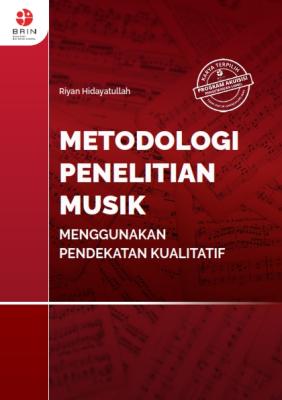
Metodologi penelitian merupakan fondasi utama dalam setiap kerja ilmiah, termasuk dalam bidang musik. Sayangnya, literatur metodologi penelitian yang secara khusus membahas musik masih sangat terbatas di Indonesia—terutama yang ditulis dalam bahasa Indonesia dengan pendekatan yang kontekstual dan praktis. Sebagian besar sumber yang tersedia ditulis dalam bahasa asing dengan kerangka pikir yang belum tentu sesuai dengan kebutuhan peneliti lokal, sehingga menciptakan kesenjangan literasi metodologis yang cukup signifikan di kalangan mahasiswa maupun peneliti pemula.
Metodologi Penelitian Musik: Menggunakan Pendekatan Kualitatif hadir untuk mengisi kekosongan tersebut. Buku ini membahas secara sistematis dan komprehensif berbagai aspek esensial dalam penelitian musik, mulai dari landasan teoretis, perumusan masalah, tahapan penelitian, teknik pengumpulan data, analisis dan interpretasi data, pengabsahan data, hingga ragam desain penelitian seperti etnografi, fenomenologi, grounded theory, etnomusikologi, dan analisis konten. Buku ini juga mengulas cara menyusun laporan penelitian dan mempublikasikan hasilnya di jurnal ilmiah, prosiding, maupun book chapter. Dilengkapi dengan contoh-contoh penerapan yang berpijak pada konteks musik lokal Indonesia, buku ini dapat digunakan sebagai panduan praktis sekaligus referensi akademis bagi mahasiswa, dosen, dan peneliti di bidang musik.
Abrahams, F. (2005). The Application of Critical Pedagogy to Music Teaching and Learning: A Literature Review. Update: Applications of Research in Music Education, 23(2), 12–22. https://doi.org/10.1177/87551233050230020103
Ahimsa-Putra, H. S. (2015). Seni tradisi, jati diri dan strategi kebudayaan. Jurnal Ilmu Sosial Mamangan, 4(1), 1–16. https://doi.org/10.22202/mamangan.1195
Ahmed, S. K. (2024). The pillars of trustworthiness in qualitative research. Journal of Medicine, Surgery, and Public Health, 2, 100051. https://doi.org/10.1016/j.glmedi.2024.100051
American Musicological Society. (n.d.). What is musicology? - American Musicological Society [Webpage]. https://www.amsmusicology.org/page/whatismusicology
Anzul, M., Downing, M., Ely, M., & Vinz, R. (2003). On writing qualitative research: Living by words. Routledge.
Ariyani, F., Hidayatullah, R., Putrawan, G. E., Perdana, R., Sulaeman, D., & Dzakiria, H. (2023). Translating the Lampung oral literature into music for educational purpose: A case atudy of pisaan on the Indonesian Island of Sumatra. Education Research International, 2023, 1–11. https://doi.org/10.1155/2023/8643881
Baker, P. R., Francis, D. P., Hall, B. J., Doyle, J., & Armstrong, R. (2010). Managing the production of a Cochrane systematic review. Journal of Public Health, 32(3), 448–50.
Bandura, A. (1977). Social learning theory. Prentice Hall.
Barendregt, B. (2021). Digital ethnography, or “deep hanging out” in the age of big data. In Audiovisual and digital ethnography: A practical and theoretical guide. Routledge.
Bazeley, P., & Jackson, K. (2013). Qualitative data analysis with NVivo (Second edition). SAGE.
Baumeister, R. F., & Leary, M. R. (1997). Writing Narrative Literature Reviews. Review of General Psychology, 1(3), 311–320. https://doi.org/10.1037/1089-2680.1.3.311
Bazeley, P., & Jackson, K. (2013). Qualitative data analysis with NVivo (Second edition). SAGE.
Beck, L. C., Trombetta, W. L., & Share, S. (1986). Using focus group sessions before decisions are made. North Carolina Medical Journal, 47(2), 73–74.
Beer, L. (2013). Qualitative music. The Qualitative Report, 18(21), 1–11. Retrieved from https://doi.org/10.46743/2160-3715/2013.1515
Bem, D. J. (1995). Writing a review article for Psychological Bulletin. Psychological Bulletin, 118(2), 172–77.
Bent, I. (1987). Analysis. MacMillan Press.
Birt, L., Scott, S., Cavers, D., Campbell, C., & Walter, F. (2016). Member Checking: A Tool to Enhance Trustworthiness or Merely a Nod to Validation? Qualitative Health Research, 26(13), 1802–1811. https://doi.org/10.1177/1049732316654870
Blacking, J. (2000). How musical is man? (6th ed.). University of Washington Press.
Blacking, J. (1971). Deep and surface structures in Venda music. Yearbook of the International Folk Music Council, 3, 91–108.
Bloch, M. E. F. (1998). How we think they think: Anthropological approaches to cognition, memory, and literacy. Westview Press.
Blumer, H. (1986). Interactionism: perspective and method. University of California Press.
Bresler, L. (2021). Qualitative paradigms in music education research. Visions of Research in Music Education, 16(3), 64–79.
Bogdan, R. C., & Biklen, S. K. (1982). Qualitative research for education: An intoduction to theory and methods. Allyn and Bacon, Inc.
Booth, A., Sutton, A., & Papaioannou, D. (2016). Systematic approaches to a successful literature review (Second edition). Sage.
Borgdorff, H. (2012). The conflict of the faculties. perspectives on artistic research and academia. Leiden University Press.
Bowen, G. A. (2009). Document Analysis as a Qualitative Research Method. Qualitative Research Journal, 9(2), 27–40. https://doi.org/10.3316/QRJ0902027
Burnard, P. (2004). Writing a qualitative research report. Accident and Emergency Nursing, 12(3), 176–181. https://doi.org/10.1016/j.aaen.2003.11.006
Byrne, D., & Callaghan, G. (2014). Complexity theory and the social sciences. Routledge.
Campbell, P. S. (2003). Ethnomusicology and music education: Crossroads for knowing music, education, and culture. Research Studies in Music Education, 21(1), 16–30. https://doi.org/10.1177/1321103X030210010201
Carr, E. H. (2001). What is history. Palgrave.
Carter, N., Bryant-Lukosius, D., DiCenso, A., Blythe, J., & Neville, A. J. (2014). The use of triangulation in qualitative research. Oncology Nursing Forum, 41(5), 545–547. https://doi.org/10.1188/14.ONF.545-547
Clarke, M., & Chalmers, I. (1998). Discussion sections in reports of controlled trials published in general medical journals. Islands in search of continents? JAMA, 280(280–2).
Charmaz, K. (2014). Constructing Grounded Theory (2nd Edition). Sonoma State University: SAGE Publications. https://uk.sagepub.com/en-gb/asi/constructing-grounded-theory/book235960
Collier, M. (2001). Approaches to analysis in visual anthropology. In T. V. Leeuwen & C. Jewitt (Eds.), Handbook of visual analysis (pp. 35–60). Sage.
Cook, N. (1987). A guide to musical analysis. W.W. Norton & Company.
Cooley, T. J., & Gregory, B. (2008). Casting Shadows in the Field: An Introduction. In Shadows in the Field: New Perspectives for Fieldwork in Ethnomusicology (2nd ed). Oxford University Press.
Crawford, T., & Gibson, L. (Eds.). (2009). Modern Methods for Musicology. Ashgate Publishing limited.
Creswell, J. W. (2012). Educational research: Planning, conducting, and evaluating quantitative and qualitative research (4th ed). Pearson.
Croft, J. (2015). Composition is not research. Tempo, 69(272), 6–11. https://doi.org/10.1017/S0040298214000989
Crowe, S., Cresswell, K., Robertson, A., Huby, G., Avery, A., & Sheikh, A. (2011). The case study approach. BMC Medical Research Methodology.
Daigneault, P. M., Jacob, S., & Ouimet, M. (2014). Using systematic review methods within a Ph D dissertation in political science: Challenges and lessons learned from practice. International Journal of Social Research Methodology, 17(3), 267–83.
Daveson, B. A. (2016). Charting the terrain of grounded theory research in music therapy: Where we’ve been and where we have the potential to go. In J. Edwards (Ed.), The Oxford handbook of music therapy (pp. 748–767). Oxford University Press.
Deacon, S. A. (2006). Creativity within qualitative research on families: New ideas for old methods. In S. N. Hesse-Biber & P. Leavy (Eds.), Emergent methods in social research (pp. 95–108). Sage.
Denzin, N. K. (1978). Sociological methods: A sourcebook. McGraw-Hill.
Denzin, N. K., & Lincoln, Y. S. (Eds.). (2018). The SAGE handbook of qualitative research (5th ed.). SAGE Publications, Inc.
Denzin, N. K., & Lincoln, Y. S. (1994). Introduction: Entering the field of qualitative research. In N. K. Denzin & Y. S. Lincoln (Eds.), Handbook of Qualitative Research (pp. 1–22). SAGE. https://cir.nii.ac.jp/crid/1573668925240107904
DeVoto, M. (2003). Analysis. In M. Randel (Ed.), The Harvard Dictionary of Music (4th edition). Harvard University Press.
Dogantan-Dack, M. (Ed.). (2016). Artistic practice as research in music: Theory, criticism, practice. Routledge. https://www.taylorfrancis.com/books/9781317178217
Drisko, J. W. (1997). Strengthening Qualitative Studies and Reports: Standards to Promote Academic Integrity. Journal of Social Work Education, 33(1), 185–197. https://doi.org/10.1080/10437797.1997.10778862
Drisko, J. W. (2005). Writing up Qualitative Research. Families in Society, 86(4), 589–593. https://doi.org/10.1606/1044-3894.3465
Eisenhardt, K. (1989). Building theories from case study research. Academy of Management Review, 14, 532–550.
Feagin, J. R., Orum, A. M., & Sjoberg, G. (Eds.). (1991). A case for the case study. University of North Carolina Press.
Ferreira, C. S. A. (2012). Second Life: Representation and remediation of social space (Unpublished Catholic University of Portugal Doctoral Dissertation). Catholic University of Portugal.
Flyvbjerg, B. (2011). Case study. In N. K. Denzin & Y. S. Lincoln (Eds.), The SAGE handbook of qualitative research (4th ed, pp. 301–316). Sage.
Fine, M. (1994). Working the hyphens: Reinventing the self and other in qualitative research. In Denzin & Y. S. Lincoln (Eds.), Handbook of qualitative research (pp. 70–82). SAGE.
Fink, A. (2005). Conducting Research Literature Reviews: From the Internet to Paper (2nd Edition). SAGE.
Folkestad, G. (2006). Formal and informal learning situations or practices vs formal and informal ways of learning. British Journal of Music Education, 23(2), 135–145. https://doi.org/10.1017/S0265051706006887
Erickson, K. C., & Stull, D. D. (1997). Doing team ethnography. Sage Publications.
Gelir, I. (2021). Can insider be outsider? Doing an ethnographic research in a familiar setting. Ethnography and Education, 16(2), 226–242. https://doi.org/10.1080/17457823.2021.1905535
Garfinkel, H. (1967). Studies in ethnomethodology. Prentice-Hall.
Garraghan, G. J. (1957). A Guide to Historical Method (4th ed.). United States of America: Fordham University Press.
Giddens, A. (1991). Sociology. Polity Press.
Given, L. M. (2008). Researcher as instrument. In The SAGE Encyclopedia of Qualitative Research Methods (pp. 767-767). , (pp. 767–767). SAGE Publications, Inc. https://doi.org/10.4135/9781412963909
Glaser, B. G., & Strauss, A. L. (1967). The discovery of grounded theory: Strategies for qualitative research. Aldine Transaction.
Golden-Biddle, K., & Locke, K. (2007). Composing Qualitative Research. SAGE Publications, Inc. http://methods.sagepub.com/book/composing-qualitative-research
Green, L. (2008). Music, informal learning and the school: A new classroom pedagogy. Ashgate.
Grover, V. K. (2015). Research approach: An overview. Golden Research Thoughts, 4(8), 1–8.
Geertz, C. (1973). Thick description: Toward an interpretive theory of culture. In C. Greetz (Ed.), The interpretation of cultures (pp. 2–30). Basic Books.
George, A., & Bennett, A. (2004). Case studies and theory development in the social sciences. MIT Press.
Gerring, J. (2004). What is a case study and what is it good for? American Political Science Review, 98, 341–354.
Giorgi, A. (Ed.). (1985). Phenomenology and psychological research. Duquesne University Press.
Given, L. M. (2008). Music in qualitative research. In The SAGE Encyclopedia of Qualitative Research Methods. SAGE Publications.
Guntur. (2016a). Metode penelitian artistik. (A.N. Panindias,Ed.). ISI Press. https://penerbitan.isi-ska.ac.id/
Guntur. (2016b). Penelitian artistik: Sebuah paradigma alternatif.
Hart, C. (1998). Doing a Literature Review: Releasing the Social Science Research Imagination. Sage.
Herbst, J.-P., & Mynett, M. (2022). What is “Heavy” in Metal? A Netnographic Analysis of Online Forums for Metal Musicians and Producers. Popular Music and Society, 45(5), 633–653. https://doi.org/10.1080/03007766.2022.2114155
Hess, J. (2020). Finding the “both/and”: Balancing informal and formal music learning. International Journal of Music Education, 38(3), 441–455. https://doi.org/10.1177/0255761420917226
Hesse-Biber, S. N., & Leavy, P. (Eds.). (2006). Emergent methods in social research. Sage.
Hartwig, K. A. (Ed.). (2014). Research methodologies in music education. Cambridge Scholars Publishing.
Hidayatullah, R. (2022). Analisis musik. Yogyakarta: Arttex. http://grahailmu.id/arttex/produk/analisis-musik/
Hidayatullah, R. (2022b). Desain penelitian musik di era digital (sebuah tinjauan studi literatur). Virtuoso: Jurnal Pengkajian Dan Penciptaan Musik, 5(1), 28–40. https://doi.org/10.26740/vt.v5n1.p28-40
Hidayatullah, R. (2022). Merefleksikan netnografi untuk penelitian seni (resensi buku). Pelataran Seni, 7(1), 61–72. https://doi.org/10.20527/jps.v7i1.13394
Hidayatullah, R. (2024). Gitar tunggal Lampung Pesisir: Eksistensi, enkulturasi, dan pewarisan musik informal dalam perspektif etnopedagogi. BRIN.
Hine, C. (2000). Virtual ethnography. SAGE.
Hine, C. (2015). Ethnography for the internet. Bloomsbury Academic.
Hodeir, A. (1966). The forms of music. Walker.
Holloway, I. (2005). Qualitative Research in Health Care. McGraw-Hill Education (UK).
Hood, M. (1971). The ethnomusicologist. Kent State University Press.
Hopkins, C. D. (1976). Educational research: A structure for inquiry. Charles E. Merrill, Chapters 1 and 2.
Hughes, D. W. (1988). Deep structure and surface structure in Javanese music A grammar of gendhing lampah. Journal of the Society for Ethnomusicology, 32(1), 23–74. http://dx.doi.org/10.2307/852225
Irawan, R. (2013). Deep structure pada peting gambus dan gitar Lampung Pesisir (Master Thesis). Pasca Sarjana Kajian Musik Nusantara, Institut Seni Indonesia Surakarta, Surakarta, Jawa Tengah.
Irawan R, R. (2016). Ritme inti pada gambus dan gitar Lampung Pesisir: Sebuah kajian transformasi musikal. In M. Widodo, U. Suparman, Sumarti, & E. S. Agustina (Eds.), Prodising Konferensi Internasional VI, Bahasa, Sastra, dan Budaya Daerah Indonesia (pp. 461–472). Bandar Lampung: Program Studi Magister Pendidikan Bahasa, Sastra, dan Daerah (MPBSD) Fakultas Keguruan dan Ilmu PendidikanUniversitas Lampung.
Janesick, V. J. (2011). Stretching exercises for qualitative researchers (3rd ed). SAGE Publications.
Jarzabkowski, P., Bednarek, R., & Cabantous, L. (2015). Conducting global team-based ethnography: Methodological challenges and practical methods. Human Relations, 68(1), 3–33. https://doi.org/10.1177/0018726714535449
Jones, N. R. (1997). Improvisation in the beginning piano class (Thesis). North Texas State University, Denton, Texas.
Kant, I. (1923). Kritik Der Reinen Vernunft (German Edition). Philipp Reclam, Jun Verlag GmbH.
Karlin, F., & Wright, R. (2004). On the Track: A Guide to Contemporary Film Scoring (2nd Ed). Routledge.
Keen, P. (2022). aural archipelago [Situs Web]. https://www.auralarchipelago.com
Ketelle, D. (2010). The ground they walk on : Photography and narrative inquiry. The Qualitative Report, 15(3), 547–568.Kirk, J., & Miller, M. L. (1986). Reliability and validity in qualitative research (Vol. 1). SAGE Publications.
Koentjaraningrat. (1974). Kebudayaan, mentalitas, dan pembangunan. Gramedia.
Kolinski, M. (1959). The evaluation of tempo. Ethnomusicology, 3, 45–56.
Kostova, I. (2017). Thick Description. In The Wiley-Blackwell Encyclopedia of Social Theory (pp. 1–2). John Wiley & Sons, Ltd. https://doi.org/10.1002/9781118430873.est0774
Kozinets, R. V. (1998). On netnography: Initial reflections on consumer research investigations of cyberculture. In J. Alba & W. Hutchinson (Eds.), NA - Advances in consumer research (Vol. 25, pp. 366–371). Provo, UT: Association for Consumer Research. https://www.acrwebsite.org/volumes/8180/volumes/v25/NA-25/full
Kozinets, R. V. (2002). The Field behind the Screen: Using Netnography for Marketing Research in Online Communities. Journal of Marketing Research, 39(1), 61–72.
Kozinets, R. V. (2015). Netnography: Redefined. (M. Steele,Ed.) (2nd Ed). SAGE Publications Ltd.
Kramer, L. (2002). Musical Meaning: Toward a Critical History. University of California Press.
Krueger, R. A. (1998). Developing Questions for Focus Groups. SAGE Publications.
Kunst, J. (1974). Ethnomusicology: A study of its nature, its problems, methods and representative personalities to which is added a bibliography (3rd ed.). Dordrecht: Springer Netherlands. http://public.ebookcentral.proquest.com/choice/publicfullrecord.aspx?p=3103785
Lacey, A., & Luff, D. (2009). Qualitative data analysis. Trent Focus Group.
LeCompte, M. D., Klinger, J. K., Campbell, S. A., & Menke, D. W. (2003). Editor’s introduction. Review of Educational Research, 73(2), 123–4.
Letule, N., Ala-Ruona, E., & Erkkilä, J. (2018). Professional freedom: A grounded theory on the use of music analysis in psychodynamic music therapy. Nordic Journal of Music Therapy, 27(5), 448–466. https://doi.org/10.1080/08098131.2018.1490920
Lincoln, Y. S., & Guba, E. G. (1985). Naturalistic inquiry. SAGE Publications.
Lochhead, J. (1986). Phenomenological approaches to the analysis of music: Report from Binghamton. In Theory and practice,11 (pp. 9–13). http://www.jstor.org/stable/41054204
Lofland, J., & Lofland, L. H. (1984). Analyzing social settings: A guide to qualitative observation and analysis. Wads worth Publishing Company.
Lysoff, R. T. A. (1997). Mozart in Mirrorshades: Ethnomusicology, Technology, and the Politics of Representation. Ethnomusicology, 41(2), 206–219.
Mahoney, J. (2007). Qualitative methodology and comparative politics. Comparative Political Studies, 40, 122–144.
Martopo, H. (2006). Paradigma baru penelitian seni. Harmonia: Journal of Arts Research and Education, 7(3). https://doi.org/10.15294/harmonia.v7i3.737
Maryaeni. (2012). Metode penelitian kebudayaan (Cetakan ke-3). Bumi Aksara.
Maslow, A. H. (1954). Motivation and personality. Harper & Row, Publishers , Inc.
Mavhandu-Mudzusi, A. H., Moyo, I., Mthombeni, A., Ndou, A., Mamabolo, L., Ngwenya, T., Marebane, T., & Netshapapame, T. (2022). WhatsApp as a Qualitative Data Collection Method in Descriptive Phenomenological Studies. International Journal of Qualitative Methods, 21, 16094069221111124. https://doi.org/10.1177/16094069221111124
Maxwell, J., & Miller, B. (Eds.). (2008). Categorising and connecting strategies in qualitative data analysis. In Handbook of emergent methods. Guildford Press.
Miksza, P., & Elpus, K. (2018). Design and Analysis for Quantitative Research in Music Education. Oxford University Press.
McGhee, G., Marland, G. R., & Atkinson, J. (2007). Grounded theory research: Literature reviewing and reflexivity. Journal of Advanced Nursing, 60(3), 334–42.
Mead, M. (1935). Sex and temperament in three primitive societies. Routledge and Kegan Paul.
Mead, M. (2002). Cooperation and Competition Among Primitive Peoples. Transaction Publishers.
Merriam, A. P. (1964). The anthropology of music. Northwestern University Press.
Messick, S. (1989). Meaning and Values in Test Validation: The Science and Ethics of Assessment. Educational Researcher, 18(2), 5–11. https://doi.org/10.3102/0013189X018002005
Mielke, S., & Andrews, B. W. (2023). Composing for students: Composers’ reflections on the process of creating educational music. Research Studies in Music Education, 45(2), 379–396. https://doi.org/10.1177/1321103X221114613
Miles, M. B., & Huberman, A. M. (1994). Qualitative data analysis: An expanded sourcebook (2nd ed.). Sage Publications, Inc.
Miles, M. B., Huberman, A. M., & Saldaña, J. (2014). Qualitative data analysis: A methods sourcebook (Third edition). SAGE Publications, Inc.
Moher, D., Liberati, A., Tetzlaff, J., & Altman, D. G. (2009). Preferred Reporting Items for Systematic Reviews and Meta-Analyses: The PRISMA Statement. Annals of Internal Medicine, 151(4), 264–269. https://doi.org/10.7326/0003-4819-151-4-200908180-00135
Moleong, L. J. (2017). Metodologi penelitian kualitatif (36th ed.). PT. Remaja Rodakarya.
Monash University. (2025). Using academic journal articles for research and study [Monash University]. Student Academic Success. https://www.monash.edu/student-academic-success/study-better/develop-strategies-for-reading-and-note-making/using-academic-journal-articles-for-research-and-study
Morse, J. M. (1994). Critical Issues in Qualitative Research Methods. SAGE.
Moustakas, C. E. (2009). Phenomenological research methods (Nachdr.). Sage.
Mulrow, C. D. (1995). Rationale for systematic reviews. In I. Chalmers & D. Altman (Eds.), Systematic Reviews. MJ Publishing Group.
Murchison, J. M. (2010). Ethnography essentials: Designing, conducting, and presenting your research (1st ed). Jossey-Bass.
Murdock, G. P. (1956). How culture changes. In H. L. Shapiro (Ed.), Man, culture, and society (pp. 247–260). Oxford University Press.
Neal, A. S. (2017, August 9). Hammers (2015) for toy piano [score video]. Adam Scott Neal. https://www.youtube.com/watch?v=-hM-ZfjMQn0
Neal, A. S. (2023, October 10). Music composition as research [Blog]. Retrieved 8 January 2025 from https://soundpudding.com/music-composition-as-research
Nettl, B. (1964). Theory and method ethnomusicology. Free Press of Glencoe.
Nettl, B. (1983). The Study of Ethnomusicology (New, Vol. 7). University of Illinois Press. https://www.jstor.org/stable/780225?origin=crossref
Nettl, B. (2005). An ethnomusicological perspective. International Journal of Music Education, 23(2), 131–133. https://doi.org/10.1177/0255761405052407
Neuman, L. W. (2014). Basics of Social Research: Qualitative & quantitative approaches. Pearson Education Limited.
OECD. (2015). Frascati Manual 2015: Guidelines for Collecting and Reporting Data on Research and Experimental Development. Paris: Organisation for Economic Co-operation and Development. https://www.oecd-ilibrary.org/science-and-technology/frascati-manual-2015_9789264239012-en
Olmos-Vega, F. M., Stalmeijer, R. E., Varpio, L., & Kahlke, R. (2023). A practical guide to reflexivity in qualitative research: AMEE Guide No. 149. Medical Teacher, 45(3), 241–251. https://doi.org/10.1080/0142159X.2022.2057287
O’Neill, S. A. (2014). Mind the gap: Transforming music engagement through learner-centred informal music learning. The Recorder: Journal of the Ontario Music Educators’ Association, 56(2), 18–22.
O’Reilly, K. (2009). Insider ethnographies. In Key Concepts in Ethnography. SAGE Publications Ltd. https://dx.doi.org/10.4135/9781446268308
Parkin, S., Locock, L., Montgomery, C., & Chisholm, A. (2021). ‘Team ethnography visual maps’: Methods for identifying the ethnographic object in multiple sites of fieldwork. Ethnography, 22(4), 556–577. https://doi.org/10.1177/14661381211038383
Perkins, A. (2010). Identification in popular music: A netnographic exploration of online fan communities. In Proceedings of the Australian and New Zealand Marketing Academy Conference. http://anzmac2010. org/proceedings/pdf/anzmac10Final00030. pdf.
Patton, M. Q. (1999). Enhancing the quality and credibility of qualitative analysis. Health Services Research, 34(5 Pt 2), 1189–1208.
Pezalla, A. E., Pettigrew, J., & Miller-Day, M. (2012). Researching the researcher-as-instrument: An exercise in interviewer self-reflexivity. Qualitative Research, 12(2), 165–185. https://doi.org/10.1177/1468794111422107
Phelps, R. P., Sadoff, R. H., Warburton, E. C., & Ferrara, L. (2005). A guide to research in music education (5th edition). The Scarecrow Press, Inc.
Phillippi, J., & Lauderdale, J. (2018). A Guide to Field Notes for Qualitative Research: Context and Conversation. Qualitative Health Research, 28(3), 381–388. https://doi.org/10.1177/1049732317697102
Polit, D. F., & Beck, C. T. (2012). Nursing Research: Generating and Assessing Evidence for Nursing Practice. Lippincott Williams & Wilkins.
Przybylski, L. (2020). Hybrid ethnography: Online, offline, and in between (Vol. 58). SAGE Publications, Inc.
Pudaruth, S., Moheeputh, S., Permessur, N., & Chamroo, A. (2018). Sentiment analysis from facebook comments using automatic coding in NVivo 11. ADCAIJ: Advances in Distributed Computing and Artificial Intelligence Journal, 7(1), 41–48. https://doi.org/10.14201/ADCAIJ2018714148
Putra, R. E. K., Rachman, A., Raharjo, E., & Suharto, S. (2021). Interaksi simbolik pada pertunjukan musik keroncong oleh Orkes Keroncong Gunung Jati new musik di Stasiun Tawang Semarang. Gondang: Jurnal Seni Dan Budaya, 5(1), 30–39. https://doi.org/10.24114/gondang.v5i1.19996
Ragin, C. C. (1992). Introduction: Cases of “what is a case?” In C. C. Ragin & H. Becker (Eds.), What is a case? Exploring the foundations of social inquiry (pp. 1–17). Cambridge University Press.
Ragin, C. C., & Amoroso, L. M. (2011). Constructing social research (2nd ed). Sage.
Randolph, J. (2009). A guide to writing the dissertation literature review. Practical Assessment, Research and Evaluation, 14(13).
Rice, T. (2014). Ethnomusicology: A very short introduction. Oxford University Press.
Rodgers, B. L., & Cowles, K. V. (1993). The qualitative research audit trail: A complex collection of documentation. Research in Nursing & Health, 16(3), 219–226. https://doi.org/10.1002/nur.4770160309
Riessman, C. K. (1994). Preface: Making room for diversity in social work research. In C. K. Riessman (Ed.), Qualitative studies in social work (pp. vii–xx). SAGE.
Rohidi, T. R. (2011). Metodologi penelitian seni. Cipta Prima Nusantara Semarang.
Roy, W., & Dowd, T. (2010). ‘What is sociological about music?’ Annual Review of Sociology, 36, 183-203 [Online]. https://www.annualreviews.org/content/journals/10.1146/annurev.soc.012809.102618
Ryan, G. W., & Bernard, H. R. (2003). Techniques to Identify Themes. Field Methods, 15(1), 85–109. https://doi.org/10.1177/1525822X02239569
Sage Publications. (2022). Methods Map: Ethnography: SAGE Research Methods [Website]. https://methods.sagepub.com/methods-map/ethnography
Sahlins, M. (1994). Goodbye to tristes tropique: Ethnography in the context of modern world history. In R. Borofsky (Ed.), Assessing cultural anthropology (pp. 377–395). McGraw-Hill, Inc.
Seale, C. (2003). Quality in qualitative research. In Y. S. Lincoln & N. K. Denzin (Eds.), Turning points in qualitative research: Tying knots in a handkerchief (Crossroads in Qualitative Inquiry No.3 (pp. 169–184). AltaMira Press.
Seeger, A. (1983). Why Suyá Sing. Oxford University Press.
Schwandt, T. A., & Gates, E. F. (2018). Case study methodology. In N. K. Denzin & Y. S. Lincoln (Eds.), The SAGE handbook of qualitative research (5th ed, pp. 600–630). SAGE Publications, Inc.
Schwandt, T. A. (2014). The SAGE Dictionary of Qualitative Inquiry. SAGE Publications.
Scrivener, S. A. R. (2002). The art object does not embody a form of knowledge. Working Papers in Art and Design. http://www.herts.ac.uk/artdes1/research/p apers/wpades/vol2/scrivenerfull.htm
Simaremare, L. (2017). Perubahan budaya musik dari perspektif teori kebudayaan. CIKINI: Jurnal Seni Nasional, 1(1), 7–25.
Simmons, H. (2009). Case study research in practice. Sage.
Slobin, M. (1993). Ethical Issues. In H. Meyers (Ed.), Ethnomusicology: An Introduction (pp. 329–336). Norton.
Stahl, N. A., & King, J. R. (2020). Expanding Approaches for Research: Understanding and Using Trustworthiness in Qualitative Research. Journal of Developmental Education, 44(1), 26–28.
Stake, R. R. (1995). The art of case study research. Sage.
Stein, L. (1979). Structure & style : The study and analysis of musical forms (Expanded). Summy-Birchard Inc.
Snyder, H. (2019). Literature review as a research methodology: An overview and guidelines. Journal of Business Research, 104, 333–339. https://doi.org/10.1016/j.jbusres.2019.07.039
Snyder, H. (2024). Designing the literature review for a strong contribution. Journal of Decision Systems, 33(4), 551–558. https://doi.org/10.1080/12460125.2023.2197704
Soeprapto. (2002). Interaksionisme simbolik. PT. Averroes Press.
Spradley, J. P. (1980). Participant Observation. Holt, Rinehart and Winston.
Stein, L. (1979). Structure & style: The study and analysis of musical forms (Expanded). Summy-Birchard Inc.
Strauss, A. L. (1987). Qualitative analysis for social scientists. Cambridge University Press.
Suthcott, J., & Sell, D. (2014). Historical research in music education. In K. A. Hartwig (Ed.), Research methodologies in music education (pp. 9–34). Cambridge Scholars Publishing.
Swanborn, P. (2010). Case study research: What, why, and how? Thousand Oaks, CA: Sage.
Takari, M. (2009). Etnomusikologi, ilmu-ilmu seni, dan pengembangan teori [Webpage]. https://www.etnomusikologiusu.com/artikel-etnomusikologi.html
Taylor, D. (2020, May 3). The literature review: A few tips on conducting it [Webpage]. University of Toronto: Writing Advice. https://advice.writing.utoronto.ca/types-of-writing/literature-review/
Tenor Boston. (2023). Call for Contributions – TENOR Conference Boston 2023 [Webpage]. https://tenorboston23.sites.northeastern.edu/call-for-contributions/
Thacher, D. (2006). The normative case study. American Journal of Sociology, 111, 1631–1676.
Thomson, S. B. (2011). Qualitative research: Validity. JOAAG, 6(1), 77–82.
Thornberg, R. (2012). Informed Grounded Theory. Scandinavian Journal of Educational Research, 56(3), 243–259. https://doi.org/10.1080/00313831.2011.581686
Tjahjadi, I., Andayani, S., & Wafa, H. (2020). Pengantar teori dan metode penelitian budaya. (A. Sutrisno & N. Hidayati,Eds.). Pagan Press.
Titon, J. T. (Ed.). (2009). Worlds of music: An introduction to the music of the world’s people (3rd ed.). Schirmer Cengage Learning.
Torraco, R. J. (2005). Writing Integrative Literature Reviews: Guidelines and Examples. Human Resource Development Review, 4(3), 356–367. https://doi.org/10.1177/1534484305278283
Tovey, D. F. (1935). Essays in musical analysis (Vol. I–VI). Oxford University Press.
Tovey, D. F. (2013). The forms of music. Read Books Limited.
Tovey, D. F. (2014). Symphonies and Other Orchestral Works: Selections from Essays in Musical Analysis. Courier Dover Publications.
Tranfield, D., Denyer, D., & Smart, P. (2003). Towards a Methodology for Developing Evidence-Informed Management Knowledge by Means of Systematic Review. British Journal of Management, 14(3), 207–222. https://doi.org/10.1111/1467-8551.00375
Tylor, E. B. (1871). Primitive culture (Vol. 1 & 2). John Murray.
USC Annenberg. (2018, February 28). Netnography: Robert Kozinets [YouTube]. YouTube. https://www.youtube.com/watch?v=F8axfYomJn4
Van Kaam, A. (1966). Existential foundations of psychology. Duquesne University Press.
Vaughan, D. (1992). Theory elaboration: The heuristics of case analysis. In C. C. Ragin & H. Becker (Eds.), What is a case: Exploring the foundations of social inquiry (pp. 173–202). Cambridge University Press.
Varto, J. (2009). Basics of artistic research: Ontological, epistemological and historical justifications, University of Art and Design Helsinki Publication B94. Helsinki: Gummerus.
Wadiyo. (2003). Teori dan masalah penjelman seni dalam perspektf sosio-kultural. Harmonia: Journal of Arts Research and Education, 4(3). Retrieved 13 November 2021 from https://doi.org/10.15294/harmonia.v4i3.727
Waldron, J. (2009). Exploring a virtual music community of practice: Informal music learning on the Internet. Journal of Music, Technology & Education, 2(2–3), 97–112. https://doi.org/10.1386/jmte.2.2-3.97_1
Wa-Mbaleka, S. (2020). The Researcher as an Instrument. In A. P. Costa, L. P. Reis, & A. Moreira (Eds.), Computer Supported Qualitative Research (pp. 33–41). Springer International Publishing. https://doi.org/10.1007/978-3-030-31787-4_3
Weidner, B. N. (2020). A Grounded Theory of Musical Independence in the Concert Band. Journal of Research in Music Education, 68(1), 53–77. https://doi.org/10.1177/0022429419897616
Weihs, C., Jannach, D., Vatolkin, I., & Rudolph, G. (Eds.). (2016). Music Data Analysis: Foundations and Applications. Chapman and Hall/CRC. https://doi.org/10.1201/9781315370996
Widdess, R. (2012). Music, meaning and culture. Empirical Musicology Review, 7(1–2), 88–94. https://doi.org/10.18061/1811/52985
Wilkinson, S. (1998). Focus group methodology: A review. International Journal of Social Research Methodology, 1(3), 181–203. https://doi.org/10.1080/13645579.1998.10846874
Williamon, A., Ginsborg, J., Perkins, R., & Waddell, G. (2021). Performing music research: Methods in music education, psychology, and performance science. In Performing Music Research. Oxford: Oxford University Press. Retrieved 12 March 2022 from https://doi.org/10.1093/oso/9780198714545.003.0002
Williams, R. (2014). Keywords: A vocabulary of culture and society (New edition). Oxford University Press.
White, C. (2022). The Music in the Data: Corpus Analysis, Music Analysis, and Tonal Traditions (1st ed.). Routledge. https://doi.org/10.4324/9781003285663
White, J. D. (2003). Comprehensive musical analysis. Scarecrow Press.
Wolcott, H. F. (2008). Writing Up Qualitative Research. SAGE Publications.
Wong, L. (2008). Data Analysis in Qualitative Research : A Brief Guide to Using Nvivo. Malaysian Family Physician: The Official Journal of the Academy of Family Physicians of Malaysia, 3(1), 14–20.
Wood, P., & Sikes, P. (2022). Successful writing for qualitative researchers. Routledge.
Yarbrough, C. (2003). Multiple methods of research: Possibilities for the study of music teaching and learning. Research Studies in Music Education, 21(1), 3–15. https://doi.org/10.1177/1321103X030210010101
Yin, R. K. (2003). Case study research: Design and methods (3rd ed.). Sage Publications.
Yin, R. K. (2014). Case study research (5th ed). Sage.

This work is licensed under a Creative Commons Attribution-NonCommercial-ShareAlike 4.0 International License.