






















Cowarmoka–Community Water Resources Management on Karst Area–merupakan pengelolaan air bersih berbasis masyarakat di daerah karst yang diprakarsai oleh tim peneliti dari Lembaga Ilmu Pengetahuan Indonesia (LIPI). Cowarmoka lahir dari rahim sebuah program pengelolaan air bersih yang sebelumnya sudah dicanangkan di Desa Ligarmukti, Kecamatan Klapanunggal, Bogor. Oleh para peneliti LIPI, lembaga pengelolaan air bersih yang sudah ada di Desa Ligarmukti tersebut dikaji dan dievaluasi melalui serangkaian kegiatan uji laboratorium sosial dan juga beberapa kali focus group discussion (FGD), seminar serta workshop. Semua pendapat, masukan, dan kritik dari para panelis selama kegiatan berlangsung menjadi catatan tersendiri dalam menyempurnakan model yang dibuat. Dari kegiatan pengujian yang berlangsung selama tiga tahun tersebut diperoleh gambaran bahwa model yang sebelumnya sudah dicanangkan ternyata memiliki kekurangan. Seluruh kegiatan dari hulu sampai hilir murni dikendalikan oleh pemerintah tanpa melibatkan masyarakat. Absennya peran masyarakat ini sering kali kemudian menimbulkan konflik sosial. Salah satu solusi untuk mengatasi hal tersebut adalah dengan melahirkan model pengelolaan air bersih berbasis masyarakat yang disebut sebagai 'Cowarmoka'. Cowarmoka turut melibatkan peran aktif dan kreativitas masyarakat dalam mengelola air bersih di daerahnya. Tidak hanya cocok diterapkan di daerah karst, Cowarmoka ternyata juga cocok diterapkan di daerah-daerah yang kesulitan memperoleh air bersih.
Amri, A. (2011). Ketersedian air bersih di Indonesia tinggal 25 persen. Media Indonesia, 27 April 2011.
Gutomo, B. A., Alihar, F., Zaelani, A. A., & Cahyadi, R. (2004). Reposisi institusi pengelolaan DAS, untuk pengembangan partisipasi masyarakat, studi di DAS Ciliwung. Jakarta: Pusat Penelitian Kependudukan LIPI.
Dahlan, T. A. (2007). Pelaksanaan Pengadaan tanah guna proyek pem- bangunan Waduk Jatibarang di Kota Semarang. Semarang: Universitas Diponegoro.
Hunter, L. (2001). Population and environtment: A complex relationship in population matters policy brief. (http//www.rand.org/pubs/reserach- brief/RB504/index1.html.
IPSK, LIPI. (2013). Data pengembangan baseline data laboratorium Sosial Desa Ligarmukti. Jakarta: IPSK LIPI.
Kementerian Dalam Negeri. (2007). Peraturan Menteri Dalam Negeri Nomor 2, Tahun 2007 tentang Organisasi dan Kepegawaian PDAM. Jakarta: Kementerian Dalam Negeri.
Kementerian Dalam Negeri. (2010). Peraturan Menteri Dalam Negeri Nomor 48, Tahun 2010 tentang Penerimaan hibah dari Pemerintah Pusat kepada Pemerintah Daerah dan penyertaan modal Pemerintah Daerah kepada PDAM dalam rangka penyelesaian hutang PDAM kepada Pemerintah Pusat secara non kas. Jakarta: Kementerian Dalam Negeri.
Surtiari, G. A. K., Alihar, F., Cahyadi, R., dan Sutopo, T. (2012). Adaptasi masyarakat perkotaan terhadap perubahan ketersediaan sumberdaya air, kasus Kota Semarang. Jakarta: PPK LIPI.
Khristanto, A. (2015). Kaligarang masih mampukah disampaikan dalam Seminar Kaligarang dan Tata Kelola Air di Kota Semarang, diselenggarakan oleh PDAM Tirtamodal Kota Semarang.
Maryono. 2011. Menilai aksesibilitas air minum, studi kasus : Aksesibilitas air bersih penduduk miskin di Kota Semarang. Semarang: Fakultas Teknik, Jurusan Teknik Perencanaan Wilayah dan Kota, Universitas Dipenogoro.
Mujiyani, Rachmawati, L. & Hidayati, D. (2006). Pemetaan penduduk, lingkungan dan kemiskinan: provinsi-provinsi Indonesia. Jakarta: Pusat Penelitian Kependudukan LIPI.
Rochmah, S. (2015). Kebijakan pelayanan: Studi pada kebijakan pelayanan air bersih. Malang: Universitas Brawijaya Press.
Sanim, B. (2011). Sumberdaya air dan kesejahteraan publik, suatu tinjauan teoritis dan kajian praktis. Bogor: IPB Press.
UN General Assemby. (2010). General; Comment No. 15. e Right to water. ResolutionA/RES64/29.
UN-Water. (2013). Water security and the Global water agenda : A UN-Water analytical brief. Ontario, Canada: UNU-INWEH.
Zulkarnain, I. (2011, 19 September). Lemahnya manajemen pengelolaan air Bersih. Kompas,
Boelens, R., Gelles, P. H., & Zwarteveen. M. (2011). Water Right and Politics in Andean, Water Policy Reform. Wageningen: Wageningen University Press.


This work is licensed under a Creative Commons Attribution-NonCommercial-ShareAlike 4.0 International License.
This book that publish in BRIN Publishing is licensed under a Creative Commons Attribution Non-commercial Share Alike 4.0 International license (CC BY-NC-SA 4.0). This license permits you to share, copy, distribute and transmit the work for your personal use and non-commercial purposes, provided you provide appropriate attribution. Derivative works and modifications must use the same license. Detailed information regarding the CC-BY-NC-SA 4.0 license is available via the link: https://creativecommons.org/licenses/by-nc-sa/4.0/
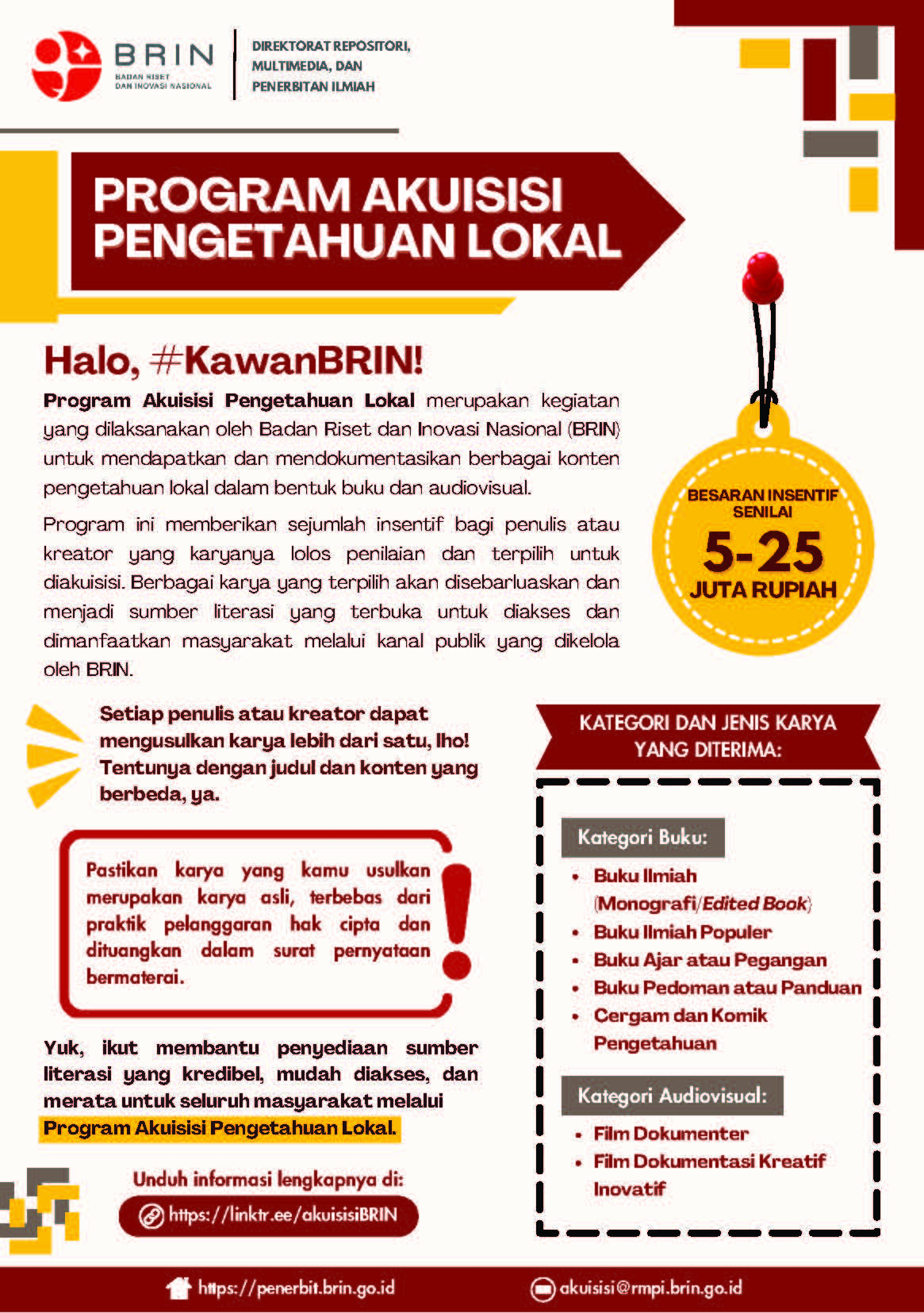
BRIN Publishing has a program named Akuisisi Pengetahuan Lokal that acquisition any of books or audiovisual content that meet our standard publication. The rights of BRIN Publishing is to disseminate and distribute all the content acquisitions for the public.
As an author you (or your employer or institution) may do the following:
All copies, print or electronic, or other use of the paper or article must include the appropriate bibliographic citation for the books