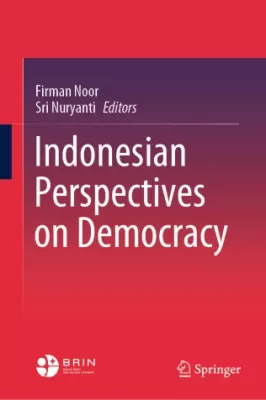


























This book discusses the extent to which Indonesia's trajectory to democracy has changed its direction toward democratic consolidation. In the case of democratic decline in Indonesia, there are numerous studies conducted in order to explain the challenges facing democratization. However, not many of them demonstrate the existing precursors and symptoms of democratic decline, which this book confronts. The authors unpack the problems that continue to hinder Indonesia's path to democratic consolidation and show that against this decline, Indonesia has experienced a new phase of its democratic life during, and in the immediate aftermath of, the COVID-19 pandemic, whereby the political ecosystem has seen a strengthening of the role of the state. This has, in fact, further complicated Indonesia's democratic transition. This book explains how these challenges impact Indonesia’s trajectory to democracy, drawing from three important approaches of democratic regime studies, encompassing actors, institutions, and norms. These aspects are elaborated upon in relation to various issues facing the country, thus capturing a sweeping picture of the political struggles preventing democratic growth. Relevant to researchers and students studying countries in democratic transition, but particularly the case of Indonesia, this is a novel contribution to understanding the country's developing political landscape.
Akbar, N. A. 2020. Alasan Partai Demokrat Tolak RUU Cipta Kerja Disahkan. Republika. https://www.republika.co.id/berita/qhnrty328/5-alasan-partai-demokrat-tolak-ruu-cipta-kerja-disahkan.
Ambardi, K. 2009. Mengungkap Politik Kartel: Studi tentang Sistem Kepartaian di Indonesia Era Reformasi. Jakarta: Kepustakaan Populer Gramedia.
Appadurai, A. 2017. Democracy Ffatigue., Dalam The Great Regression, diedit oleh H. Geiselberger. Cambridge: Polity Press.
Aspinall, E., and W. Berenschot. 2019. Democracy for sale, election, clientism and the state in Indonesia. New York: Cornell University Press.
Aspinall, E., and M. Mietzner. 2019. Indonesia’s democratic paradox: Competitive elections amidst rising illiberalism. Bulletin of Indonesian Economic Studies 55 (3): 295–317.
Asril, S. 2022. Survei Litbang “Kompas”: Tingkat Kepuasan Publik terhadap Jokowi-Ma’ruf Turun 6,8 Persen. Kompas. https://nasional.kompas.com/read/2022/06/20/05140061/survei-litbang-kompas-tingkat-kepuasan-publik-terhadap-jokowi-maruf-turun-68.
Bland, B. 2019. Politics in Indonesia: Resilient election and defective democracy. Sydney: Lowy Institute for International Studies.
Bunte, M. and A. Ufen. 2009. The new order and its legacy: Reflections on democratization in Indonesia. In Democratization on Post-Suharto Indonesia, ed. M. Bunte, M. dan and A. Ufen. London: Routledge.
Crouch, C. 2004. Post-democracy. Cambridge: Polity Press.
Coronavirus in Asia and ASEAN- Live Updates By Country. 2020. Asean Briefing. https://www.aseanbriefing.com/news/coronavirus-asia-asean-live-updates-by-country. diakses pada 10 Juni, 2020.
Dinasti Politik di Pilkada 2020 Disebut Meningkat, 67 Menang. 2020. CNN Indonesia. https://www.cnnindonesia.com/nasional/20201216200833-32-583132/dinasti-politik-di-pilkada-2020-disebut-meningkat-67-menang. 17 Dec 2020.
Damarjati, D. 2022. Survei Litbang Kompas: Kepuasan terhadap Jokowi-Ma’ruf turun menjadi 62,1%. Detik. https://news.detik.com/berita/d-6365023/survei-litbang-kompas-kepuasan-terhadap-jokowi-maruf-turun-jadi-621.
Davidson, J. S. 2015. Dilemmas of democratic consolidation in Indonesia. The Pacific Review 22(3): 293—310.
Diamond, L. 2010. Indonesia’s place in global Democracy. In Problems of democratisation in Indonesia, elections, institutions and society, ed. E. Aspinall and M. Mietzner. Singapore: ISEAS.
Ekawati, E., ed. 2019. Peta Sosial Politik Pemilu Serentak 2019: Survei Pandangan Ahli. Jakarta: LIPI Press.
Ford, M. and T. B. Pepinsky. ed. 2014. Beyond oligarchy. Wealth, power and contemporary Indonesian politics. New York: Cornell Southeast Asia Program Publications.
Fransisca, O. 2020. Tidak Seperti Orde Baru, Sekarang Kwik Kian Gie Takut Berbeda Pendapat. Anomali. https://www.askara.co/read/2021/02/06/14910/tidak-seperti-orde-baru-sekarang-kwik-kian-gie-takut-berbeda-pendapat. 25 Aug 2020.
Geiselberger, H., ed. 2017. The great regression. Cambridge: Polity Press.
Guritno, T. 2019. Survei Litbang “Kompas” Kepuasan Publik pada 5 Aspek Penegakan Hukum Terburuk Sejak Oktober 2019. Kompas. https://nasional.kompas.com/read/2022/10/24/06410661/survei-litbang-kompas-kepuasan-publik-pada-5-aspek-penegakan-hukum-terburuk. 24 Oct 2022.
Guritno, T. 2022. Survei Litbang “Kompas” Kepuasan Publik pada Penegakkan Hukum Menurun. Kompas. https://nasional.kompas.com/read/2022/10/24/06181351/survei-litbang-kompas-kepuasan-publik-pada-penegakan-hukum-menurun.
Guritno, T. 2022. Survei Litbang “Kompas”: 37,7 Persen Responden Nilai Kualitas Demokrasi di Indonesia Memburuk. Kompas. https://nasional.kompas.com/read/2022/09/19/08061081/survei-litbang-kompas-377-persen-responden-nilai-kualitas-demokrasi-didi-Indonesia-Memburuk.
Hadiz, V. 2017. Indonesia’s year of democratic setbacks: Towards a new phase of deepening illiberalism? Bulletin of Indonesian Economic Studies 53: 261–278.
Hanafi, R. I. ed. 2021. Partai Politik dan Pemilu Serentak 2019. Jakarta: Yayasan Obor Indonesia.
Google Scholar
Hamid, U. 2019. Indonesia’s Information law has threatened free speech for more a decade. This must stop. The Conversation. https://theconversation.com/indonesias-information-law-has-threatened-free-speech-for-more-than-a-decade-this-must-stop-127446. 25 Nov 2019.
Hicken, A. 2020. Indonesia’s democracy in a comparative perspective. In Democracy in Indonesia: From stagnantion to regression, ed. T. Power and E. Warburton. Singapore: ISEAS-Yusof Ishak Institute.