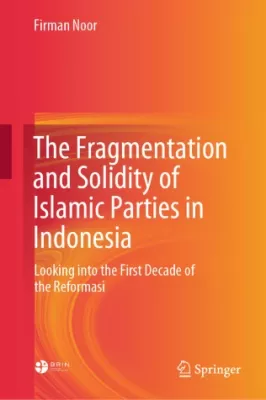


























This book delves into the background of fragmentation and solidity of Indonesia’s Islamic parties. By examining the National Awakening Party (PKB) and the Prosperous Justice Party (PKS) as a research subject, this book exhibits the critical nature of a party’s internal institutionalization, both in fragmentation and solidity. In addition, this book challenges popular perceptions that individuals or actors are the primaries, if not the only, factors that impede or promote a party’s unity. In short, this book explores and scrutinizes the many aspects and reasons for the division and cohesion of Islamic political parties concerning the presence of a party institutionalization throughout the first decade of the Reform Era (1998–2008).
The book gives the readers insights and understandings into the dynamics of Islamic parties in Indonesia’s contemporary politics and contains numerous interesting facts and studies. The first set of sections discuss the causes behind Islamic parties’ inability to maintain the integrity and internal cohesion and the impacts of consistency in upholding the party’s constitution and procedures that ensure a high degree of trust in the party. The second explores the effect of the presence of competent and institutionalized conflict mechanisms on the stirring of an internal sense of justice. The next set of chapters investigate the influence of systematic cadreization on the development of esprit de corps, in which accomplishments rather than likes or dislikes define a cadre’s position, and finally, the effect of commitment to the party’s shared values or agreed-upon ideology on putting the party’s interests first is examined. This is a must-read book for undergraduate students, lecturers, researchers of politics and religion, Islamic studies, political science, political sociology, and Asian studies.
A. Effendy Choirie, PKB, Politik Jalan Tengah NU (Jakarta: Pustaka Ciganjur, 2002), p. 174.
Greg Fealy, Ijtihad Politik Ulama: Sejarah NU 1952–1967 (Yogyakarta: LKiS, 2003), pp. 299–340. See also Hermawan Sulistyo, Palu Arit di Ladang Tebu (Jakarta: Kepustakaan Populer Gramedia, 2006).
Fealy, Ijtihad Politik Ulama: Sejarah NU 1952–1967, pp. 341–259.
The Leadership of the MPRS (1967–1972) consisted of General Abdul Haris Nasution (Chairperson), H.M. Subchan Z.E. (Vice-Chairperson), Osa Maliki (Vice-Chairperson), M. Siregar (Vice-Chairperson), Brigadier General Mashudi (Vice Chairperson).
Other Islamic parties that joined the merger were the Muslim Party of Indonesia (Partai Muslimin Indonesia/Parmusi) that later on popularly known as the Muslimin Indonesia (MI), PSII or Sarekat Islam (SI), and the Islamic Education United (Persatuan Tarbiyah Islamiyah/Perti).
Syamsuddin Haris, PPP dan Politik Orde Baru (Jakarta: Gramedia, 1991), p. 76.