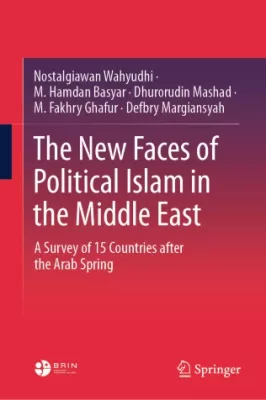


























This book provides a survey of the political situation in 15 Arab countries in the Middle East and North Africa and provides overviews of associated post-Arab Spring politics, with an emphasis of political Islamist movements. A translation from its original in Bahasa Indonesia, the book critically assesses the concept of post-Islamism from an Indonesian perspective. It argues that the wave of democratization in the Middle East following the Arab Spring failed to create an open democratic life in the region, except in the country where the Arab Spring began, Tunisia. Rather, it has left growing conflicts and destabilization in the region, with the rise of new authoritarianism. The authors simultaneously show that Islamic political movements in general are adaptive in the face of the changing political environment post-Arab Spring. They present the example of the Muslim Brotherhood as a movement with distinctive characteristics and high levels of adaptability in changing socio-political environments. It is relevant to advanced undergraduate and graduate students studying and researching contemporary Arab or Islamist movements and to scholars look for a neat comparative survey of countries after the Arab Spring.
HIST120, “HIST120: The Arab Spring and Its Contexts: Image,” accessed February 3, 2018.
Robert Alan Dahl, Democracy and Its Critics (Yale University Press, 1989).
Nostalgiawan Wahyudhi et al., “Politik Islam Di Timur Tengah Pasca Arab Spring: Sebuah Pembelajaran [Political Islam in the Middle East After the Arab Spring: A Lesson],” Policy Paper, Policy Paper Pusat Penelitian Politik (Jakarta: The Indonesian Institute of Sciences, 2019).
Martin Beck and Simone Hüser, “Political Change in the Middle East: An Attempt to Analyze the ‘Arab Spring,’” Working Paper (German Institute of Global and Area Studies [GIGA], 2012). Beck and Hüser classify the responses of Middle Eastern countries to the Arab Spring into four broad categories based on two classifications of political systems: authoritarian and transitional. The above classification is an adaptation of the Beck and Huser categories.
Nostalgiawan Wahyudhi, “Problematika Kekuatan Politik Islam Di Aljazair: Politik Islam, Otoritarianisme-Militer, Dan Krisis Legitimasi Di Aljazair [Problems of Islamic Political Power in Algeria: Political Islam, Military-Authoritarianism, and Legitimacy Crisis in Algeria],” in Problematika Kekuatan Politik Islam Di Yaman, Suriah, Dan Aljazair [The Problem of Islamic Political Power in Yemen, Syria and Algeria], ed. Muhammad Fakhry Ghafur (Bandung: Dunia Pustaka Jaya, 2016), 137–80.
Lahouari Addi, “Political Islam and Democracy: The Case of Algeria,” in Democracy’s Victory and Crisis, ed. Axel Hadenius (Cambridge: Cambridge University Press, 1997), 105–20; “Why Has the Arab Spring Not Spread to Algeria?” HuffPost, April 3, 2011.
Mohammed Hashas, “Moroccan Exceptionalism Examined: Constitutional Insights Pre- and Post-2011,” IAI Working Papers 23 (Istituto Affari Internazionali [IAI], 2013).
Indriana Kartini, “Problematika Kekuatan Politik Islam Di Maroko [Problems of Islamic Political Power in Morocco],” in Problematika Kekuatan Politik Islam Di Maroko, Sudan, Dan Somalia [Problems of Islamic Political Power in Morocco, Sudan and Somalia], ed. Muhammad Fakhry Ghafur (Jakarta: Mahara Publishing, 2016), 61–92.
Daniel Meier, “The Effects of Arab Spring and Syrian Uprising on Lebanon,” May 2013, https://www.lebanesestudies.com/wp-content/uploads/2013/10/daniel-May-.pdf.
Indriana Kartini, “Kekuatan Politik Islam di Lebanon: Politik Sektarianisme [Political Islam Power in Lebanon: The Politics of Sectarianism],” in Problematika Kekuatan Politik Islam di Bahrain, Qatar, dan Lebanon [Problems of Islamic Political Power in Bahrain, Qatar, and Lebanon], ed. Indriana Kartini (Jakarta: UI Press, 2017), 138–39.
Dhurorudin Mashad, “Kekuatan Politik Islam dalam Konstelasi Politik Bahrain, Qatar, dan Lebanon [Political Power of Islam in the Political Constellation of Bahrain, Qatar and Lebanon],” in Problematika Kekuatan Politik Islam di Bahrain, Qatar, dan Lebanon [Problems of Islamic Political Power in Bahrain, Qatar, and Lebanon], ed. Indriana Kartini (Jakarta: UI Press, 2017), 150–87.
Silvia Colombo, “The GCC Countries and the Arab Spring: Between Outreach, Patronage and Repression,” IAI Working Papers 12 (Istituto Affari Internazionali [IAI], March 2012).
Indriana Kartini, “Demokrasi dan Kebangkitan Politik Islam di Tunisia [Democracy and the Rise of Political Islam in Tunisia],” in Agama dan Demokrasi: Munculnya Kekuatan Politik Islam di Tunisia, Mesir dan Libya [Religion and Democracy: The Emergence of Islamic Political Power in Tunisia, Egypt and Libya], ed. Indriana Kartini (Bandung: Dunia Pustaka Jaya, 2016), 77–110.