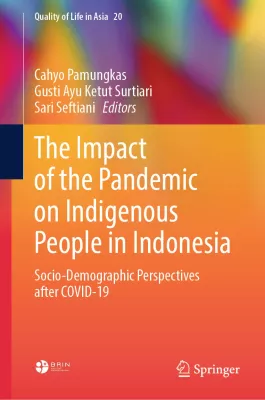

























This book explores the complex aftermath and socio-demographic effects of COVID-19 on indigenous people in Indonesia. As a vulnerable group facing multiple problems relating to marginalization, poverty, and lack of access to public facilities, Indigenous communities have been shown to fare worse off than other groups during the pandemic. This book reveals Indonesian indigenous people's socio-economic vulnerability and adaptation strategies. Using qualitative approaches and drawing from recent statistical data, this book includes geographical representation of communities include Orang Rimba (Jambi), Tengger (East Java), Bali Age (Bali), Marapu (East Nusa Tenggara), Nuaulu (Central Maluku), Togutil (North Maluku), and Orang Asli Papua (Papua). The book shows that in times of crisis, Indigenous peoples can provide lessons to the broader public. Relevant to policymakers.
Andiarsi, M. K. (2020, October 10). Sebaran masyarakat adat. kata data https://katadata.co.id/padjar/infografik/5f8030631f92a/sebaran-masyarakat-adat
Araujo, S., Cannon, M., Schmidt-Sane, M., Shankland, A., Snijder, M., & Wu, Y. C. (2021). Key considerations: Indigenous people in COVID-19 response and recovery. Social Science in Humanitarian Action Platform. https://www.socialscienceinaction.org/resources/key-considerations-indigenous-peoples-in-covid-19-response-and-recovery/
Asia-Pacific Economic Cooperation/ APEC. (2021). Report: Understanding the economic impact of COVID-19 on indigenous peoples. SOM Steering Committee on Economic and Technical Cooperation (SCE). https://www.apec.org/docs/default-source/publications/2021/10/understanding-the-economic-impact-of-covid-19-on-indigenous-peoples/221_sce_economic-impact-of-covid-19-on-indigenous-peoples.pdf?sfvrsn=76620920_1
Block, P., Hoffman, M., Raabe, I. J., Dowd, J. B., & Mills, M. C. (2020). Social network-based distancing strategies to flatten the COVID-19 curve in a post-lockdown world. arXiv: 2004.07052. https://doi.org/10.1038/s41562-020-0898-6
BPS (2020). Hasil survei sosial demografi dampak COVID-19. Jakarta: Badan Pusat Statistik. https://www.bps.go.id/id/publication/2020/06/01/669cb2e8646787e52dd171c4/hasil-surveisosial-demografi-dampak-covid-19-2020.html
Cardona, O. D., van Aalst, M. K., Birkmann, J., Fordham, M., McGregor, G., Perez, R., Pulwarty, R. S., Schipper, E. L. F., & Sinh, B. T. (2012). Determinants of risk: Exposure and vulnerability. In C. B. Field, V. Barros, T. F. Stocker, D. Qin, D. J. Dokken, K. L. Ebi, M. D. Mastrandrea, K. J. Mach, G.-K. Plattner, S. K. Allen, M. Tignor, & P. M. Midgley (Eds.), Managing the risks of extreme events and disasters to advance climate change adaptation. A special report of working groups I and II of the Intergovernmental Panel on Climate Change (IPCC) (pp. 65–108). Cambridge University Press. https://www.ipcc.ch/site/assets/uploads/2018/03/SREX-Chap2_FINAL-1.pdf
Chriscaden, K. (2020, Oktober 13). Impact of COVID-19 on people’s livelihoods, their health, and our food systems: Joint statement by ILO, FAO. https://www.who.int/news/item/13-10-2020-impact-of-covid-19-on-people’s-livelihoods-their-health-and-our-food-systems
Cord, L., & Pizarro, D. M. (2021, August 6). Indigenous Peoples’ resilience: Supporting solutions from within. World Bank Blog. https://blogs.worldbank.org/voices/indigenous-peoples-resilience-supporting-solutions-within
Denny, D. M. T., Seixa, C., de Castro, D., & Pereira, L. I. (2021). COVID-19 magnifies the vulnerabilities: The Brazilian case. International Journal of Discrimination and the Law, 21(3), 272–287. https://doi.org/10.1177/13582291211031374
Dihni, V. A. (2021). Total kematian COVID-19 Indonesia peringkat ke-7 di dunia. Katadata. https://databoks.katadata.co.id/datapublish/2021/10/08/total-kematian-covid-19-indonesia-peringkat-ke-7-di-dunia
Economic Commission for Latin America and the Caribbean (ECLAC). (2021). The impact of COVID-19 on indigenous peoples in Latin America (Abya Yala): Between invisibility and collective resistance. Project Documents (LC/TS.2020/171). https://repositorio.cepal.org/bitstream/handle/11362/46698/S2000893_en.pdf?sequence=1
FAO. (2020, August 7). From the countryside with love: Combating food insecurity in Peru with ancestral solidarity during the COVID-19 crisis. Food and Agriculture Organization of the United Nations. https://www.fao.org/fao-stories/article/en/c/1300299/
Fineman, M. A. (2017). Vulnerability and inevitable inequality. Olso Law Review, 4, 133–149. https://doi.org/10.18261/issn.2387-3299-2017-03-02
Fineman, M. A. (2018). The vulnerable subject: Anchoring equality in the human condition. Yale Journal of Law and Feminism, 20(1). https://openyls.law.yale.edu/bitstream/handle/20.500.13051/6993/03_20YaleJL_Feminism1_2008_2009_.pdf?sequence=2
Fitzmaurice, M. (2021). The COVID-19 crisis, indigenous peoples, and international law: A vulnerability perspective. In M. M. Mbengue & J. D.’Aspremont (Eds.), Crisis narratives in international law (pp 173–181). https://doi.org/10.1163/9789004472365_019
Garrett, G. (2020, May 29). The post-COVID-19 world will be less global and less urban. Wharton Magazine. https://magazine.wharton.upenn.edu/digital/the-post-covid-19-world-will-be-less-global-and-less-urban/
GEF. (2020, August 7). Indigenous peoples and COVID-19: Response and resilience. The GEF. https://www.thegef.org/newsroom/blog/indigenous-peoples-and-covid-19-response-and-resilience
Gordon-Bouvier, E. (2021). Vulnerable bodies and invisible work: The COVID-19 pandemic and social reproduction. International Journal of Discrimination and the Law, 21(3), 212–229. https://doi.org/10.1177/13582291211031371