























This book brings to light the sustainability dilemma in Southeast Asia, with a sharp focus on Indonesia’s rapid economic growth and its profound impact on natural resources, ecosystems, and society. It examines the complex challenge of fostering strong economic development while avoiding environmental degradation and social dislocation. Central to this discourse is the vital role of government regulation and the imperative of community involvement in managing natural resources. Indonesia’s economic boom—mirroring trends across Asia—has triggered escalating land-use conflicts in forests, peatlands, rural-urban zones, and karst landscapes. This is paralleled by expanding access to coal, tin, and oil and gas, leading to large-scale extractive operations and widespread environmental damage. The book adopts a sustainable development framework, exploring its ecological, economic, social, and political dimensions. Crucially, it argues that today’s socio-ecological crisis is not just a consequence of growth, but a systemic condition rooted in capitalism. Written by leading experts, the book offers interdisciplinary perspectives—socio-cultural, legal, political, and economic—supported by detailed case studies. A timely and essential resource for policymakers, researchers, and practitioners committed to Indonesia’s sustainable future.
Bappenas, SDG Goals, https://sdgs.bappenas.go.id/.
Batubara and Warsilah, H (2010) Maleh Dadi Segoro: Social Ecological Crisis in the Coastal Areas of Demak and Semarang. Lintas Nalar Publisher. Yogyakarta
Batubara B, dan Handriana E (2021a) Urbanisasi Sebagai pabrik Krisis Sosial-Ekologis: Berdialektika dengan Prisma 1971–2021, Majalah PRISMA. https://www.prismajurnal.com/article/urbanisasi-sebagai-pabrik-krisis-sosialekologis-berdialektika-dengan-prisma-1971-2021/
Batubara B, Handriana E (2021b) From socio-ecological crisis to social ecology: the case of Suburbia Semarang. Prism 40(3):30–46
This book that publish in BRIN Publishing is licensed under a Creative Commons Attribution Non-commercial Share Alike 4.0 International license (CC BY-NC-SA 4.0). This license permits you to share, copy, distribute and transmit the work for your personal use and non-commercial purposes, provided you provide appropriate attribution. Derivative works and modifications must use the same license. Detailed information regarding the CC-BY-NC-SA 4.0 license is available via the link: https://creativecommons.org/licenses/by-nc-sa/4.0/
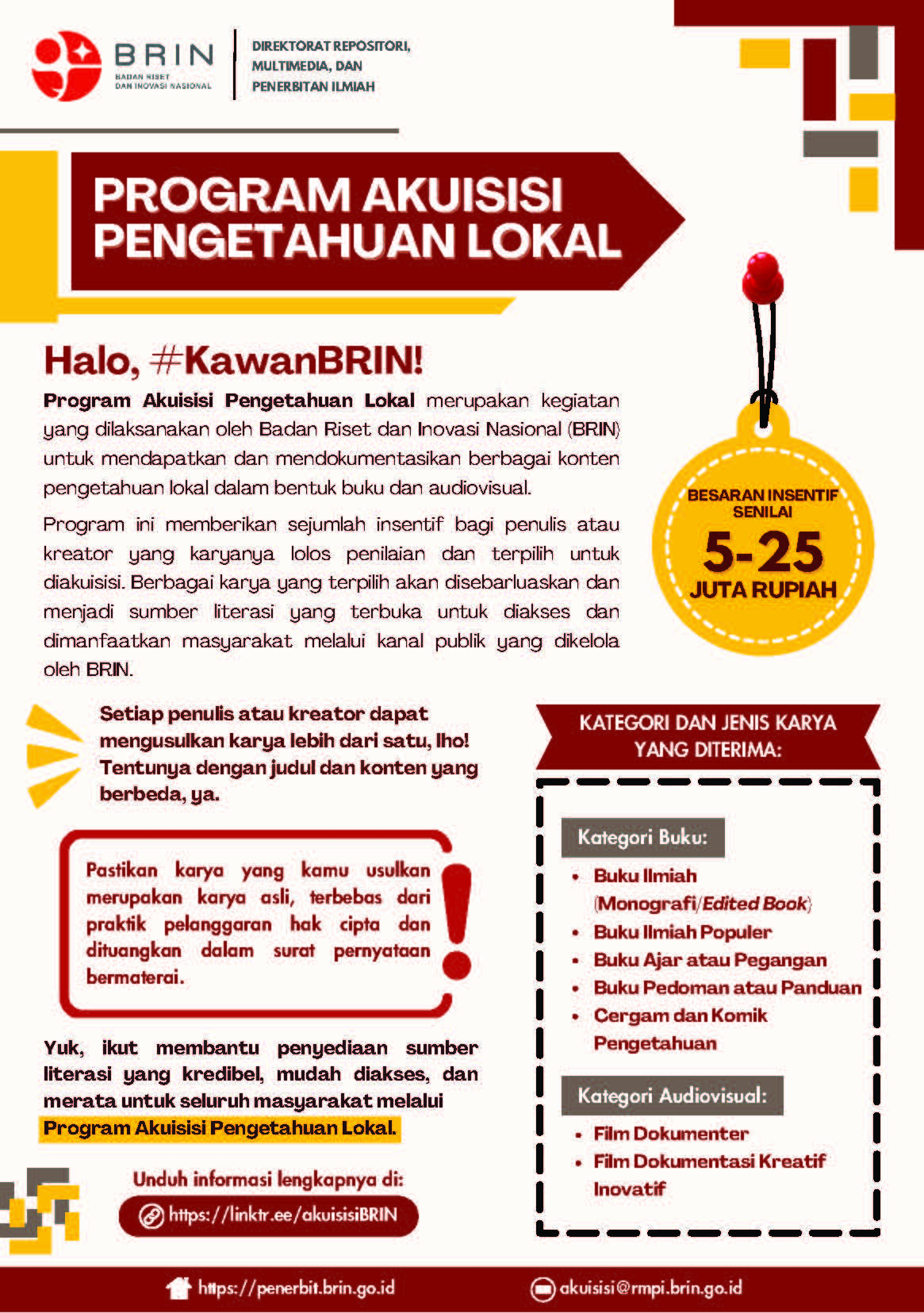
BRIN Publishing has a program named Akuisisi Pengetahuan Lokal that acquisition any of books or audiovisual content that meet our standard publication. The rights of BRIN Publishing is to disseminate and distribute all the content acquisitions for the public.
As an author you (or your employer or institution) may do the following:
All copies, print or electronic, or other use of the paper or article must include the appropriate bibliographic citation for the books