


























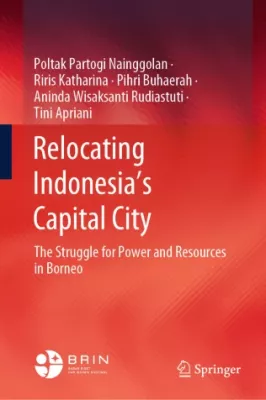
This book looks at the process of relocating Indonesia's capital from Jakarta to Nusantara in East Kalimantan. It looks critically at the surrounding conflict and its causes, as well as the solution from the perspective of evidence-based-policy and regulatory impacts assessments whose presence is increasingly needed today, to campaign for participatory policies and achieve the right targets. It is not widely known that the process of relocation of the capital took place behind closed doors and unilaterally. Through a closed legislative process, without public debate, and by amending the constitution later, this takeover process took place without resistance from disadvantaged regions. Following this, when the central government faced financing difficulties along the way, its development budget initially relied on foreign investment, then became dependent on domestic financing, both sourced from state finances (APBN) and local resources. From here, the book maps the subsequent problems that arose, the first of which relates to local resources. It shows how local residents are also affected with land evictions without proper relocation. Through political-economic research and analysis, the book dissects the conflict as it appears in central-regional power relations, by exploring the roots of the problem and recommending several solutions, as well as looking at possible future development of the conflict. This timely book is helpful to those who carry out development studies and are involved in making public policy for campus, government, parliament and the business world.
Bapenda Kutai Kartanegara. 2023. Laporan Kinerja Instansi Pemerintah (LKJIP) Badan Pendapatan Daerah (Bapenda) Kabupaten Kutai Kartanegara [Performance Report of Government Institutions/LKJIP) of Regional Revenue Agency/Bapenda of Kutai Kartanegara Regency]. Regency Government Document.
CNN Indonesia. 2022. Jokowi Tetapkan IKN Jadi Proyek Strategis Nasional [Jokowi Decided IKN as National Strategic Project]. Cnnindonesia.Com. 2022. https://www.cnnindonesia.com/ekonomi/20220906154708-532-844076/jokowi-tetapkan-ikn-jadi-proyek-strategis-nasional.
Nainggolan, Poltak Partogi and Riris Katharina. 2022. DPR dan Defisit Demokrasi [The Indonesian House of Representatives and Democratic Deficit]. Jakarta: Yayasan Pustaka Obor Indonesia.
Prasojo, Eko. 2006. Konstruksi Ulang Hubungan Pemerintah Pusat dan Pemerintah Daerah di Indonesia: Antara Sentripetalisme dan Sentrifugalisme [Reconstruction of Central and Regional Government Relations in Indonesia: Between Centripetalism and Centrifugalism]. https://lib.ui.ac.id/file?file=digital/2017-3/115404-PGB0072-EkoPrasojo.pdf.
Wadipalapa, Rendy Pahrun, Poltak Partogi Nainggolan, and Riris Katharina. 2023. Authority or Authoritarian? The Democratic Threats behind Indonesia’s New Capital City. Contemporary Southeast Asia 45 (3): 520–43.
This book that publish in BRIN Publishing is licensed under a Creative Commons Attribution Non-commercial Share Alike 4.0 International license (CC BY-NC-SA 4.0). This license permits you to share, copy, distribute and transmit the work for your personal use and non-commercial purposes, provided you provide appropriate attribution. Derivative works and modifications must use the same license. Detailed information regarding the CC-BY-NC-SA 4.0 license is available via the link: https://creativecommons.org/licenses/by-nc-sa/4.0/
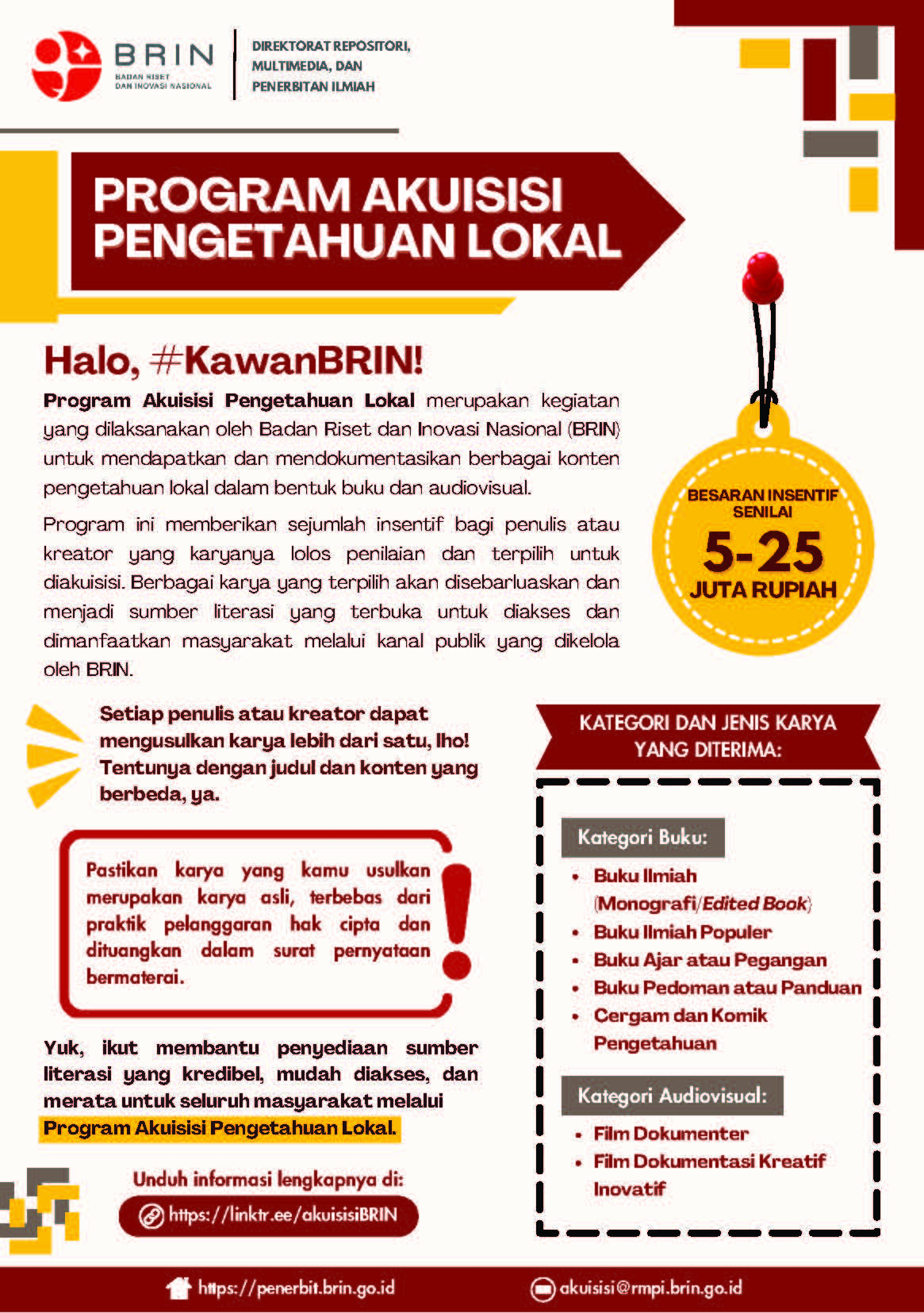
BRIN Publishing has a program named Akuisisi Pengetahuan Lokal that acquisition any of books or audiovisual content that meet our standard publication. The rights of BRIN Publishing is to disseminate and distribute all the content acquisitions for the public.
As an author you (or your employer or institution) may do the following:
All copies, print or electronic, or other use of the paper or article must include the appropriate bibliographic citation for the books