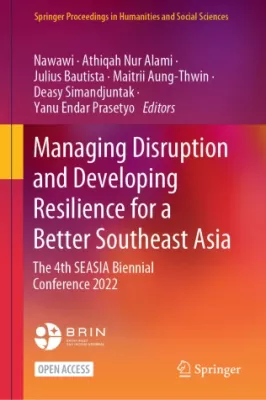


























This open access book, stemming from the biennial Consortium for Southeast Asian Studies in Asia conference, confronts numerous contemporary issues in the Southeast Asia region, under the banner of the 2022 theme “Managing Disruption, Developing Resilience for a Better Southeast Asia.” Providing a platform for discussion and collaboration in the fields of sociology, education, population studies, cultural studies, public health, international relations, and other humanities and social science disciplines, the range of interdisciplinary chapters focus their critical analyses vis-à-vis the interpellation of economic, social, historical, artistic, cultural, religious, and political viewpoints. Organized into three sections, the first looks at new models of economic development, the challenges to education quality, the labor market in the digital era, and the demographic changes and critical issues facing both the young and elderly in the region. The second examines disasters as a future challenge for risk management, understandings of contemporary society and culture, the digital humanities, social development in the time of COVID-19, and identities in relation to religion, minorities, and social harmony. The final section addresses diaspora, migration, the region in the pandemic, citizenship and human security, democracy, and human rights, as well as foreign policy, diplomacy, and state sovereignty in Southeast Asia. As ASEAN comes of age, there has never been a more compelling need to provide region-based perspectives to complement the deepening economic, social, and cultural integration in the region. For scholars working on Southeast Asia, “area” matters in geopolitical, economic, intellectual, institutional, social, cultural, and affective terms, and so this book transports the study of Southeast Asia from the periphery to the center, so as to enable scholars who live in and research the region to bring their research to a global readership. Relevant to scholars, public intellectuals, policy-makers, and activists working in all areas of the social sciences and humanities, this comprehensive book presents the very latest research on, and from, Southeast Asia.
Salim Z, Pranata N, Sabilla K (2020) Benchmarking Singapore and Hong Kong to develop Indonesia’s trade facilitation. Int J Bus Global 26(1/2):119–147
Salzman J (2003) Methodological choices encountered in the construction of composite indices of economic and social well-being
Sen A (1988) Development as capability expansion. In: Readings in human development, vol 987, pp 3–16
Sharpe A (2004) Literature review of frameworks for macro-indicators, no February
Spilker G, Bernauer T, Umana V (2016) Selecting partner countries for preferential trade agreements: experimental evidence from Costa Rica, Nicaragua, and Vietnam. Int Stud Quart 60:706–718. https://doi.org/10.1093/isq/sqv024
UNCTAD (2019) International classification of non-tariff measures
UNCTAD (2020) Impact of the coronavirus outbreak on global FDI, no March 2020. https://unctad.org/en/PublicationsLibrary/diae_gitm34_coronavirus_8march2020.pdf
WITS (2021) Non-tariff measures (NTM) by country. https://wits.worldbank.org/tariff/non-tariff-measures/en/ntm-bycountry
World Bank (2021) World development indicators. Worldbank.Org. https://databank.worldbank.org/source/world-development-indicators