





















Buku “Belajar Bahasa Daerah (Jawa) untuk Mahasiswa PGSD dan Guru SD” berisi materi bahasa Jawa sebagai mata pelajaran muatan lokal wajib sekolah dasar di Provinsi Jawa Timur, Jawa Tengah, dan DIY Yogyakarta. Buku tersebut, disajikan dalam bahasa Indonesia sehingga mempermudah mahasiswa atau guru dari luar suku Jawa untuk mempelajarinya. Untuk memantapkan pemahaman materi, dilengkapi latihan soal dan kunci jawaban.
Aminuddin. 2010. Penganter Apresiasi Karya Sastra. Bandung:Sinar Baru Algensindo.
Danandjaja, James. 2002. Folklor Indonesia: Ilmu Gosip, Dongeng, dan Lain-Lain. Jakarta: Pustaka Utama Grafiti.
Dharmamulya, Sukirman dkk. 1992. Transformasi Nilai Melalui Permainan Rakyat Daerah Istimewa Yogyakarta. Jakarta:Depdikbud.
Dwidjahapsara, Mas Sumardji. 2001. Antologi Tembang Jawi: Lelagon Dolanan. Malang:Lembaga Pelestarian lan Pengembangan Basa Jawi Pusat Malang.
Hardjowijono, Harujono. 1994. Tradisi Lisan Macapat. Yogyakarta: Makalah Sarasehan Tradisi Lisan Jarahnitra.
Harjawiyana, Haryana dan Supriya. 2009. Kamus Unggah-ungguh Basa Jawa. Yogyakarta: Kanisius
Kesolo.com, Tembang Macapat, Tembang Jawa Kaya Makna Http://Kesolo.com diakses pada tanggal 6 Juni 2017
Laginem. 1996. Macapat Tradisional dalam Bahasa Jawa. Yogyakarta: Proyek Penelitian Bahasa dan Sastra Indonesia dan daerah.
Padmosoekotjo, S. 1953. Ngengrengan Kasusastran Djawa. Yogyakarta: Soejadi
Prabowo, Dhonu Priyo. 1992. Tema Macapat Modern dalam Kandha Raharja. Yogyakarta: Widyaparwa
Pradipta. 2012. Http://pradiptailmu.blogspot.com diakses pada tanggal 1 Juni 2017
Purwadi. 2006. Seni Tembang: Reroncen Wejangan Luhur dalam Budaya Jawa. Yogyakarta: Tanah Air.
Rass, J. J. 1985. Bunga Rampai Sastra Jawa Muthakir. Jakarta: PT. Grafitipers
Riyadi, Slamet. 1995. Cerita Anak-anak dalam Sastra Jawa. Jakarta: Depdikbud.
Sarwono, dkk. 1995. Gendhing Dolanan Anak, Jilid I. Solo: Tiga Serangkai
Sasangka, Sry Satria Tjatur Wisnu. 2008. Paramasastra Gagrag Anyar Basa Jawa. Jakarta: Yayasan Paramalingua
Sasangka, Sry Sastriya Tjatur Wisnu. 2010. Unggah-unggh Bahasa Jawa. Jakarta: Paramalingua
Sahlan, A dan Mulyono. 2012. Pengaruh Islam Terhadap Budaya Jawa Tembang Macapat. Malang: Fakultas Tarbiyah UIN Maulana Malik Ibrahim
SDN Sebomenggalan. 2017. Http://Sdn-sebomenggalan.blogspot.co.id diakses tanggal 29 Mei 2017
Subalidinata, R.S. 1981. Seluk Beluk Kesusastraan Jawa. Yogyakarta: Fakultas Sastra Universitas Gajah Mada
Suroto. 1989. Teori dan Bimbingan Apresiasi Sastra Indonesia. Jakarta: Erlangga.
Waluyo, J, Herman. 2002. Apresiasi Puisi. Jakarta: PT. Gramedia Pustaka Utama.
Yuwana, Setya, dkk. 2000. Pendekatan Stilistika dalam Puisi Jawa Modern Dialek Using. Jakarta: Departemen Pendidikan Nasional.


This work is licensed under a Creative Commons Attribution-NonCommercial-ShareAlike 4.0 International License.
This book that publish in BRIN Publishing is licensed under a Creative Commons Attribution Non-commercial Share Alike 4.0 International license (CC BY-NC-SA 4.0). This license permits you to share, copy, distribute and transmit the work for your personal use and non-commercial purposes, provided you provide appropriate attribution. Derivative works and modifications must use the same license. Detailed information regarding the CC-BY-NC-SA 4.0 license is available via the link: https://creativecommons.org/licenses/by-nc-sa/4.0/
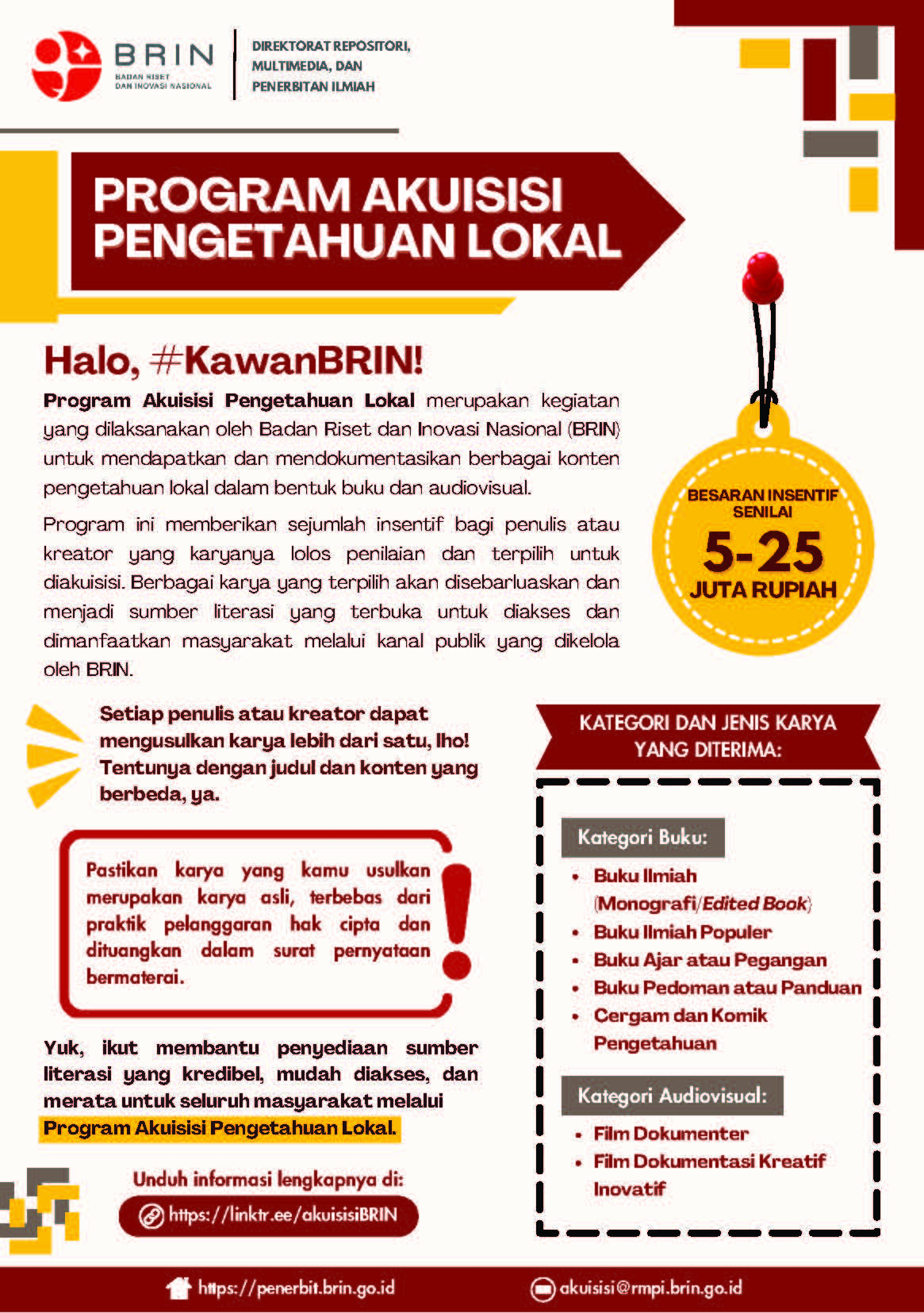
BRIN Publishing has a program named Akuisisi Pengetahuan Lokal that acquisition any of books or audiovisual content that meet our standard publication. The rights of BRIN Publishing is to disseminate and distribute all the content acquisitions for the public.
As an author you (or your employer or institution) may do the following:
All copies, print or electronic, or other use of the paper or article must include the appropriate bibliographic citation for the books