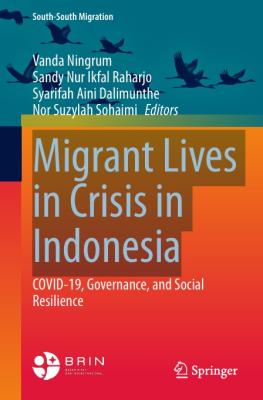

























This comprehensive volume offers a critical, socio-demographic examination of the COVID-19 crisis and human mobility in Indonesia. Drawing on data from across the archipelago, it covers the demographic, economic, psychosocial, and socio-political contexts of the pandemic, rigorously analyzing emergency management and its severe, specific impacts on migrants (domestic and international workers, students) and Internally Displaced Persons (IDPs). The book meticulously analyzes the consequences of enforced restrictions and border closures, detailing the disruption of livelihoods and the adaptive strategies employed by these vulnerable populations. As the first book to frame the pandemic through this lens in Indonesia, it provides a crucial platform for rethinking crisis response commitment and underscores the importance of domestic implementation of international laws for protecting migrant rights. Beyond informing post-pandemic policy and research on migration in Indonesia, this work provides enduring, actionable lessons relevant to public health crises and state-of-emergency management throughout the Global South.
Alfana, M. A. F., Pitoyo, A. J., Rohmah, H. N., & Laudiansyah, R. (2020). Disaster management problems in Indonesia: Urgency of “Migrant Worker” data collection, learning from conditions during the Covid-19 pandemic. Social, Humanities, and Educational Studies (SHEs): Conference Series, 3(1). https://doi.org/10.20961/shes.v3i1.45026
Baldassar, L., & Pyke, J. (2014). Intra-diaspora Knowledge Transfer and ‘New’ Italian Migration. International Migration, 52(4), 128–143. https://doi.org/10.1111/imig.12135
Barhate, B., Hirudayaraj, M., Gunasekara, N., Ibrahim, G., Alizadeh, A., & Abadi, M. (2021). Crisis within a crisis: Migrant workers’ predicament during COVID-19 lockdown and the role of non-profit organizations in India. Indian Journal of Human Development, 15(1), 151–164. https://doi.org/10.1177/0973703021997624
Bedford, J., Farrar, J., Ihekweazu, C., Kang, G., Koopmans, M., & Nkengasong, J. (2019). A new twenty-first century science for effective epidemic response. Nature, 575(7781), 130–136. https://doi.org/10.1038/s41586- 019- 1717- y
Berg, L. (2015). Migrant rights at work. Routledge. https://doi.org/10.4324/9781315752327
Brettell, C. B. (2014). Theorizing migration in anthropology, the cultural, social, and phenomenological dimensions of movement. In C. B. Brettell & J. F. Hollifield (Eds.), Migration theory talking across disciplines (3rd ed., pp. 147–197). Routledge.
Caraka, R. E., Lee, Y., Kurniawan, R., Herliansyah, R., Kaban, P. A., Nasution, B. I., Gio, P. U., Chen, R. C., Toharudin, T., & Pardamean, B. (2020). Impact of COVID-19 large scale restriction on environment and economy in Indonesia. Global Journal of Environmental Science and Management, 6(Special Issue), 65–84. https://doi.org/10.22034/GJESM.2019.06.SI.07
Czaika, M., & Reinprecht, C. (2022). Migration drivers: Why do people migrate? In P. Scholten (Ed.), Introduction to migration studies an interactive guide to the literatures on migration and diversity (pp. 49–82). Springer Nature. https://link.springer.com/bookseries/13502
Fasani, F., & Mazza, J. (2020). A vulnerable workforce: Migrant workers in the COVID-19 pandemic.
Guadagno, L. (2020). Migrants and the COVID-19 pandemic: An initial analysis (60). www.iom.int
Henry, C. S., Sheffield Morris, A., & Harrist, A. W. (2015). Family resilience: Moving into the third wave. Family Relations, 64(1), 22–43. https://doi.org/10.1111/fare.12106
ILO. (2020). Protecting migrant workers during the COVID-19 pandemic recommendations for policy-makers and Constituents. https://www.ilo.org/sites/default/files/wcmsp5/groups/public/%40ed_protect/%40protrav/%40migrant/documents/publication/wcms_743268.pdf
ILO. (2021). World employment and social outlook: Trends 2021.
IOM. (2019). International migration law: Glossary on migration. International Organization for Migration.
IOM. (2020). The impact of COVID-19 on migrants.
Krishnakumar, P., & Indumathi, T. (2014). Pull and push factors of migration. Global Management Review, 8(4), 8–12.
Liem, A., Wang, C., Wariyanti, Y., Latkin, C. A., & Hall, B. J. (2020). The neglected health of international migrant workers in the COVID-19 epidemic. The Lancet Psychiatry, 7(4), e20. https://doi.org/10.1016/S2215- 0366(20)30076- 6
Matta, S., Chopra, K. K., & Arora, V. K. (2020). Morbidity and mortality trends of Covid 19 in top 10 countries Shanker. Indian Journal of Tuberculosis, 67(January), S167–S172. https://doi.org/10.1016/j.ijtb.2020.09.031
Neuman, W. L. (2014). Social research methods: Qualitative and quantitative approaches. Pearson Education Limited.
Phillimore, J., Pertek, S., Akyuz, S., Darkal, H., Hourani, J., McKnight, P., Ozcurumez, S., & Taal, S. (2022). “We are forgotten”: Forced migration, sexual and gender-based violence, and coronavirus disease-2019. Violence Against Women, 28(9), 2204–2230. https://doi.org/10.1177/10778012211030943
Randall, S., & Koppenhaver, T. (2004). Qualitative data in demography. Demographic Research, 11, 57–94. https://doi.org/10.4054/DemRes.2004.11.3
Ssenyonga, M. (2021). Imperatives for post COVID-19 recovery of Indonesia’s education, labor, and SME sectors. In Cogent economics and finance (Vol. 9 1). Cogent OA. https://doi.org/10.1080/23322039.2021.1911439
WHO. (2021). Coronavirus disease (COVID-19). Https://Www.Who.Int/Health- Topics/Coronavirus#tab=tab_1.
Wirawan, G. B. S., Harjana, N. P. A., Nugrahani, N. W., & Januraga, P. P. (2022). Health beliefs and socioeconomic determinants of COVID-19 booster vaccine acceptance: An Indonesian cross-sectional study. Vaccines (Basel), 10(5). https://doi.org/10.3390/vaccines10050724
Witono, N. B. (2021). Kebijakan pelindungan pekerja migran Indonesia dalam pandemi covid-19. Indonesian Journal of Peace and Security Studies (IJPSS), 3(1), 34–54. https://doi.org/10.29303/ijpss.v3i1.57
World Bank. (2019). Strengthening the disaster resilience of Indonesian cities – A policy note.