
























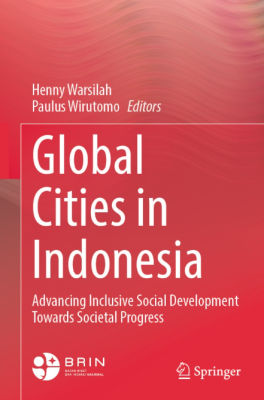
This book examines the development of global cities in Indonesia and proposes a new paradigm for urban development, grounded in inclusive social development. Inclusive development is defined as a new approach to development by developing an increasingly open environment, inviting and inclusive of everyone with different backgrounds, characteristics, abilities, status, conditions, ethnicities, and cultures. Urban development in Southeast Asia, particularly Indonesia, requires a more specific approach, particularly related to the inclusive social development paradigm, which emphasizes human interaction and participation. The inclusive social development paradigm highlights important structural, social, and cultural aspects. This book demonstrates that these three aspects of development do not stand alone but are interconnected and mutually supportive, which in turn reveals how they operate. Relevant for urbanologists, city policy makers, environmental social scientists, development studies academics, and sociologists, this book is a timely contribution to discussions about Indonesian cities, their present, and their future.
A.T. Kearney. (2024). Global Cities Index and Global Cities Outlook.
Alwi Rubidium Sjaaf, 2025. Disertasi Membangun Keadilan di kota Global, Universitas Indonesia.
Andreas, Heri. 2021. Manajemen Risiko Bencana Pesisir Jakarta akibat Kenaikan Muka Air Laut (Sea Level Rise), Penurunan Tanah (Land Subsidence), dan Efek Lain Perubahan Iklim. Disampaikan dalam Webinar Dinas Sumber Daya Air Jakarta 02 September 2021.
Asian Development Bank (2006), Outlook 2006 Update, ADB.
Belsky, Eric S. 2012. “Planning for Inclusive and Sustainable Urban Development”, In Starke, Linda (eds), State of the World 2012: Moving Toward Sustainable Prosperity (pp. 38–52). Washington DC: Island Press/Center for Resource Economics.
Branch, Melville C. (1996). Comprehensive Urban Planning: Introduction and Explanation. Translation. Yogyakarta: Gajah Mada University Press.
Coleman, J. 1988. Social Capital in the Creation of Human Capital.
Douglass, M. (2010). Globalization, Mega-projects and the Environment Urban Form and Water in Jakarta. Environment and Urbanization ASIA, 45–65. https://doi.org/10.1177/097542530900100105.
Fainstein, S. (2010). The Just City. Ithaca: Cornell University Press. ISBN 978-0-8014-4655-9.
Grootaert, C. and T van Bastelaer. 2001. “Understanding_and_Measuring_ Social Capital: A Synthesis of Findings and Recommendations from the Social Capital Initiative”. Social Capital Initiative Working Paper No. 24. Washington, D.C: The World Bank 43.
International Disability and Development Consortium (IDDC). 2010. Report on the Caritas Asia Regional Forum in Phnom Penh, Cambodia, 16–18 June 2010.
Korten, D.C. and Syahrir (ed.) (1988). Development with a People’s Dimension. Jakarta; Obor Indonesia Foundation.
Lefevbre, H. (1996). The Right to the City. Lefevbre, Henri. (2000). Writing on Cities. Cambridge: Blackwell Publisher.
Lenoir, Rene. 1974. Les Exlus: Un Francais Sur Dix, Paris: Seuil Publication.
Moe, I. R., Kure, S., Januriyadi, N. F., Farid, M., Udo, K., Kazama, S., & Koshimura, S. (2016). Effect of Land Subsidence on Flood Inundation in Jakarta, Indonesia. Journal of Japan Society of Civil Engineers, Ser. G (Environmental Research), 72(5), I_283–I_289. https://doi.org/10.2208/jscejer.72.i_283.
Narayan, D. and Pritchett, L. 1997. “Cents and Socialibility. House hold Income and_Social Capital in Rural Tanzania”, Policy Research Department, the World Bank, Washington DC, August 1996. (Mimeograph).
Pierson, John. 2002. Tracking Social Exclusion. London and New York: Routledge.
Prasetyantoko, A, Setyo Budiantoro, and Sugeng Bahagijo (eds). 2012. Inclusive Development. Publisher: LP3ES, Jakarta, March 2012, xviii + 456 pages.
Putnam, R. 1993. “The Prosperous Community” Social Capital and Public_Life.” American Prospect (13): 35–42. (In The World Bank. 1998, pp. 5–7).
Ranieri, R. _and_Ramos, R. A. 2013. “Inclusive Growth: The Building_up of a Concept”, IPC-IG Working Paper No. 104. Brazil; International Policy Center for Inclusive Growth.
Roitman, Sonia, and Deden Rukmana, 2022a. Routledge Handbok of Urban Indonesia. Published by Taylor Francis, https://doi.org/10.4324/9781003318170, ISBN: 9781003318170. https://www.taylorfrancis.com/books/edit/10.4324/9781003318170/routledge-handbook-urban-indonesia-sonia-roitman-deden-rukmana.
Roitman, Sonia, and Deden Rukmana, 2022b. Handbook of Urban Indonesia, Published by Routledge.
Sassen, S. (1991). The Global City: New York, London, Tokyo. Princeton University Press.
Somerville, Peter. 1998. “Explanation of Social Exclusion: Where does housing fit in?” in Hausing Study, Vol.19, No. 6:761–780. London.
Tadié, Jérôme (Penerjemah Rahayu S. Hidayat) (2009) Wilayah Kekerasan di Jakarta. Masup Jakarta.
Tjokrowinoto, Moeljarto (1987) *Development Politics: An Analysis of Concepts, Directions, and Strategies*, Publisher: Tiara Wacana Yogyakarta, 1987. https://books.google.co.id/books/about/Politik_pembangunan.html?id=AzYsAAAAIAAJ&redir_esc=y
Todaro. (2006). Economic Development. Seventh Edition, New York, Addition Wesley Longman, Inc.
Tonkiss, F. 2000. “Trust, Social Capital and Economy” in F. Tonkiss and A. Pasey (eds.). 2000. Trusts and Civil Society. New_York:__St.Martin’s. global region.
VOA, 2015. www.voaindonesia.com/media/video/...voa-7-mei-2015/2752740.html. Diakses pada 7 Mei 2015.
Ward, P. J., Marfai, M. A., Yulianto, F., Hizbaron, D. R., & Aerts, J. C. J. H. (2011). Coastal inundation and damage exposure estimation: A case study for Jakarta. Natural Hazards, 56(3), 899–916. https://doi.org/10.1007/s11069-010-9599-1.
Warsilah, Henny, 2017. Perencanaan Sosial dan Pembangunan Inklusif Kota Solo-Jawa tengah. Penerbit Yayasan Obor Indonesia, Jakarta.
Wirutomo, Paulus. 2013. “Mencari_ Makna Pembangunan Sosial: Studi Kasus Sektor Informal di Kota_Solo”, Jurnal Sosiologi Masyarakat Vol. 18, No. 1, Januari 2013:101–120.
Wirutomo (2015), Social Development, University of Indonesia.
World Bank. 1998. Social Development Family, Environmentally and Socially Sustainable Development Network. June 1998. Dalamhttp://www1.worldbank.org/prem/poverty/scapital/wkrppr/sciwp2.pdf.9. Diakses pada bulan Mei tahun 2005.
World Bank. 2000. World Development Report 1999/2000: Entering the 21st Century. New York: Oxford University Press. Diakses pada bulan Mei 2005.
World Health Organization (2023), Global Health Briefing Book, Global Health Council.
This book that publish in BRIN Publishing is licensed under a Creative Commons Attribution Non-commercial Share Alike 4.0 International license (CC BY-NC-SA 4.0). This license permits you to share, copy, distribute and transmit the work for your personal use and non-commercial purposes, provided you provide appropriate attribution. Derivative works and modifications must use the same license. Detailed information regarding the CC-BY-NC-SA 4.0 license is available via the link: https://creativecommons.org/licenses/by-nc-sa/4.0/
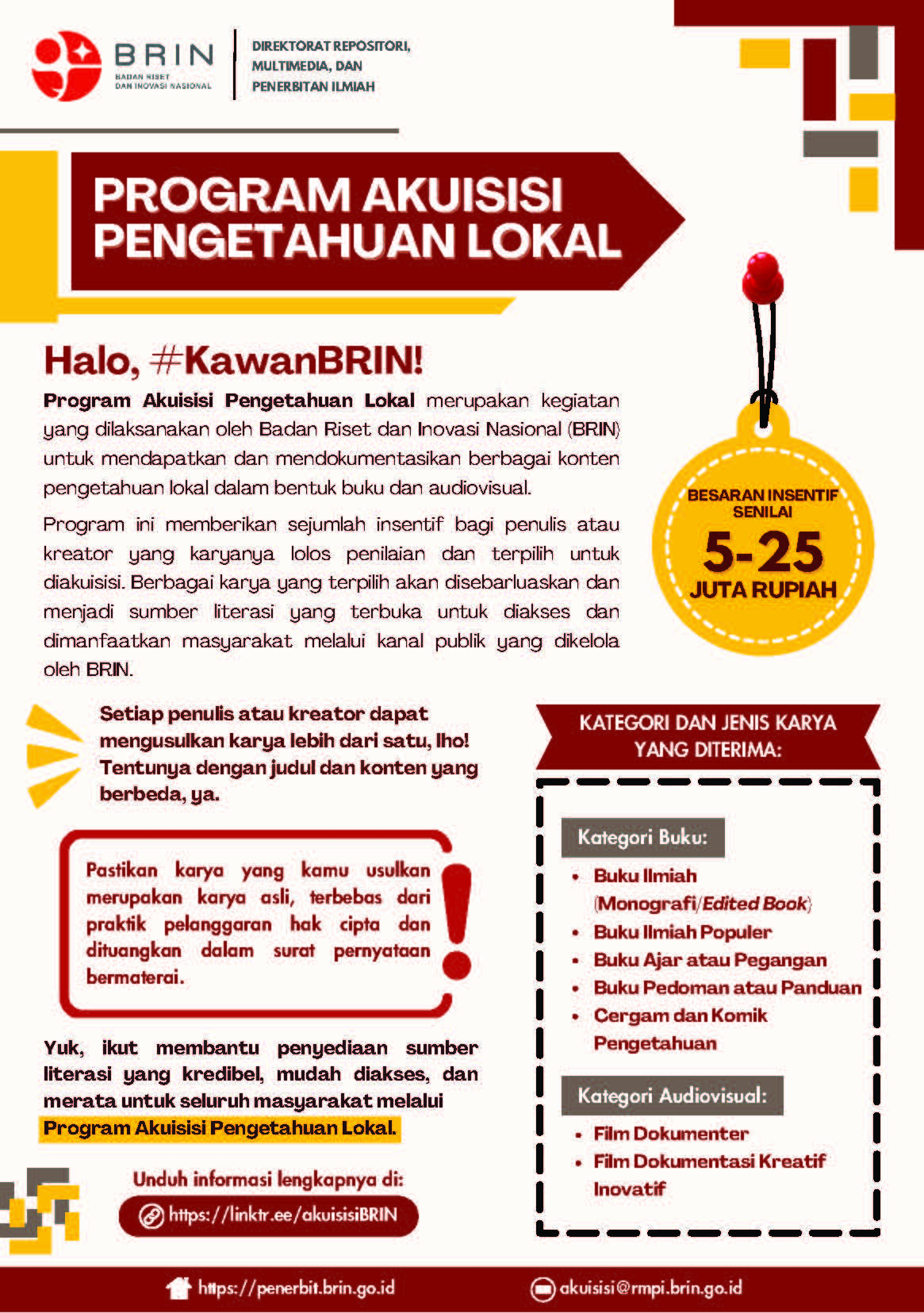
BRIN Publishing has a program named Akuisisi Pengetahuan Lokal that acquisition any of books or audiovisual content that meet our standard publication. The rights of BRIN Publishing is to disseminate and distribute all the content acquisitions for the public.
As an author you (or your employer or institution) may do the following:
All copies, print or electronic, or other use of the paper or article must include the appropriate bibliographic citation for the books