
























Industri kecil pengolahan pangan, khususnya pengolahan tahu, memanfaatkan air cukup banyak, namun juga menghasilkan limbah cair dan limbah padat sehingga mencemari lingkungan sekitar industri. Kajian terhadap peluang pemanfaatan teknologi tepat guna ini dikaitkan dengan penerapan konsep produksi bersih di industri kecil pengolahan tahu, khususnya industri kecil pengolahan tahu di Subang dan Sumedang. Buku ini juga menyajikan beberapa manfaat penerapan teknologi produksi bersih pada industri pengolahan tahu, di antaranya dapat menghemat penggunaan air bersih, meningkatkan jumlah produksi tahu, mengurangi limbah cair, dan memanfaatkan limbah padat. Hasil rekomendasi teknis diharapkan dapat dimanfaatkan oleh pihak-pihak yang berkepentingan, antara lain Dinas Perindustrian, Badan Pengendalian Lingkungan Hidup, dan Industri Tahu.
Dengan demikian, penerapan cleaner production diharapkan dapat memberikan manfaat bagi para pembaca dan pihak-pihak yang berkepentingan dalam rangka meningkatkan kualitas industri kecil dan menengah, khususnya pengolahan tahu.
Abbas, A. dan Tri Radiyati. 1999. Alih Teknologi: Konsep, Tujuan dan Strategi. Kerjasama JICA dan UPT. Subang: Balai Pengembangan Teknologi Tepat Guna.
Alaerts, G. dan Santika, S.S. 1984. Metoda Penelitian Air. Surabaya: Usaha Na- sional.
Arundhati, S.T. 2008. “Regulatory Aspect and Implementation of Cleaner Pro- duction in Indonesia”. Disampaikan dalam Tranning Course on Cleaner Pro- duction Technology for Virgin Coconut Oil (VCO) of Food Industry for ASEAN Countries, Jakarta.
Astawan, M. dan M.W. Astawan. 1991. Teknologi Pengolahan Pangan Nabati Tepat Guna. Jakarta: Akademika Pressindo.
Badan Standarisari Nasional. 1998. SNI Tahu. Jakarta:BSN.
BPS. 2006. Kabupaten Sumedang dalam Angka. Katalog BPS: 1403.3211. Sume-
dang.
BPS. 2007. Subang dalam Angka. Katalog 3213.0601. Subang.
DisperindagSar Kabupaten Subang. 2008. Daftar Industri Tahu di Kabupaten Su- bang. Subang: DisperindagSar.
DisperindagSar Kabupaten Subang. 2010. Daftar Industri Tahu di Kabupaten Su- bang. DisperindagSar, Subang.
Disperindag Kabupaten Sumedang. 2009. Daftar Industri Tahu Tempe di Kabupaten Sumedang. Disperindag, Sumedang.
Disperindag Kabupaten Sumedang. 2010. Daftar Industri Tahu Tempe di Kabupaten Sumedang. Disperindag, Sumedang.
DisperindagKop, Kabupaten Sleman Yogyakarta. 2008. Data Industri Kabupaten Sleman. DisperindagKop, Kabupaten Sleman.
Francis, R. L. and John A. White. 1974. Facility layout and location: an analytical approach. Prentice-Hall.
Fujitsuka, T. 2008. “Regulatory Aspect and Implementation of Cleaner Produc- tion”. Disampaikan dalam Tranning Course on Cleaner Production Technology for Virgin Coconut Oil (VCO) of Food Industry for ASEAN Countries, Jakarta.
Holman, J.P. 1997. Perpindahan Kalor. Alih Bahasa oleh Jasj , E., Edisi ke-6. Jakarta: Erlangga.
http://www.subang.go.id/index.php. “Pro l Pemerintah Kabupaten Subang”. Diak- ses tanggal 19 November 2009.
http://www.sumedang.go.id. “Pro l Pemerintah Kabuapten Sumedang”. Diakses tanggal 19 November 2009.
http://www.pertanian.go.id/Indikator/tabe-15b-konsumsi-rata.pdf. “Tabel 15.b. Kon- sumsi Rata-rata per Kapita Setahun Beberapa Bahan Makanan di Indone- sia, 2009–2012”. Diakses tanggal 19 Februari 2013.
http://www.unep.fr/scp/cp/. “Resource Ef cient and Cleaner Production”. Diak- ses tanggal 13 Agustus 2013.
http://www.en.wikipedia.org/wiki. “Appropriate_technology”. Diakses tanggal 13 November 2009.
http://bangkittani.com/kiat-sukses/dibutuhkan-kedelai-lokal-30-ton-per-bulan/. Diak- ses tanggal 7 Desember 2009.
Maryam, S. 2007. Penentuan Suhu Optimal Air Saat Menggiling Kedele untuk Mengha- silkan Tahu Berkualitas. Undiksha: Jurusan Pendidikan Kimia Fakultas MIPA.
Noor, E. 2006. “Produksi Bersih”. Presentasi dalam Pelatihan Doses PTN dan PTS se-Jawa Bali dalam Audit Lingkungan.
Parnanto, N.H.R. 2008. Teknologi Pengolahan dan Pemanfaatan Limbah Industri Tahu. Jurnal Teknologi Hasil Pertanian, ISSN: 1979-0309 Vol I No. 1 Februari 2008, UNS, Surakarta.
Pusat Produksi Bersih Nasional (PPBN). 2006. Panduan Penerapan Produksi Bersih Industri Kecil Tahu. Jakarta: PPBN.
Radiati, T. 2002. Teknologi Pembuatan Tahu dan Tempe. Seri Inovasi Teknologi Tepat Guna. Subang: B2PTTG LIPI.
Romli, M. 2008. “Cleaner Production in the Manufacturing of Virgin Coconut Oil (VCO)”. Disampaikan dalam Trainning Course on Cleaner Production Tech- nology for Virgin Coconut Oil (VCO) of Food Industry for ASEAN Countries, Jakarta.
Salim, T. dan Sriharti. 1996. Sanitasi Lingkungan Pada Industri Tahu. Subang: BPTTG Puslibang Fisika Terapan LIPI.
Saputri, S.D. dan Syarifa A. K. 2009. “Pengaruh Lama Pemasakan dan Tempera- tur Pemasakan Kedelai terhadap Proses Ekstraksi Protein Kedelai untuk Pembuatan Tahu”. Makalah Seminar Tugas Akhir. Universitas Diponegoro. Semarang. http://www.clicktoconvert.com. Diakses: 20 Agustus 2013.
Saragih, Yan Pieter; Sarwono, B. 2001. Membuat Aneka Tahu. Depok: Penebar Swadaya.
Sharif, N. 1992. “Technological dimensions of international cooperation and sustainable development”. Technological Forecasting and Social Change: Volume 42, Issue 4, December 1992, Pages 367–383.
Seels, B. B. & Richey, R. C. 1994. Instructional technology: The de nition and domains of the eld. Bloomington, IN: Association for Educational Communica- tions and Technology.
Suhaidi, I. 2003. Pengaruh Lama Perendaman Kedelai dan Jenis Zat Penggumpal terha- dap Mutu Tahu. Fakultas Pertanian, Jurusan Teknologi Pertanian, Univer- sitas Sumatera Utara. USU Digital Library.
Suprapti, M.L. 2005. Pembuatan Tahu, Seri Pengolahan Pangan. Yogyakarta: Penerbit Kanisius.
Supriadi, G. 2003. Membuat Susu Kedelai dan Tahu. Jakarta: Departemen Pendi- dikan Nasional.
Supriyato, Mamat. 1994. Modi kasi Tungku Industri Pengrajin Tahu. Subang: BPTTG Puslitbang Fisika Terapan LIPI.
Tim Penyusun Pusat Kamus. 1990. Kamus Besar Bahasa Indonesia. Jakarta: Balai Pustaka.


This work is licensed under a Creative Commons Attribution-NonCommercial-ShareAlike 4.0 International License.
This book that publish in BRIN Publishing is licensed under a Creative Commons Attribution Non-commercial Share Alike 4.0 International license (CC BY-NC-SA 4.0). This license permits you to share, copy, distribute and transmit the work for your personal use and non-commercial purposes, provided you provide appropriate attribution. Derivative works and modifications must use the same license. Detailed information regarding the CC-BY-NC-SA 4.0 license is available via the link: https://creativecommons.org/licenses/by-nc-sa/4.0/
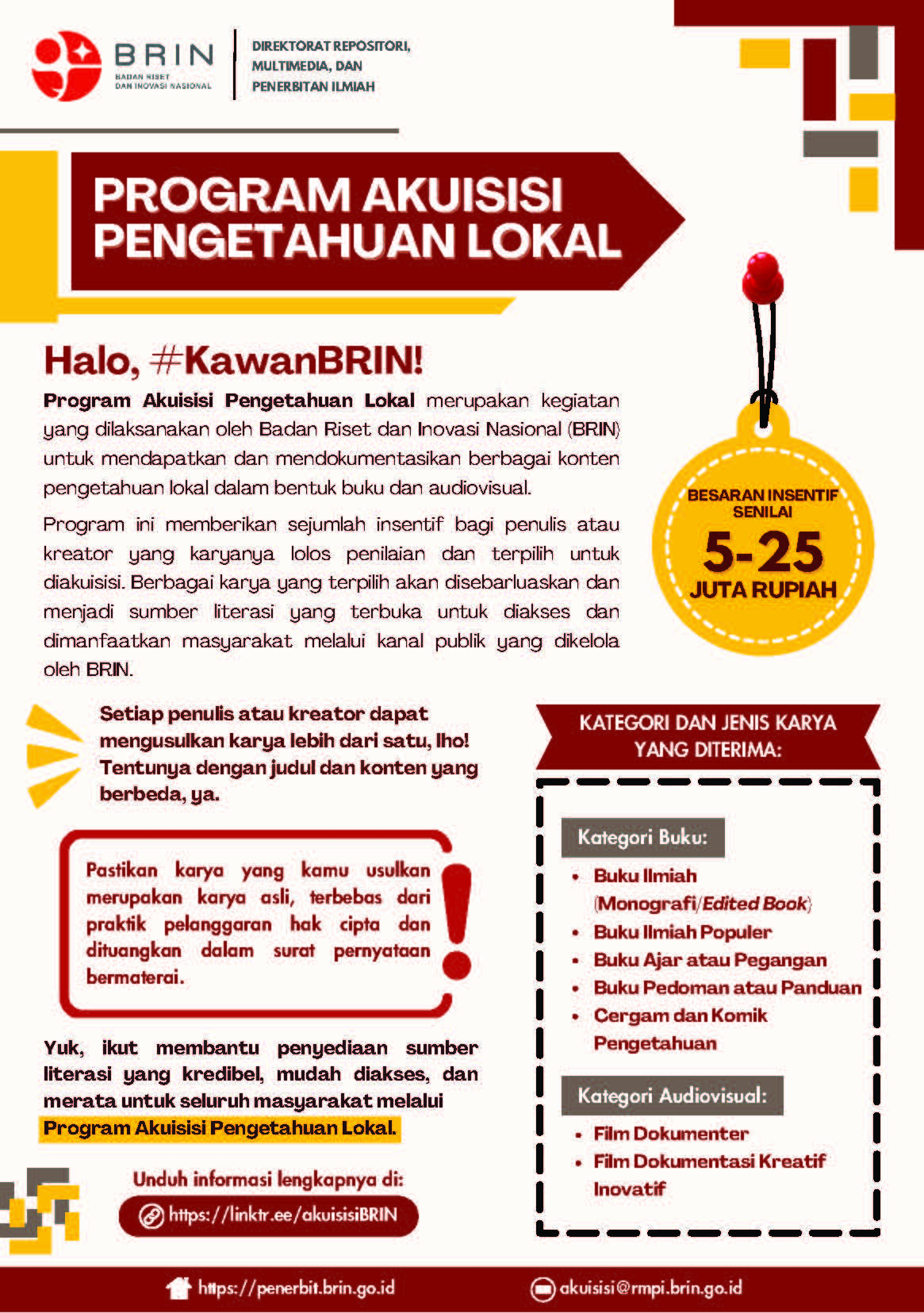
BRIN Publishing has a program named Akuisisi Pengetahuan Lokal that acquisition any of books or audiovisual content that meet our standard publication. The rights of BRIN Publishing is to disseminate and distribute all the content acquisitions for the public.
As an author you (or your employer or institution) may do the following:
All copies, print or electronic, or other use of the paper or article must include the appropriate bibliographic citation for the books