
























Bahasa dan budaya memiliki peranan sangat kuat dalam persatuan dan kesatuan masyarakat bangsa. Lokasi di wilayah pedalaman dan perbatasan antarnegara tentu akan menjadi ilustrasi bagaimana bahasa dan budaya daerah memosisikan diri di tengah bahasa dan kebudayaan nasionalnya. Bunga rampai di tangan Anda ini menarik karena menyajikan ilustrasi terkait konsepsi persatuan dan kesatuan bangsa di wilayah homogen, tidak melulu merujuk pada wilayah yang bersifat heterogen. Pembelajaran persatuan dan kesatuan dari masyarakat yang seragam sama sulitnya dengan mengungkap proses persatuan dan kesatuan dari masyarakat yang beragam. Dari berbagai aspek, upaya persatuan dan kesatuan ditilik secara saksama. Ikatan kesejarahan lama dan aspek mitologi yang sama, pernikahan, sistem mata pencaharian, ruang bangunan fisik yang memiliki makna simbolis, dan kebahasaan daerah dipotret oleh tim peneliti sebagai sarana penting peneguhan persatuan dan kesatuan dalam konteks lokal. Selain sebagai konsumsi publik, diharapkan buku ini juga dapat mendorong pemerintah dalam menentukan tindakan afirmatif dalam merumuskan dan menyusun kebijakan tentang upaya pelestarian bahasa dan budaya daerah yang bermanfaat guna kepentingan Negara Kesatuan Republik Indonesia. Semoga bunga rampai ini dapat bermanfaat bagi pengambil kebijakan, masyarakat luas, dan generasi yang akan datang. Selamat membaca!
Anwar, Dewi Fortuna, Helene Bouvier, Glenn Smith, dan Roger Tol (ed.).
Konflik Kekerasan Internal. Tinjauan Sejarah, Ekonomi Politik, dan
Kebijakan di Asia Pasifik. Jakarta: Yayasan Obor Indonesia, LIPI,
Lasema CNRS, KITLV, 2005.
Budiman, H. Pembunuhan yang Selalu Gagal: Modernisme dan Krisis
Rasionalitas Menurut Baniel Bell. Yogyakarta: Pustaka Pelajar, 1997.
Creswell, John W. Qualitative Inquiry and Research Design: Choosing
among Five Traditions. Thousand Oaks, London, and New Delhi: Sage
Publication, 1998.
Fedyani, Achmad S. Antropologi Kontemporer: Suatu Pengantar Kritis
Mengenai Paradigma. Malang: Kencana, 2007.
Handwerker, P. W. The Construct Validity of Cultures: Cultural Diversity,
Culture Theory, and a Method for Ethnography. American
Anthropologist Journal, Vol. 104, no. 2 (2002). Doi: 10.1525/
aa.2002.104.1.106
Herawati, Nanik. “Kearifan Lokal Budaya Jawa”. Yogyakarta: Seminar
Kebudayaan Jawa, 2005.
Humaedi, M. Alie. Ekspedisi Menuju Tuhan: Menelusur Praktik Pengobatan
Komunitas Tahu Taa Wana. Yogyakarta: Valia Press, 2016.
Humaedi, M. Alie. Merangkai Adaptasi dalam Penguatan Kedaulatan
NKRI di Kalimantan Barat. Dalam Humaedi, M. A., editor. Adaptasi
Komunitas Etnik Beda Bahasa & Budaya di Perbatasan Kalimantan
Barat. Jakarta: Gading Inti Prima, 2015.
Garna, Judistira K. Metode Penelitian Pendekatan Kualitatif. Bandung:
Primco Akademika, 1999.
Kuswarno, Engkus. Metode Penelitian Komunikasi. Bandung: Widya
Padjadjaran, 2008.
Liliweri, Allo. Dasar-dasar Komunikasi Antar Budaya. Yogyakarta: Pustaka
Pelajar, 2002.
Muriel, Saville-Troike. The Etnography of Communication: An Introduction.
Southampton: The Camelot Press, 1986.
Sekretaris Kecamatan Entikong. Monografi Kecamatan Entikong 2012.
Entikong: Sekretaris Kecamatan Entikong, 2012.
Sihabudin, Ahmad. Komunikasi Antarbudaya: Satu Perspektif Multidimensi
(Cetakan ke-3). Jakarta: Bumi Aksara, 2014.
Simuh. Tasawuf dan Perkembangannya dalam Islam. Yogyakarta: Raja
Grapindo Persada, 1996.
Suryadinata, Leo. Politik Tionghoa Peranakan di Jawa. Jakarta: Sinar
Harapan, 1994.
Suseno, Frans Magnis. Etika Jawa: Sebuah Analisa Filsafat tentang
Kebijaksanaan Hidup Orang Jawa. Jakarta: Gramedia, 1984.
Uchrowi, Zaim. Karakter Pancasila. Jakarta: Balai Pustaka, 2013.


This work is licensed under a Creative Commons Attribution-NonCommercial-ShareAlike 4.0 International License.
This book that publish in BRIN Publishing is licensed under a Creative Commons Attribution Non-commercial Share Alike 4.0 International license (CC BY-NC-SA 4.0). This license permits you to share, copy, distribute and transmit the work for your personal use and non-commercial purposes, provided you provide appropriate attribution. Derivative works and modifications must use the same license. Detailed information regarding the CC-BY-NC-SA 4.0 license is available via the link: https://creativecommons.org/licenses/by-nc-sa/4.0/
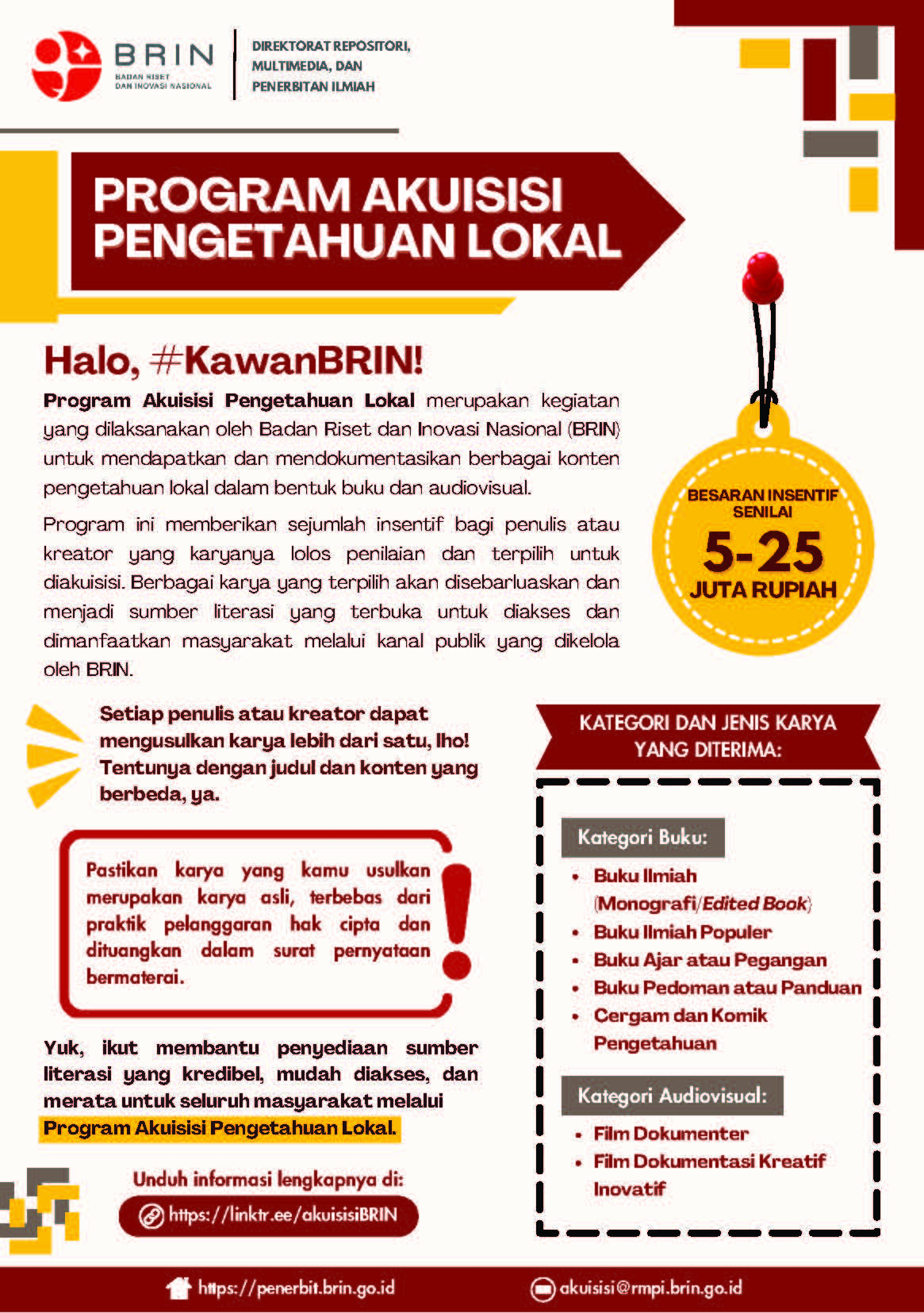
BRIN Publishing has a program named Akuisisi Pengetahuan Lokal that acquisition any of books or audiovisual content that meet our standard publication. The rights of BRIN Publishing is to disseminate and distribute all the content acquisitions for the public.
As an author you (or your employer or institution) may do the following:
All copies, print or electronic, or other use of the paper or article must include the appropriate bibliographic citation for the books