


























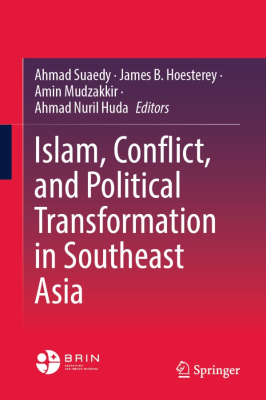
Islam, Conflict, and Political Transformation in Southeast Asia

Authors

Ahmad Suaedy (ed)
Universitas Nahdlatul Ulama Indonesia
James B. Hoesterey (ed)
Emory University
Amin Mudzakkir (ed)
Coordinating Ministry for Community Empowerment
Ahmad Nuril Huda (ed)
National Research and Innovation Agency

Keywords:

religious conflict, conflict, political transformation, Southeast Asia, civil society

Synopsis

This books explores several dimensions of conflict and transformation in Southeast Asian Islam, with a particular focus on the largest Islamic country in the region, Indonesia, based on a diverse range of in-depth case studies that engage local, national, regional, global and digital perspectives. These dimensions include but are not limited to forms and patterns of conflicts between Islam and local culture; conflicts between Islam and other groups of believers; conflicts between Islam and the state; and how these conflicts have changed over time. It also includes discussions relating to how Muslim figures, organizations, and groups in Southeast Asia have responded to conflicts, and the extent to which the conflicts have led to the consolidation of democratic society and civic governance. Moreover, with the rise and proliferation of digital media practices among various communities of believers in Southeast Asia, a special space is given to discuss how media and mediation practices could change the dynamics and complexity of a religious conflict, and form new strategies for practicing religion in conflict situations. It is intended for academics researching prevailing current issues connected to religion, politics and conflict transformation in Southeast Asia, and beyond.

Downloads

Download data is not yet available.

Author Biographies

Ahmad Suaedy, Universitas Nahdlatul Ulama Indonesia

Ahmad Suaedy is currently the Dean of the Faculty of Islam Nusantara - UNUSIA Jakarta and Chairman of the Nahdlatul Ulama Executive Board (PBNU). He is a Visiting Researcher of the National Research and Innovation Agency (BRIN), 2022-2023. His research topics are Islam in Southeast Asia, Social Movements, Minorities and Reconciliation. Some of his works include “Shaping Resemblance in Relational Dynamics: Exploring the Interactions between Indonesian Islamic Organizations and China" at https://iis.fudan.edu.cn/32/c (2025); “Aswaja Turn in Islamic Studies and Its Implications: Martin van Bruinessen, Gus Dur, and the Nahdlatul Ulama” in Trajectories of Indonesian Islam: Festschrift in Honour of Martin van Bruinessen (Jakarta: UIII 2025); “Indonesian Islamic Studies and the Notion of Islamic Area Studies: From Centrifugal to Centripetal. (By BRIN, forthcoming); “Professor Mitsuo Nakamura, Sang GOAT Penelitian Islam Indonesia” (introduction, YOI, forthcoming); and Nahdlatul Ulama Abad Kedua, Islam Nusantara dan Siyasah Peradaban (Jakarta: UNUSIA Press 2025). He wrote on a master’s thesis entitled “The Dynamics of Muslim Minorities Seeking a Peaceful Path: The Role of Muslim Civil Society in Southern Thailand and the Southern Philippines” (The Ministry of Religious Affairs, 2012); and a dissertation entitled “Gus Dur, Islam Nusantara and Diverse Citizenship: Resolution of the Aceh and Papua Conflicts 1999-2001” (Jakarta: Gramedia, 2018).

James B. Hoesterey, Emory University

James B. Hoesterey is Associate Professor of Islamic Studies at Emory University, and his research focuses on Islam, media, and politics in Indonesia. Hoesterey’s first book, Rebranding Islam: Piety, Prosperity, and a Self-Help Guru, chronicled the rise and fall of celebrity preacher Abdullah Gymnastiar and was awarded honorable mention for the Clifford Geertz Book Prize by the Society for the Anthropology of Religion. With generous funding by the Henry Luce Foundation, the Fulbright Foundation, and the Contending Modernities Project, Hoesterey has conducted over a year of fieldwork in Indonesia, Europe, and the United States for his current book project, Faith in Diplomacy: Indonesia, Soft Power, and the Making of “Moderate Islam.” Hoesterey has served as chair of the Indonesia-Timor Leste Studies Committee (Association for Asian Studies) and secretary for the American Institute for Indonesian Studies (AIFIS), and continues to serve as core faculty in Religion, Conflict, and Peacebuilding in Emory’s Graduate Division of Religion.

Amin Mudzakkir, Coordinating Ministry for Community Empowerment

Amin Mudzakkir is an Indonesian scholar with deep interest in philosophy, cultural studies, and political Islam. He currently serves as an Assistant Deputy II of Community Empowerment of the Coordinating Ministry for Community Empowerment. Formerly, he served as a researcher at the Research Center for Area Studies, National Research and Innovation Agency (BRIN), and is also a lecturer at the University of Indonesia's School of Strategic and Global Studies and the postgraduate program at Nahdlatul Ulama. He earned his bachelor's degree in History from Gadjah Mada University (2005), followed by a Master’s and Doctorate in Philosophy from the Driyarkara School of Philosophy, Jakarta (2015 and 2021). His academic journey reflects a strong commitment to interdisciplinary inquiry, particularly focusing on identity politics, minority rights, feminism, and Islamic movements. Previously, Dr. Mudzakkir was a long-time researcher at the Indonesian Institute of Sciences (LIPI) from 2006 to 2021. He has authored numerous scholarly articles, books, and book chapters, including Feminisme Kritis: Gender dan Kapitalisme dalam Pemikiran Nancy Fraser (2022) and Kosmopolitanisme Seyla Benhabib (2022).

Ahmad Nuril Huda, National Research and Innovation Agency

Ahmad Nuril Huda is a researcher at the Research Center for Area Studies (PRW), National Research and Innovation Agency (BRIN), with academic training in Arabic Literature, Islamic Studies, and Anthropology. His research interests include religion, media and digital anthropology, gender and sexuality, foodways culture, and the politics of visibility and invisibility in the regional contexts of Southeast Asia, (Muslim) Europe, and Indonesia. His dissertation, titled The Cinematic Santri: Youth Culture, Tradition, and Technology in Muslim Indonesia, examines the emergence of cinematic practices among younger generations of traditionalist Muslim groups in post-Suharto Indonesia. His recent publications include “Making Film as an Ethical Practice” (Contemporary Islam, 2025) and “KUPI’s Gender Campaigns, Digital Activism, and a Counterpublic in the Making” (African Journal of Religion and Gender, September 2025). At PRW-BRIN, he is involved in projects related to Digital/AI Islam, Gastrodiplomacy, and Urban Smart Cities.

References

Anceschi, L., Camilleri, J.A., Palapathwala, R., & Wicking, A. (Eds.). (2011). Religion and Ethics in A Global World. Palgrave Macmillan.

Asad, T. (2003). Formation of the Secular: Christianity, Islam and Modernity. Stanford University Press.

Aspinall, E., & Mietzner, M. (2019). Southeast Asia’s Troubling Elections: Nondemocratic Pluralism in Indonesia. Journal of Democracy, 30(4), October, 104-118. https://doi.org/10.1353/jod.2019.0055

Bourchier, D. (2015). Illiberal Democracy in Indonesia: The Ideology of the Family State. Routledge.

Menchik, J. (2019). Moderate Muslims and Democratic Breakdown in Indonesia. Asian Studies Review, 43(3), 415-433. https://doi.org/10.1080/10357823.2019.1627286

Mouffe, C. (1999). Deliberative Democracy or Agonistic Pluralism. Social Research, 66(3): 745–758.

Omer, A. (2015). Religious Peacebuilding: The Exoctic, The Good, and the Theatrical. In A. Omer, R.S. Appleby, & D. Little (Eds.), The Oxford Handbook of Religion, Conflict, and Peacebuilding (pp. 3-32). Oxford University Press.

Picard, M., & Madinier, R. (2011). The Politics of Religion in Indonesia: Syncretism, Orthodoxy, and Religious Contention in Java and Bali. Routledge.

Ricklefs, M. C. (2012). Islamisation and Its Opponents in Java: A Political, Social, Cultural and Religious History, C. 1930 to the Present. University of Hawaii Press.

Schmidt, L. (2017). Islamic Modernities in Southeast Asia: Exploring Indonesian Popular and Visual Culture. Rowman & Littlefield International Ltd.

Schottmann, S., & Camilleri, J. A. (2013). Culture, Religion and the Southeast Asian State. In J. A. Camilleri, & S. Schottmann (Eds.), Religion and Conflict in Muslim Southeast Asia Negotiating Tense Pluralisms (pp. 1-16). Routledge.

Suaedy, A. (2018). Islam, Minorities and Identity in Southeast Asia. Inklusif-ISAIs.
Downloads

Published

April 8, 2026
HOW TO CITE

License

License

Details about this monograph

Co-publisher's ISBN-13 (24)

978-981-95-5473-7