



























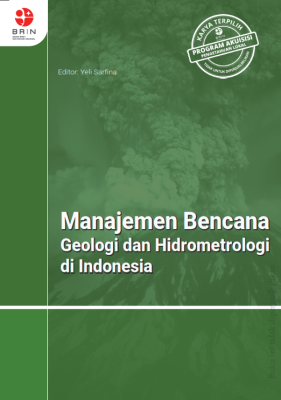
Kondisi geografi, geologi dan demografi telah mengantarkan Indonesia sebagai negara rawan bencana di dunia yang berada di kawasan cincin api pasifik dan kondisi iklim tropis yang sangat dinamis. Data terus mencatat berbagai kejadian bencana yang menunjukkan intensitas dan frekuensi kejadian yang terus meningkat dengan dampak yang juga semakin meningkat, baik dampak pada nyawa manusia (jumlah korban meninggal), kerugian material berupa kerusakan infrastruktur, maupun kerugian lainnya seperti psikis dan trauma. Hampir 90% kejadian bencana di Indonesia adalah bencana hidrometerologi dan sisanya bencana geologi.
Buku ini mengangkat berbagai isu terkait kebencanaan di Indonesia, baik kebencanaan hidrometeorologi maupun kebencanaan geologi. Hal tersebut mulai dari identifikasi penyebab bencana, pemetaan resiko bencana, analisis potensi kebencanaan untuk pembangunan, misalnya untuk pembangunan bandara dan pembangkit listrik tenaga nuklir, kesiapsiagaan bencana, sistem peringatan dini dan penyebaran informasinya, ketangguhan, mitigasi berbasis alam dan terakhir tentang kearifan lokal upaya mitigasi bencana yang ada pada masyarakat di Indonesia.
Azuga, N. A. (2021). Kerentanan kawasan pesisir terhadap bencana kenaikan muka air laut (sea level rise) di Indonesia. J-Tropimar: Jurnal Kelautan Tropis dan Maritim, 3(2), 65–76.
Badan Nasional Penanggulangan Bencana. (2024). Indeks risiko bencana Indonesia (IRBI) 2024. Direktorat Pemetaan dan Evaluasi Risiko Bencana.
Badan Nasional Penanggulangan Bencana. (2025). Info bencana Desember 2025. Pusat Data Informasi dan Komunikasi Kebencanaan.
Badan Pusat Statistik. (2023). Statistik sumber daya laut dan pesisir 2023: Ekonomi laut berkelanjutan dan tantangan pengelolaan kawasan pesisir.
Cazenave, A., & Cozannet, G. L. (2014). Sea level rise and its coastal impacts. Earth's Future, 2(2), 15–34. https://doi.org/10.1002/2013EF000188
Center for Excellence in Disaster Management & Humanitarian Assistance. (2006). Indonesia: Disaster management reference handbook. CFEDM.
Church, J. A., & White, N. J. (2011). Sea-level rise from the late 19th to the early 21st century. Surveys in Geophysics, 32, 585–602. https://doi.org/10.1007/s10712-011-9119-1
Dartanto, T. (2017). Disaster, mitigation and household welfare in Indonesia (LPEM-FEUI Working Paper No. 006). Lembaga Penyelidikan Ekonomi dan Masyarakat, Fakultas Ekonomi dan Bisnis Universitas Indonesia.
EM-DAT. (2025). Worldwide disaster data. Centre for Research on the Epidemiology of Disasters. https://www.emdat.be/
Hadi, S. (2020). Disaster management in the implementation of the 2030 Sustainable Development Goals in Indonesia. The Journal of Indonesia Sustainable Development Planning, 1(1), 12–25.
Hoque, M. A., Pradhan, B., Ahmed, N., & Roy, S. (2019). Tropical cyclone risk assessment using geospatial techniques for the eastern coastal region of Bangladesh. Science of the Total Environment, 692, 10–22. https://doi.org/10.1016/j.scitotenv.2019.05.131
Kohno, N., Fritz, C., Sharma, M., Berg, R., Greenslade, D., Telford, D., Rogers, M., & Uson, M. C. C. (2024). Forecasting tropical cyclone coastal hazard and impact. Tropical Cyclone Research and Review, 13(1), 1–14. https://doi.org/10.1016/j.tcrr.2024.03.001
Nicholls, R. J., & Tol, R. S. J. (2006). Impacts and responses to sea-level rise: A global analysis of the SRES scenarios over the twenty-first century. Philosophical Transactions of the Royal Society A: Mathematical, Physical and Engineering Sciences, 364(1841), 1073–1095. https://doi.org/10.1098/rsta.2006.1754
Nur, S. A., Wibowo, A., Supriatna, & Tampubolon, S. B. (2024). Spatial pattern of tropical cyclone in South Indonesia during 1990-2023. Jurnal Geografi Lingkungan Tropik, 8(2).
Ramadhan, C., Dina, R., & Nurjani, E. (2023). Spatial and temporal based deforestation proclivity analysis on flood events applying watershed scale (Case study: Lasolo watershed in Southeast Sulawesi, Central Sulawesi and South Sulawesi, Indonesia). IOP Conference Series: Earth and Environmental Science.
Sabri, Aimon, H., & Amar, S. (2024). Economic growth and environmental degradation in Indonesia: The roles of investment, inflation, income inequality, fossil consumption and poverty. International Journal of Sustainable Development and Planning, 19(5), 1941–1946. https://doi.org/10.18280/ijsdp.190535
Sagala, S., Riawan, E., Wicaksono, A. Z. P., Adysti, R. T., Pratama, N. H., Lisan, I. H., & Yuanita, C. N. (2025). Cyclone Senyar and the escalating hydrometeorological risk in Sumatra: Shaping recommendations in Indonesia’s disaster preparedness and response (RDI Policy Brief No. 11). Resilience Development Initiative.
Sitorus, S. R. P., & Pravitasari, A. E. (2017). Land degradation and landslide in Indonesia. Sumatra Journal of Disaster, Geography and Geography Education, 1(2), 61–71.
United Nations Office for Disaster Risk Reduction. (2020). Disaster risk reduction in Indonesia: Status report 2020. Regional Office for Asia and the Pacific.
United Nations Publication. (2026). Rising heat, rising risk: Policy pathway for regional resilience. United Nations.

This work is licensed under a Creative Commons Attribution-NonCommercial-ShareAlike 4.0 International License.
This book that publish in BRIN Publishing is licensed under a Creative Commons Attribution Non-commercial Share Alike 4.0 International license (CC BY-NC-SA 4.0). This license permits you to share, copy, distribute and transmit the work for your personal use and non-commercial purposes, provided you provide appropriate attribution. Derivative works and modifications must use the same license. Detailed information regarding the CC-BY-NC-SA 4.0 license is available via the link: https://creativecommons.org/licenses/by-nc-sa/4.0/
BRIN Publishing has a program named Akuisisi Pengetahuan Lokal that acquisition any of books or audiovisual content that meet our standard publication. The rights of BRIN Publishing is to disseminate and distribute all the content acquisitions for the public.
As an author you (or your employer or institution) may do the following:
All copies, print or electronic, or other use of the paper or article must include the appropriate bibliographic citation for the books


