
























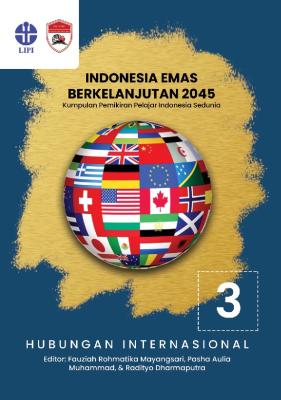
LIPI Press berkolaborasi dengan Perhimpunan Pelajar Indonesia (PPI) Dunia menerbitkan rangkaian buku seri Indonesia Emas Berkelanjutan 2045: Kumpulan Pemikiran Pelajar Indonesia Sedunia. Rangkaian bunga rampai ini terdiri dari 12 buku dengan sejumlah topik yang mendukung Tujuan Pembangunan Berkelanjutan atau Sustainable Development Goals (SDGs) untuk mencapai tujuan Indonesia Emas 2045. Buku ini merupakan seri ketiga dari rangkaian tersebut. Seri Hubungan Internasional mendukung poin ke-17 SDGs, yakni “kemitraan untuk mencapai tujuan”. Buku ini berisi pemikiran kumpulan pelajar Indonesia yang menyajikan berbagai wawasan serta ide baru mengenai hubungan internasional Indonesia dengan negara-negara di seluruh dunia. Terbagi menjadi tiga bagian, buku ini membahas kemitraan Indonesia dengan negara besar, negara berkembang, dan organisasi internasional. Buku ini diharapkan dapat menjadi bacaan yang bermanfaat bagi masyarakat Indonesia, khususnya para pemangku kepentingan di bidang hubungan internasional dan pembangunan. Temukan beragam sudut pandang serta ide menarik terkait kemitraan internasional Indonesia sebagai penyalur energi positif pelajar Indonesia sedunia. Selamat membaca!
Alexandra, L. (2014, 28 Mei). Becoming a 'middle power'. The Jakarta Post. https://www.thejakartapost.com/news/2014/05/28/becoming-a-middle-power.html.
Aljunied, S.M.A. (2012). Locating the rise of Indonesia: Is the great power status possible? The World View. https://lkyspp.nus.edu.sg/gia/article/locating-the-rise-of-indonesia-is-the-great-power-status-possible.
ANTARA News. (2020, 9 Januari). Presiden Jokowi minta para dubes fokus lakukan diplomasi ekonomi. https://www.antaranews.com/berita/1242200/presiden-jokowi-minta-para-dubes-fokus-lakukan-diplomasi-ekonomi.
Azra, A. (2015). Indonesia’s Middle Power Public Diplomacy: Asia and Beyond. Dalam J. Mellisen & Y. Sohn (Eds.), Understanding Public Diplomacy in East Asia: Middle Powers in a Troubled Region (pp. 131-154). Palgrave Macmillan.
BAPPENAS. (2019). Indonesia 2045: Berdaulat, Maju, Adil, dan Makmur. https://www.bappenas.go.id/files/Visi%20Indonesia%202045/Ringkasan%20Eksekutif%20Visi%20Indonesia%202045_Final.pdf.
Bley, B. (2019, 23 Agustus). A middle-power moment. The Interpreter. https://www.lowyinstitute.org/the-interpreter/middle-power-moment.
Chapnick, A. (1999). The Middle Power. Canadian Foreign Policy Journal, 7(2), 73–82. https://doi.org/10.1080/11926422.1999.9673212.
Cooper, A.F., Higgott, R., & Nossal, K. (1993). Relocating Middle Powers: Australia and Canada in a Changing World Order. UBC Press.
Dewi, R.K. (2019, 20 Oktober). Jokowi Sebut Cita-cita Indonesia di Tahun 2045, Apa Saja?. KOMPAS. https://www.kompas.com/tren/read/2019/10/20/190800865/jokowi-sebut-cita-cita-indonesia-di-tahun-2045-apa-saja-?page=all.
Efstathopoulos, C. (2018). Middle Powers and the Behavioural Model. Global Society, 32(1), 47-69. https://doi.org/10.1080/13600826.2017.1351422.
Holbraad, C. (1984). Middle Powers in International Politics. St. Martin’s Press.
Jordaan, E. (2003). The Concept of a Middle Power in International Relations: Distinguishing between Emerging and Traditional Middle Powers. Politikon, 30(2), 165–181. https://doi.org/10.1080/0258934032000147282.
Karim, M.F. (2018). Middle power, status-seeking and role conceptions: the cases of Indonesia and South Korea. Australian Journal of International Affairs, 72(4), 343-363. https://doi.org/10.1080/10357718.2018.1443428.
Kementerian Luar Negeri Republik Indonesia. (2015). Rencana Strategis 2015-2019. https://kemlu.go.id/download/L3NpdGVzL3B1c2F0L0RvY3VtZW50cy9BS0lQL0tlbWVudGVyaWFuJTIwTHVhciUyME5lZ2VyaS9SZW5jYW5hJTIwU3RyYXRlZ2lzJTIwS2VtbHUlMjAyMDE1LTIwMTkucGRm.
Lowy Institute. (2020). Asia Power Index: 2020 Edition. https://power.lowyinstitute.org/.
Nabbs-Keller, G. & Errington, I. (2020, 8 April). Indonesia’s and Australia’s middle-power moment. ASPI - The Strategist. https://www.aspistrategist.org.au/indonesias-and-australias-middle-power-moment/.
Neack, L. (1992). Empirical Observations on “Middle State” Behavior at the Start of a New International System. Pacific Focus, 7(1), 5–21. https://doi.org/10.1111/j.1976-5118.1992.tb00139.x.
Pandjaitan, L.B. (2018, 15 Februari). Indonesia ready to take on bigger role in Indo-Pacific. The Straits Times. https://www.straitstimes.com/opinion/indonesia-ready-to-take-on-bigger-role-in-indo-pacific.
Quayle, L. (2013). Power and paradox: Indonesia and the ‘English School’ concept of great powers. International Relations of the Asia-Pacific, 13(2), 301–330. https://doi.org/10.1093/irap/lct001.
Ravenhill, J. (1998). Cycles of Middle Power Activism: Constraint and Choice in Australian and Canadian Foreign Policies. Australian Journal of International Affairs, 52(3), 309–327. https://doi.org/10.1080/10357719808445259.
Roberts, C.B. & Sebastian, L.C. (2015). Ascending Indonesia: Significance and Conceptual Foundations. Dalam C. Roberts, A. Habir, & L. Sebastian (Eds.), Indonesia’s Ascent: Power, Leadership, and the Regional Order (pp. 1-21). Palgrave Macmillan.
Robertson, J. (2017). Middle-power definitions: confusion reigns supreme. Australian Journal of International Affairs, 71(4), 355-370, https://doi.org/10.1080/10357718.2017.1293608.
Robertson, J. (2020, 6 Juni). Middle powers after the middle-power moment. East Asia Forum. https://www.eastasiaforum.org/2020/06/06/middle-powers-after-the-middle-power-moment/.
Schweller, R. (2017). The Concept of Middle Power. Dalam V.D. Cha & M. Dumond (Eds.), The Korean Pivot: The Study of South Korea as Global Power (pp. 3-9). Center for Strategic and International Studies.
Thies, C. & Sari, A.C. (2020). A Role Theory Approach to Middle Powers: Making Sense of Indonesia’s Place in the International System. Contemporary Southeast Asia, 40(3), 397-421. https://doi.org/10.1355/cs40-3c.
Thies, C. (2010). Role Theory and Foreign Policy. Dalam R.A. Denemark & R. Marlin-Bennett (Eds.), International Studies Encyclopedia. Wiley-Blackwell.

This work is licensed under a Creative Commons Attribution-NonCommercial-ShareAlike 4.0 International License.
This book that publish in BRIN Publishing is licensed under a Creative Commons Attribution Non-commercial Share Alike 4.0 International license (CC BY-NC-SA 4.0). This license permits you to share, copy, distribute and transmit the work for your personal use and non-commercial purposes, provided you provide appropriate attribution. Derivative works and modifications must use the same license. Detailed information regarding the CC-BY-NC-SA 4.0 license is available via the link: https://creativecommons.org/licenses/by-nc-sa/4.0/
BRIN Publishing has a program named Akuisisi Pengetahuan Lokal that acquisition any of books or audiovisual content that meet our standard publication. The rights of BRIN Publishing is to disseminate and distribute all the content acquisitions for the public.
As an author you (or your employer or institution) may do the following:
All copies, print or electronic, or other use of the paper or article must include the appropriate bibliographic citation for the books