























Buku ini menggambarkan motif dalam cerita asal-usul suku dan nenek moyang yang terdapat di pulau Alor, Pura, dan Pantar Kabupaten Alor, NTT. Adapun beberapa motif yang terdapat dalam cerita asal-usul nenek moyang yang berhasil dikumpulkan dalam penelitian ini meliputi motif nenek moyang turun dari langit, nenek moyang sebagai pencipta, penjelmaan makhluk, kepemilikan benda ajaib, nenek moyang menata alam, asal mula tempat, keturunan nenek moyang, asal-usul suku, dan lain-lain. Motif-motif cerita tersebut menggambarkan kosmologi masyarakat Alor yang menghormati leluhur dan meninggikan asal keberadaannya. Kepemilikan cerita asal-usul pada suku-suku di kabupaten Alor ini juga memperlihatkan keberagaman suku-suku dan bahasa yang merupakan ciri identitas kultural pada masing-masing suku. Terdapat kurang lebih 18 bahasa daerah di Alor meliputi bahasa Alurung, Abui, Adang, Blagar, Hamap, Lamma, Kui, Klon, Kabola, Kamang, Kafoa, Nebebang, Pura, Retta, Sawila, terewang, Taiwa, dan Wersing. Kekayaan bahasa daerah ini juga menandai kekayan sastra termasuk di dalammnya cerita asal-usul suku dan nenek moyang. Sekalipun suku-suku di Alor sangat beragam dan berbeda akan tetapi mereka dikat oleh sebuah identitas kultural yang menyatukan yang terlihat pada tarian lego-lego (bahasa Abui) atau beku (bahasa Alurung) atau dar (dalam bahasa Kui). Tarian ini menggambarkan persatuan dan kesatuan dan dikenal luas di kabupaten Alor.
Barnes, R.H. 1973. Two Terminologies of Symmetric Prescriptive Alliance from Pantar and Alor in Eastern Indonesia. Sociologus 23:71-89. 1982 The Majapahit Dependency--------------. 1982. The Majapahit Depedency Galiyao, Bijdragen Tot De Taal,- Land- En volkenkunde van Nederlansch-Indië 138-4: 407-411.
Bintarti. D.D. 1983.
Bouman, M.A. 1943. “De Aloreeshe dansplaats”, Bijdragen tot de Taal-, Land- En volkenkunde van Nederlansch-Indië 102-3/4:481-500
Dickens, Charles. 1843. A Christmas Carol. London: Chapman & Hall.
Du Bois, Cora. 1944. The People of Alor: A Social- Pssychological Study of an East Indian Island. Minneapolis: The University of Minnesota.
Fraassen, CH. F. van. 1976. Drië plaatsnamen uit Oost- Indonesië
Gomang, Syarifuddin R.1993. The People of Alor and Their Alliances in Eastern Indonesia: A Study in Politiccal Sociology. Wollongong, Asutralia: University of Wollongong. (M.A. Thesis).
--------------------------- 2006. “Muslim and Christian Alliances: ‘Familial Relationship’ between Inland and Coastal Peoples of Belagar Community in Eastern Indonesia.” Dalam Bijdragen tot de Taal-Land-en Volkenkunde (BKI), hal. 468-489.
Gombrich, E.H. 1969. Art and Illusion: A Study in the Psychology of Pictorial Representation. Princeton: Princeton University Press. (Cetakan 1960.) Go1969.
Greimas. A.J. 1986. Semantique Structurale. Paris: Universitaires de France
Henige, D. 1982. Oral Historiography. London: Oxford.
Koentjaraningrat. 1993. Metode-Metode Penelitian Kualitatif. Jakarta: Penerbit Djambatan
--------------------- 2007.(ed) ke 20. Manusia dan Kebudayaan di Indonesia. Jakarta: Djambatan.
Katubi. 2008. “Lego Lego of Alor People in East Nusa Tenggara, Indonesia: The Expression of Ancestors Experience and Language Maintenance”. Research for Center for Society and Culture Indonesia Institute of Sciences. --------- 2017. Lego-Lego Orang Kui di Pulau Alor Dalam Ekologi Bahasa Yang Terancam Punah. Disertasi Fakultas Ilmu Budaya, Universitas Indonesia, Depok.
Hobsbawm, Eric. 1993. The Invented Tradition. New York: Atheneum
Koentjaraningrat. 1993. Masalah Kesukubangsaan dan Integrasi Nasional. Jakarta:Gramedia Pustaka
Laufa, Semuel. 2009. Moko Alor: Bentuk, Ragam Hisa dan Nilai Berdasarkan Urutan. Kalabahi: Dinas Kebudayaan dan Pariwisata Kabupaten Alor.
Lord, Albert B. 1976. The Singer of Tales. New York: Atheneum.
Liaw Yock Fang. 1994. Sejarah Kesusastraan Melayu Klasik. Jakarta: Penerbit
Erlangga
Melalatoa, M.J. 1997. Sistem Budaya Indonesia. Jakarta: Pamator dan FIB UI. Press.
Ong, Walter J. 1967. The Presence of the Word. New Haven: Yale University --------------------. 1982. Orality and Literacy: The Technologizing of The Words. New Haven: Yale University
Purwanto, Bambang dalam Vansina, Jan. 2014. Tradisi Lisan Sebagai Sejarah (Terjemahan). Jogyakarta:Ombak.
Pudentia MPSS. 1998. Metodologi Kajian Tradisi Lisan. Jakarta: Yayasan Obor Indonesia
Propp. Vladimir. 1958. Morfology of Folktale. Texas: University of Texas Press.
Rodemeier, Susanne.1995. Local Tradition on Alor and Pantar: An Attetmpt at Localizing aliyao, “ dalam Bijdragen tot de Taal-Land-en Volkenkunde (BKI), KITLV, Dell 151:438-442.
------------------------2006. Tutu kadire in Pandai - Munaseli. Erzählen und Erinnern auf der vergessenen Insel Pantar (Ostindonesien). Berlin: Lit Verlag. (Passauer Beiträge zur Südostasienkunde, 12) The Legacy of Eugene A. Nida A Contribution to Anthropological Theory.
Sudarmaji, Miranti dan Innayah Tusalihah. 2017. “Vitalitas Bahasa Nedebang, Pantar, Kabupaten Alor”. Laporan Penelitian Pusat Pelindungan, Badan Bahasa Jakarta.
Stokhof, W.A.L.1984. “Annotations to a text in the Abui language (Alor),” dalam Bijdragen tot de taal-land en volkenkunde; vol.140 (1984), afl.1, hlm.106-162/1984.
Sweeney Amin. 1980. Authors and Audiences in Traditional Malay Literature. Berkeley: University of California.————. 1987. A Full Hearing: Orality And Literacy In The Malay World.
Berkeley: University of California Press.
Stith Thompson. 1955. Motif and Index on Folk Literarture. Bloominton:
Indiana University Press. Vansina, Jan. 2014.Tradisi Lisan Sebagai Sejarah (Terjemahan). Jogyakarta:Ombak.


This work is licensed under a Creative Commons Attribution-NonCommercial-ShareAlike 4.0 International License.
This book that publish in BRIN Publishing is licensed under a Creative Commons Attribution Non-commercial Share Alike 4.0 International license (CC BY-NC-SA 4.0). This license permits you to share, copy, distribute and transmit the work for your personal use and non-commercial purposes, provided you provide appropriate attribution. Derivative works and modifications must use the same license. Detailed information regarding the CC-BY-NC-SA 4.0 license is available via the link: https://creativecommons.org/licenses/by-nc-sa/4.0/
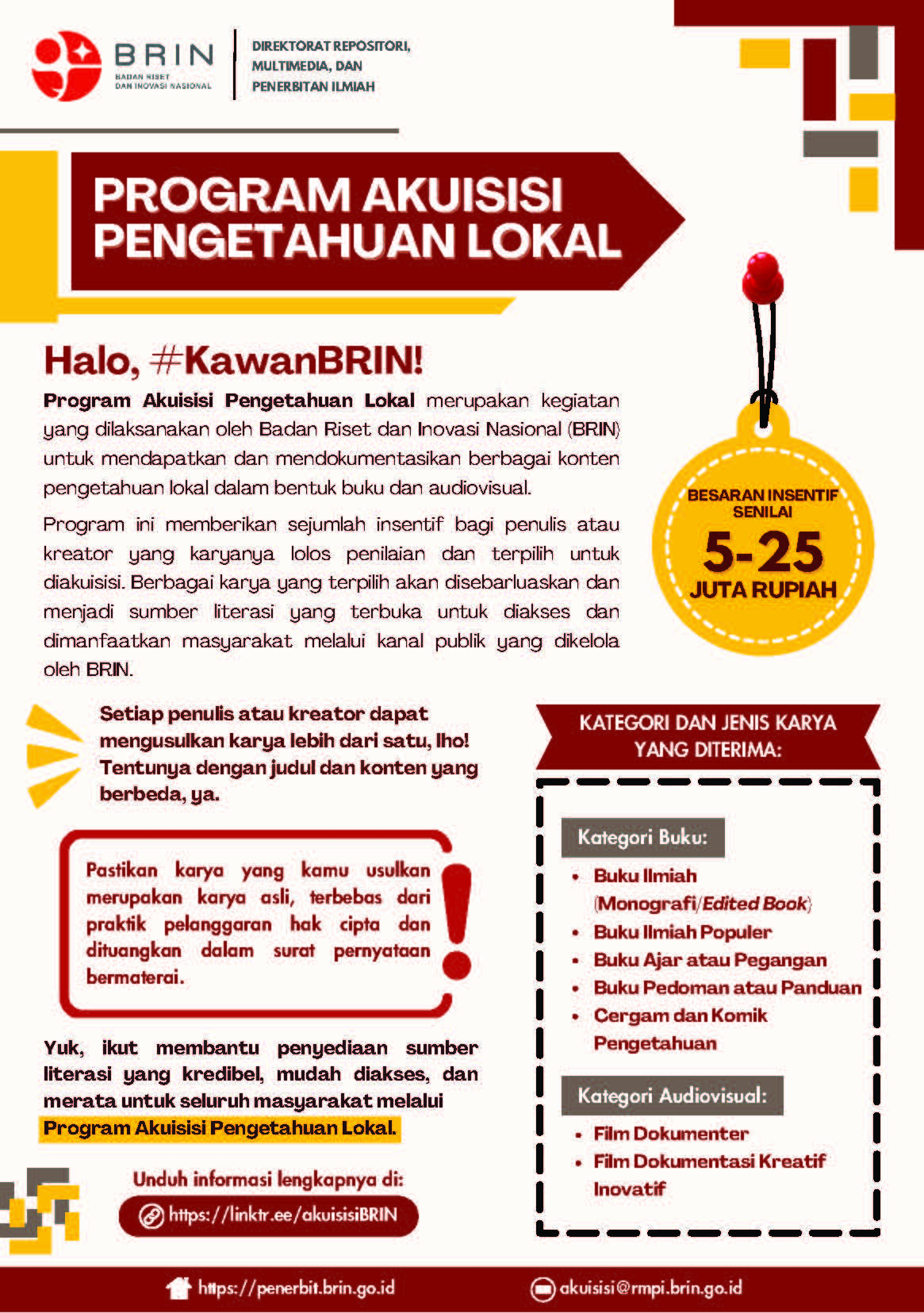
BRIN Publishing has a program named Akuisisi Pengetahuan Lokal that acquisition any of books or audiovisual content that meet our standard publication. The rights of BRIN Publishing is to disseminate and distribute all the content acquisitions for the public.
As an author you (or your employer or institution) may do the following:
All copies, print or electronic, or other use of the paper or article must include the appropriate bibliographic citation for the books