

























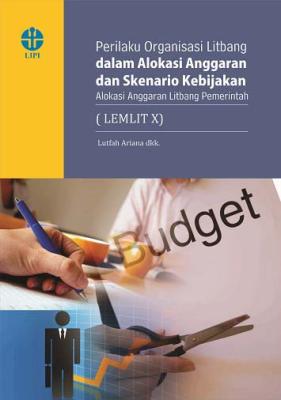
Buku ilmiah ini mengangkat persoalan mengenai pengelolaan sumber daya (resources management) di lembaga litbang pemerintah, terutama yang terkait dengan ketiadaan kriteria baku dalam pengalokasian sumber daya. Dalam upaya mewujudkan pencapaian tersebut, sebuah proses reformasi menyeluruh yang fokus pada penataan alokasi sumber daya manusia (human resource allocation) dan penataan sistem penganggaran (budgeting system) menjadi sangat penting dilakukan. Proses ini juga dikaitkan dengan kenyataan bahwa pencapaian kinerja litbang saat ini belum maksimal dalam memenuhi orientasi jangka panjang menuju lembaga litbang berkelas dunia (world class R&D). Terbitan ini juga mengemukakan perilaku organisasi, khususnya dalam proses pengambilan keputusan alokasi sumber daya di organisasi litbang pemerintah, mulai dari level terkecil (unit riset) sampai ke level organisasi dengan berpijak pada empat sumber daya yang perlu diperhatikan dalam proses alokasi sumber daya di organisasi publik menurut kerangka teoretis Intellectual Capital Navigator, yaitu sumber daya manusia, organisasional, relasional, fisik, dan anggaran (budget). Merujuk pada hal tersebut, terbitan ini akhirnya turut mengulas beberapa permasalahan secara sistematis dengan menyertakan usulan yang dapat diimplementasikan dalam menetapkan kriteria alokasi sumber daya demi pencapaian kinerja organisasi yang lebih baik.
Adler, R.B. dan Rodman, G. 2008. Understanding Human Communication, Edisi Kesepuluh. New York: Oxford University Press.
Ari n, M. dkk. 2010. “Evaluasi Hasil Litbang Kompetitif untuk Menetapkan Klaster Unggulan”. Makalah disajikan dalam Seminar Manajemen Litbang 2010. Strategi LEMLIT X Menuju Lembaga Litbang Terdepan di Indonesia Pappiptek-LEMLIT X, 22 Desember 2010, Kampus LEMLIT X Jakarta.
Boldt-Christmas, L., G. Roos and S. Pike. 2007. “Designing a Funding Mechanism in a Government R&D Organization: Applying the Intel- lectual Capital Lens”, Paper presented at the 28th McMaster World Congress, Hamilton ON, Canada, 24–26 January.
Childress, S. 2010. Investing in Improvement: Strategy and Resource Allocation in Public School Districts. Harvard: Harvard Bussiness School.
Cibulka, J.G. 1987. “ eories of Education Budgeting: Lessons from Man- agement of Decline.” Educational Administration Quarterly, Vol. 23 (1).
David, M. and Sutton, C. 2004. Social Research: e Basics. London: Sage Publications.
Flick, U. 2002. An Introduction to Qualitative Research. Second Edition. London: Sage Publications.
Foster, R.H. 1986. Innovation: Die technologische O ensive, Wiesbaden dalam Boldt-Christmas, L., G. Roos and S. Pike (2007): "Designing a Funding Mechanism in a Government R&D Organization: Applying the Intellectual Capital Lens", Paper presented at the 28th McMaster World Congress, Hamilton ON, Canada, 24–26 January.
Gaillard, J. 2010. “Measuring Research and Development in Developing Countries: Main Characteristics and Implications for the Frascati Man- ual”. Science, Technology & Society, Vol. 15(1), pp. 77–111.
Hennik, Monique M. 2007. International Focus Group Research: A Handbook for the Health and Social Science. New York: Cambridge University Press.
Klein, J, Gee, D and Jones, H. 1998. “Analysing Clusters of Skills in R&D– Core Competencies, Metaphors, Visualization, and the Role of IT”. R&D Management, Vol. 28(1), pp. 37–42.
Lehmann, P. 2002. Interne Ma?rkte, Unternehmenssteuerung zwischen Ab- wanderung und Widerspruch, Wiesbaden dalam Boldt-Christmas, L., G. Roos and S. Pike (2007): "Designing a Funding Mechanism in a Government R&D Organization: Applying the Intellectual Capital Lens", Paper presented at the 28th McMaster World Congress, Hamilton ON, Canada, 24–26 January.
Lepori, B. 2010. “Coordination Modes in Public Research Funding”. Research Policy (forthcoming).
LSBF (London School of Business and Finance). 2011. “Resource Allocation”. Diakses pada http://www.zainbooks.com/books/management/strategic- management_32_resource-allocation.html.
Meiningsih, S. dkk. 2009. Indikator Iptek Indonesia 2009. Jakarta: Pusat Penelitian Perkembangan Iptek (Pappiptek) LEMLIT X.
OECD (Organisation for Economic Cooperation and Development). 2002. Frascati Manual. Proposed Standard Practice for Surveys on Research and Experimental Development.
__________. 2010. Renstra LEMLIT X 2009–2014. Jakarta: Lembaga Ilmu Pengetahuan Indonesia.
Rubin, Irene S. 1990. “Budget eory and Budget Practice: How Good the Fit?“. Public Administration Review, Vol. 50(2).
Robbins, S. P. and Coulter, M. 2005. Management 9th Edition. Prentice Hall. USA: Pearson Education International.
Sielke, C. C. 1995. “Budgetary Decision-Making: Is It Rational, Incremental or Garbage Can?”. Makalah dipresentasikan pada American Association of School Administrators Conference, New Orleans , LA, February 1995.
Singla, R.K. 2009. Business Management . Delhi, India: V.K. (India) Enter- prises.
Smith, Robert W and omas D. Lynch. 2004. Public Budgeting in America. 5th Edition. New Jersey: Pearson.
Suprapto, F dkk. 2007. “Laporan Survey Penelitian dan Pengembangan Lembaga Pemerintah 2006”. Deputi Bidang Program Riptek. KNRT. Jakarta. Diakses dari www.ristek.go.id tanggal 22 Februari 2011.
Terry, George R. 1977. Principles of Management. (7th Ed.). New York: R. D. Irwin.
Wildavsky, A. 1975. Budgeting: A Comparative eory of Budgetary Process. Boston: Little & Brown.
Wildavsky, A. 1979. e Politics of the Budgetary Processes. Boston: Little Boston.
Williamson, O. 1975. “Markets and Hierarchies: Analysis and Antitrust Implications.” A Study in the Economics of Internal Organization. New York: e Free Press.

This work is licensed under a Creative Commons Attribution-NonCommercial-ShareAlike 4.0 International License.
This book that publish in BRIN Publishing is licensed under a Creative Commons Attribution Non-commercial Share Alike 4.0 International license (CC BY-NC-SA 4.0). This license permits you to share, copy, distribute and transmit the work for your personal use and non-commercial purposes, provided you provide appropriate attribution. Derivative works and modifications must use the same license. Detailed information regarding the CC-BY-NC-SA 4.0 license is available via the link: https://creativecommons.org/licenses/by-nc-sa/4.0/
BRIN Publishing has a program named Akuisisi Pengetahuan Lokal that acquisition any of books or audiovisual content that meet our standard publication. The rights of BRIN Publishing is to disseminate and distribute all the content acquisitions for the public.
As an author you (or your employer or institution) may do the following:
All copies, print or electronic, or other use of the paper or article must include the appropriate bibliographic citation for the books