






















Ketenteraman negeri Unenapo terganggu. Seekor burung raksasa kerap mendatangi ladang. Memakan tanaman dan hewan, bahkan memangsa manusia. Para toono motuo, tetua adat, berembuk mencari cara mengatasinya. Bagaimana upaya warga mengusir si burung kongga? Bacalah kisah dalam buku ini. Kalian akan menemukan pelajaran berharga. Selamat Membaca!
Anafiah, S. (2015). Pemanfaatan cerita rakyat sebagai alternatif bacaan bagi anak. Trihayu: Jurnal Pendidikan Ke-SD-an, 1(2), 128–133. https://doi.org/10.30738/trihayu.v1i2.839
Bunanta, M. (1998). Problematika penulisan cerita rakyat untuk anak Indonesia. Balai Pustaka.
Bunga, R. D., Rini, M. M., Serlin, M. F. (2020). Peran cerita rakyat sebagai media pembelajaran bahasa Indonesia di Kabupaten Ende. Retorika: Jurnal Pembelajaran Bahasa dan Sastra Indonesia, 1(1), 65–77.
Dongeng Cerita Rakyat. (2016, 16 Maret). Cerita rakyat dari Sulawesi Tenggara: Ksatria dan burung garuda. Cerita Rakyat Nusantara. https://dongengceritarakyat.com/cerita-rakyatdari-sulawesi-tenggara-ksatria-dan-burunggaruda/?amp=1
Dongeng Kita. (2020, 11 Agustus). Asal usul gunung mekongga-cerita rakyat Sulawesi Tenggara [video]. Youtube. https://youtu.be/sWHHQoqgLak
Nurgiyantoro, B. (2005). Sastra anak: pengantar pemahaman dunia anak. Gadjah Mada University Press.
Marwiah, U., & Akhir, M. (2020). Pengembangan model materi ajaran bahasa daerah Bugis-Makassar berdasarkan kebijaksanaan lokal Anggaru. eProsiding Hiski, 1(1), 459–468.
Muhlis, A. (2019). Eksistensi tradisi tari lulo di Kec. Pakue, Kabupaten Kolaka Utara, Sulawesi Tenggara. Skripsi, Prodi Sejarah Peradaban Islam. Fakultas Ushuluddin, Adab dan Dakwah, Institut Agama Islam Negeri (IAIN) Parepare.
Yetti, E. (2011). Kearifan dalam cerita rakyat nusantara: Upaya melestarikan budaya bangsa. Masaban, 5(2), 13–24. https://doi.org/10.26499/mab.v5i2.207


This work is licensed under a Creative Commons Attribution-NonCommercial-ShareAlike 4.0 International License.
This book that publish in BRIN Publishing is licensed under a Creative Commons Attribution Non-commercial Share Alike 4.0 International license (CC BY-NC-SA 4.0). This license permits you to share, copy, distribute and transmit the work for your personal use and non-commercial purposes, provided you provide appropriate attribution. Derivative works and modifications must use the same license. Detailed information regarding the CC-BY-NC-SA 4.0 license is available via the link: https://creativecommons.org/licenses/by-nc-sa/4.0/
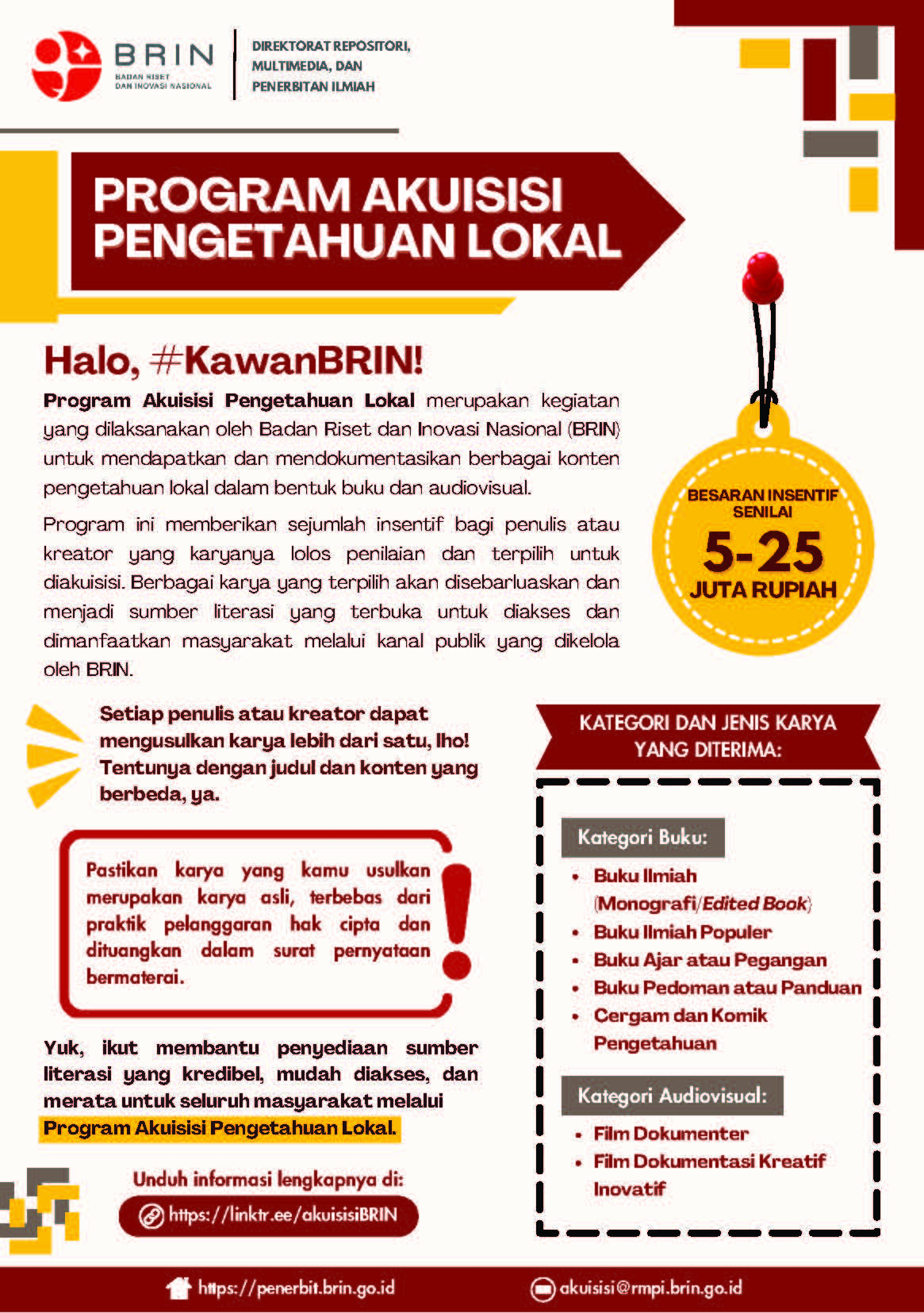
BRIN Publishing has a program named Akuisisi Pengetahuan Lokal that acquisition any of books or audiovisual content that meet our standard publication. The rights of BRIN Publishing is to disseminate and distribute all the content acquisitions for the public.
As an author you (or your employer or institution) may do the following:
All copies, print or electronic, or other use of the paper or article must include the appropriate bibliographic citation for the books