






















Kakawin adalah puisi atau kumpulan puisi kesusastraan Jawa Kuno yang berisi ajaran-ajaran tertentu. Kakawin Nitisastra merupakan salah satu kumpulan puisi Jawa Kuno yang mengandung persoalan moralistis-didaktis, ajaran-ajaran moral yang berguna bagi seluruh kalangan masyarakat, mulai dari rakyat jelata hingga para penguasa.
Buku ini mengajarkan pengetahuan tentang etika dan moralitas, budi pekerti, tata cara pergaulan setiap hari dengan sesama
makhluk dan sesama umat manusia, serta bagaimana memusatkan perhatian dan pelayanan kepada Tuhan Yang Maha Esa. Selain itu, buku ini bisa menjadi referensi untuk menambah wawasan dan pengetahuan tentang nilai-nilai moral dalam kehidupan. Sementara itu, bagi kalangan intelektual, buku ini bisa sebagai referensi untuk mengkaji secara ilmiah atau meneliti sastra dan kesusastraan Jawa kuno, khususnya yang terkait dengan Nitisastra.
Abraham, R. A. (2021). Pria antik, wanita unik. Penerbit ANDI.
Adair, J. (2007). Cara Menumbuhkan pemimpin: 7 prinsip kunci pengembangan kepemimpinan yang efektif. Gramedia Pustaka Utama.
Adnyana, P. E. (2021). Sabdalamkara dalam kakawin nitisastra: Tahapan dasar kepemimpinan dalam diri. Kalangwan: Jurnal Pendidikan Agama, Bahasa, dan Sastra, 11(2), 110-118.
Agastia, I. B. (1987). Sagara giri, kumpulan esei sastra Jawa kuna. Wyasa Sanggraha.
Agastia, I. B. (1994). Kesusastraan Hindu Indonesia: Sebuah pengantar. Yayasan Dharmasastra.
Agastia, I. B. (2000). Nirartha Prakreta. Yayasan Dharmasastra.
Agastia, I. B. (2001). Siwaratri kalpa karya Mpu Tanakung. Yayasan Dharma Sastra.
Anshoriy, H. N. (2008). Neo patriotisme: Etika kekuasaan dalam kebudayaan Jawa. LKiS.
Any, A. (1989). Rahasia ramalan Jayabaya, Ranggawarsito dan Sabdopalon. Aneka Ilmu.
Artha, A. T. (2009). Laku spiritual sultan: Langkah raja Jawa menuju istana. Galangpress.
Atharwaweda. (n.d.). Maharishi University of Management Vedic Literature Collection.
Badan Penerbit Buddhis. (1990). Dhammapada: Kitab suci agama Buddha. Aryasuryacandra.
Badudu, J. (2008). Kamus peribahasa: Memahami arti dan kiasan peribahasa, pepatah, dan ungkapan. Penerbit Buku Kompas.
Banerji, D. (2015). Rabindranath Tagore in the 21st century. Springer.
Best, D. L. (2001). Cultural Gender Roles. In Encyclopedia of Women and Gender (Judith Worell, Ed.). Academic Press.
Biru, M. (2012, 17 November 2012). Lali Mati. Panyebar Semangat.
Boff, L. (2008). Essential care: An ethics of human nature, Translation and notes: Alexandre Guilherme. Baylor University Press.
Brataatmadja, H. K. (1985). Kamus 5000 peribahasa Indonesia. Kanisius.
Bratawijaya, T. W. (1997). Mengungkap dan mengenal budaya Jawa. Pradnya Paramita.
Brew, L. E. (2008). Ungolden silence, a thought provoking novel. Xilbris Corporation.
Chatterjee, S. (1998). Indian civilization and culture. M D Publication Pvt Ltd.
Chinmayananda, S. (2006). Discourse on Taittiriya Upanisad. Central Chinmaya Mission Trust.
Chodjim, A. (2007). Mistik dan makrifat Sunan Kalijaga. Serambi.
Cleary, T. F. (1999). The Taoist classics: The Taoist I Ching, I Ching Mandalas. Shambhala Publications.
Clemmer, J. (2009). Sang pemimpin: Prinsip abadi untuk keberhasilan tim dan organisasi. Kanisius.
Darmasoetjipto, F. (1985). Kamus peribahasa Jawa, dengan penjelasan kata-kata dan artinya. Kanisius.
Dass, R. (2007). Jalan menuju pencerahan. (S. A. Reny, & P. Edy, Penerj.) Media Hindu. (Karya original terbit tahun 1971)
Ekopriyono, A. (2005). The spirit of pluralism: Menggali nilai-nilai kehidupan, mencapai kearifan hidup. PT Elex Media Komputindo.
Ermawati, R. (2014, Senin, 25 Agustus). Kisah Unik: Inilah Mbah Gotho, Manusia Tertua Asal Sragen yang Kini Berusia 144 Tahun. Solo Pos: https://news.solopos.com/kisah-unik-inilah-mbah-gotho-manusia-tertua-asal-sragen-yang-kini-berusia-144-tahun-529901.
Flanagan, O. J. (1996). Self expressions: Mind, morals, and the meaning of life. Oxford University Press.


This work is licensed under a Creative Commons Attribution-NonCommercial-ShareAlike 4.0 International License.
This book that publish in BRIN Publishing is licensed under a Creative Commons Attribution Non-commercial Share Alike 4.0 International license (CC BY-NC-SA 4.0). This license permits you to share, copy, distribute and transmit the work for your personal use and non-commercial purposes, provided you provide appropriate attribution. Derivative works and modifications must use the same license. Detailed information regarding the CC-BY-NC-SA 4.0 license is available via the link: https://creativecommons.org/licenses/by-nc-sa/4.0/
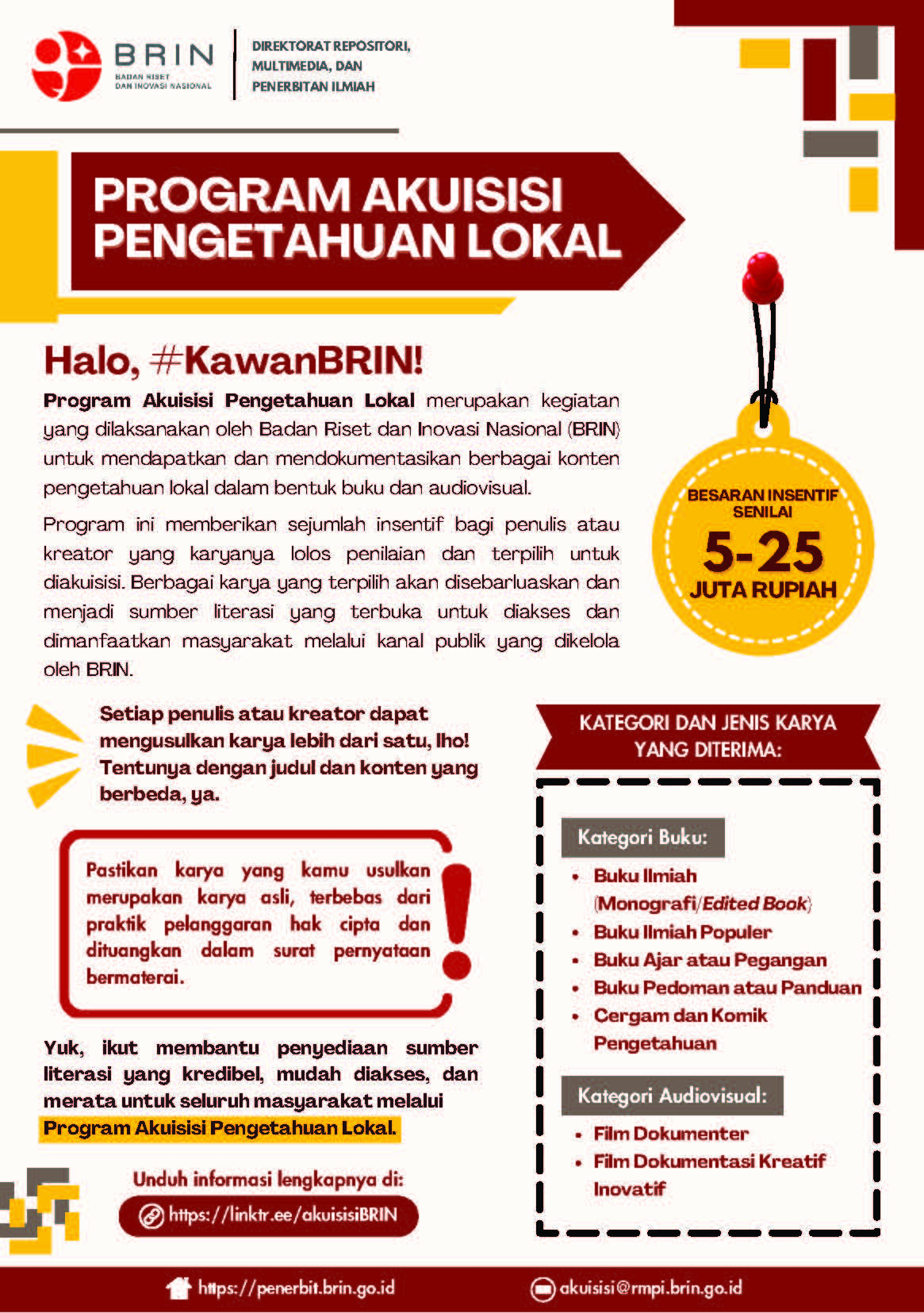
BRIN Publishing has a program named Akuisisi Pengetahuan Lokal that acquisition any of books or audiovisual content that meet our standard publication. The rights of BRIN Publishing is to disseminate and distribute all the content acquisitions for the public.
As an author you (or your employer or institution) may do the following:
All copies, print or electronic, or other use of the paper or article must include the appropriate bibliographic citation for the books