























Siapa yang tidak tahu matematika? Hal yang paling dasar dalam kehidupan kita juga selalu bersinggungan dengan matematika. Oleh karena itu, penting bagi kita mengetahui dan menguasai dasar-dasar tentang ilmu ini, apalagi sebagai tenaga pendidik.
Melalui buku Pendidikan Matematika Sekolah Dasar, pembaca dapat menemukan satu cara belajar matematika yang sangat asyik dan mudah dipahami karena disajikan dalam bentuk interaktif. Dengan demikian, pembaca, termasuk calon guru sekolah dasar/matematika ataupun siapa saja yang tertarik dengan pembelajaran matematika akan menemukan satu metode pengajaran matematika yang sangat menyenangkan.
Amir, M. F., & Prasojo, B. H. (2016). Matematika dasar. UMSIDA Press.
Awaludin, A. A. R., Rawa, N. R., Narpila, S. D., Yuliani, A. M., Wewe, M., Gradini, E., ... & Resi, B. B. F. (2021). Teori dan aplikasi pembelajaran matematika di SD/MI. Yayasan Penerbit Muhammad Zaini.
Basri, H. (2021). Teori bilangan. Eurike Media Aksara.
Budiono, Tri. (2008). Hand TryMATIKA. Asta Aji Pustaka
Chea, S. (2018). Es krim dalam kerucut [Gambar]. Pexels. Diakses dari https://www.pexels.com/id-id/foto/es-krim-dalam-kerucut-1294943/
Ehlers, M. (2018). Foto jerapah [Gambar]. Pexels. Diakses dari https://www.pexels.com/id-id/foto/foto-jerapah-1319515/
Fahmi, S., & Priwantoro, S. W. (2021). Logika matematika dan himpunan. UAD PRESS.
Hadi, S. (2015). Scaffolding dalam menyelesaikan permasalahan KPK dan FPB. Jurnal Pendidikan Matematika, 1(1).
Handayani, R., & Yulina, Y. (2020). Teori bilangan. UMKO Publishing.
Hashisaki, J. (1983). Theory and application of mathematics for elementary school teachers. John Wiley & Sons.
Heryanto, N. (2008). Materi pokok statistika dasar. Universitas Terbuka.
Jupri, A. (2021). Geometri dengan pembuktian dan pemecahan masalah. Bumi Aksara.
Karim, M. A. (2011). Materi pokok pendidikan matematika 2. Universitas Terbuka.
Karso, H. (2009). Pendidikan matematika 1. Universitas Terbuka.
Karso, H. (2014). Pendidikan matematika. Universitas Terbuka.
Khikmawan, A. (2017). Matematika. CV. Hasan Pratama.
Lumbantoruan, J. H. (2019). Buku materi pembelajaran geometri 1. Universitas Kristen Indonesia.
Muslikh, M. (2012). Analisis real. Universitas Brawijaya Press.
Musser, G. L., Peterson, B. E., & Burger, W. F. (2013). Mathematics for elementary teachers: A contemporary approach. John Wiley & Sons.
Nalim, N., & Salafudin, S. (2012). Statistika deskriptif. STAIN Pekalongan Press.
Nur’aeni, E., Pranata, O. H., Muharram, M. R. W., & Apriani, I. F. (2020). SPADE: Model Pembelajaran Geometri di Sekolah Dasar. Indonesian Journal of Primary Education, 4(2), 204–211.
Pinontoan, B., & Titaley, J. (2016). Matematika diskrit. CV. Patra Media Grafindo.
Polya, G. (2004). How to solve it: A new aspect of mathematical method. Princeton University Press.
Portal Tata Ruang. (2022, 26 Maret). Profil Beserta Gambar Peta Pulau Jawa Lengkap [Peta]. Diakses dari https://www.tataruang.id/2022/03/26/profil-beserta-gambar-peta-pulau-jawa-lengkap/
Purnomo, Y. W. (2014). Bilangan cacah dan bulat. Alfabeta.
Rosiyanti, H., Eminita, V., & Riski, R. (2020). Desain Media Pembelajaran Geometri Ruang Berbasis Powtoon. FIBONACCI: Jurnal Pendidikan Matematika Dan Matematika, 6(1), 77–86.
Sadalmelik. (2007, 30 Agustus). Topographic location map of Java (Indonesia), dibuat dengan GMT dari data SRTM [Peta], dari https://commons.wikimedia.org/wiki/File:Java_Locator_Topography.png
Sandeep. (2020). [Gambar]. Pexels. Diakses dari https://www.pexels.com/id-id/foto/makanan-sehat-daun-panen-5813226/
Varberg, D. E., Purcell, E. J., & Rigdon, S. E. (2017). Calculus, 9th Edition. Pearson Education International.
Walpole, R. E. (1995). Pengantar statistika.Gramedia Pustaka Utama.
Wheeler, R. E. (1973). Modern mathematics: An elementary approach. Brooks/Cole Publishing Company.
Widiyanto, M. A. (2013). Statistika terapan. Elex Media Komputindo.
Wu, H. (2011). Understanding numbers in elementary school mathematics. American Mathematical Society.


This work is licensed under a Creative Commons Attribution-NonCommercial-ShareAlike 4.0 International License.
This book that publish in BRIN Publishing is licensed under a Creative Commons Attribution Non-commercial Share Alike 4.0 International license (CC BY-NC-SA 4.0). This license permits you to share, copy, distribute and transmit the work for your personal use and non-commercial purposes, provided you provide appropriate attribution. Derivative works and modifications must use the same license. Detailed information regarding the CC-BY-NC-SA 4.0 license is available via the link: https://creativecommons.org/licenses/by-nc-sa/4.0/
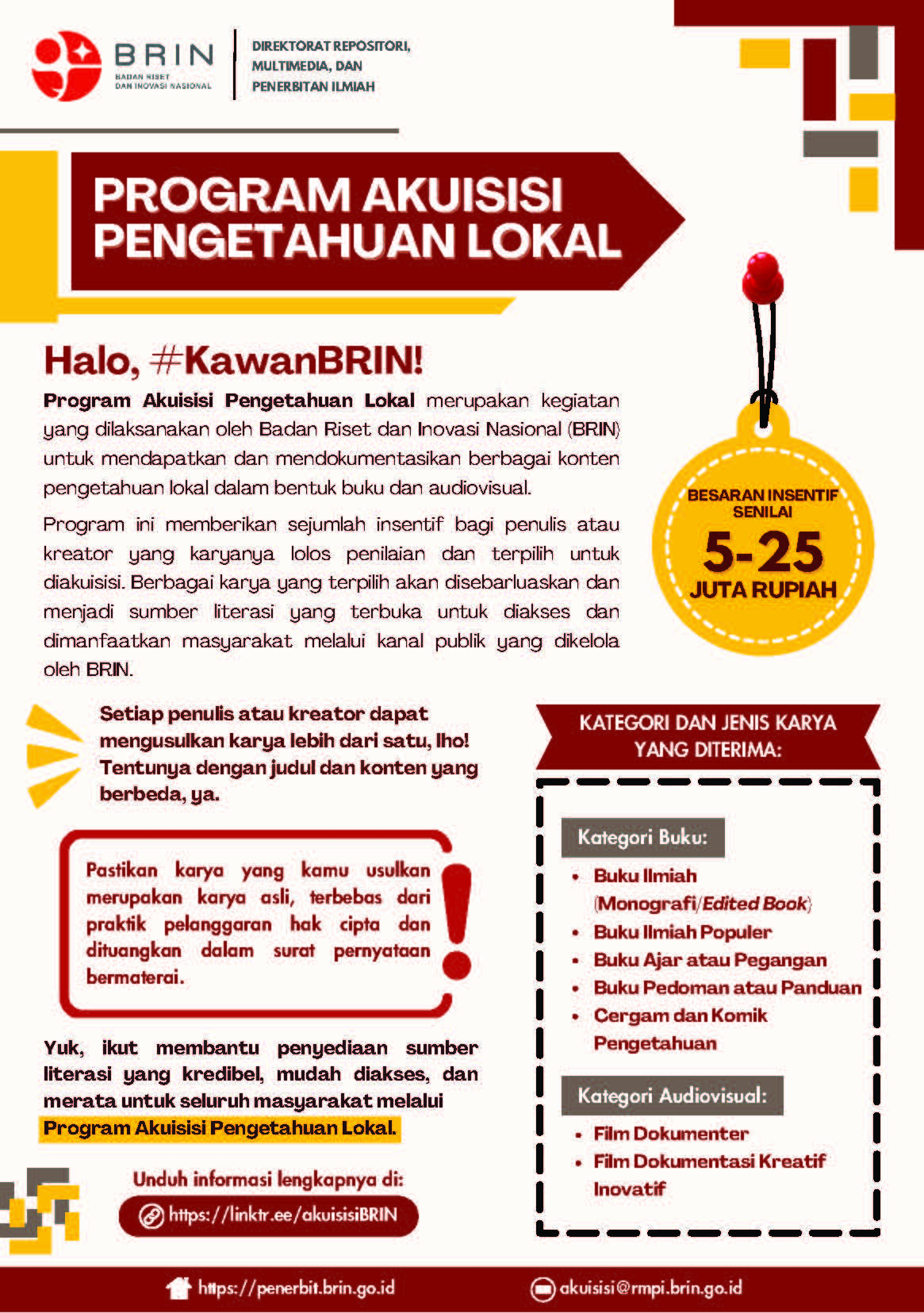
BRIN Publishing has a program named Akuisisi Pengetahuan Lokal that acquisition any of books or audiovisual content that meet our standard publication. The rights of BRIN Publishing is to disseminate and distribute all the content acquisitions for the public.
As an author you (or your employer or institution) may do the following:
All copies, print or electronic, or other use of the paper or article must include the appropriate bibliographic citation for the books