
























Indonesia sebagai negara kepulauan dengan berbagai tipe ekosistem merupakan sumber keragaman jenis khamir yang tinggi. Sekurang kurangnya terdapat 125 taksa khamir yang berhasil diisolasi dari alam dan pangan tradisional Indonesia, dan banyak diantaranya merupakan jenis baru. Biak biak potensial tersebut didapatkan melalui Pengembangan teknik isolasi. Mikroorganisme unggul tersebut memiliki karakter fisiologi yang dapat digunakan dalam proses produksi biofuel seperti etanol, lipid (biodiesel), enzim, surfaktan, asam organik, dan obat. Kedepan perlu dikembangkan teknologi Bioprospeksi khamir untuk pengembangan biofuel dan bioindustri, sehingga kegiatan bioprospeksi dapat dilakukan lebih cepat dan efisien, melalui penggunaan mikroorganisme terpilih yang telah divalidasi oleh taksonom.
Peran taksonom sangat sentral dalam kegiatan bioprospeksi yaitu melalui rekomendasi kepada peneliti bioprospeksi tentang karakter fisiologi khusus dari isolat sesuai dengan produk yang akan dikembangkan. Namun jumlah taksonom mikroorganisme sangat terbatas. Masalah kekurangan taksnonom menjadi sangat serius karena kecepatan kerusakan lingkungan yang semakin cepat, sehingga kepunahan mikroorganisme potensial yang terdapat pada Kawasan tertentu berlangsung lebih cepat.
Untuk menjamin ketersediaan sumber daya mikroorganisme, Khamir yang telah diisolasi dan diverifikasi karakter fisiologinya harus disimpan di Kultur Koleksi Mikroorganisme dengan standar manajemen yang baik. Untuk selanjutnya sumber daya mikroorganisme tersebut dapat digunakan setiap saat dan didistribusikan untuk kegiatan pembuatan produk yang bernilai ekonomi.
Indonesian culture collection (InaCC) memiliki sekitar 350 biak khamir potential untuk dikembangkan pada industri Biofuel. Beberapa teknologi pendukung untuk produksi Biofuel telah dikuasai dengan baik yaitu teknologi penapisan yang mampu dengan cepat mengetahui khamir potensial sebagai pengakumulasi lipid, teknologi cepat untuk prediksi khamir penghasil etanol. Dalam hal pengembangan energi terbarukan, telah dilakukan penjajakan kerjasama nasional dengan Pertamina, dan Kerjasama internasional termasuk didalamnya pemanfaatan limbah lignoselulosa sebagai pendukung industri green biofuel. Selanjutnya perlu pengembangan metoda scale up dari pilot plan menjadi sekala industri. Kerangka pengembangan tersebut dapat dimulai dengan pembentukan zona pengembangan industri green biofuel pada kawasasn terpilih.
BRIN telah menjadi inisiator Perpres tentang pengelolaan mikroorganisme yaitu melalui Peraturan Presiden No. 1/2021 tentang perlindungan kekayaan mikroorganisme Indonesia Secara garis besar Perpres ini mengatur 6 hal yaitu: (1) akses terhadap sampel yang mengandung mikroorganisme, (2) perlindungan mikroorganisme melalui mekanisme penyimpanan mikroorganisme mengikuti standard internasional, (3) pendistribusian mikroorganisme serta pemanfaataanya untuk kepentingan nasional, (4) perjanjian pengalihan material, (5) pengelolaan pangkalan data mikroorganisme, dan (6) pembinaan serta pengawasan pengelolaan mikroorganisme. PERPRES tersebut merupakan satu satunya peraturan nasional yang mengatur managemen sumber daya mikroorganisme yang memerlukan langkah langkah operasional lebih lanjut.
Kurtzman CP. Molecular taxonomy of the yeasts. Yeast. 1994 ;10(13): 1727- 40. doi:10.1002/yea.320101306.
Barnett JA. A history of research on yeasts 7: enzymic adap-tation and regulation. Yeast. 2004; 21(9): 703-46. doi:10.1002/yea.1113.
Garay LA, Sitepu IR, Fry R W, Kanti A, Boundy-Mills KL et al. Discovery of synthesis and secretion of polyol esters of fatty acids by four basidiomycetous yeast species in the order Sporid-iobolales. Journal of Industrial Microbiology & Biotechnology. 2017; 44(6): 923-36. doi:10.1007/s10295-017-1919-y.
Barnett JA. A history of research on yeasts 8: taxonomy. Yeast. 2004 Oct 30;21(14):1141-93.
Barnett JA. A history of research on yeasts 10: foundations of yeast genetics1. Yeast. 2007 Oct 1;24(10):799-846.
Alexander WG. A history of genome editing in Saccharomyces cerevisiae. Yeast. 2018 May;35(5):355-60.
Spagnuolo M, Yaguchi A, Blenner M. Oleaginous yeast for biofuel and oleochemical production. Current Opinion in Bio-technology. 2019 Jun 1;57:73-81.
Achmadi AS, Hamidy A, Maryanto I, Kahono S, Kartonegoro A, Kanti A et al. Ekspedisi Sulawesi Barat, Flora, Fauna dan Mikroorganisme. LIPI Press; 2018.p. 167.
Ardiyani M, Dwibadra D, Dewi K, Meliah S, Kanti A et al. Temuan dan Pertelaan Jenis Baru Biota Indonesia 1967-2017: Sumbangsih LIPI untuk Sains. LIPI Press; 2018.
Kuriyama H, Sastraatmadja D, Igosaki Y, Watanabe K, Kanti A, Fukatsu T. Isolation, Identification and Biochemical Properties of Yeast from Indonesian fermented food . Project Report. 1999.
Sukara E, Lisdiyanti P, Kanti A, Yopi, Ratnakomala S et al. Exploring Indonesian Microbial Genetic Resources for Industrial Application. In: Sukara E, Lisdiyanti P, editors. LIPI Press; 2018. p. 221.


This work is licensed under a Creative Commons Attribution-NonCommercial-ShareAlike 4.0 International License.
This book that publish in BRIN Publishing is licensed under a Creative Commons Attribution Non-commercial Share Alike 4.0 International license (CC BY-NC-SA 4.0). This license permits you to share, copy, distribute and transmit the work for your personal use and non-commercial purposes, provided you provide appropriate attribution. Derivative works and modifications must use the same license. Detailed information regarding the CC-BY-NC-SA 4.0 license is available via the link: https://creativecommons.org/licenses/by-nc-sa/4.0/
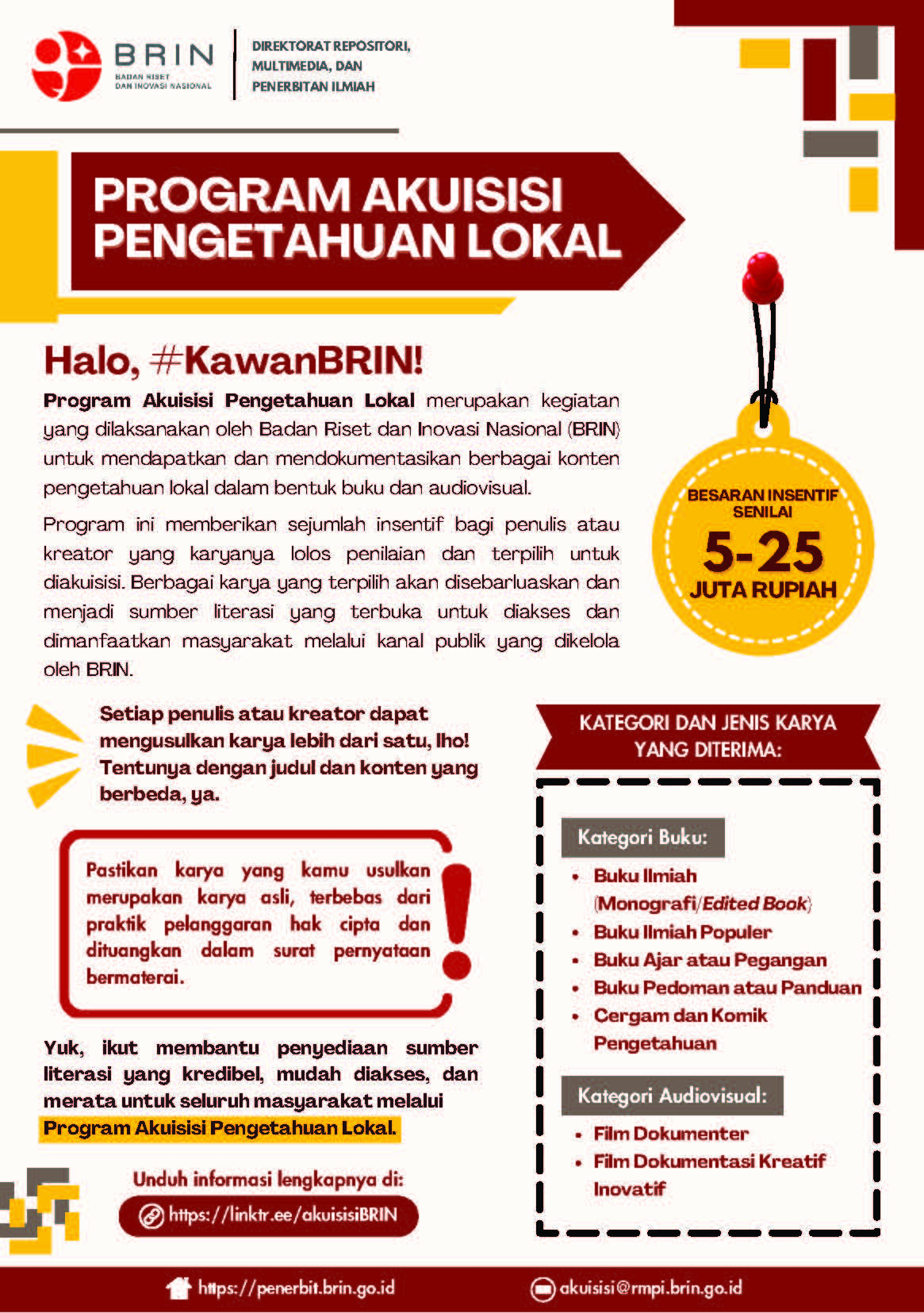
BRIN Publishing has a program named Akuisisi Pengetahuan Lokal that acquisition any of books or audiovisual content that meet our standard publication. The rights of BRIN Publishing is to disseminate and distribute all the content acquisitions for the public.
As an author you (or your employer or institution) may do the following:
All copies, print or electronic, or other use of the paper or article must include the appropriate bibliographic citation for the books