

























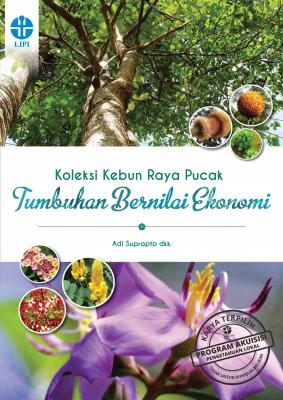
Sebagai salah satu pusat keanekaragaman hayati tertinggi di dunia, Indonesia memiliki beragam jenis tumbuhan beserta potensi yang terkandung di dalamnya. Namun, kerusakan hutan dan ekosistem akibat ulah manusia membuat kelestarian tumbuhan terganggu, terutama tumbuhan yang bernilai ekonomi. Untuk menjaga kelestarian tumbuhan tersebut, Pusat Konservasi Tumbuhan Kebun Raya-LIPI membuat strategi konservasi yang tepat dengan membangun kebun raya daerah, salah satunya Kebun Raya Pucak. Kebun raya ini mengusung tema “Agro Botanical Garden” yang mengungkapkan potensi dari tumbuhan yang memiliki nilai ekonomi, seperti obat-obatan, sandang, papan, pangan, dan berbagai macam produk olahan dari tumbuhan. Selain itu, di dalam buku ini tidak hanya dibahas mengenai nama ilmiah, nama daerah, suku, atau sinonim dari nama ilmiah, tetapi juga ciri-ciri, habitat, kegunaan, dan cara membudidayakan tumbuhan tersebut. Oleh karena itu, buku ini diharapkan dapat bermanfaat bagi peneliti, mahasiswa, pemerintah serta masyarakat yang ingin mengetahui jenis tumbuhan apa saja yang memiliki nilai ekonomi.
Anonim. 2012. “Plantamor Cananga odorata. Your Plant Database”. http://www. plantamor.com/index.php?plant=258. Diakses tanggal 16 Juni 2014.
Australian Tropical Rainforest Plants. 2013. http://keys.trin.org.au/key-server/ data/0e0f0504-0103-430d-8004-060d07080d04/media/Html/taxon/index.htm. Diakses tanggal 26 Oktober 2013.
Bidang Pengembangan Kawasan Konservasi Tumbuhan Ex situ. 2014. Perkembangan Pembangunan Kebun Raya di Indonesia. Pusat Konservasi Tumbuhan Kebun Raya Bogor-LIPI. Bogor.
Bijdr. 1825. Plants of Southeast Asia: Ficus variegata Blume. http://asianplant.net/ Moraceae/Ficus_variegata.html. Diakses tanggal 21 Juni 2014.
Brotonegoro, S., M. Wessel, dan M. Brink. 2013. “Detil Data Areca catechu L. http:// www.proseanet.org/prohati2/browser.php?docsid=241. Diakses tanggal 18 November 2013.
Brown, S.H. 2012. Stachytarpheta jamaicensis (L.) Vahl. Horticulture Agent Kim Cooprider. University of Florida. Florida.
De Padua, L.S., N. Bunyapraphatsara, dan R.H.M.J. Lemmens. 2013. Detil Data Cassia stula L. http://www.proseanet.org/prohati2/browser.php?docsid=137. Diakses tanggal 18 November 2013.
Dubey, P.C., R.L.S. Sikarwar, K.K. Khanna, dan A.P. Tiwari. 2009. Ethnobotany of Dillenia pentagyna Roxb. Dalam Vindhya region of Madhya Pradesh, India. Natural Product Radiance 8 (5): 546-548.
Enum, P.I. 2014. “Strchytarpheta jamaicensis (L.) Vahl. A Plant List A Working List of All Plant Species”. http://www.theplantlist.org/tpl1.1/ search?q=Stachytarpheta+jamaicensis+. Diakses tanggal 19 Juni 2014.
Heyne, K. 1987. Tumbuhan Berguna Indonesia (Terjemahan) Jilid I – IV. Badan Litbang Kehutanan. Yayasan Sarana Wanajaya. Jakarta.
Irwanto. 2009. “Pohon Buah Rao–Dracontomelon dao (Blanco) Merr. & Rolfe”. http:// www.irwantoshut.net/dracontomelon_dao.html. Diakses tanggal 18 Juni 2014.
Jupiter. 2011. Manfaat Buah Pinang (Areca catechu L. dan sinonim A. hortensis Lour.). http://jupitter.blogspot.com/2011/05/manfaat-buah-pinang-areca-catechu-l-dan. html. Diakses tanggal 12 Juni 2014.
Lorence, D.H. 2013. “National Tropical Botanical Garden: Canarium indicum L”. http://ntbg.org/plants/plant_details.php?plantid=11906. Diakses tanggal 18 November 2013.
Myers, N., R.A. Mittermeier, C.G. Mittermeier, G.A.B. da Fonseca and J. Ken. 2000. Biodiversity hotspots for conservation priorities. Nature 403: 853-858.
Nirwana, D. 2012. Biologi Lestari: Tumbuhan Berdasarkan Fungsinya. http:// dayunirwanaputri.blogspot.com/2012/07/tumbuhan-berdasarkan-fungsinya- minuman.html. Diakses tanggal 18 November 2013.
Nurrohman, E. dan T.H. Swandayani. 2011. Info Teknis Arboretum. Balai Penelitian Teknologi Serat Tanaman Hutan. Pekanbaru.
Orwa, C., A. Mutua, R. Kindt, R. Jamnadass, dan S. Anthony. 2009. Andira inermis (Sw.) Kunth ex DC, Fabaceae–Papilionoideae. Agroforestry Database 4.0. http:// www.worldagroforestry.org/treedb2/AFTPDFS/Andira_inermis.pdf. Diakses tanggal 18 November 2013.
Partomihardjo, T., D. Ari ani, B.A. Pratama, dan R. Mahyuni. 2014. Jenis-jenis Pohon Penting di Hutan Nusakambangan. LIPI Press. Jakarta.
Rifai, M.A. 2004. Kamus Biologi. Pusat Bahasa Departemen Pendidikan Nasional. Balai Pustaka. Jakarta.
Rumphia. 1847. Plants of Southeast Asia: Dictyoneura acuminata Blume”. http://www. asianplant.net/Sapindaceae/Dictyoneura_acuminata.htm. Diakses tanggal 21 Juni 2014.
Soerianegara, I. dan R.H.M.J. Lemmens. 1993. Plant Resources of South-East Asia 5(1): Timber Trees: Major Commercial Timbers. Pudoc Scienti c Publishers, Wageningen.
Sunarno, B., R.H.M.J. Lemmens, Sulaiman, dan A. Binti. 2014. “Detil Data Vitex pinnata L”. http://www.proseanet.org/prohati2/browser.php?docsid=295. Diakses tanggal 18 Juni 2014.
Uji, T. 2005. Keanekaragaman dan Potensi Flora di Suaka Margasatwa Buton Utara, Sulawesi Tenggara. Biodiversitas 6(3): 205–211.
Widowati, L., B. Wahjoedi, B. Dzulkarnain, Saroni, Adjirni, M.W. Winarno, dan D. Sundari. 1995. Penelitian Tanaman Obat di Beberapa Perguruan Tinggi di Indonesia VII. Pusat Penelitian dan Pengembangan Farmasi Badan Penelitian dan Pengembangan Kesehatan Departemen Kesehatan RI. Jakarta.
Windadri, F.I., dan J.L.C.H. van Valkenburg. 2014. “Detil Data Lantana Camara L”. http://proseanet.org/prosea/e-prosea_detail.php?frt=&id=337. Diakses tanggal 18 Juni 2014.
Yusuf, U.K., dan V.O. Sinohin. 2013. “Detil Data Cananga odorata (Lmk.) Hook.f.”. http://www.proseanet.org/prohati2/browser.php?docsid=95. Diakses tanggal 18 November 2013.
Yuzammi dan S. Hidayat. 2002. Flora Sulawesi: Unik, Endemik, dan Langka. Pusat Konservasi Tumbuhan Kebun Raya Bogor, LIPI. Bogor.

This work is licensed under a Creative Commons Attribution-NonCommercial-ShareAlike 4.0 International License.
This book that publish in BRIN Publishing is licensed under a Creative Commons Attribution Non-commercial Share Alike 4.0 International license (CC BY-NC-SA 4.0). This license permits you to share, copy, distribute and transmit the work for your personal use and non-commercial purposes, provided you provide appropriate attribution. Derivative works and modifications must use the same license. Detailed information regarding the CC-BY-NC-SA 4.0 license is available via the link: https://creativecommons.org/licenses/by-nc-sa/4.0/
BRIN Publishing has a program named Akuisisi Pengetahuan Lokal that acquisition any of books or audiovisual content that meet our standard publication. The rights of BRIN Publishing is to disseminate and distribute all the content acquisitions for the public.
As an author you (or your employer or institution) may do the following:
All copies, print or electronic, or other use of the paper or article must include the appropriate bibliographic citation for the books