






















Bersama “Kiko” dan “Popo”, kita akan berkenalan dengan sains tumbuhan. Dalam buku Aku Sebuah Penopang ini kita akan membahas mengenai organ batang. Buku ini berisi tentang definisi dan fungsi batang, anatomi batang, perbedaan morfologi monokotil dan dikotil, morfologi batang, modifikasi batang, jenis-jenis batang, dan arah tumbuh batang. Yuk, mengenal batang dengan berpetualang bersama mereka!
Farida, K. N., & Hartatik. (2010). Konsep IPA SD. Universitas Kanjuruhan.
Heradi, D. (2020). Struktur fungsi & metabolisme tubuh tumbuhan. SEAMEOQITEP Science.
Herliani. (2020). Plant morphology. Biology Education Study Universitas Mulawarman.
Pratiwi, R. (2015). Anatomi tumbuhan. Universitas Negeri Surabaya Press.
Ramdhini, R. N., Manalu, A. I., Ruwaida, I. P., Isrianto, P. L., Panggabean, N. H., Wilujeng, S., Erdiandini, I., Purba, S. R. F., Sutrisno, E., Hulu, I. L., Purwanti, S., Utomo, B., & Surjaningsih, D. R. (2021). Anatomi tumbuhan. Yayasan Kita Menulis.
Tjitrosoepomo, G. (2007). Morfologi tumbuhan. Gadjah Mada University Press.


This work is licensed under a Creative Commons Attribution-NonCommercial-ShareAlike 4.0 International License.
This book that publish in BRIN Publishing is licensed under a Creative Commons Attribution Non-commercial Share Alike 4.0 International license (CC BY-NC-SA 4.0). This license permits you to share, copy, distribute and transmit the work for your personal use and non-commercial purposes, provided you provide appropriate attribution. Derivative works and modifications must use the same license. Detailed information regarding the CC-BY-NC-SA 4.0 license is available via the link: https://creativecommons.org/licenses/by-nc-sa/4.0/
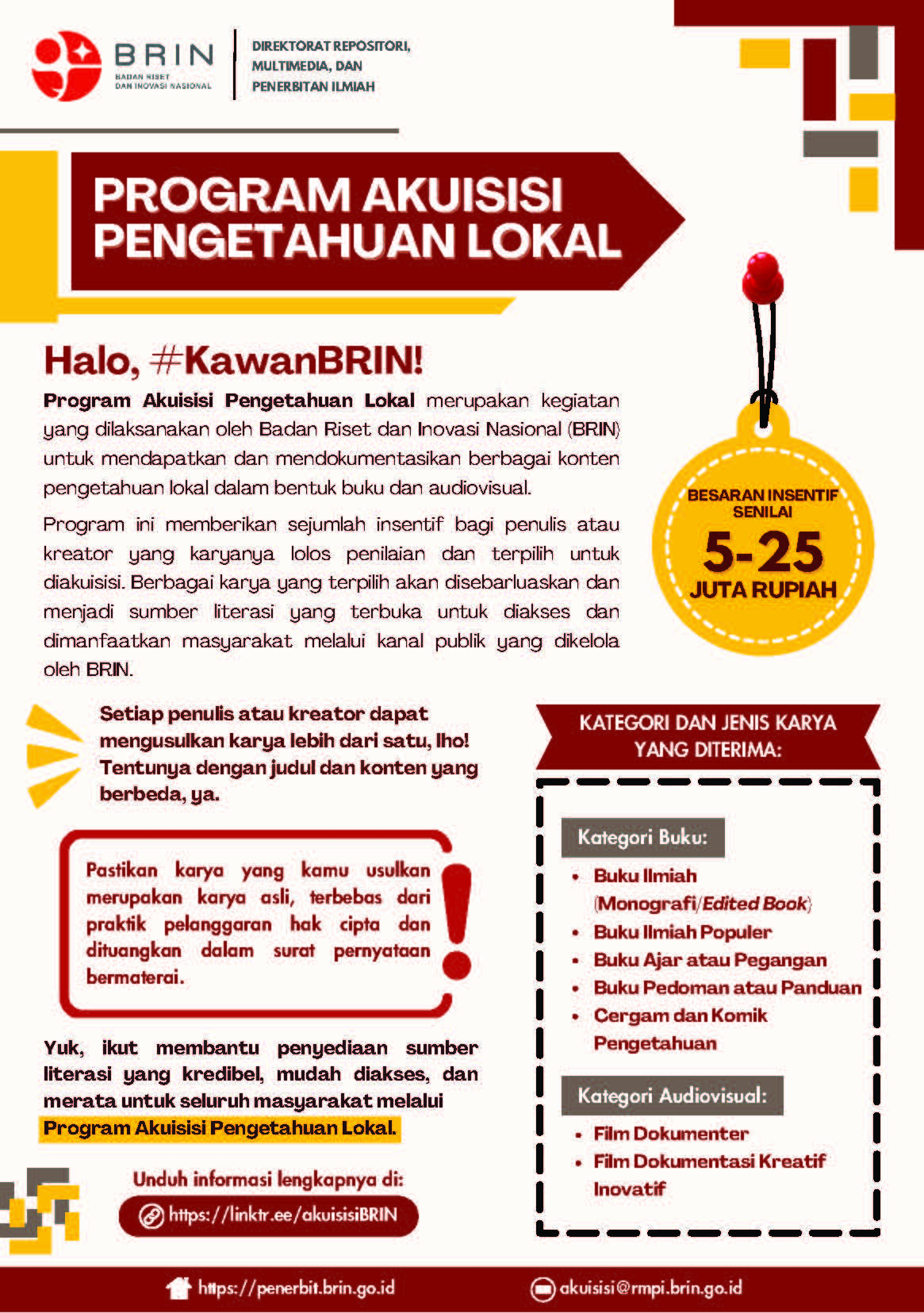
BRIN Publishing has a program named Akuisisi Pengetahuan Lokal that acquisition any of books or audiovisual content that meet our standard publication. The rights of BRIN Publishing is to disseminate and distribute all the content acquisitions for the public.
As an author you (or your employer or institution) may do the following:
All copies, print or electronic, or other use of the paper or article must include the appropriate bibliographic citation for the books