



























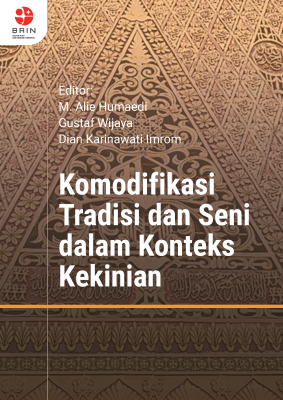
Buku ini merekam ragam tradisi sebagai upaya preservasi dan melestarikan jejak tradisi – tradisi di Indonesia. Pada sisi lain, rekaman yang ada disertai upaya mengangkat tradisi unggul sebagai bagian dari komodifikasi yang berikutnya dapat membuka falsafah hidup yang bangkit kembali sesuai dengan konteks jaman modern saat ini. Bagaimana masyarakat merespons kapitalisme misalnya, pada sisi tertentu dianggap buruk, menimbulkan kesenjangan misalnya. Namun tentu dalam konteks ekonomi global, tantangan dalam kapitalisme sudah seharusnya disambut dengan daya saing yang sebaik mungkin dipersiapkan. Buku ini diharapkan mampu menjadi penggugah, pendobrak yang mencoba mengingatkan pembaca, bahwa ada banyak tradisi dan budaya kita yang belum tergali maksimal, belum terdokumentasi dengan baik, di samping butuh pengawalan dan komodifikasi dari berbagai pihak, agar resistan dan peka jaman, sehingga dapat lestari hingga menjadi warisan bagi generasi berikutnya.
Ahmad Bahrudin, S. S. M. S. (2017). ORNAMEN MINANGKABAU: Dalam Perspektif Ikonografi. ISI Padang Panjang. https://books.google.co.id/books?id=2A5fDwAAQBAJ
Alika, S. D. (2017). Faktor Pemertahanan Bahasa Minangkabau Ragam Nonformal dalam Ranah Kekariban pada Komunitas Seni Sakato di Kota Yogyakarta. Deiksis: Jurnal Pendidikan Bahasa Dan Sastra Indonesia, 4(2), 31. https://doi.org/10.33603/deiksis.v4i2.515
Amalia, A. (2020, September 30). Selongkar Suar Semsar. https://medium.com/@audyaamalia/selongkar-suar-semsar-dfe115b1e52f
Amir, A dkk. (2006). Pemetaan Sastra Lisan Minangkabau. Andalas University Press.
Ardoin, N.M., Bowers, A.W., Lin, V., Phukan, I. (2022). Design Thinking as a Catalyst and Support for Sustainability Solutions. In: Meinel, C., Leifer, L. (eds) Design Thinking Research . Understanding Innovation. Springer, Cham. https://doi.org/10.1007/978-3-031-09297-8_16
Arsa, D. (2019). Yang Tersingkap Dan Yang Tersungkup: Perang Padri Dan Implikasinya Terhadap Pakaian Keseharian Perempuan Minang-Muslim Pada Awal Abad XIX. Analisis: Jurnal Studi Keislaman, 18(2), 27–66. https://doi.org/10.24042/ajsk.v18i2.3673
Azwar, T. P. (2018, August 6). Website Resmi Pemerintah Kabupaten Agam. https://www.agamkab.go.id/Agamkab/detailkarya/667/perang-padri-sebagai-revolusi-rakyat-minang-kabau--dalam-memeluk-agama-islam.html
Badan Ekonomi Kreatif. (2019). Opus: Ekonomi Kreatif Outlook 2019. Badan Ekonomi Kreatif, 62.
Bruhn, K. L. (2018). Community and the Rantau: West Sumatran Artists in Indonesia’s Art World. Southeast of Now: Directions in Contemporary and Modern Art in Asia, 2(2), 119–142. https://doi.org/10.1353/sen.2018.0004
Cardullo, P., Kitchin, R. Being a ‘citizen’ in the smart city: up and down the scaffold of smart citizen participation in Dublin, Ireland. GeoJournal 84, 1–13 (2019). https://doi.org/10.1007/s10708-018-9845-8
Currie, M., dan Correa, M. M. (2021). Introduction: The Global Festival City. In: The Culture and Communities Mapping Project. Palgrave Macmillan, Cham. https://doi.org/10.1007/978-3-030-88651-6_1
Desmawardi, D., Hanefi, H., & Najmi, M. (2020). Tradisi Bakaba Dalam Rabab Pasisia: Sebuah Adaptasi Menjadi Film. Panggung, 30(3). https://doi.org/10.26742/panggung.v30i3.961
Diradjo, I. D. S. (2019). Tambo alam Minangkabau: tatanan adat warisan nenek moyang orang Minang. Kristal Multimedia.
Direktorat Warisan dan Diplomasi Budaya. (2020). Warisan Budaya Takbenda. https://warisanbudaya.kemdikbud.go.id/?pencatatan
Eichler, J. (2020). Intangible Cultural Heritage under Pressure? Examining Vulnerabilities in
Febriyanto, A., Riawanti, S., & Gunawan, B. (2018). Mitos Rambut Gimbal: Identitas Budaya dan Komodifikasi di Dataran Tinggi Dieng. Umbara, 2(1), 1-9. https://doi.org/10.24198/umbara.v2i1.15670
Fitryona, N. (2017). The Dialectic of Visual Arts Life in West Sumatra 1986-2003. International Journal of Creative and Arts Studies, 4(1), 27. https://doi.org/10.24821/ijcas.v4i1.1952
Flora, C.B., Flora, J.L., Gasteyer, S.P., (2016). Rural Communities: Legacy + Change. Avalon Publishing. https://doi.org/10.4324/9780429494697

This work is licensed under a Creative Commons Attribution-NonCommercial-ShareAlike 4.0 International License.
This book that publish in BRIN Publishing is licensed under a Creative Commons Attribution Non-commercial Share Alike 4.0 International license (CC BY-NC-SA 4.0). This license permits you to share, copy, distribute and transmit the work for your personal use and non-commercial purposes, provided you provide appropriate attribution. Derivative works and modifications must use the same license. Detailed information regarding the CC-BY-NC-SA 4.0 license is available via the link: https://creativecommons.org/licenses/by-nc-sa/4.0/
BRIN Publishing has a program named Akuisisi Pengetahuan Lokal that acquisition any of books or audiovisual content that meet our standard publication. The rights of BRIN Publishing is to disseminate and distribute all the content acquisitions for the public.
As an author you (or your employer or institution) may do the following:
All copies, print or electronic, or other use of the paper or article must include the appropriate bibliographic citation for the books


