



























Syair Karambangan merupakan salah satu kekayaan tradisi lisan masyarakat Pamona yang sarat akan keindahan bahasa, makna simbolik, dan nilai-nilai kehidupan. Dituturkan secara lisan dalam berbagai upacara adat maupun peristiwa sosial, syair ini menjadi media untuk menyampaikan nasihat, ungkapan kasih sayang, pesan moral, nilai religius, hingga rekam jejak sejarah dan identitas budaya masyarakat Pamona.
Syair Karambangan Pamona: Kajian Bahasa, Budaya, dan Revitalisasi mengajak pembaca mengenal salah satu warisan sastra lisan masyarakat Pamona yang sarat makna, keindahan bahasa, dan nilai-nilai kehidupan. Buku ini menghimpun 93 Syair Karambangan beserta terjemahannya ke dalam bahasa Indonesia, disertai pembahasan mengenai bentuk, gaya bahasa, cara penyampaian, serta nilai budaya yang dikandungnya. Melalui perpaduan kajian linguistik dan budaya, buku ini menunjukkan bahwa Syair Karambangan bukan sekadar tuturan puitis, melainkan cerminan sejarah, identitas, dan kearifan lokal masyarakat Pamona.
Diharapkan buku ini menjadi referensi sekaligus mendorong pelestarian dan revitalisasi tradisi lisan Indonesia bagi generasi masa kini dan mendatang.
Budasi, I. G. (2015, August). Pembeda fonologis dan leksikal antara bahasa Sawu di NTT dan bahasa Bima di NTB [Paper presentation]. The 7th International Seminar on Austronesian-non Austronesian Languages and Literature, Denpasar, Indonesia.
Echols, J. M., & Shadily, H. (1995). Kamus Inggris-Indonesia: An English-Indonesian dictionary. Gramedia Pustaka Utama.
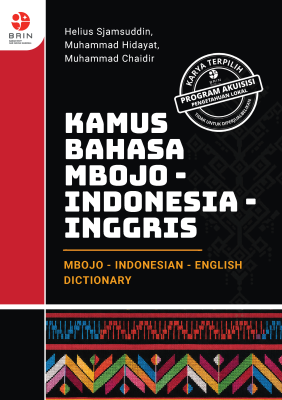
Hakim, L., Muslim, N., Hartini, H., Nuryati, N., & Yudiastini, N. M. (2015). Kamus Mbojo-Indonesia. Kantor Bahasa Provinsi Nusa Tenggara Barat.
Hasan, H. (2021). Pola penggunaan sapaan bahasa Bima. Jurnal Onoma: Pendidikan, Bahasa, dan Sastra, 7(2), 470–477. https://www.google.com/search?q=https://e-journal.my.id/onoma/article/view/1000
Jonker, J. C. G. (1893). Bimaneesch-Hollandsch woordenboek. Landsdrukkerij.
Jonker, J. C. G. (1894). Bimaneesche texten. Landsdrukkerij.
Kementerian Pendidikan dan Kebudayaan. (n.d.). Bima. Peta Bahasa. Retrieved April 18, 2024, from https://www.google.com/search?q=https://petabahasa.kemdikbud.go.id/bima.php
Novriyadi. (2023, December 21). Peta Nusa Tenggara Barat lengkap dengan nama kota. Lamudi. https://www.lamudi.co.id/journal/peta-nusa-tenggara-barat/
Rachman, A., dkk. (1985). Sistem morfologi kata kerja bahasa Bima. Pusat Pembinaan dan Pengembangan Bahasa, Departemen Pendidikan dan Kebudayaan.
Rachmawati, D., Yudiastini, N. M., Hakim, L., & Djuwairijah, S. (2018). Kamus peribahasa Mbojo. Kantor Bahasa Nusa Tenggara Barat.
Ridwan, M. (2018). Bentuk pertindihan kelas kata dalam Nggahi Mbojo di Kabupaten Dompu [Doctoral dissertation, Universitas Mataram].
Satyawati, M. S., Purnawati, K. W., & Kardana, I. N. (2019). Ekspresi verba dan pelibatan argumen dalam klausa bahasa Bima (Verbal expressions and argument engagement in the clause of Bimanese language). Mozaik, 19(2), 181–193. https://www.google.com/search?q=https://doi.org/10.20473/mozaik.v19i2.14088
Sugerman. (2014). Sistem morfologi kata kerja bahasa Bima: Perspektif linguistik struktural [Unpublished master’s thesis]. Universitas Mataram.
Sugerman. (2016). Keunikan-keunikan bahasa Bima. Lentera: Jurnal Ilmiah Ilmu Pendidikan, 6(7), 10–21.
Sugerman, Hasan, & Yulianti, E. (2021). Pemarkah deiksis bahasa Bima (sebuah kajian pragmatik). An-Nas: Jurnal Humaniora, 5(2), 27–40. https://www.google.com/search?q=https://doi.org/10.37252/an-nas.v5i2.53
Sugerman, S., Arifin, A., & Marlina, L. (2021). Entitas aspektualitas bahasa daerah dan pengintegrasiannya pada matapelajaran muatan lokal di SMA. Ainara Journal (Jurnal Penelitian dan PKM Bidang Ilmu Pendidikan), 2(3), 182–192. https://www.google.com/search?q=https://doi.org/10.54371/ainara.v2i3.86
Suryansyah, U. (2017). Interferensi fonologi dan gramatikal bahasa Bima ke dalam bahasa Indonesia pada komunitas mahasiswa Bima-Dompu di lingkungan Universitas Mataram [Doctoral dissertation, Universitas Mataram].
Taman, I. W., et al. (1996). Fonologi bahasa Bima. Pusat Pembinaan dan Pengembangan Bahasa, Departemen Pendidikan dan Kebudayaan.

This work is licensed under a Creative Commons Attribution-NonCommercial-ShareAlike 4.0 International License.
This book that publish in BRIN Publishing is licensed under a Creative Commons Attribution Non-commercial Share Alike 4.0 International license (CC BY-NC-SA 4.0). This license permits you to share, copy, distribute and transmit the work for your personal use and non-commercial purposes, provided you provide appropriate attribution. Derivative works and modifications must use the same license. Detailed information regarding the CC-BY-NC-SA 4.0 license is available via the link: https://creativecommons.org/licenses/by-nc-sa/4.0/
BRIN Publishing has a program named Akuisisi Pengetahuan Lokal that acquisition any of books or audiovisual content that meet our standard publication. The rights of BRIN Publishing is to disseminate and distribute all the content acquisitions for the public.
As an author you (or your employer or institution) may do the following:
All copies, print or electronic, or other use of the paper or article must include the appropriate bibliographic citation for the books


