

























Buku BAHASA BESEMAH 2 adalah lanjutan dari BUKU BAHASA BESEMAH. Tujuan dari buku ini adalah untuk memberi petunjuk bagaimana seharusnya kalimat, klausa, dan frasa Bahasa Besemah dibentuk. Dengan adanya buku ini diharapkan para pengguna Bahasa Besemah mempunyai panduan sesuai dengan kaidah Bahasa Bahase yang benar.
Alwi, Hasan dkk. Tata Bahasa Baku Bahasa Indonesia. Jakarta: Depdikbud RI.
Badudu, Jusuf Syarif. 1991. Panduan Penulisan Tata Bahasa Bahasa Indonesia. Jakarta: Pusat Pembinaan dan Pengembangan Bahasa Depar-temen Pendidikan dan Kebudayaan RI.
Bloomfield, Leonard. 1933. Language. New York: Henry Holt.
Cook, Walter A. 1971. Linguistics and Phonetics. London: Andre Deutch.
Djajasudarma, 1997. Analisis Bahasa, Sintaksis dan Semantik. Bandung: Humaniora Utama Press.
Elson, Benjamin and Pickett, Vellma. 1969. An Introduction to Morphology and Syntax. Santa Anna, California: Summer Institute Linguistics.
Gaffar, Zainal Abidin et al. 1983. Morfologi dan Sin-taksis Bahasa Besemah. Jakarta: Pusat Pembinaan dan Pengembangan Bahasa
Gleason, H.A. 1961. An Introduction to Descriptive Linguistics. New York: Holt, Rinehart and Win-ston.
Halim, Amran. 1975. Fungsi Politik Bahasa Nasio-nal dalam Bahasa dan Sastra. Tahun I, No. I.
Hockett, F. Charles. 1958. A Course in Modern Linguistics. New York: The Macmillan Company.
Keraf, Gorys. 1980. Tatabahasa Indonesia. Ende-Flores: Nusa Indah.
Kridalaksana, Harimurti. 2001. Kamus Linguistik. Jakarta: Penerbit PT. Gramedia.
Parera, Jos Daniel. 1977. Pengantar Linguistik Umum: Bidang Morfologi. Ende Flores: Nusa Indah.
Pollock, Carrol Washington. 1982. Communicate What You Mean. New Jersey: Prentice Hall, Inc.
Quirk, Randolph dan Greenbaum, Sidney. 1983. A University Grammar of English. London: Longman.
---------1992. A Grammar of Contemporary English. London: Longman.
Radford, Andrew. 1983. Transformational Grammar. Cambridge: Cam-bridge University Press.
Ramlan, M. 1976. Penyusunan Tata Bahasa Struktural Bahasa Indonesia (dalam Pedoman Penuloisan Tata Bahasa Indonesia; editor Yus Rusyana dan Samsuri). Jakarta: Pusat Pembinaan dan Pengembangan Bahasa, Departemen Pendidikan dan Kebudayaan.
---------. 2001. Sintaksis. Yogyakarta: CV. Karyono.
Saleh, Yuslizal et, al 1977. Struktur Bahasa Besemah. Laporan Penelitian. Palembang: Proyek Penelitian Bahasa dan Sastra Indonesia dan Daerah Sumatra Selatan.
Samsuri. 1985. Analisis Bahasa. Jakarta: Penerbit Erlangga.
Swan, Michael. 1978. Practical English Usage. London: Oxford University Press.
Tarigan, Henry Guntur.1984. Prinsip-Prinsip Dasar Sintaksis. Bandung: Penerbit Angkasa.
Urdang, Lawrence et al. 1968. The Random House Dictionary of the English Language. New York: College Edition.
Uvula Jurnal Sastra Vol. 2 No. 1 Mei 2005: 45
Verhaar, J.W.M. 1978. Pengantar Linguistik. Jogjakarta: Gajah Mada University Press.


This work is licensed under a Creative Commons Attribution-NonCommercial-ShareAlike 4.0 International License.
This book that publish in BRIN Publishing is licensed under a Creative Commons Attribution Non-commercial Share Alike 4.0 International license (CC BY-NC-SA 4.0). This license permits you to share, copy, distribute and transmit the work for your personal use and non-commercial purposes, provided you provide appropriate attribution. Derivative works and modifications must use the same license. Detailed information regarding the CC-BY-NC-SA 4.0 license is available via the link: https://creativecommons.org/licenses/by-nc-sa/4.0/
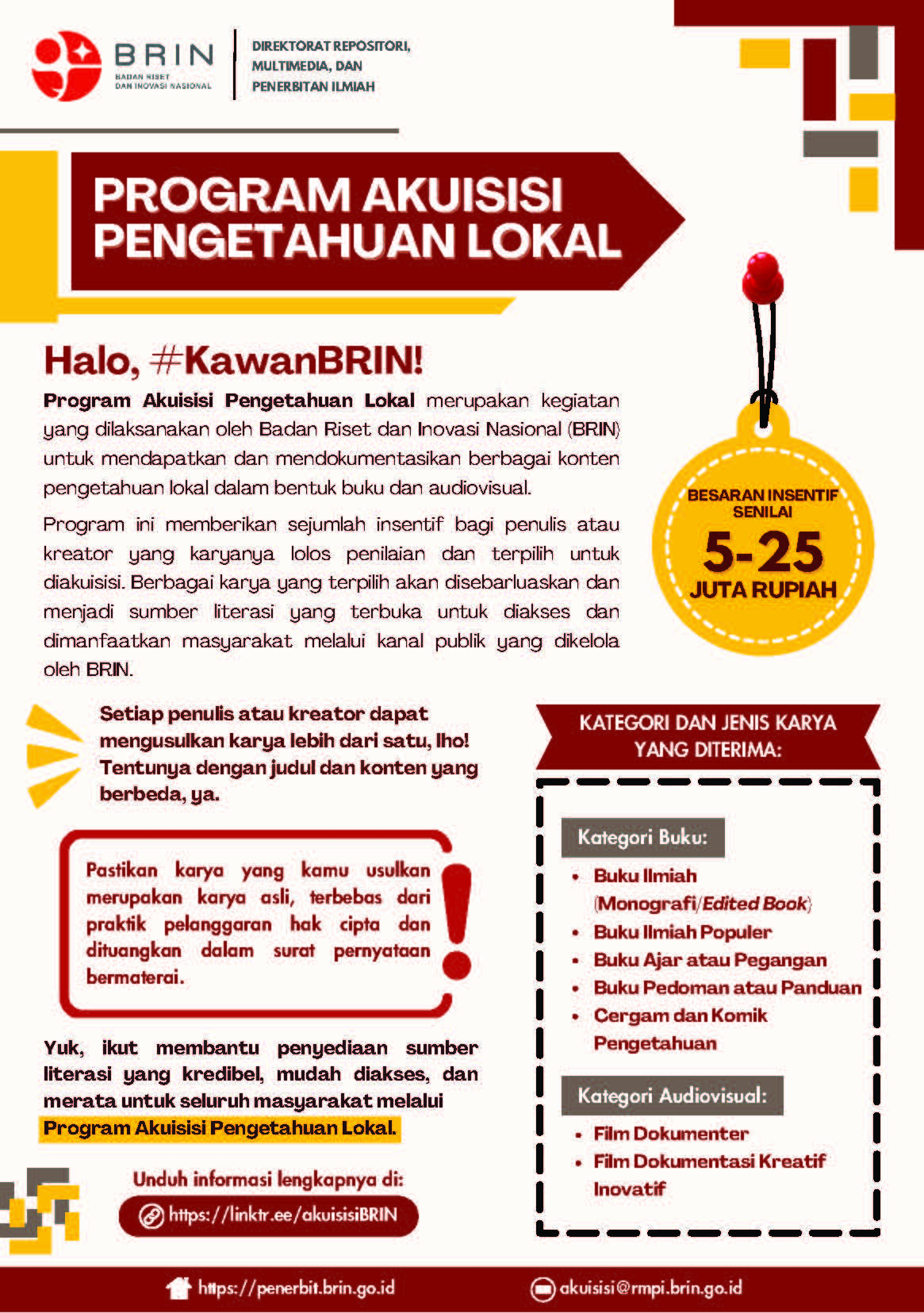
BRIN Publishing has a program named Akuisisi Pengetahuan Lokal that acquisition any of books or audiovisual content that meet our standard publication. The rights of BRIN Publishing is to disseminate and distribute all the content acquisitions for the public.
As an author you (or your employer or institution) may do the following:
All copies, print or electronic, or other use of the paper or article must include the appropriate bibliographic citation for the books