
























Berdasarkan ajaran Ki Hajar Dewantara sebagai pahlawan pendidikan nasional memiliki pandangan tentang pendidikan sebagai proses pembudayaan kodrat setiap individu dengan kemampuan untuk mempertahankan hidup, yang tertuju pada tercapainya kemerdekaan lahir bathin, sehingga memperoleh keselamatan, keamanan, kenyamanan, dan kebahagiaan lahir bathin. Pendidikan mencakup tujuan personal yaitu kokohnya tiang kemerdekaan dalam kehidupan dalam diri setiap individu, dan tujuan social yaitu terciptanya kebersamaan untuk membangun masyarakat berbudaya, dan berkebangsaan yang khas berdasarkan kemanusiaan. Taman Siswa yang didirikan oleh Ki Hajar Dewantara, pada tahun 1946 memiliki panca dharma yaitu kemerdekaan, kodrat alam, kebudayaan, kebangsaan, dan kemanusiaan. Perkembangan kedepan manajemen pendidikan sebaiknya mencerminkan realitas akan ajaran Ki Hajar Dewantara yang masih relevan dan dapat beradaptasi pada perubahan, dan dapat memenuhi kebutuhan manusia sebagai individu dan social dalam perkembangan jaman, sesuai dengan kemajuan ilmu pengetahuan serta teknologi (Muthoifin, 2015).
Abdurrahman, I. S., Mahmudah, F. N., Santosa, A. B., Paryono, Saryadi, & Cahyono, S. M. (2023).
Collaborative online learning: implementation of vocational alignment in accordance with the industry’s needs. Jurnal Pendidikan Teknologi Dan Kejuruan, 29(1), 23–33. https://doi.org/10.21831/jptk.v29i1.53082
Ahamed, B., Polas, M. R. H., Kabir, A. I., Sohel-Uz-Zaman, A. S. M., Fahad, A. Al, Chowdhury, S., & Rani Dey, M. (2024). Empowering students for cybersecurity awareness management in the emerging digital era: The role of cybersecurity attitude in the 4.0 industrial revolution era. SAGE Open, 14(1), 1–21. https://doi.org/10.1177/21582440241228920
Ahmad, A., & Alshurideh, M. (2024). Quantitative exploration of digital facility management adoption among United Arab Emirates facility managers. International Journal of Data and Network Science, 8(3), 1387–1398. https://doi.org/10.5267/j.ijdns.2024.4.004
Alenezi, M., & Akour, M. (2023). Digital transformation blueprint in higher education: A case study of psu. Sustainability (Switzerland), 15(10), 1–14. https://doi.org/10.3390/su15108204
Ba, Z. D. H., Wang, Q., Chen, C., Liu, Z., Peh, L. L. C., & Tiong, R. L. K. (2024). Change management of organizational digital transformation: A proposed roadmap for building information modelling- enabled facilities management. Buildings, 14(1), 3–23. https://doi.org/10.3390/buildings14010027
Cook, L., Coffey, A., Brown Wilson, C., Boland, P., Stark, P., Graham, M., McMahon, J., Tuohy, D., Barry, H. E., Murphy, J., Birch, M., Tierney, A., Anderson, T., McCurtin, A., Cunningham, E., Curran, G. M., & Mitchell, G. (2024). Co-design and mixed methods evaluation of an interdisciplinary digital resource for undergraduate health profession students to improve the prevention, recognition, and management of delirium in Ireland: a study protocol. BMC Medical Education, 24(1), 1–11. https://doi.org/10.1186/s12909-024-05468-1

This work is licensed under a Creative Commons Attribution-NonCommercial-ShareAlike 4.0 International License.
This book that publish in BRIN Publishing is licensed under a Creative Commons Attribution Non-commercial Share Alike 4.0 International license (CC BY-NC-SA 4.0). This license permits you to share, copy, distribute and transmit the work for your personal use and non-commercial purposes, provided you provide appropriate attribution. Derivative works and modifications must use the same license. Detailed information regarding the CC-BY-NC-SA 4.0 license is available via the link: https://creativecommons.org/licenses/by-nc-sa/4.0/
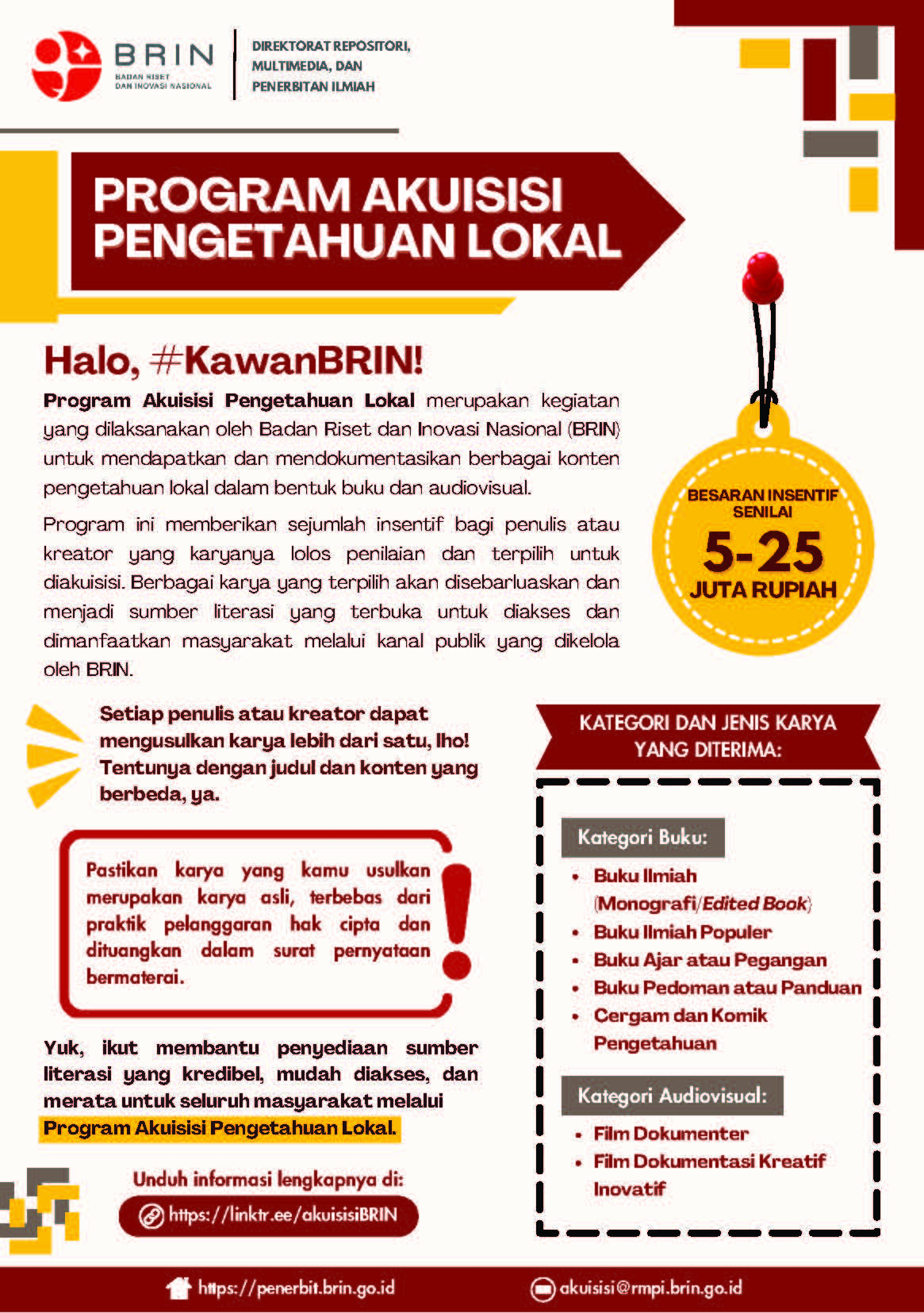
BRIN Publishing has a program named Akuisisi Pengetahuan Lokal that acquisition any of books or audiovisual content that meet our standard publication. The rights of BRIN Publishing is to disseminate and distribute all the content acquisitions for the public.
As an author you (or your employer or institution) may do the following:
All copies, print or electronic, or other use of the paper or article must include the appropriate bibliographic citation for the books