
















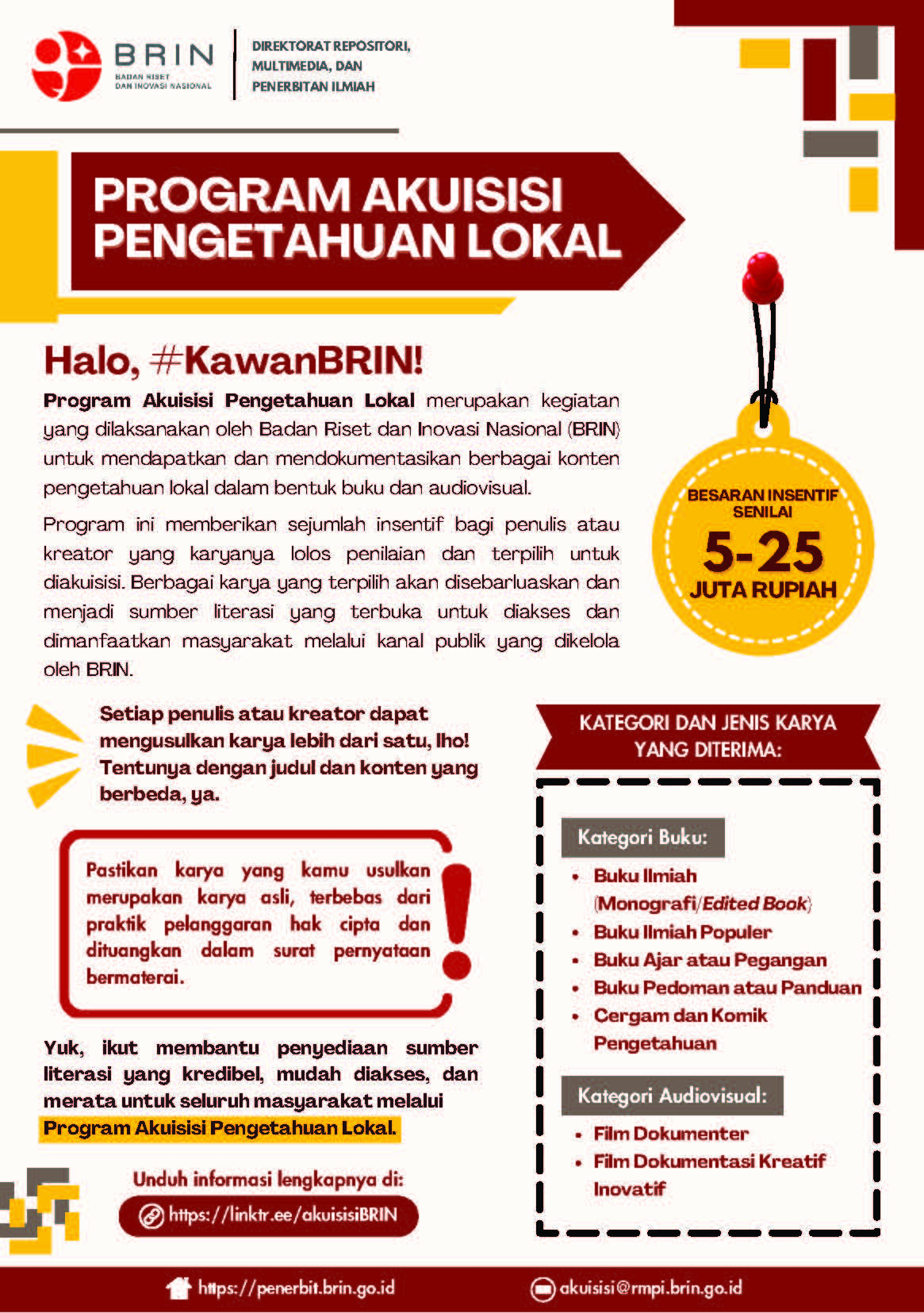










Guidebook of Beetles and Weevils of Jambi, Sumatra, Indonesia (Chrysomelidae, Curculionidae, Elateridae, and Staphylinidae)

Authors

Purnama Hidayat
IPB University image/svg+xml
Fatimah Siddikah
Dinas Tanaman Pangan dan Hortikultura Provinsi Jawa Barat
Kasmiatun
IPB University image/svg+xml
Woro Anggraitoningsih Noerdjito
Indonesian Institute of Sciences image/svg+xml
Rosyid Amrulloh
IPB University image/svg+xml
Muhammad Syaifullah Hiola
Balai Pengkajian Teknologi Pertanian (BPTP) Sulawesi Barat
Lailatun Najmi
IPB University image/svg+xml
Rizky Nazarreta
IPB University image/svg+xml
Stefan Scheu
University of Göttingen image/svg+xml
Damayanti Buchori
IPB University image/svg+xml
Jochen Drescher
University of Göttingen image/svg+xml

Keywords:

beetles, diversity, rainforest, land use, insects, leaf beetles, rove beetles, Click Beetles, Weevils, Sumatra, Indonesia

Synopsis

Indonesia is known to be the home of an incredibly biodiverse fauna, with thousands and thousands of amazing animal species. This is particularly true for the Arthropoda, which is the phylum of multi-legged invertebrates such as insects, spiders, scorpions, centipedes, and millipedes. Despite continuous taxonomic efforts to systematically describe and name newly discovered species, most Indonesian arthropods remain unknown to science. This book, as a product of the intensive collaboration between the Depart­ment of Plant Protection at IPB University and the Department of Animal Ecology at University of Göttingen within the EFForTS project, is aimed at the nexus between ecological research and taxonomical discovery. Through cooperative publication with BRIN Publishing, this book focuses on four major beetle families from Jambi Province in the heart of Sumatra, containing ecological background, identification keys to subfamily and genera, and a photographic collection of more than 500 thus far mostly undocumented species encountered in lowland rainforest and plantations of rubber and oil palm. Despite boasting highly biodiverse ecosystems, taxonomic discoveries from Jambi Province have thus far been virtually nonexistent, which this book aims to alleviate. The publication of this book is thus greatly hoped to provide a useful tool and reference for beetle identification species descriptions from the region, and helps to boost the limited number of identification books about arthropods, especially beetles, in Indonesia. Happy reading!

Downloads

Download data is not yet available.

Author Biographies

Purnama Hidayat, IPB University

Dr. Purnama Hidayat is a lecturer at the Division of Entomology, Department of Plant Protection, Faculty of Agriculture, IPB University. He is also the head of Insect Teaching and Research Collection in the department. His research interests are on insect biodiversity and taxonomy, especially agricultural and beneficial insects. He is also interested in the integrated pest management (IPM) of agricultural pests. He got his Bachelor’s degree in the Department of Plant Protection, IPB University, Indonesia in 1985. He earned his Master’s degree in the Department of Entomology, University of Wisconsin-Madison, the USA in 1992 and earned his Doctorate degree from the same university in 1996.
E-mail: phidayat@apps.ipb.ac.id

Fatimah Siddikah, Dinas Tanaman Pangan dan Hortikultura Provinsi Jawa Barat

Fatimah Siddikah is a research assistant for the CRC990/EFForTS group Z02. She earned her Bachelor’s degree in the Department of Plant Protection, IPB University, Indonesia in 2017. Now shes's work in UPTD BPTPH Dinas Tanaman Pangan dan Hortikultura Provinsi Jawa Barat. She is interested in beetles and published a paper about the diversity and community composition of weevils (Coleoptera: Curculionidae) specifically in oil palm and rubber plantation in the Indonesian Journal of Entomology (Siddikah et al., 2020).
E-mail: fatimah.siddikah@yahoo.com

Kasmiatun, IPB University

Kasmiatun currently works as a research assistant for the CRC990/EFForTS group Z02. She earned her Bachelor’s degree in the Department of Plant Protection, IPB University, Indonesia in 2018. She is interested in beetles and published a paper about the diversity and community composition of click beetles (Coleoptera: Elateridae) in the IOP Conference Series (Kasmiatun et al., 2020a) and Indonesian Journal of Entomology (Kasmiatun et al., 2020b).
E-mail: kasmiatun15@gmail.com

Woro Anggraitoningsih Noerdjito, Indonesian Institute of Sciences

Prof. Woro Anggraitoningsih Noerdjito is a researcher in the Laboratory of Entomology, Zoology Division, Research Center for Biology, Indonesian Institute of Sciences, Cibinong West Java, Indonesia. Her research interests are entomology, insect ecology, and beetles. She indeterminate many journals and books relating to beetles, ecology, diversity, and many more. She earned her bachelor’s degree in Faculty of Biology Gadjah Mada University, in 1973, then continued in Biology from Faculty of Mathematics and Natural Sciences Indonesia University, 1998. After that, she earned her Ph. D’s in Insect Ecology from Kanazawa University, Japan in 1998. She holds a Professor’s of research in 2006.
E-mail: woronoerdjito@yahoo.com

Rosyid Amrulloh, IPB University

Rosyid Amrulloh currently works as a journalist in Public Relations Department, IPB University. He is also a staff of Multimedia in the Center for Transdisciplinary and Sustainability Sciences (CTSS), IPB University. His undergraduate research was about the leaf beetles (Chrysomelidae) from CRC990/EFForTS samples. He earned his Bachelor’s degree in the Department of Plant Protection, IPB University, Indonesia in 2020.
E-mail: rosyid_45@apps.ipb.ac.id

Muhammad Syaifullah Hiola, Balai Pengkajian Teknologi Pertanian (BPTP) Sulawesi Barat

Muhammad Syaifullah Hiola has been a research assistant of CRC990/EFForTS group Z02. He studied Agrotechnology at Gorontalo University, Indonesia from 2010-2014. Then continued his Master’s degree in Entomology Department, IPB University, Indonesia in 2015-2019. He has an interest in beetles and his thesis was about the abundance, richness, and community composition of rove beetles (Coleoptera: Staphylinidae).
E-mail: syaifullahhiola@gmail.com

Lailatun Najmi, IPB University

Lailatun Najmi was a research assistant of the CRC990 - EFForTS research project Z02. She earned her Bachelor’s degree in the Department of Biology, Faculty of Mathematics and Natural Sciences, Andalas University, Indonesia in 2012. She then pursued her Master’s degree at the Entomology Department, IPB University, Indonesia from 2013 to 2017. She also is interested in beetles and authored a paper about weevils (Coleoptera: Curculionidae), specifically their diversity and community composition (Najmi et al., 2018).
E-mail: laila.najmi88@gmail.com

Rizky Nazarreta, IPB University

Rizky Nazarreta is a research assistant for the CRC990/EFForTS group Z02. She earned her Bachelor’s degree in the Department of Plant Protection, IPB University, Indonesia in 2012. She then continued her Master’s degree in Entomology Department, IPB University, Indonesia in from 2014 to 2017. During her thesis, Rizky focused on canopy ants and was the first author on a paper and a field guide to the canopy ants of Jambi Province (Nazarreta et al., 2019; Nazarreta et al., 2020).
E-mail: rizky.nazarreta@yahoo.com

Stefan Scheu, University of Göttingen

Prof. Stefan Scheu is the head of the Animal Ecology Group, JFB-Institute for Zoology and Anthropology, University of Göttingen, Germany. He is interested in the diversity, ecology and evolution of soil animals, decomposer communities, rhizosphere ecology, and food web ecology. He earned his Diploma in Biology at the University of Göttingen. Then continued as a Postdoc at the JFB-Institute for Zoology and Anthropology, University of Göttingen and at the University of Calgary, Canada. In 1997 he was appointed as Professor of Zoology and Ecology at Darmstadt University of Technology, Germany. Since 2008, he holds the Chair in Animal Ecology at the University of Göttingen.
E-mail: sscheu@gwdg.de

Damayanti Buchori, IPB University

Prof. Damayanti Buchori is a lecturer at the Department of Plant Protection, Faculty of Agriculture, IPB University. She is also the Head of Biological Control Laboratory at the Department of Plant Protection and Head of the Center for Transdisciplinary and Sustainability Sciences (CTSS), IPB University. She was featured as one of the Inspirational Women’s Scientists in Asia by the Academic Association and Scientific Society in Asia in 2018. Her research interests lie in the interphase of conservation-agricultural issues with a special focus on insect diversity and land-use change, biological control, pollination ecology, and sustainability sciences. She is also active in work related to science-based policies. She began her Bachelor’s education in the Department of Pest and Plant Diseases, IPB University, Indonesia in 1984 and received her Master’s from the Entomology Department, University of Illinois, the USA in 1989. In 1993, she received her Ph.D. from the Biology Department, Indiana University, USA. She holds a Professor of Entomology and Plant Pests since 2014.
E-mail: damayanti@apps.ipb.ac.id

Jochen Drescher, University of Göttingen

Dr. Jochen Drescher is a postdoctoral researcher at the Department of Animal Ecology, Faculty of Biology and Psychology, Göttingen University, Germany. Jochen Drescher started his studies at the RWTH Aachen, Germany, earning his pre-diploma in 2003. In 2006, he received his full diploma from the Department of Animal Ecology and Tropical Biology, Würzburg University, Germany, where he also completed his doctoral studies in 2011. After an interim position at the Department of Animal Ecology I, Bayreuth University, Germany, he joined the EFForTS project at Göttingen University in mid-2012 as a postdoctoral research fellow.
E-mail: jochen.drescher@biologie.uni-goettingen.de

References

Hackson, M. (2016). Translated and adapted from Dr. Arved Lompe (2015), Käfer Europas, Elateridae.

Johnson, P. J. (2002). Key to the Neartic Genera of Elateridae. In American beetles, Polyphaga: Scarabaeoidea through Curculionidae, volume 2. CRC Press, Gainesville, p. 160-173.

Calder, A. A. (1996). Click Beetles: Genera of The Australian Elateridae (Coleoptera). CSIRO Publishing.

Stibick, J. N. L. (1979). Classificaion of the Elateridae (Coleoptera): Relationships and classification of the subfamilies and tribes. Journal of Pasific Insect. 20, 145-186.

Dogger, J. R. (1959). The Elateridae of Wisconsin: A list of the species found in Wisconsin and keys to the identification of genera of adults and larvae. Wisconsin Academy of Science, Arts, and Lettters. 48, 103-120.

Chakraborty, P. & Chakrabarti, S. (2006). A contribution to the fauna of Click-Beetles (Coleopterida: Elateroidea: Elateridae) of West Bengal. Rec. zool. Surv. India, Occ. Paper No.254:1-220.

Anderson, R. S. (2002). Curculionidae Latreille 1802. In American Beetles, Polyphaga: Scarabaeoidea through Curculionoidea, volume 2. CRC Press, p. 722-815.

Triplehorn, C.A. & Johnson, N.F. 2005. Borrors and deLong’s introductions to the study of insects seventh editions. USA: Thomson Books Cole.

Waterhouse, D.F. 1967. The Insect of Australia. Canberra: CSIRO.

Hangay, G. & Zborowski, P. 2010. A guide to the beetles of Australia. Australia: CSIRO Publishing.

Jacoby, M. 1908. The Fauna of British India, including Ceylon and Burma.

Coleoptera: Chrysomelidae Vol 1. London: Taylor and Francis.

Kimoto, S. & Gressit, J.L. 1979. Chrysomelidae (Coleoptera) of Thailand, Cambodia, Laos and Vietnam. Pac Ins. 20: 191-256.

Mohamedsaid, M.S. 2000. The Galerucinae beetles from Tibow Sabah (Coleoptera: Chrysomelidae). Serangga. 5: 309-314.
Downloads

Published

July 22, 2022

Categories

License

Creative Commons License

This work is licensed under a Creative Commons Attribution-NonCommercial-ShareAlike 4.0 International License.

This book that publish in BRIN Publishing is licensed under a Creative Commons Attribution Non-commercial Share Alike 4.0 International license (CC BY-NC-SA 4.0). This license permits you to share, copy, distribute and transmit the work for your personal use and non-commercial purposes, provided you provide appropriate attribution. Derivative works and modifications must use the same license. Detailed information regarding the CC-BY-NC-SA 4.0 license is available via the link: https://creativecommons.org/licenses/by-nc-sa/4.0/

BRIN Publishing has a program named Akuisisi Pengetahuan Lokal that acquisition any of books or audiovisual content that meet our standard publication. The rights of BRIN Publishing is to disseminate and distribute all the content acquisitions for the public. 

As an author you (or your employer or institution) may do the following:

  • make copies (print or electronic) of the content for your own personal use, including for your own classroom teaching use;
  • make copies and distribute such copies (including through e-mail) of the article to research colleagues, for the personal use by such colleagues (but not commercially or systematically, e.g. via an e-mail list or list server);
  • present the content at a meeting or conference and to distribute copies of the article to the delegates attending such meeting;
  • retain patent and trademark rights and rights to any process, procedure, or content of manufacture described in the content;
  • include the content in full or in part in a thesis or dissertation (provided that this is not to be published commercially);
  • use the content or any part thereof in a printed compilation of your works, such as collected writings or lecture notes (subsequent to publication of the book); and prepare other derivative works, to extend the article into book-length form, or to otherwise re-use portions or excerpts in other works, with full acknowledgement of its original publication in the books;
  • may reproduce or authorize others to reproduce the content, material extracted from the content, or derivative works for the author’s personal use or for company use, provided that the source and the copyright notice are indicated, the copies are not used in any way that implies BRIN Publishing endorsement of a product or service of any employer, and the copies themselves are not offered for sale.

All copies, print or electronic, or other use of the paper or article must include the appropriate bibliographic citation for the books

Details about this monograph

ISBN-13 (15)

978-623-7425-71-7