
























Prosiding ini adalah kumpulan makalah ilmiah yang dipresentasikan dalam Seminar Nasional Bahasa dan Sastra (SNBS) II dengan tema “Pembentukan Karakter Bangsa melalui Bahasa dan Sastra pada Era Milenial”. Prosiding ini membahas berbagai macam topik yang diulas dalam bentuk hasil penelitian mengenai kebahasaan dan kesastraan dari para peneliti di lingkungan Badan Pengembangan Bahasa dan Perbukuan, dosen, dan mahasiswa beberapa
perguruan tinggi, serta peneliti LIPI. Prosiding ini diharapkan dapat merepresentasikan substansi dari acara tersebut sehingga dapat berguna bagi semua pihak, terutama yang belum memiliki kesempatan untuk menghadiri acara tersebut.
DAFTAR PUSTAKA
Arupalaka, A. F. W. (2008). Citra guru dalam kumpulan cerpen Soetji menulis di balik papan tulis karya SN Ratmana (Skripsi). FIB Universitas Indonesia, Depok, Indonesia.
Budiarti, S. Y. (2009). Representasi citra guru dalam tujuh novel Indonesia modern pascaproklamasi kemerdekaan berdasarkan tinjauan psikologi sastra (Tesis). Universitas
Pendidikan Indonesia, Bandung, Indonesia.
Dewantara, K. H. (1962). Pendidikan. Yogyakarta: Taman Siswa.
Kominfo. (2017). Penguatan pendidikan karakter jadi pintu masuk pembenahan pendidikan nasional. Diakses pada 26 November 2017 dari https://kominfo.go.id/content/
detail/10111/penguatan-pendidikan-karakter-jadi-pintu-masuk-pembenahan-pendidikan-nasional/0/artikel_gpr
Musyafa, H. (2015). Sang guru. Depok: Imania,
Nurgiyantoro, B. (2005). Teori pengkajian fiksi. Yogyakarta: UGM Press.
Koesoema, D. (2011). Pendidikan karakter; Strategi mendidik anak di zaman global. Jakarta: Grasindo.
Ratna, N. K. (2010). Teori metode, teknik penelitian sastra. Yogyakarta: Pustaka Pelajar.
Setyawan, S. (2013). Guruku panutanku. Yogyakarta: Penerbit Kanisius.
Sofia, A. (2009). Aplikasi kritik sastra feminis. Yogyakarta: Citra Pustaka.
Sugihastuti. (2000). Wanita di mata wanita; Perspektif sajak-sajak Toeti Heraty. Bandung:
Penerbit Nusantara.
Tingkat, I N. (2014). Representasi guru dalam cerpen dan novel sastrawan Bali. Jurnal
Kajian Bali, 4(1), April.
______. (2015). Representasi citra guru dalam cerpen dan novel karya pengarang Bali (Disertasi). Universitas Udayana, Bali, Indonesia.
Wahyudi, I. (2012). Mengenal profesionalisme guru; Strategi praktis mewujudkan citra guru
profesional. Jakarta: Prestasi Pustaka Publisher.
Wellek, R., & Warren, A. (2014). Teori kesusastraan terj. Melani Budianta. Jakarta: Gramedia.


This work is licensed under a Creative Commons Attribution-NonCommercial-ShareAlike 4.0 International License.
This book that publish in BRIN Publishing is licensed under a Creative Commons Attribution Non-commercial Share Alike 4.0 International license (CC BY-NC-SA 4.0). This license permits you to share, copy, distribute and transmit the work for your personal use and non-commercial purposes, provided you provide appropriate attribution. Derivative works and modifications must use the same license. Detailed information regarding the CC-BY-NC-SA 4.0 license is available via the link: https://creativecommons.org/licenses/by-nc-sa/4.0/
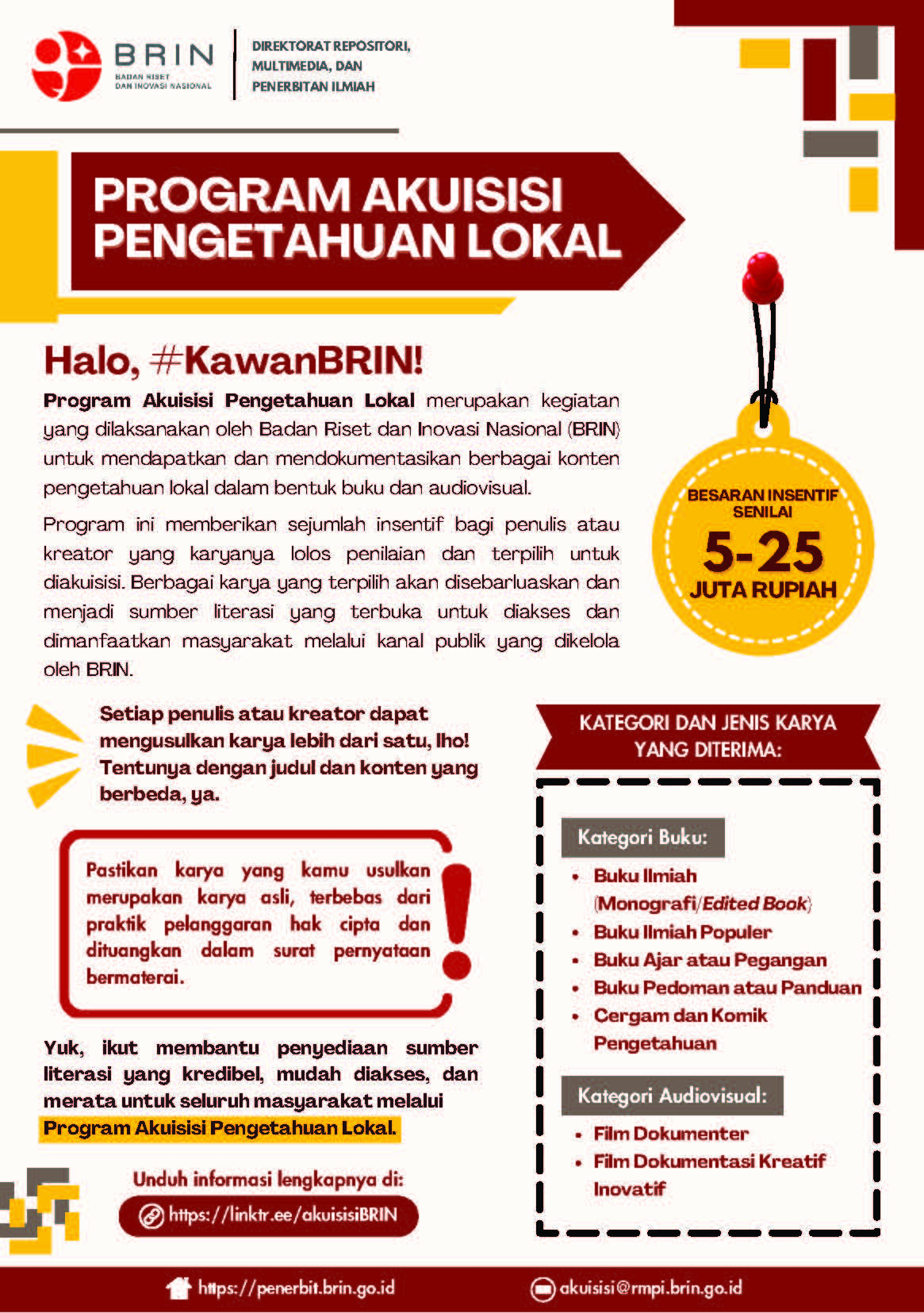
BRIN Publishing has a program named Akuisisi Pengetahuan Lokal that acquisition any of books or audiovisual content that meet our standard publication. The rights of BRIN Publishing is to disseminate and distribute all the content acquisitions for the public.
As an author you (or your employer or institution) may do the following:
All copies, print or electronic, or other use of the paper or article must include the appropriate bibliographic citation for the books