
























Masih tingginya angka kematian ibu di Indonesia saat ini, baik secara nasional maupun di tingkat kabupaten, menjadi masalah yang cukup memprihatinkan. Berbagai upaya dilakukan agar angka kematian ibu yang ditargetkan menurun pada tahun 2024 dapat tercapai. Kader kesehatan merupakan komponen masyarakat yang telah terbukti membantu terlaksananya banyak program kesehatan. Kader mempunyai peluang untuk diberdayakan guna mendukung tugas bidan desa dalam meningkatkan status kesehatan ibu di desanya. Satu Ibu Satu Kader (Sabu Saka) merupakan suatu konsep pendampingan ibu hamil oleh kader berbasis kewilayahan sejak ibu mulai dinyatakan hamil oleh petugas kesehatan. Konsep ini berawal dari inovasi “One Client One Kader” yang dicetuskan oleh Puskesmas Pejawaran, Banjarnegara, yang berhasil mendapat penghargaan “Top 45 Inovasi Pelayanan Publik”. Pengimplementasian konsep ini di wilayah yang lebih luas dilakukan dalam rangka mewujudkan keberhasilan program kesehatan serta menekan angka kematian ibu dan angka kematian bayi. Buku pedoman ini menjelaskan mulai dari proses pembentukan kegiatan pendampingan Sabu Saka, pelatihan kader kesehatan, koordinasi lintas sektor, pelaksanaan pendampingan ibu hamil, hingga pemantauan dan evaluasi. Buku ini diharapkan dapat menjadi panduan untuk pelaksana program kesehatan ibu dan anak serta dapat mempermudah petugas dinas kesehatan kabupaten/kota maupun puskesmas dalam penerapan kegiatan pendampingan Sabu Saka.
Aritonang, J. (2018). Peningkatan pengetahuan ibu tentang imunisasi pentabio lanjutan setelah pemberian pendidikan kesehatan di Puskesmas Lampaseh Aceh. Jurnal Riset Kesehatan Nasional, 2(2), 1–6.
Bappeda Aceh. (2016). Kajian Faktor Resiko Kematian Ibu dan Bayi Tahun 2016. In Laporan Penelitian Kajian Faktor Resiko Kematian Ibu dan Bayi di Provinsi Aceh.
Depkes RI. (2009). Pedoman Pelaksanaan Kelas Ibu Hamil. Departemen Kesehatan RI. https://doi.org/10.5056/jnm14109
Direktorat Kesehatan Keluarga. (2020). Pedoman Pelayanan Antenatal, Persalinan, Nifas, dan Bayi Baru Lahir di Era Adaptasi Kebiasaan Baru. Kemenkes RI.
Kementerian Kesehatan RI. (2015). Rencana Strategis Kementerian Kesehatan 2015-2019.
Keputusan Menteri Kesehatan RI Nomor 374/MENKES/SK/V/2009 tentang Sistem Kesehatan Nasional.
Khotimah, K. (2019). One Client One Cadre. Pertemuan Ilmiah Berkala Balai Litbangkes Banjarnegara.
Peraturan Pemerintah RI No 2 Tahun 2018 tentang Standar Pelayanan Minimal.
Permenkes RI Nomor 4 Tahun 2019 tentang Standar Teknis Pemenuhan Mutu Pelayanan Dasar pada Standar Pelayanan Minimal Bidang Kesehatan.
Rahmadina, D. Y. (2016). Gambaran Perilaku Ibu dalam Melakukan Perawatan Kehamilan di Desa Manis Kecamatan Pulau Rakyat Kabupaten Asahan Tahun 2016. Universitas Sumatera Utara.
Setiawan, A., Lazuardi, L., & Hakimi, M. (2016). Analisis distribusi spasial kematian ibu di Kabupaten Banjarnegara Tahun 2011 – 2013. Journal of Information Systems for Public Health, 1(2), 52–60.
Setiawati, M. E., & Nurrizka, R. H. (2019). Evaluasi pelaksanaan sistem rujukan berjenjang dalam program jaminan kesehatan nasional. Jurnal Kebijakan Kesehatan Indonesia: JKKI, 8(1), 35–40. https://jurnal.ugm.ac.id/jkki/article/view/43843
WHO. (2021). Q & As on COVID-19 and Related Health Topics. https://www.who.int/emergencies/diseases/novel-coronavirus-2019/question-and-answers-hub
Zulkifli. (2003). Posyandu dan Kader Kesehatan. https://repository.usu.ac.id/bitstream/handle/123456789/3753/fkm-zulkifli1.pdf;jsessionid=E5B04060C8F2018CCBFAAA4185F85AB3?sequence=1


This work is licensed under a Creative Commons Attribution-NonCommercial-ShareAlike 4.0 International License.
This book that publish in BRIN Publishing is licensed under a Creative Commons Attribution Non-commercial Share Alike 4.0 International license (CC BY-NC-SA 4.0). This license permits you to share, copy, distribute and transmit the work for your personal use and non-commercial purposes, provided you provide appropriate attribution. Derivative works and modifications must use the same license. Detailed information regarding the CC-BY-NC-SA 4.0 license is available via the link: https://creativecommons.org/licenses/by-nc-sa/4.0/
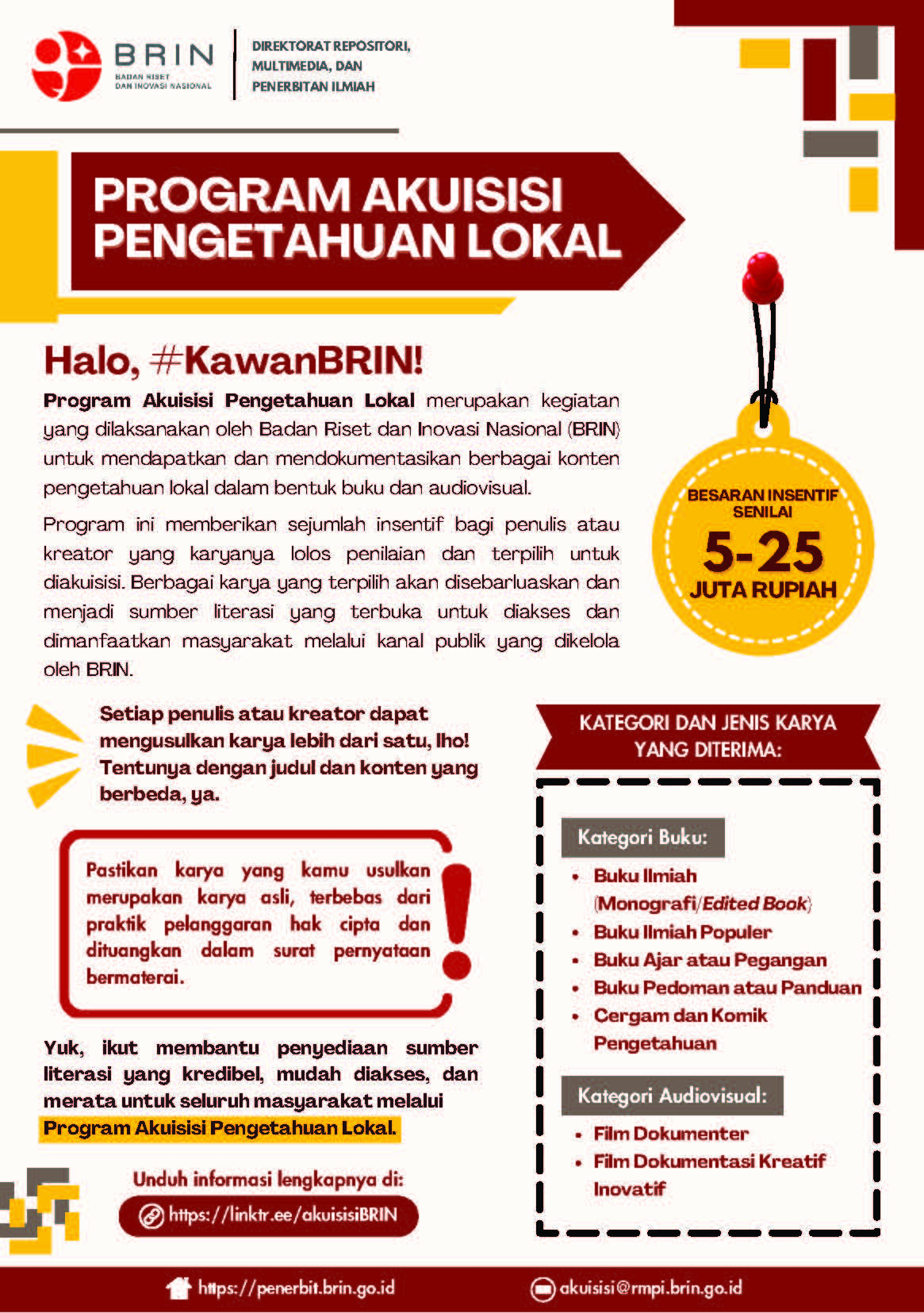
BRIN Publishing has a program named Akuisisi Pengetahuan Lokal that acquisition any of books or audiovisual content that meet our standard publication. The rights of BRIN Publishing is to disseminate and distribute all the content acquisitions for the public.
As an author you (or your employer or institution) may do the following:
All copies, print or electronic, or other use of the paper or article must include the appropriate bibliographic citation for the books